
ITL-1e9e48850b6d
Watch the video

Figure 1. The end-of-case discussion should establish readiness and the recovery plan. Conceptual illustration.
Key points
- Extubation in the operating room and extubation within six hours are different strategies; the latter has broader supporting evidence.
- The 612-patient CARDU-FAST randomized trial did not significantly reduce its primary composite outcome with operating-room extubation. Only the abstract was accessible for this post.
- Observational studies report shorter stays in selected patients, but some also report more reintubation and reoperation for bleeding.
- In a 2026 meta-analysis, the apparent mortality advantage disappeared in propensity-matched analyses; all included studies were observational.
- Make the goal a successful, sustained extubation supported by an appropriate recovery pathway, rather than a location or a clock time alone.
An uncomplicated cardiac operation is finishing. The patient was selected for a fast-track pathway, but awakening is incomplete and the surgical team is still assessing bleeding. Should the team push to remove the tube before leaving the operating room?
A planned opportunity for operating-room extubation is reasonable in selected patients. It should remain conditional on how the operation and recovery actually unfold. The 2024 ERAS–STS consensus supports structured extubation within six hours after elective procedures with moderate-quality evidence; it reserves intraoperative or immediate extubation for highly selected patients in experienced programs, with low-quality evidence.[1]
What does the randomized trial tell us?
CARDU-FAST randomized 612 adults undergoing nonemergency cardiac surgery at one center to operating-theatre extubation or early ICU extubation, 306 per group. The primary composite included all-cause mortality, prolonged intubation over 24 hours, reintubation, pneumonia, and stage III acute kidney injury. It occurred in 6.5% versus 10.1%, respectively, with P = 0.105.[2]
The abstract reports shorter ICU and hospital stays and favorable results for several secondary outcomes. The primary intention-to-treat comparison, however, did not establish superiority. A nonsignificant difference also does not prove equivalence or noninferiority. Only the abstract was accessible; detailed eligibility, protocol adherence, crossover, and full outcome tables could not be checked, so those details should not be inferred.[2]
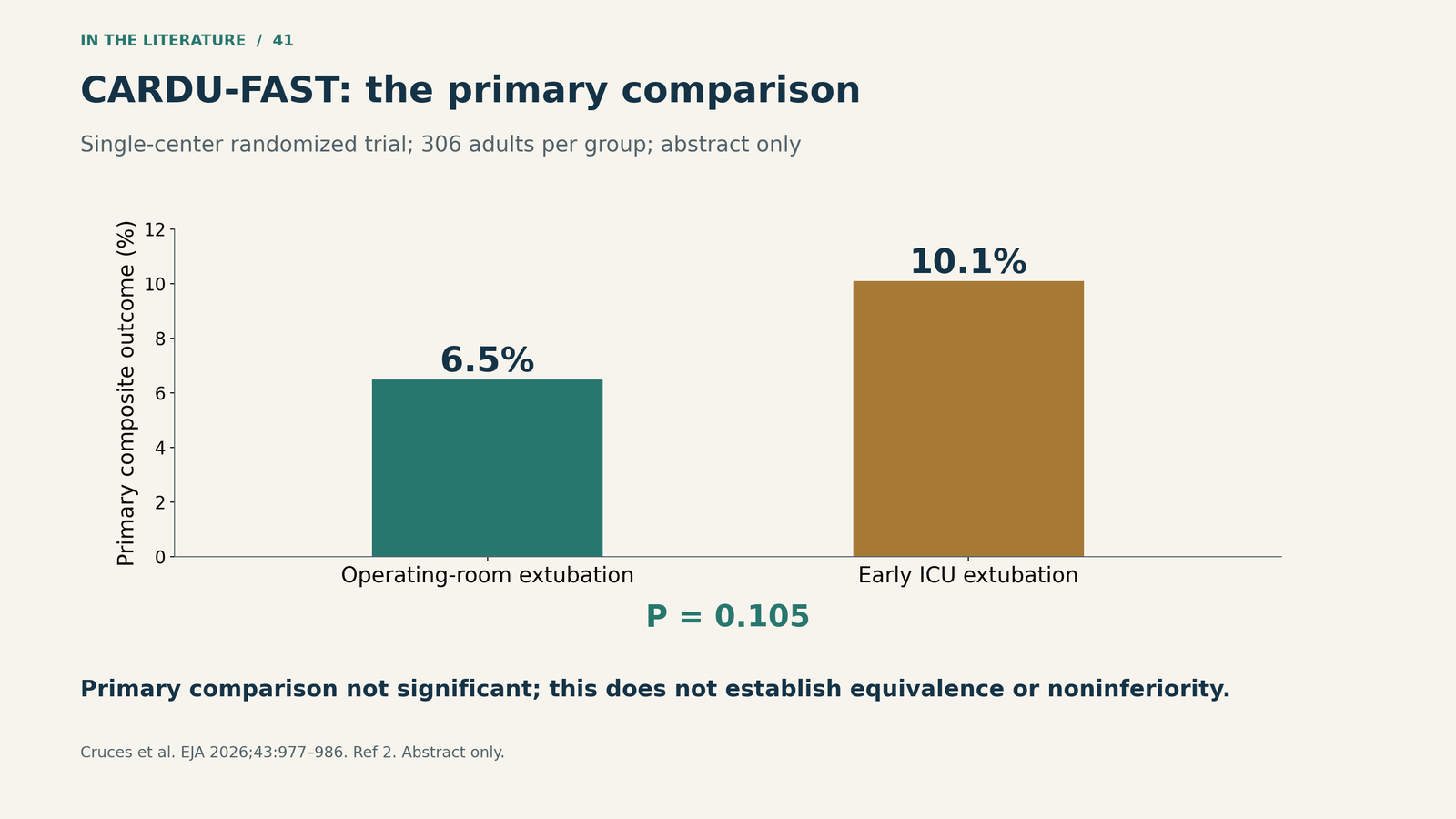
Figure 2. CARDU-FAST primary outcome, as reported in the abstract. The numerical difference favored operating-room extubation, but the primary comparison was not statistically significant. This is not a mortality-only endpoint or a demonstration of equivalent safety.[2]

Why do observational results pull in different directions?
Hawkins and colleagues compared patients extubated in the OR with those extubated within six hours after leaving it. Their regional registry analysis matched 487 OR-extubation patients to 899 fast-track patients. Reintubation was more frequent after OR extubation: 21/487 (4.3%) versus 16/899 (1.8%). Mean hospital stay was shorter, 5.6 versus 6.2 days, although the median was five days in both groups. Reoperation for bleeding was also more frequent.[3]
These are associations, not proof that earlier tube removal caused either harm or benefit. Selection depended on clinicians and centers, and patients whose initial ventilation exceeded six hours were excluded. That exclusion can make the comparator look different from everyone originally intended for a fast-track pathway.[3]
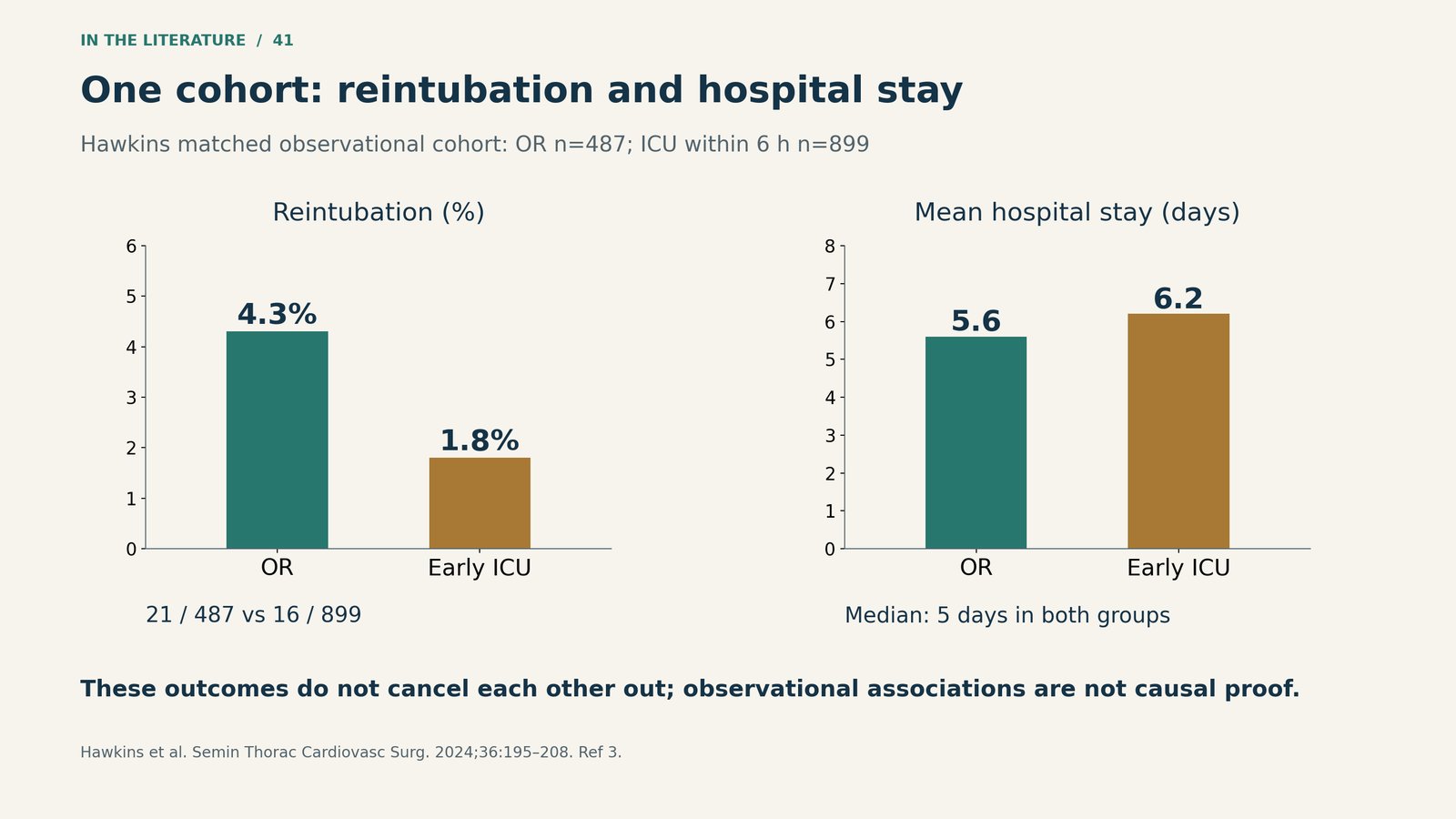
Figure 3. Two outcomes from the same matched observational cohort. The stay values are means, not medians; the comparison does not establish causation or an individual patient's expected trade-off.[3]

The newer Santos meta-analysis included 20 observational studies and searched literature through October 2025, before CARDU-FAST was published. It defined ultra-fast-track as extubation in the OR or within one hour, so its exposure was broader than OR extubation alone. In seven propensity-matched studies, the mortality odds ratio was 0.95 (95% CI, 0.71–1.26), rather than the apparent mortality benefit in the overall analysis. Shorter stays persisted, with substantial heterogeneity; reoperation for bleeding was more frequent in the matched analysis.[4]
The practical implication is to avoid presenting a large pooled sample as proof that the fastest strategy is best. Patient selection, readiness, anesthetic management, and the surrounding care pathway all influence these comparisons.
What should be ready before the tube comes out?
The following four questions are a practical synthesis, not a validated pass score or a substitute for the institution's extubation protocol.[1, 3]
Awakening and breathing: Is the patient sufficiently awake to protect the airway, with effective spontaneous ventilation and acceptable gas exchange on support appropriate for extubation? Confirm recovery from neuromuscular blockade and provide analgesia without excessive sedation. Opening the eyes alone does not establish readiness.
Circulation and surgical course: Is the circulation stable, without escalating support or an unresolved surgical concern? Reassess bleeding, temperature, and acid–base status. Preoperative low risk does not cancel problems that developed during the case.
A safe destination: Is the receiving team ready for close observation and prompt treatment of respiratory or hemodynamic deterioration? OR extubation does not itself justify bypassing monitored postoperative care.
A shared alternative plan: If readiness is incomplete, continue a coordinated ICU extubation pathway and reassess the specific barrier. Agree on the response to respiratory failure, including access to timely reintubation when required. An ICU extubation can be a successful planned recovery, not a failed OR-extubation attempt.
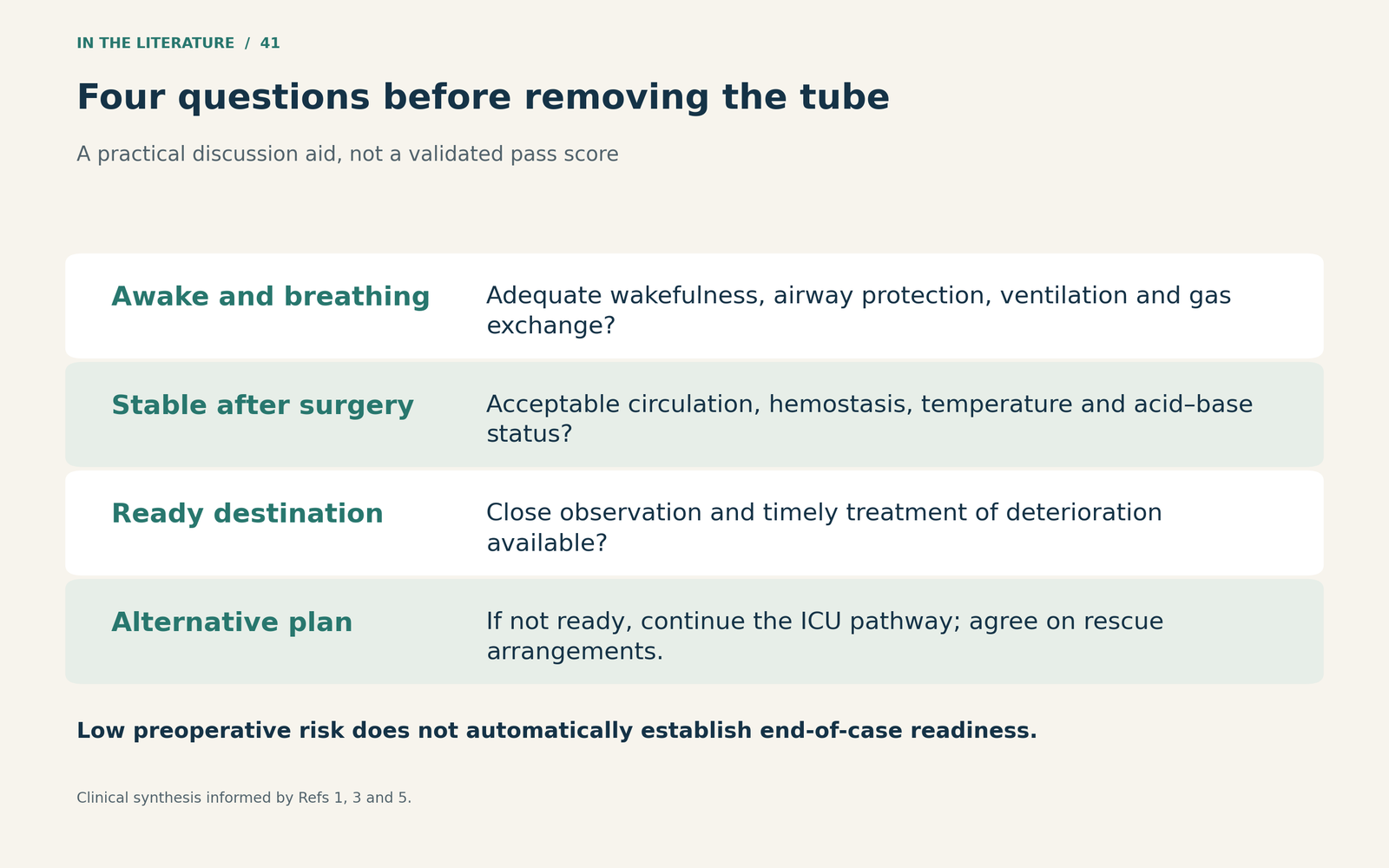
Figure 4. A clinical discussion aid. Selection happens before surgery; readiness must be reassessed at the end of surgery. No single score or time target replaces the full assessment.

A functioning pathway need not insist on OR extubation
Cotovanu and colleagues' prospective single-center pathway included 261 selected low-risk patients; 159 (60.9%) were extubated in the OR and 102 in the ICU. The pathway therefore allowed both locations. Its reported 80.1% completion rate also included 18 patients who met step-down criteria but remained in the ICU because of bed availability—it was not the percentage actually transferred within six hours. Across the cohort, 13 patients were reintubated within 30 days, 12 for reintervention and one for respiratory insufficiency.[5]
That is feasibility evidence from a selected population without a contemporaneous control group. It shows why programs should audit the whole recovery course: sustained extubation, respiratory rescue, bleeding and reoperation, actual transfer, and patient recovery. Counting only the proportion extubated in the OR misses much of what matters.
Three takeaways
- Plan early extubation; make OR extubation conditional. Current evidence does not support making the OR location a universal performance target.
- Read the outcome before the headline. CARDU-FAST's primary comparison was nonsignificant; matched observational evidence does not establish a mortality benefit.
- Assess readiness and the receiving system together. A timely ICU extubation may be the right result when end-of-case conditions are not yet suitable.
References
- Grant MC, Crisafi C, Alvarez A, Arora RC, Brindle ME, Chatterjee S, et al. Perioperative care in cardiac surgery: a joint consensus statement by the Enhanced Recovery After Surgery (ERAS) Cardiac Society, ERAS International Society, and The Society of Thoracic Surgeons (STS). Ann Thorac Surg. 2024;117(4):669–689. doi:10.1016/j.athoracsur.2023.12.006.
- Cruces LM, Alcázar MC, Sial RLB, Vizcayno ML, Martín RS, Camargo DP, et al. Evaluation of clinical impact of ultra fast-track versus conventional extubation in patients undergoing nonemergency cardiac surgery: ‘CARDU-FAST’: a randomised clinical trial. Eur J Anaesthesiol. 2026;43(12):977–986. Published online April 27, 2026. Abstract only. doi:10.1097/EJA.0000000000002400.
- Hawkins AD, Strobel RJ, Mehaffey JH, Hawkins RB, Rotar EP, Young AM, et al. Operating room versus intensive care unit extubation within 6 hours after on-pump cardiac surgery: early results and hospital costs. Semin Thorac Cardiovasc Surg. 2024;36(2):195–208. doi:10.1053/j.semtcvs.2022.09.013.
- Santos K, Patel N, Umibe T, Abo T, Sakai W, Oya K, et al. Is faster always better? Ultra-fast-track versus fast-track extubation in adult cardiac surgery: a comprehensive meta-analysis with meta-regression. J Cardiothorac Vasc Anesth. 2026;40(9):2845–2855. doi:10.1053/j.jvca.2026.06.012.
- Cotovanu AGM, Berendsen RR, van Dorp ELA, Okkerse P, de Weger A, de Blok ACJ, et al. Ultrafast track pathway after low-risk cardiac surgery enables intensive care unit stepdown within 6 hours: a feasible model for anesthesia-led recovery. J Cardiothorac Vasc Anesth. 2026;40(3):896–907. doi:10.1053/j.jvca.2025.12.007.