
ITL-aca74808b429
Watch the video

Figure 1. A camera can shorten data entry; the treatment decision still requires verified inputs and clinical interpretation. Conceptual illustration.
Key points
- Treat image recognition, clinical-rule execution and patient benefit as three separate questions. Success at one does not establish the others.
- The 2026 CCA Pro report evaluated 50 simulated cardiac critical-care scenarios, including 15 coagulation scenarios—not 50 patients treated using the application.[1]
- Its reported agreement with experts is promising preliminary evidence. It does not establish fewer dosing errors, faster treatment or better patient outcomes.[1]
- Before acting, verify the source values, units, patient and sample time; then check the recommendation against the bleeding mechanism and a current local protocol.
- A recommendation should remain reviewable and overridable. A verified number can still feed an inappropriate treatment rule.
The clinical question begins after the photograph
A patient is bleeding after cardiac surgery. A photograph of the viscoelastic display populates an application, which proposes a coagulation product and dose. The attractive part is obvious: fewer numbers to transcribe while the team manages a time-sensitive problem. The difficult part is deciding whether the proposed treatment fits this patient.
CCA Pro v6.0, described in a 2026 JCVA development study, illustrates this distinction. It integrates ROTEM, TEG, blood-gas interpretation, ventilation, hemodynamic assessment and ECMO support. Its camera layer uses a vision-language model to extract values; the values then populate the same fields used for manual entry and feed programmed clinical algorithms. Manual correction remains available.[1]
This architecture deserves a more precise evaluation than asking whether “AI is accurate.” The camera may read the wrong value. The software may apply a rule to a situation for which it was not designed. Or the rule may be reasonable, yet fail to improve the clinician's decision in an actual emergency. Those are different failure points, requiring different evidence.
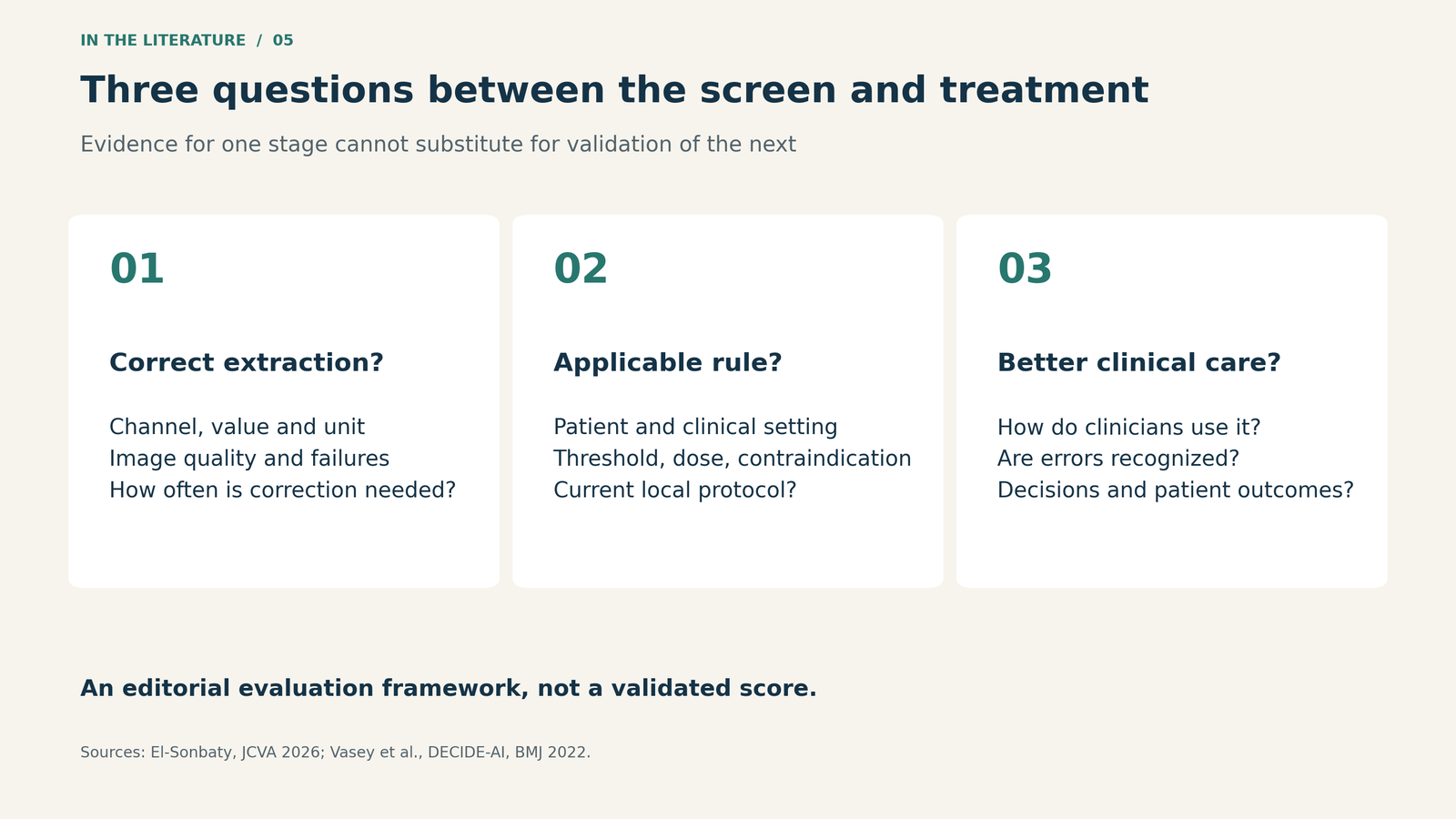

Figure 2. Evaluate the whole path from screen to decision. This is an editorial framework informed by the application report and DECIDE-AI; it is not a validated score.[1, 2]
Read “100% agreement” with its denominator
CCA Pro was tested using 50 simulated scenarios derived from deidentified cardiac surgical cases. Three senior cardiac anesthesiologists independently reviewed the scenarios; agreement was defined against the consensus of at least two of the three reviewers. The scenario mix was 15 coagulation, 12 acid-base or electrolyte, 10 ventilation, five hemodynamic and eight ECMO scenarios.[1]
Table 4 reports agreement in all 50 scenarios for the overall diagnosis and first-line therapy summaries. However, the module-specific comparison was not identical throughout: ventilation recommendations were judged within the experts' range, while the five Fick cardiac-output scenarios included comparison within 15% of a thermodilution reference. These are useful checks of a prototype, but not a single uniform measure of bedside treatment accuracy.
The camera evaluation also needs its own denominator. Table 3 labels structured-screen extraction as “high” and free-format blood-gas printout extraction as “moderate.” These are qualitative categories. The report does not provide a quantitative image-level accuracy estimate with a clearly enumerated image denominator and confidence interval. The 50/50 scenario result cannot be repurposed as 100% camera accuracy.[1]
Most importantly, the study did not prospectively compare clinician care with and without the tool. It did not demonstrate a reduction in medication errors, transfusion, treatment delay or clinical complications. Its developer was also the study author. Independent evaluation in the intended workflow remains necessary before translating the agreement result into a claim of patient benefit.[1]
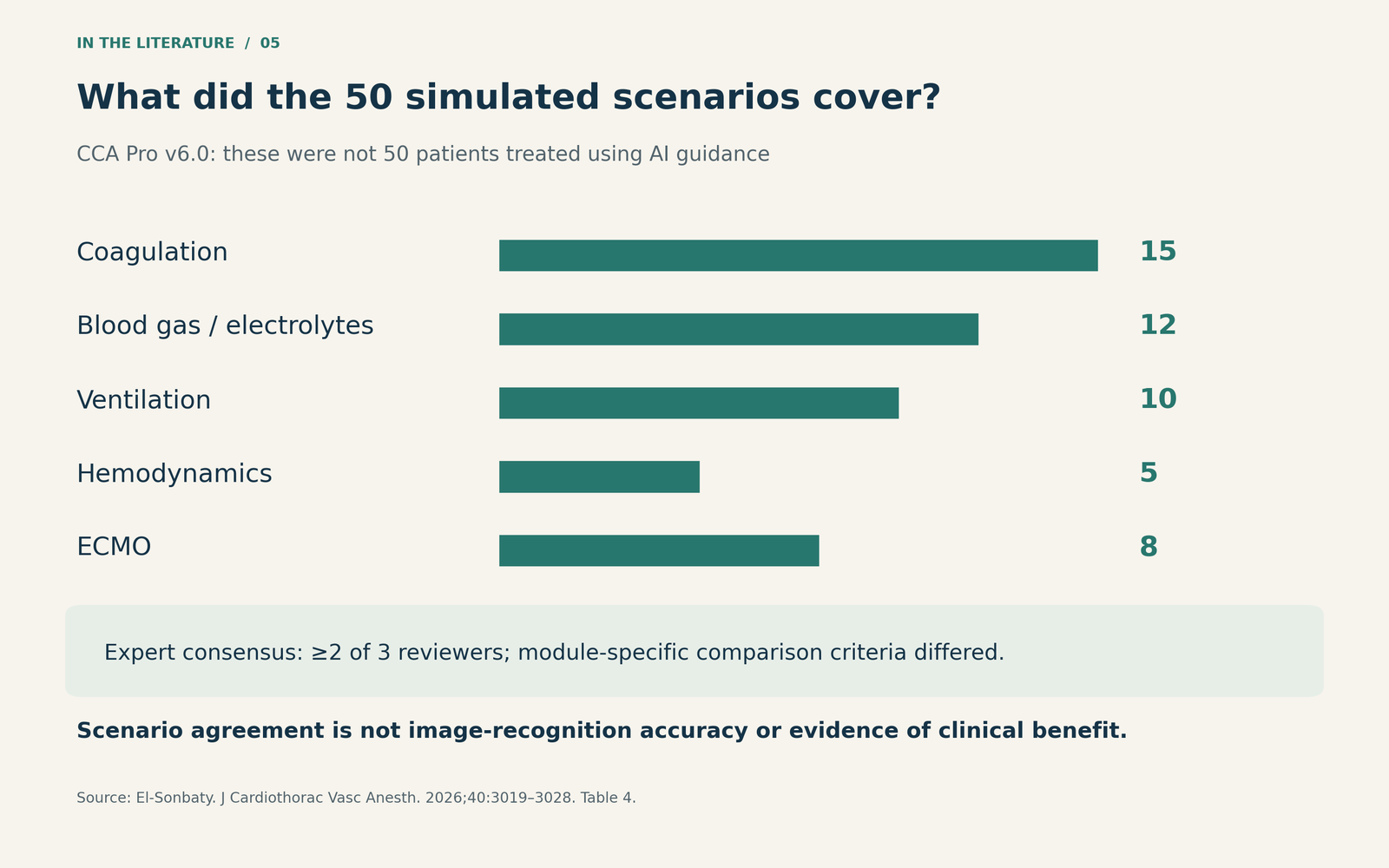

Figure 3. What was actually tested: 50 simulated scenarios, with only 15 focused on coagulation. These counts describe the test sample, not the number of treated patients or photographs.[1]
At the bedside, verify the recommendation in two passes
First verify what entered the application. Compare the extracted values directly with the original display. Check the assay channel, units, decimal placement, patient identity and sampling time. Distinguish a current result from an earlier sample, and distinguish measured patient weight from an assumed default. If the display cannot be read confidently, manual entry from the original source is preferable to accepting a plausible-looking extraction. This is a practical verification approach, not a performance claim established by the prototype study.
The paper itself reports occasional manual corrections for blood-gas printouts and notes dependence on image quality, lighting and display format. Although the rule-based application can function offline, its described AI camera service requires an external inference platform and internet connection.[1] Clinical use therefore needs an institutionally approved data pathway and a workable manual fallback.
Then verify why this treatment is appropriate. A numerical threshold is only one part of the decision. For post-bypass bleeding, inspect the surgical field, assess residual heparin and consider fibrinogen and platelet deficits alongside clot-initiation results. For example, the EACTS/EACTAIC blood-management guideline advises correcting low fibrinogen before considering PCC, and considers PCC for significant bleeding attributable to coagulation-factor deficiency.[3] A prolonged clotting time alone does not settle that diagnosis.
Check the proposed product, dose units, contraindications and repeat-dose logic against the current local protocol and product information. A software-development paper is not itself a drug-dosing authority. When the recommendation conflicts with the clinical picture, identify the conflicting input or assumption and reassess the patient; accepting the output simply because it is displayed confidently adds no evidence.
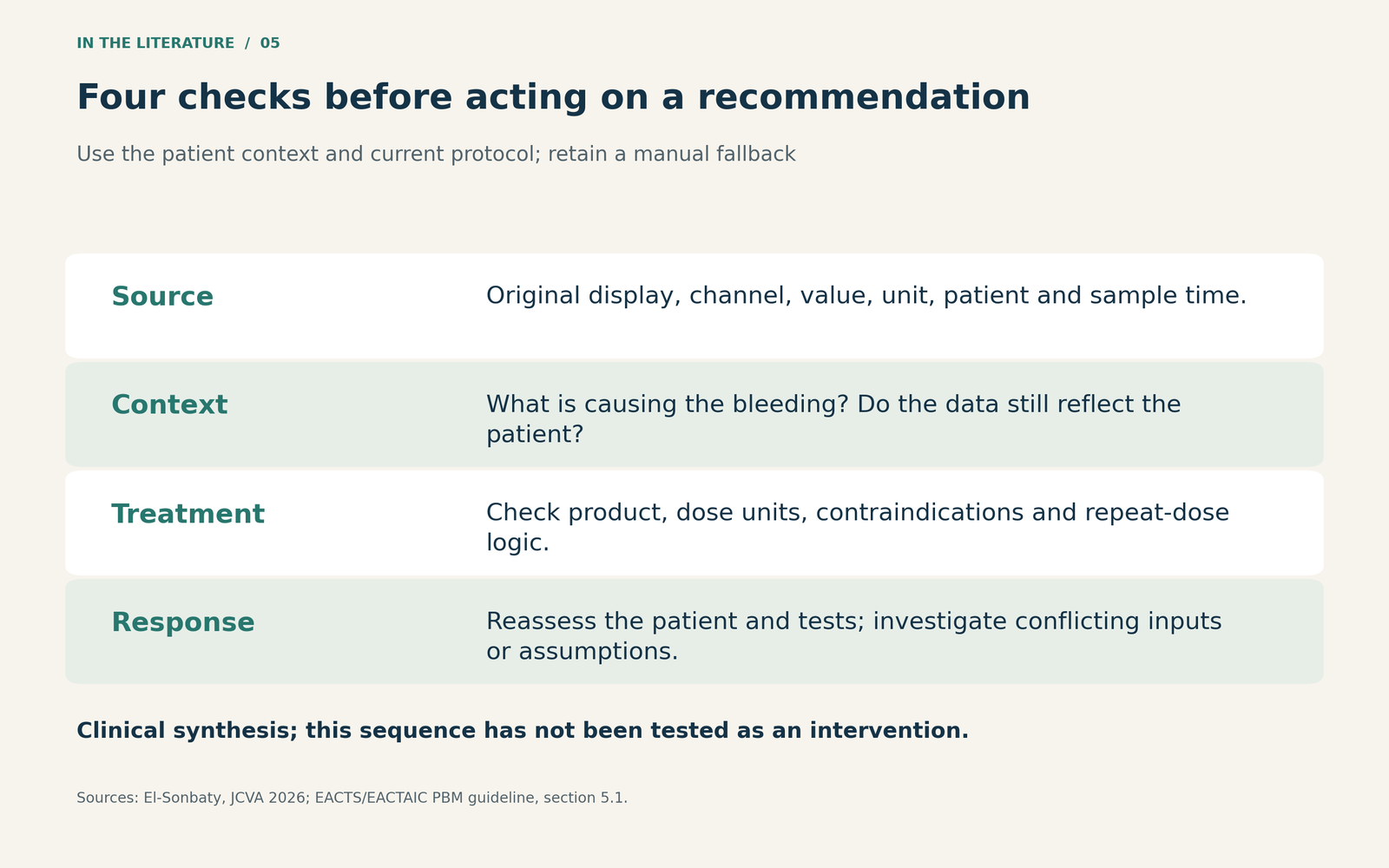

Figure 4. A practical bedside verification sequence. The clinician synthesis combines reported input limitations with established bleeding-management principles; it has not been tested as a clinical intervention.[1, 3]
What would make the next validation study convincing?
The useful next step is a prospective evaluation of the specific tool version with the clinicians, devices and patients for whom it is intended. Report extraction failures separately from treatment-rule errors, and measure whether clinicians correct, follow or override the output. Compare decision quality and time to appropriate treatment, while tracking harmful recommendations and actual patient outcomes.
DECIDE-AI provides a reporting framework for early live clinical evaluations: it asks investigators to describe inputs, missing or poor-quality data, workflow, errors, human–computer interaction and safety. It is a reporting guideline, not certification that a system is safe.[2] For a cardiac team, the practical question is whether the tool improves care in its own workflow while allowing errors to be recognized and corrected.
Three takeaways
- Separate reading from reasoning. Verify the captured data before evaluating the proposed treatment.
- Keep the denominator visible. Fifty successful simulated scenarios do not establish camera accuracy or clinical benefit.
- Retain an explicit clinical decision. Match the recommendation to the patient, current protocol and observed response; use a tested fallback when the tool fails.
References
- El-Sonbaty AI. Development and validation of an integrated artificial intelligence-powered clinical decision support application for cardiac critical care: combining coagulation management, blood gas analysis, mechanical ventilation, hemodynamic assessment, and extracorporeal membrane oxygenation. J Cardiothorac Vasc Anesth. 2026;40(9):3019–3028. doi:10.1053/j.jvca.2026.05.062.
- Vasey B, Nagendran M, Campbell B, et al. Reporting guideline for the early stage clinical evaluation of decision support systems driven by artificial intelligence: DECIDE-AI. BMJ. 2022;377:e070904. doi:10.1136/bmj-2022-070904.
- Casselman FPA, Lance MD, Ahmed A, et al. 2024 EACTS/EACTAIC Guidelines on patient blood management in adult cardiac surgery in collaboration with EBCP. Eur J Cardiothorac Surg. 2025;67(5):ezae352. doi:10.1093/ejcts/ezae352.