
ITL-c74c27018dc5
Juan Li · In the Literature · Updated November 16, 2026
Watch the video

Key points
- Judge access closure by bleeding, vascular injury and preserved limb perfusion, as well as time to hemostasis.
- In CHOICE-CLOSURE, MANTA achieved faster hemostasis but more access-related vascular composite events than a ProGlide-based strategy that allowed adjunctive closure devices.
- Planned single-suture-plus-Angio-Seal closure is a different strategy from MANTA alone; ACCESS-TAVI supports its vascular composite outcome against double-suture closure, based here on the published abstract.
- The latest SINGLE-CLOSURE abstract reports noninferiority of single versus double ProGlide for a composite dominated by minor events; it does not establish superior safety.
- Anatomy, the exact closure plan and the team's rescue capability matter more than a universal device ranking.
A dry puncture site is only part of the outcome
The valve has been implanted and the large femoral sheath is coming out. Rapid hemostasis is attractive, but the clinical question is broader: which closure strategy limits bleeding while preserving the artery and distal perfusion?
Access complications include hematoma and retroperitoneal bleeding, but also dissection, stenosis, thrombosis and ischemia. Pseudoaneurysm, fistula or infection may become apparent later. This is why the anesthesia and interventional teams need a shared understanding of the closure strategy, anticipated rescue options and postoperative vascular assessment. A JCVA editorial emphasizes this perioperative perspective. [1]
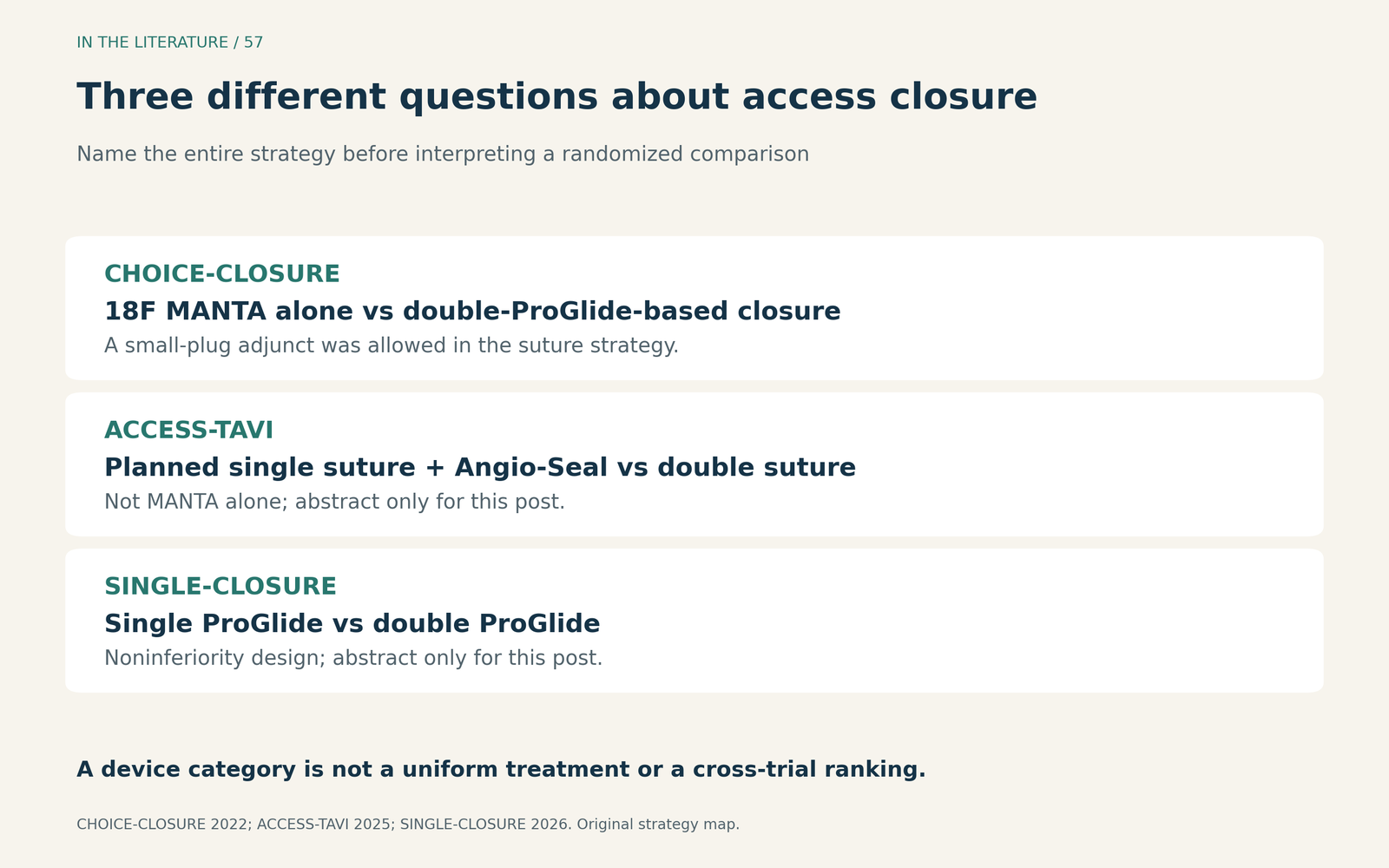
Figure 1. Original map of three different comparisons. ACCESS-TAVI and SINGLE-CLOSURE are represented from their complete published abstracts only. A result for one strategy cannot be transferred to every device in the same broad category. [2, 3, 4] View figure

What CHOICE-CLOSURE actually tells us
CHOICE-CLOSURE randomized 516 patients to 18F MANTA alone or a strategy beginning with two ProGlide devices, with an additional small plug permitted. The comparator was therefore a closure strategy with an available adjunct, not invariably suture-only closure. An additional device was used in 151/258 ProGlide patients (58.5%); a single permitted adjunct did not itself count as strategy failure. [2]
MANTA shortened median time to hemostasis: 80 versus 240 seconds. Yet the primary outcome—in-hospital VARC-2 major or minor access-related vascular complications—occurred in 50/258 versus 31/258 patients: 19.4% versus 12.0%. The relative risk was 1.61 (95% CI, 1.07–2.44). Faster closure did not translate into a better vascular composite outcome. These percentages are not major-bleeding rates, and the trial did not establish a significant difference in the major vascular component alone. [2]
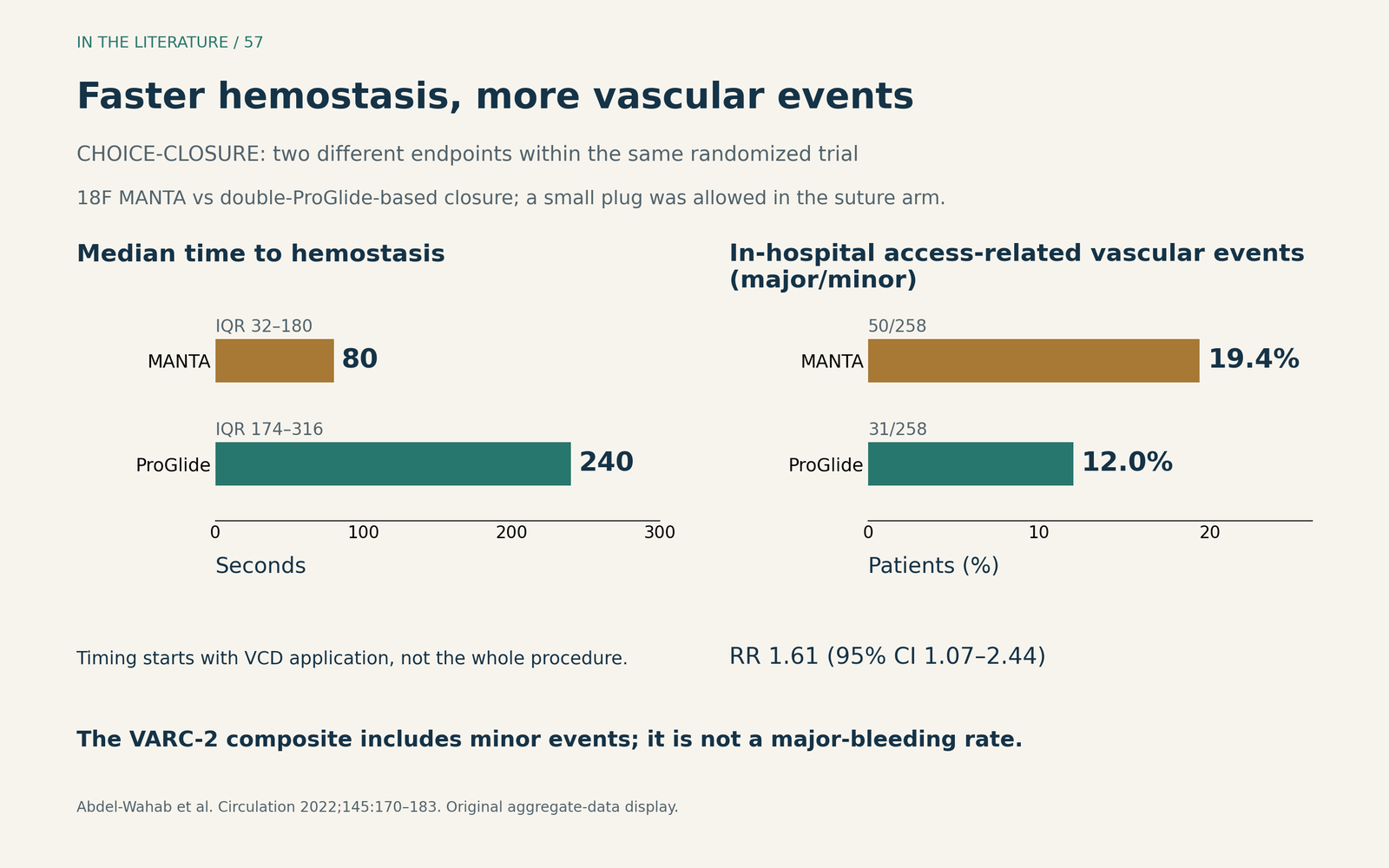
Figure 2. Original display of CHOICE-CLOSURE results. Hemostasis time starts with closure-device application, not the start of TAVR. The safety endpoint combines major and minor events related to the large-bore access. Both panels compare 18F MANTA with the ProGlide-based strategy described above. [2] View figure

The 2025 individual-patient meta-analysis strengthens the vascular signal, while changing the endpoint framework. It combined 722 participants from CHOICE-CLOSURE and MASH-TAVI, harmonizing outcomes to VARC-3; these are existing trial patients, not a third independent randomized population. In-hospital main-access major/minor events occurred in 40/362 ProGlide-strategy patients (11.0%) versus 67/360 MANTA patients (18.6%), with an odds ratio of 0.54 (95% CI, 0.35–0.82). Major vascular events were also less frequent: 5/362 versus 14/360, OR 0.35 (95% CI, 0.12–0.97), although this estimate rests on few events. [5]
That analysis still concerns ProGlide-based closure permitting small-plug adjuncts versus 18F MANTA. It does not establish the performance of ProStyle, other MANTA sizes or closure after ECMO. Differences in surveillance and the retrospective endpoint harmonization also matter when comparing its rates with the original trials. [5]
A planned hybrid strategy answers a different question
ACCESS-TAVI—abstract only for this article— randomized 454 patients to one ProGlide/ProStyle plus Angio-Seal or two ProGlide/ProStyle devices. Its index-hospitalization VARC-3 major/minor access-site vascular composite occurred in 62/230 versus 121/224 patients: 27% versus 54% (P<.001), favoring the planned hybrid strategy. Reported time to hemostasis was also shorter, 108 ± 208 versus 206 ± 171 seconds. [3]
The clinically useful distinction is the treatment being tested: a small plug supplements a suture. This result neither contradicts CHOICE-CLOSURE nor shows that a large-bore plug alone is preferable. The composite should not be relabeled as major vascular injury, and its absolute rate should not be used to rank devices against a different trial's population and endpoint. [2, 3]
Does every patient need two ProGlides?
The SINGLE-CLOSURE trial, published online in November 2026, randomized 876 patients aged at least 65 years at 25 Chinese centers. Only the complete published abstract was available for this article. The in-hospital VARC-3 access-site/access-related major-or-minor composite occurred in 57/436 patients (13.1%) with single ProGlide versus 65/430 (15.1%) with double ProGlide in the reported modified intention-to-treat analysis. [4]
The reported risk difference was −2.2 percentage points (95% interval, −7.0 to 2.6), meeting the prespecified 3.19-point noninferiority margin (P=.013). This supports noninferiority for that composite in the studied population, not superior safety or exact equivalence. Events were predominantly minor. Additional closure devices were reported in 2.5% versus 0.9%, respectively: beginning with one device does not guarantee that one will suffice. [4]
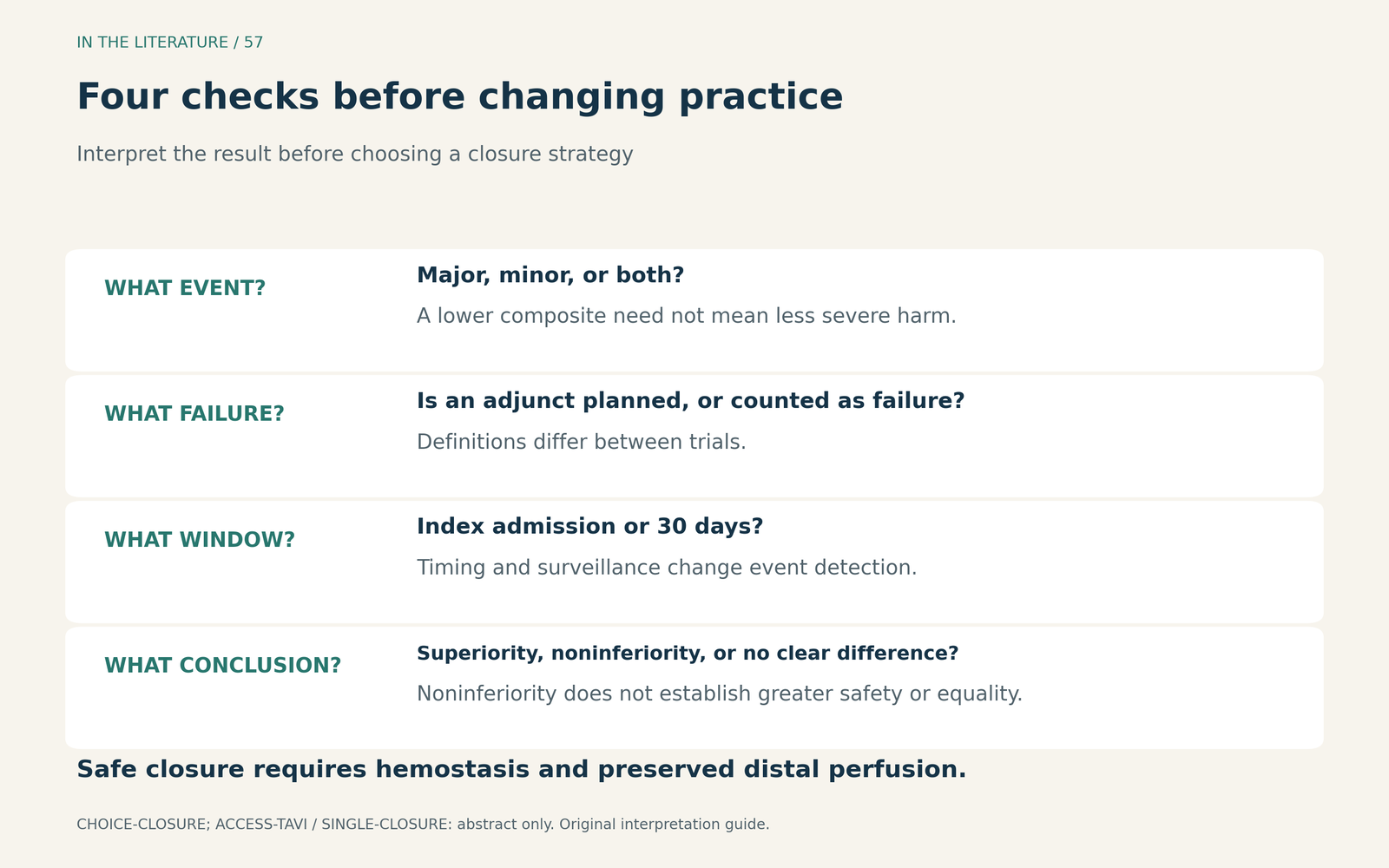
Figure 3. Original guide to interpreting closure studies. A lower composite rate, faster hemostasis and noninferiority are different findings. ACCESS-TAVI and SINGLE-CLOSURE information is abstract only; the interpretation of surveillance and endpoint harmonization also draws on the full individual-patient analysis. [2–5] View figure

What should change at the bedside?
These findings support evaluating the complete closure strategy, including what happens if the initial seal is incomplete. Vascular disease, calcium distribution, sheath characteristics and operator experience affect the risk; a trial average cannot substitute for the patient's access anatomy. [1, 2, 5]
For the perioperative team, the practical implication is to retain attention to both bleeding and impaired perfusion after apparent hemostasis. Hemodynamic deterioration, an expanding access-site hematoma or evidence of limb ischemia warrants prompt assessment rather than reassurance from a dry skin puncture. The plan should also account for delayed access complications. These perioperative priorities follow from the spectrum of access injuries described in the literature. [1]
Three takeaways
- Do not select a closure strategy on hemostasis time alone. CHOICE-CLOSURE demonstrates that faster sealing can coexist with more access-related vascular events.
- Compare like strategies and like endpoints. MANTA alone, a suture strategy with optional adjuncts, planned hybrid closure and single-ProGlide closure are distinct approaches.
- Preserve individualized planning and vascular surveillance. New noninferiority evidence supports a selected strategy; it does not eliminate rescue needs or establish universal device superiority.
References
- Pospishil L, Krishnan S, Neuburger PJ. Vascular Access CLOSURE in Transcatheter Aortic Valve Implantation: Is There A Better CHOICE? J Cardiothorac Vasc Anesth. 2022;36(8 Pt A):2255–2258. doi:10.1053/j.jvca.2022.03.019
- Abdel-Wahab M, Hartung P, Dumpies O, et al. Comparison of a pure plug-based versus a primary suture-based vascular closure device strategy for transfemoral transcatheter aortic valve replacement: the CHOICE-CLOSURE randomized clinical trial. Circulation. 2022;145(3):170–183. doi:10.1161/CIRCULATIONAHA.121.057856
- Rheude T, Ruge H, Altaner N, et al. Comparison of strategies for vascular ACCESS closure after Transcatheter Aortic Valve Implantation: the ACCESS-TAVI randomized trial. Eur Heart J. 2025;46(7):635–645. doi:10.1093/eurheartj/ehae784. Abstract only.
- Liu X, Guo Y, Song G, et al. Single vs Double ProGlide Devices for Access Site Closure after Transfemoral Aortic Valve Replacement: The SINGLE-CLOSURE Trial. J Am Coll Cardiol. Published online November 3, 2026. doi:10.1016/j.jacc.2026.10.055. Abstract only.
- Dumpies O, van Wiechen M, Jobs A, et al. Suture-based versus plug-based closure for large-bore arterial access: an individual patient-level meta-analysis of randomised trials. EuroIntervention. 2025;21(20):e1222–e1233. doi:10.4244/EIJ-D-25-00001