ITL-9e656d49542b
Juan Li, MD · Updated November 17, 2026
Watch the video
Key points
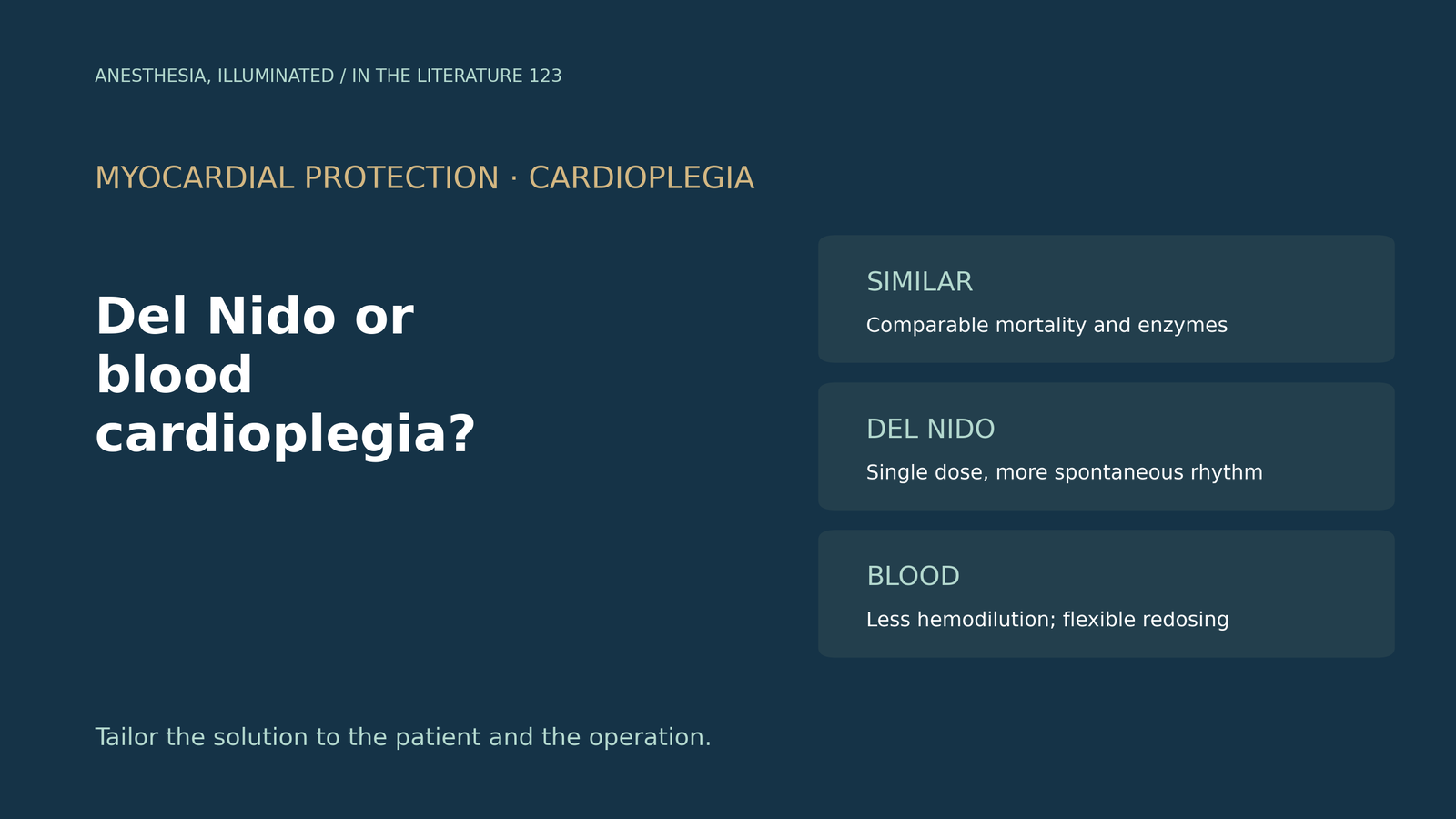
- There is no single best solution. The 2024 EACTS/EACTAIC/EBCP guideline recommends tailoring myocardial protection to the patient and procedure rather than relying on a fixed institutional cardioplegia, notes that blood cardioplegia is preferred in most centers, and accepts single-shot cardioplegia in low-risk cases with short cross-clamp times.[1]
- In a 2024 meta-analysis of 10 randomized trials, del Nido used less cardioplegia and more often allowed spontaneous return of rhythm, with comparable clinical outcomes and in-hospital mortality.[2]
- In a 311-patient randomized trial in aortic valve replacement, peak troponin and creatine kinase did not differ, but del Nido gave more spontaneous rhythm (66.7% vs 43.1%) and less ventricular fibrillation needing defibrillation (23.6% vs 49.7%), at the cost of a larger cardioplegia volume.[3]
- Long cross-clamp times are the gray zone. Trials are lacking; in aortic root surgery, del Nido was linked to more myocardial injury beyond 180 minutes, and the authors now use del Nido alone only when ischemia is expected to be under 150 minutes.[4], [5], [6]
- In isolated CABG, mortality was comparable overall, but one large registry showed a trend against del Nido; blood cardioplegia should be considered when hemodilution or bleeding is a concern (Class IIa B).[7], [1]
A surgical team that uses blood cardioplegia for every case asks whether to switch to single-dose del Nido for a mix of valve and coronary operations, including some long aortic root repairs. What do the trials show, and when might one solution be better than the other?[1], [2]
What the guideline says
The 2024 EACTS/EACTAIC/EBCP guideline on cardiopulmonary bypass notes that hyperkalemic blood cardioplegia is preferred in most centers worldwide and that del Nido can be given as a single dose for up to 90 minutes of ischemia. Single-shot cardioplegia may be used in low-risk cases with short cross-clamp times. It recommends that myocardial protection be patient-centred and tailored to clinical and anatomical conditions and procedural complexity rather than relying on a fixed institutional solution, and that blood cardioplegia be considered in selected patients to reduce hemodilution, bleeding and transfusion (Class IIa B).[1]
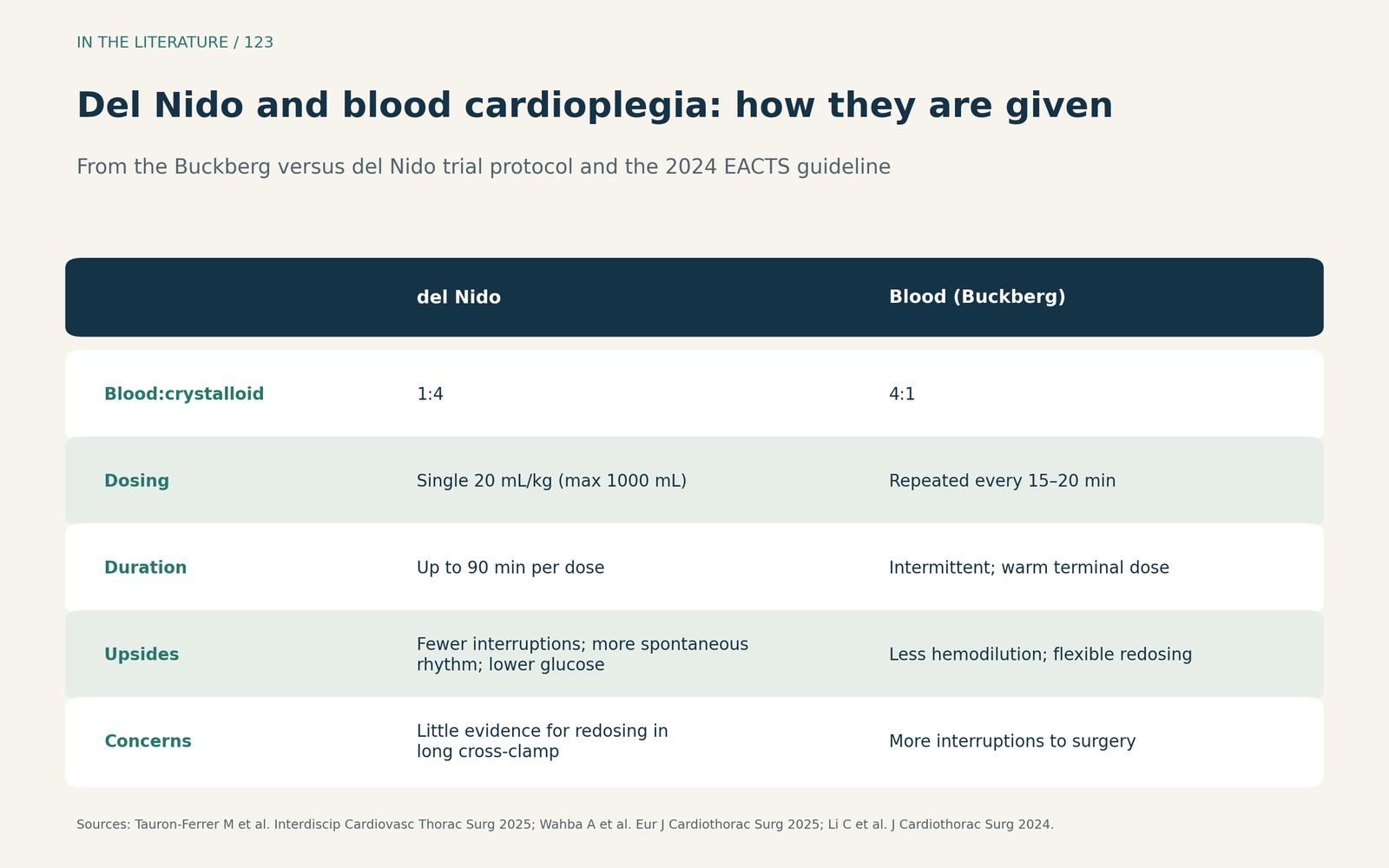
Figure 1. Del Nido and blood cardioplegia: how they are given. Synthesized from the Buckberg versus del Nido trial protocol, the 2024 EACTS guideline and Li et al.[3], [1], [2] View larger.

What the randomized trials show
Li and colleagues pooled 10 randomized trials with 889 patients receiving del Nido and 907 receiving cold blood cardioplegia, mostly in CABG. Del Nido required less cardioplegia, more often allowed spontaneous rhythm after unclamping and was associated with lower troponin T and CK-MB, while troponin I, ejection fraction and clinical outcomes, including in-hospital mortality, were comparable. All trials were single-center, and the authors note that there is no consensus on how to redose del Nido beyond 90 minutes.[2]
Tauron-Ferrer and colleagues randomized 311 patients undergoing isolated aortic valve replacement to Buckberg blood cardioplegia or del Nido. Peak creatine kinase and troponin T did not differ. Del Nido produced more spontaneous rhythm after unclamping (66.7% vs 43.1%), less ventricular fibrillation requiring defibrillation (23.6% vs 49.7%) and lower intraoperative glucose. The total del Nido volume was larger (1000 vs 374.5 mL); the minimum intraoperative hematocrit was slightly lower, but transfusion did not differ.[3]
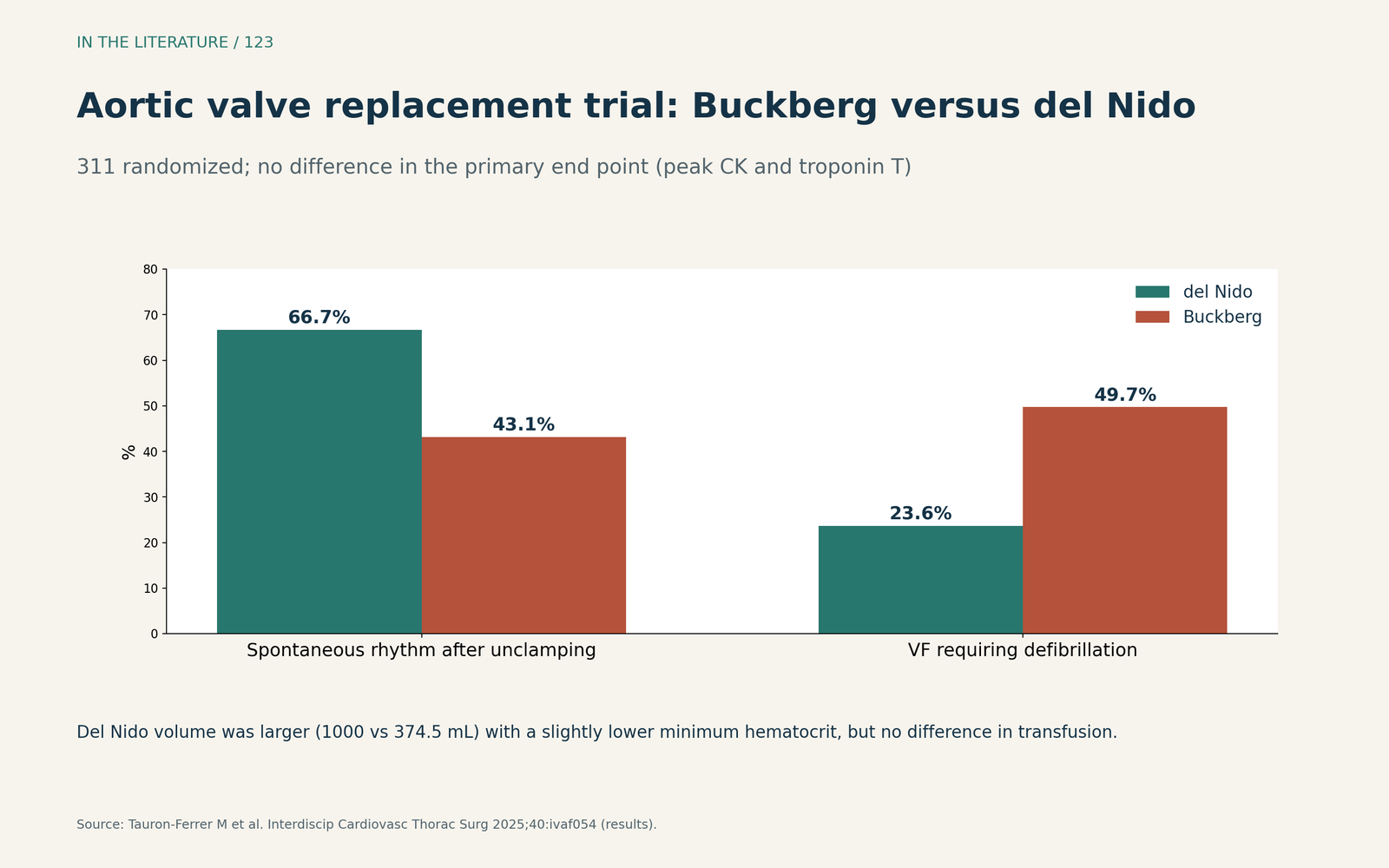
Figure 2. Buckberg versus del Nido in aortic valve replacement. Redrawn from the results of Tauron-Ferrer et al.[3] View larger.

Long cross-clamp times
Fresilli and colleagues, in an earlier meta-analysis of randomized trials, concluded that it is unclear whether del Nido confers any major advantage over conventional cardioplegia, and note that some centers switch to multidose blood cardioplegia when cross-clamp time is expected to exceed 60 minutes.[4] In aortic root surgery, Lenoir and colleagues found more myocardial injury with del Nido in patients with ischemia longer than 180 minutes, and caution against it for interventions needing long ischemic times; they now use del Nido alone when ischemia is expected to be under 150 minutes.[5] Willekes and colleagues similarly found higher troponin T with del Nido at cross-clamp times between 150 and 180 minutes; myocardial temperature was not measured.[6]
Isolated CABG
Yamashita and colleagues found comparable mortality with del Nido in isolated CABG, but their meta-analysis was mostly observational (4 randomized and 20 observational studies), and one registry of 28,289 patients showed a trend toward higher mortality with del Nido (adjusted odds ratio 1.24; P = 0.069).[7]
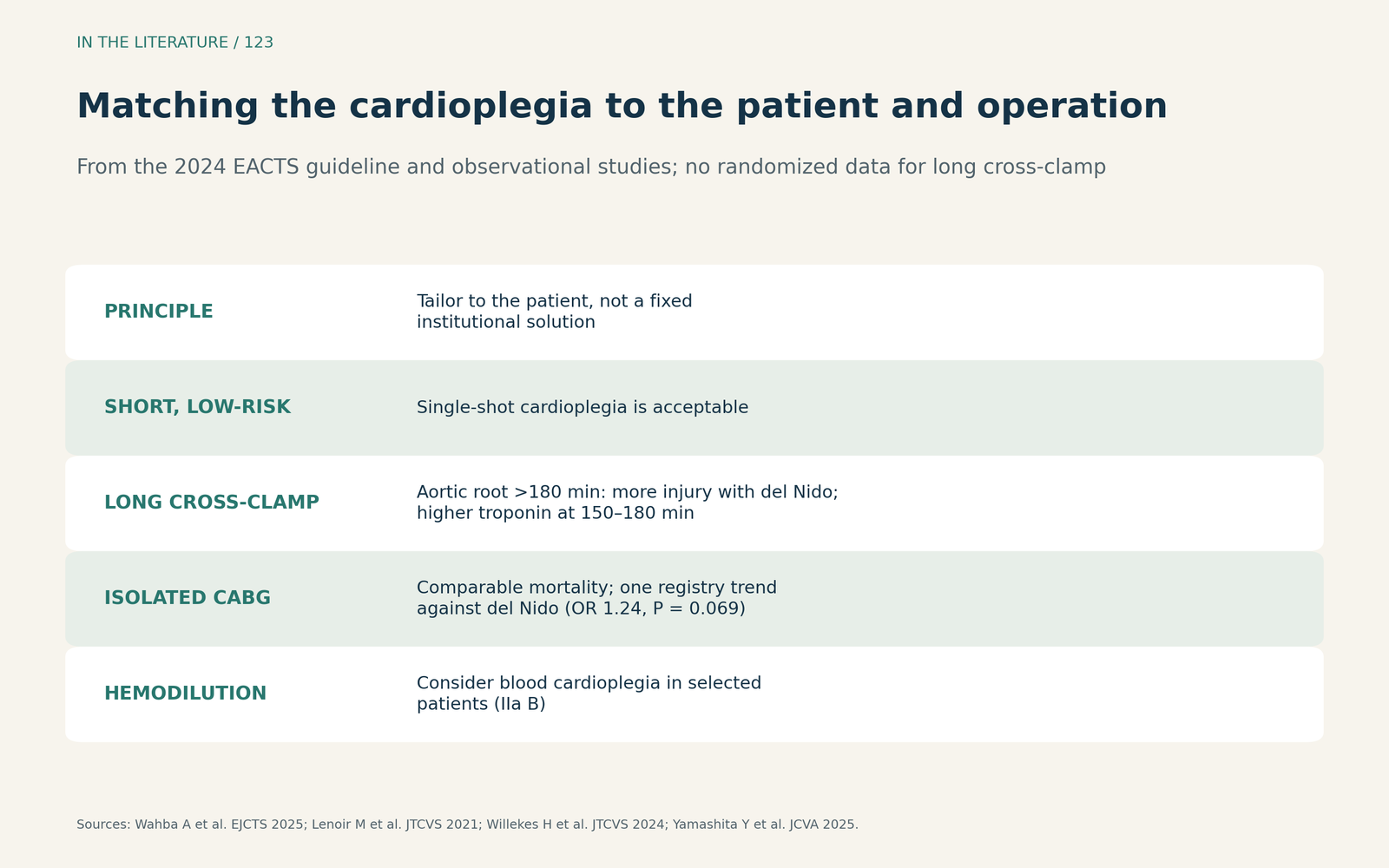
Figure 3. Matching the cardioplegia to the patient and operation. Synthesized from the 2024 EACTS guideline, Lenoir et al., Willekes et al. and Yamashita et al.[1], [5], [6], [7] View larger.

Three takeaways
- Expect similar outcomes in routine cases. Del Nido and blood cardioplegia give comparable enzyme release and mortality in trials of shorter operations.[2], [3]
- Know what del Nido adds. Fewer interruptions, more spontaneous rhythm and less defibrillation, but a larger crystalloid volume.[2], [3]
- Be cautious when the clamp will be long. For very long ischemic times or concern about hemodilution, blood cardioplegia or a switch strategy is reasonable.[1], [5], [6]
References
- Wahba A, Kunst G, De Somer F, et al. 2024 EACTS/EACTAIC/EBCP guidelines on cardiopulmonary bypass in adult cardiac surgery. Eur J Cardiothorac Surg. 2025;67(2):ezae354. doi:10.1093/ejcts/ezae354
- Li C, Xiang H, Yang H, et al. Del Nido cardioplegia versus cold blood cardioplegia in adult cardiac surgery: a meta-analysis of randomized clinical trials. J Cardiothorac Surg. 2024;19(1):356. doi:10.1186/s13019-024-02846-0
- Tauron-Ferrer M, Roselló-Díez E, Muñoz-Guijosa C, et al. Buckberg versus Del Nido in isolated aortic valve replacement: a prospective, two-centre, randomized trial. Interdiscip Cardiovasc Thorac Surg. 2025;40(3):ivaf054. doi:10.1093/icvts/ivaf054
- Fresilli S, Labanca R, Monaco F, et al. Del Nido cardioplegia in adult cardiac surgery: meta-analysis of randomized clinical trials. J Cardiothorac Vasc Anesth. 2023;37(7):1152–1159. doi:10.1053/j.jvca.2023.02.045
- Lenoir M, Bouhout I, Jelassi A, et al. Del Nido cardioplegia versus blood cardioplegia in adult aortic root surgery. J Thorac Cardiovasc Surg. 2021;162(2):514–522.e2. doi:10.1016/j.jtcvs.2020.01.022
- Willekes H, Parker J, Neill J Jr, et al. Efficacy of del Nido cardioplegia in adult cardiac procedures with prolonged aortic crossclamp time. J Thorac Cardiovasc Surg. 2024;167(3):996–1007.e4. doi:10.1016/j.jtcvs.2022.02.066
- Yamashita Y, Baudo M, Magouliotis DE, et al. Effect of del Nido cardioplegia on isolated coronary artery bypass grafting: a study-level meta-analysis. J Cardiothorac Vasc Anesth. 2025;39(6):1538–1546. doi:10.1053/j.jvca.2025.01.007