ITL-357c0d372d04
Juan Li, MD · Updated November 17, 2026
Watch the video
Key points
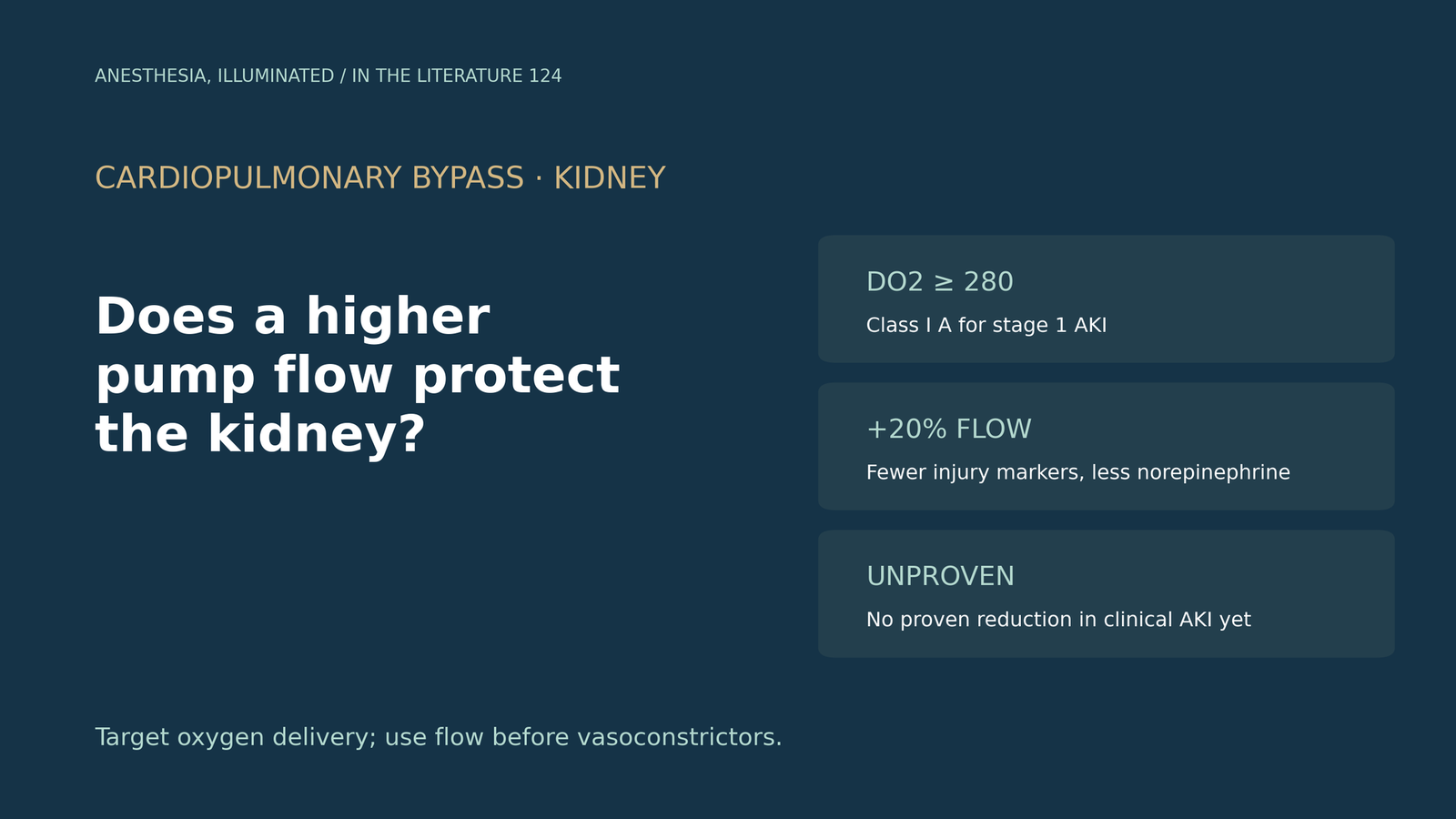
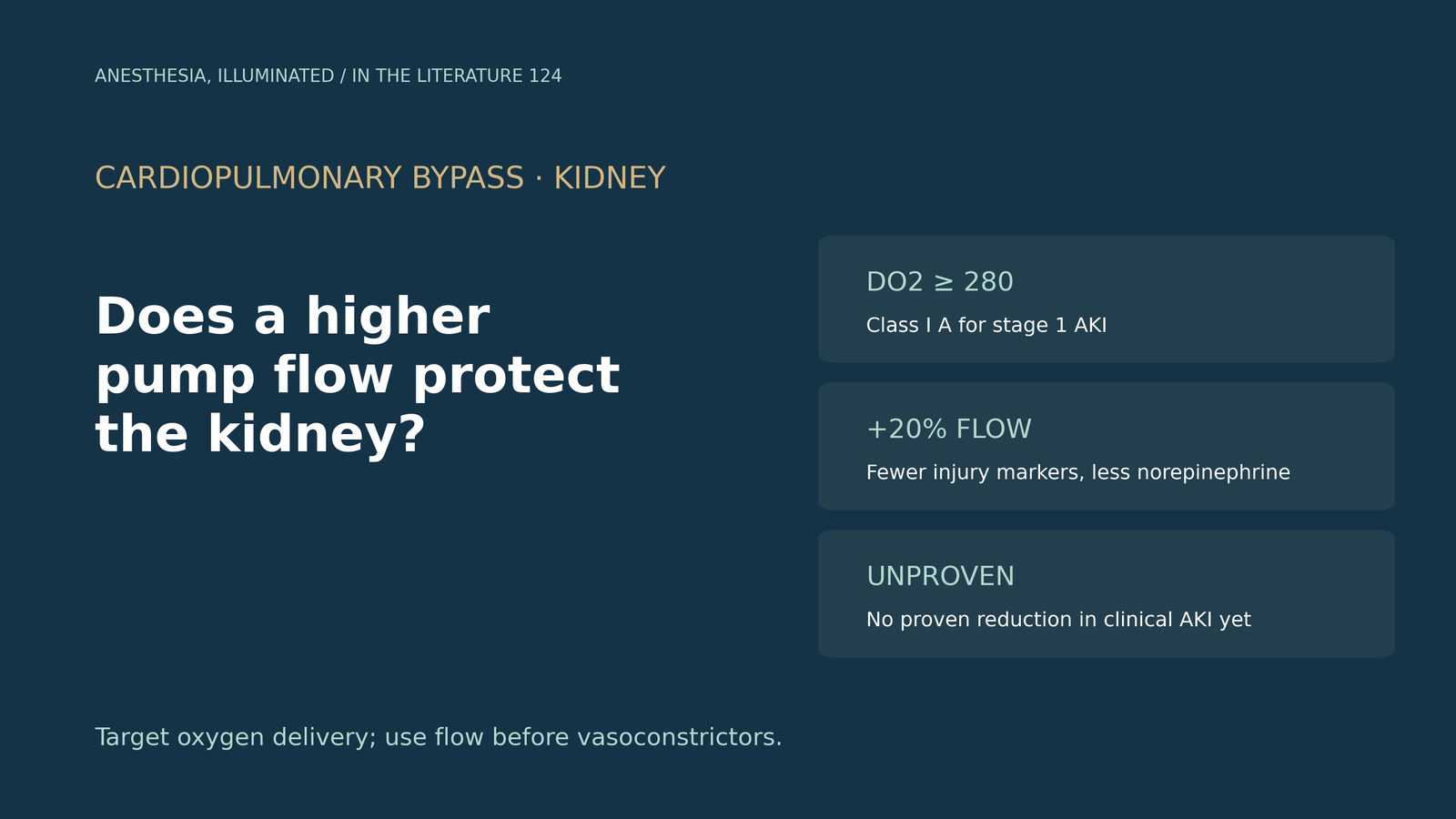
- The 2024 EACTS/EACTAIC/EBCP guideline does not name a single optimal pump flow. It recommends keeping oxygen delivery (DO2) at 280 mL/min/m² or more to reduce stage 1 acute kidney injury (AKI) (Class I A), and limiting the nadir and the time spent at low DO2 (Class I B).[1]
- Two randomized trials of goal-directed perfusion, which mainly raises pump flow to hold DO2 above a threshold, reduced mild AKI. Neither reduced severe AKI or other clinical end points.[2], [3]
- Raising flow by about 20% above a standard of 2.4 L/min/m² lowered tubular injury markers and norepinephrine needs. In ICAROX 2 (89 patients), AKI was 16% vs 25%, but the trial was not powered for AKI.[4], [5]
- How it works is not settled. In the renal-catheter trial, higher flow raised GFR but did not raise measured renal blood flow; a crossover study found better bladder urine oxygen tension.[5], [6]
- Higher flow has costs: larger cannulas, higher oxygenator pressure drops, possible hemolysis and more crystalloid. Pushing pressure with vasoconstrictors instead of flow is not recommended (Class III A).[5], [1]
During a valve operation on normothermic bypass, the perfusionist is running 2.4 L/min/m², the mean arterial pressure is 60 mmHg on norepinephrine, and the hematocrit has drifted down. Should the team raise the pump flow to protect the kidney, and what does the evidence actually show?[1], [4]
What the guideline says
The 2024 EACTS/EACTAIC/EBCP guideline states that it is impossible to recommend an optimal pump flow rate on the basis of any single index. The starting flow should be set from body surface area and the planned temperature (Class I C), and its adequacy judged from oxygenation and metabolic markers such as venous saturation, oxygen extraction and lactate. It recommends a minimum DO2 of 280 mL/min/m² to reduce stage 1 AKI (Class I A), says a threshold of 280 to 300 mL/min/m² should be considered during normothermic bypass (Class IIa B), and recommends limiting both the DO2 nadir and the time spent at low DO2 (Class I B). A DO2 target individualized from preoperative risk, peripheral oxygenation and pulse pressure may be considered (Class IIb B).[1]
On pressure, it recommends a MAP of 50 to 80 mmHg once anesthetic depth and pump flow are adequate (Class I A) and advises against routinely targeting a high MAP with vasoconstrictors to reduce AKI (Class III A). In its words, it is more important to target DO2 and optimize flow than to raise pressure with vasopressors. When the guideline was written, no randomized trial had tested pump flow rate against outcomes.[1]
Goal-directed perfusion trials
Ranucci and colleagues randomized 350 patients at 9 centers to goal-directed perfusion with DO2 at 280 mL/min/m² or more, or to conventional perfusion. Stage 1 AKI was reduced (relative risk 0.45), while stage 2 to 3 AKI and secondary outcomes did not differ.[2] Mukaida and colleagues randomized 300 patients to a DO2 index above 300 mL/min/m², maintained through pump flow adjustment, or to flow based on body surface area. AKI occurred in 14.6% vs 30.4% (relative risk 0.48); secondary end points did not differ.[3] In a 1-year follow-up of 199 of the 275 analyzed patients, eGFR followed a different course over time, but chronic kidney disease stage at 12 months did not differ, and the authors call the finding exploratory.[7]
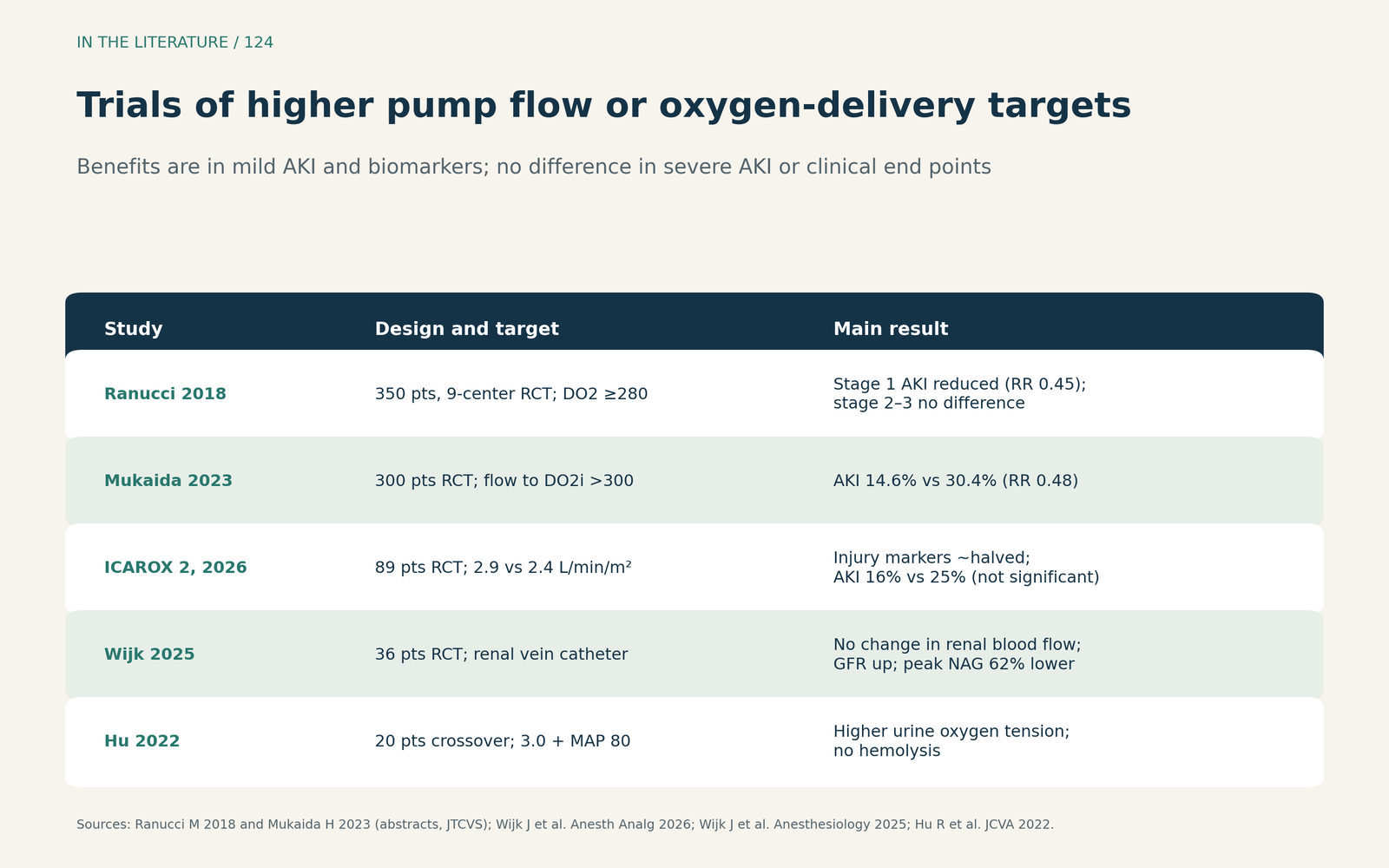
Figure 1. Trials of higher pump flow or oxygen-delivery targets on bypass. Synthesized from Ranucci et al., Mukaida et al., ICAROX 2, Wijk et al. and Hu et al.[2], [3], [4], [5], [6] View larger.

Flow above standard
In ICAROX 2, 89 adults were randomized to 2.9 or 2.4 L/min/m², with MAP held at 60 to 80 mmHg. Mean DO2 index was 405 vs 357 mL/min/m², and the two urinary tubular injury markers were roughly halved (geometric mean ratios 0.43 and 0.46). Urine output on bypass was 41% higher. AKI was 16% vs 25%, a difference the trial was not powered to detect, and no patient needed renal replacement therapy. The high-flow group had lower preoperative renal function, and the standard-flow group had longer bypass times.[4]
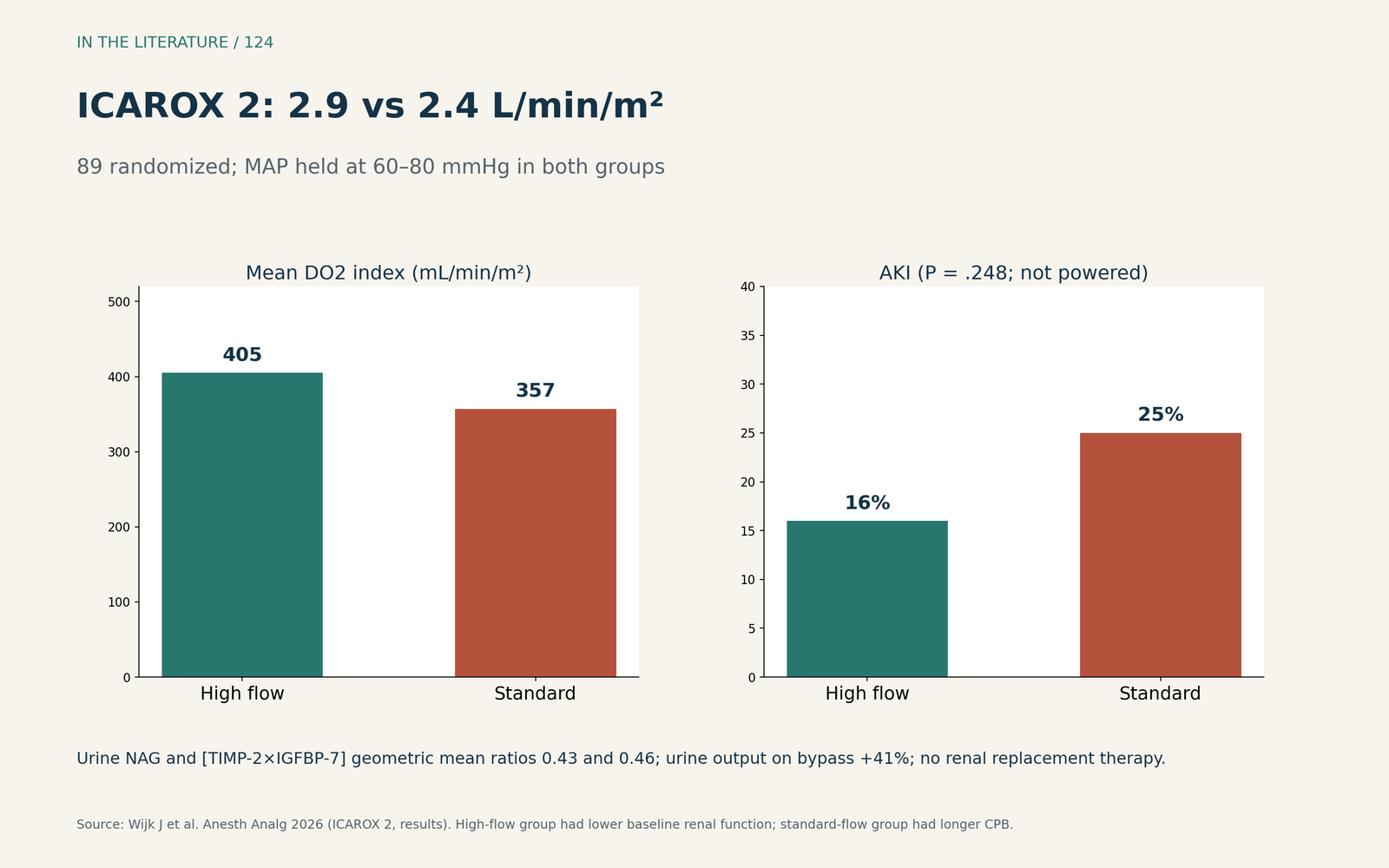
Figure 2. ICAROX 2: higher flow raised oxygen delivery; the AKI difference was not significant. Redrawn from Wijk et al. 2026.[4] View larger.

The same group's renal-vein catheter trial in 36 patients tested the same flows. Renal blood flow and renal oxygen extraction did not differ between groups, yet GFR rose with high flow and peak urinary NAG was 62% lower. The norepinephrine dose in the standard-flow group was twice as high, and the high-flow group needed more crystalloid (579 vs 129 mL). Baseline renal function was lower in the high-flow group.[5] Hu and colleagues, in a 20-patient crossover, raised flow to 3.0 L/min/m² together with a MAP of 80 mmHg and found higher bladder urine oxygen tension without signs of hemolysis; because flow and pressure were changed together, their effects cannot be separated.[6]
Who may benefit most
In a retrospective cohort of 1064 patients, each 10 mL/min/m² increase in DO2 index was associated with 4% lower odds of AKI, and the association was stronger in patients with a high preoperative pulse pressure.[8] This supports the guideline's suggestion to individualize DO2 targets, but it is observational.[1]
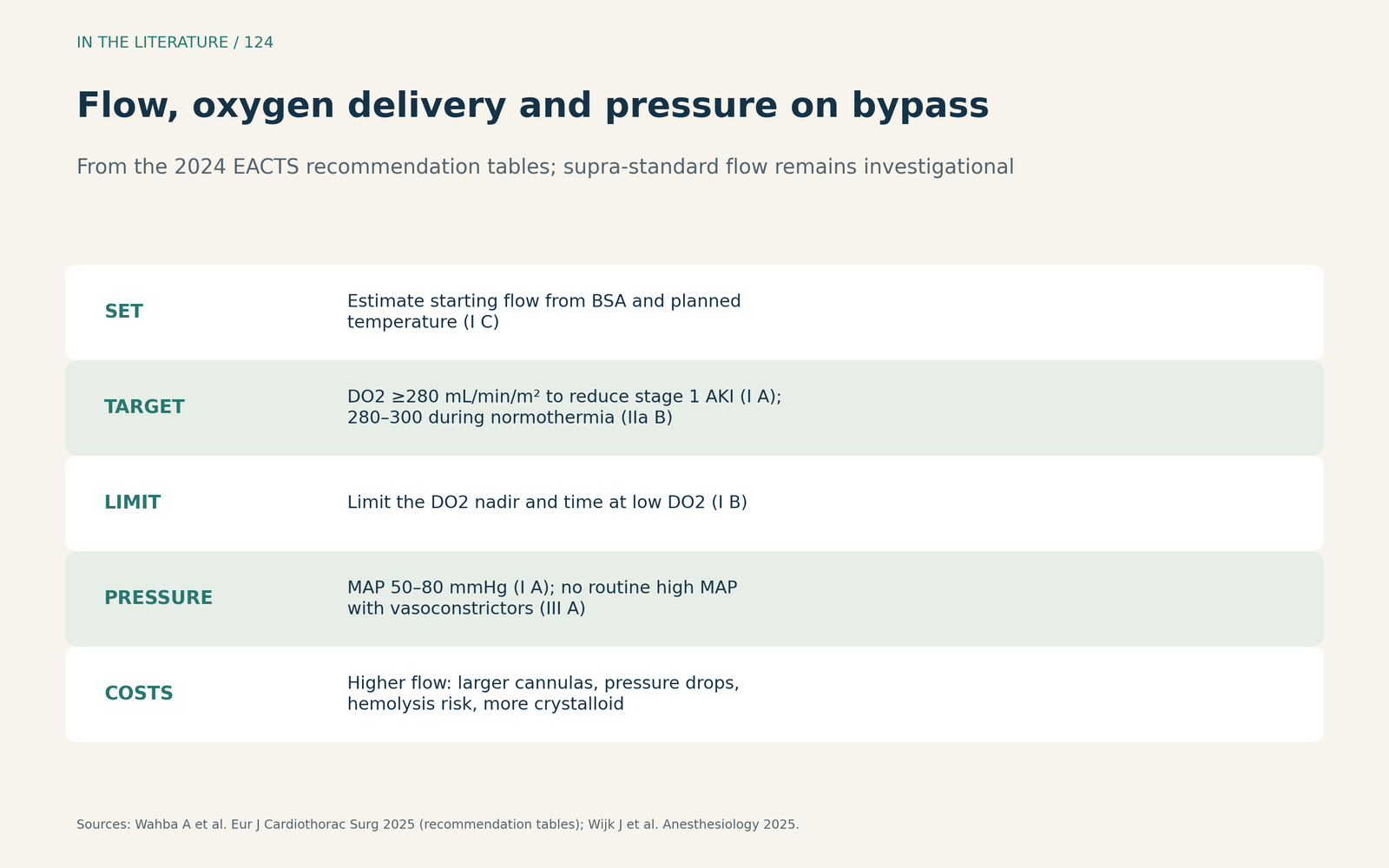
Figure 3. Flow, oxygen delivery and pressure on bypass. Synthesized from the 2024 EACTS guideline recommendation tables and Wijk et al.[1], [5] View larger.

Three takeaways
- Target oxygen delivery, not a fixed number. Keep DO2 at or above 280 mL/min/m², and limit the depth and duration of low values.[1]
- Use flow before vasoconstrictors. Raising flow lowered injury markers and norepinephrine needs; pushing MAP with vasoconstrictors is not recommended.[1], [4], [5]
- Treat supra-standard flow as unproven. Benefits so far are in biomarkers and mild AKI, from small or single-center trials; watch cannula pressure, hemolysis and fluid balance.[2], [3], [4], [5]
References
- Wahba A, Kunst G, De Somer F, et al. 2024 EACTS/EACTAIC/EBCP guidelines on cardiopulmonary bypass in adult cardiac surgery. Eur J Cardiothorac Surg. 2025;67(2):ezae354. doi:10.1093/ejcts/ezae354
- Ranucci M, Johnson I, Willcox T, et al. Goal-directed perfusion to reduce acute kidney injury: a randomized trial. J Thorac Cardiovasc Surg. 2018;156(5):1918–1927.e2. Abstract only. doi:10.1016/j.jtcvs.2018.04.045
- Mukaida H, Matsushita S, Yamamoto T, et al. Oxygen delivery-guided perfusion for the prevention of acute kidney injury: a randomized controlled trial. J Thorac Cardiovasc Surg. 2023;165(2):750–760.e5. Abstract only. doi:10.1016/j.jtcvs.2021.03.032
- Wijk J, Corderfeldt-Keiller A, Redfors B, Lannemyr L. Elevated cardiopulmonary bypass flow for renal protection in cardiac surgery: a randomized trial. Anesth Analg. 2026. Published online ahead of print. doi:10.1213/ANE.0000000000008196
- Wijk J, Cordefeldt-Keiller A, Bragadottir G, et al. Effects of increased cardiopulmonary bypass pump flow on renal filtration, perfusion, oxygenation, and tubular injury in cardiac surgical patients: a randomized controlled trial. Anesthesiology. 2025;143(4):906–916. doi:10.1097/ALN.0000000000005648
- Hu R, Yanase F, McCall P, et al. The effects of targeted changes in systemic blood flow and mean arterial pressure on urine oximetry during cardiopulmonary bypass. J Cardiothorac Vasc Anesth. 2022;36(9):3551–3560. doi:10.1053/j.jvca.2022.05.023
- Mukaida H, Minami Y, Tabata M. Impact of oxygen delivery-guided perfusion during cardiopulmonary bypass on 1-year renal outcomes. JTCVS Open. 2026;32:101926. doi:10.1016/j.xjon.2026.101926
- Mitrev L, Krickus C, DeChiara J, et al. Association of preoperative pulse pressure and oxygen delivery index during cardiopulmonary bypass with postoperative acute kidney injury. J Cardiothorac Vasc Anesth. 2022;36(11):4070–4076. doi:10.1053/j.jvca.2022.06.040