ITL-69a5b4460e1c
Juan Li · In the Literature · Updated November 16, 2026
Watch the video
Key points
- Low operative risk describes part of today's procedural risk; it does not establish the best valve strategy for the rest of a patient's life.
- Age, life expectancy, valve and access anatomy, associated surgical disease and patient preferences must accompany the risk score.
- PARTNER 3 at seven years and Evolut Low Risk at six years did not show a significant difference in their respective primary composites. Neither result proves lifetime equivalence.
- The latest Evolut report raises a reintervention concern in available seven-year follow-up; only its complete published abstract was available for this article.
- Plan the next intervention and future coronary access before choosing the first valve.
Start with the patient beyond the risk score
A patient with symptomatic severe aortic stenosis needs valve replacement. The estimated surgical mortality is low, and the patient asks for the less invasive procedure. Does low risk make TAVR the preferred choice?
Not by itself. The decision starts with whether the patient is an appropriate candidate for a bioprosthesis, then considers which route offers a suitable lifetime treatment plan. A patient in their late seventies with favorable transfemoral anatomy and a younger patient with bicuspid disease and an ascending aortic aneurysm should not receive the same recommendation simply because both have a low surgical-risk score. [1, 2]
Read the guideline together with its conditions
The 2025 ESC/EACTS guideline recommends SAVR for patients younger than 70 years when surgical risk is low (Class I, level B). It recommends TAVI from age 70 in tricuspid aortic stenosis when anatomy is suitable and transfemoral access is feasible (Class I, level A). Remaining candidates require Heart Team assessment of anatomy, comorbidities, expected outcomes, lifetime management and preference. [1]
The 2020 ACC/AHA guideline uses a different framework. When bioprosthetic AVR is appropriate, it recommends SAVR below 65 years or when life expectancy exceeds 20 years. For symptomatic patients aged 65–80, either SAVR or transfemoral TAVI is recommended after shared decision-making when transfemoral anatomy is suitable. For symptomatic severe AS above 80 years, or with life expectancy below 10 years, suitable transfemoral TAVI is preferred over SAVR. These are separate guideline frameworks, not a single interchangeable age cutoff. [2]
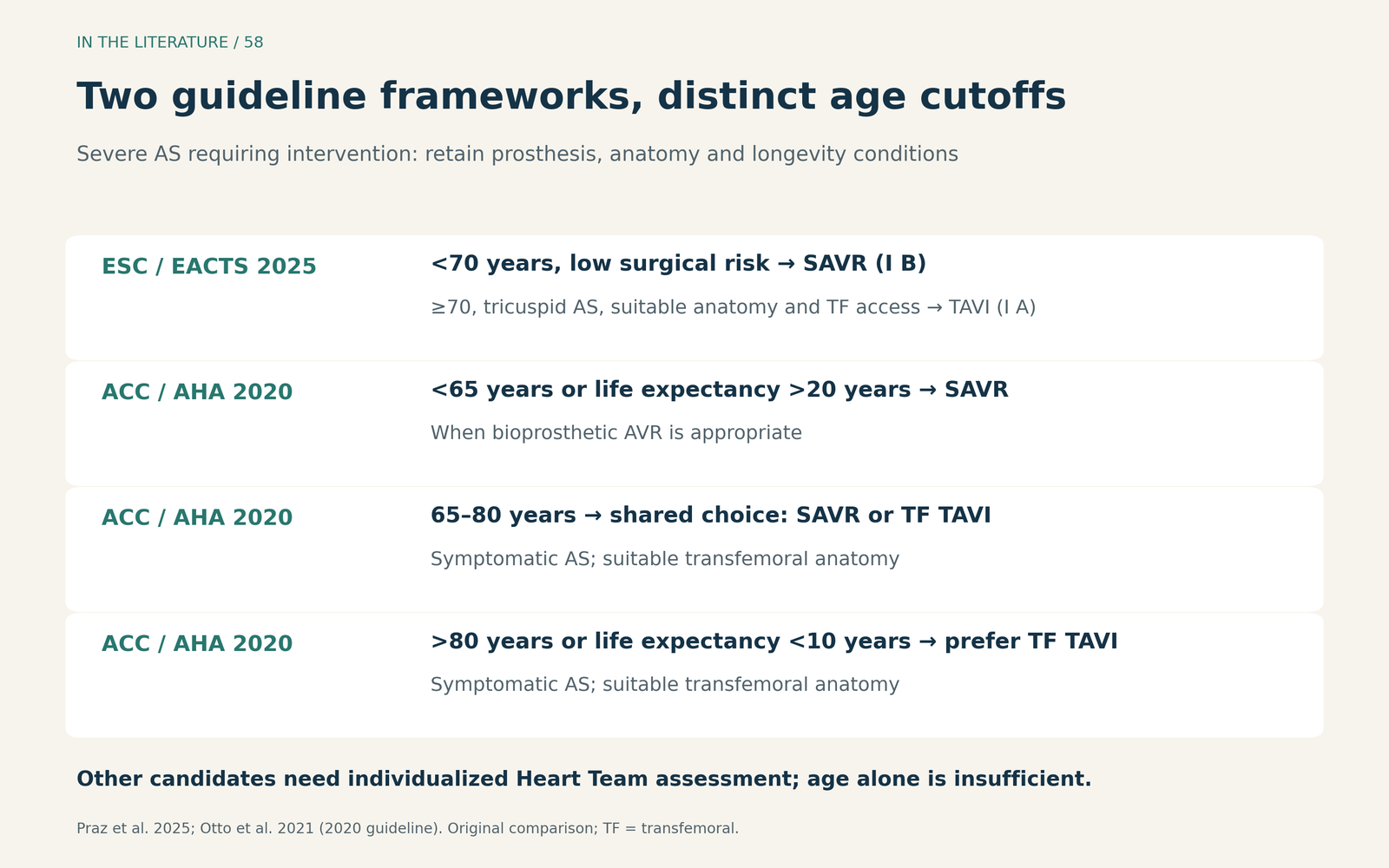
Figure 1. Original comparison of guideline frameworks for severe aortic stenosis requiring intervention. Age is considered alongside prosthesis choice, anatomy, life expectancy and patient preference; the chart is not an age-only treatment rule. [1, 2] View figure

What do the latest long-term randomized results establish?
PARTNER 3 randomized 1,000 patients to transfemoral SAPIEN 3 TAVR or surgical bioprosthetic replacement. Their mean age was 73 years. This was a selected low-risk population, not a trial of every young patient or every aortic anatomy. [3]
At seven years, the Kaplan–Meier estimate for death, stroke or rehospitalization related to the procedure, valve or heart failure was 34.6% with TAVR versus 37.2% with surgery. The difference was −2.6 percentage points (95% CI, −9.0 to 3.7). No significant difference was detected; the interval still permits clinically meaningful differences in either direction. Mortality assessed with additional vital-status follow-up was 19.5% versus 16.8%, without a demonstrated mortality difference. That additional ascertainment was not incorporated into the primary composite. [3]
Bioprosthetic valve failure at seven years was 6.9% versus 7.5%, estimated with death as a competing risk. This is encouraging medium-to-long-term follow-up, but valve failure is broader than structural degeneration, and seven years does not answer a much younger patient's lifetime durability question. [3]
Evolut Low Risk—abstract only for this article— reports 1,414 attempted implantations. At six years, the Kaplan–Meier estimate for the primary composite of all-cause death or disabling stroke was 23.3% with TAVR versus 20.4% with surgery. The reported difference was 2.8 percentage points (95% CI, −1.9 to 7.6; P=.43). This endpoint differs from PARTNER 3, so their percentages should not be compared as a valve-platform ranking. [4]
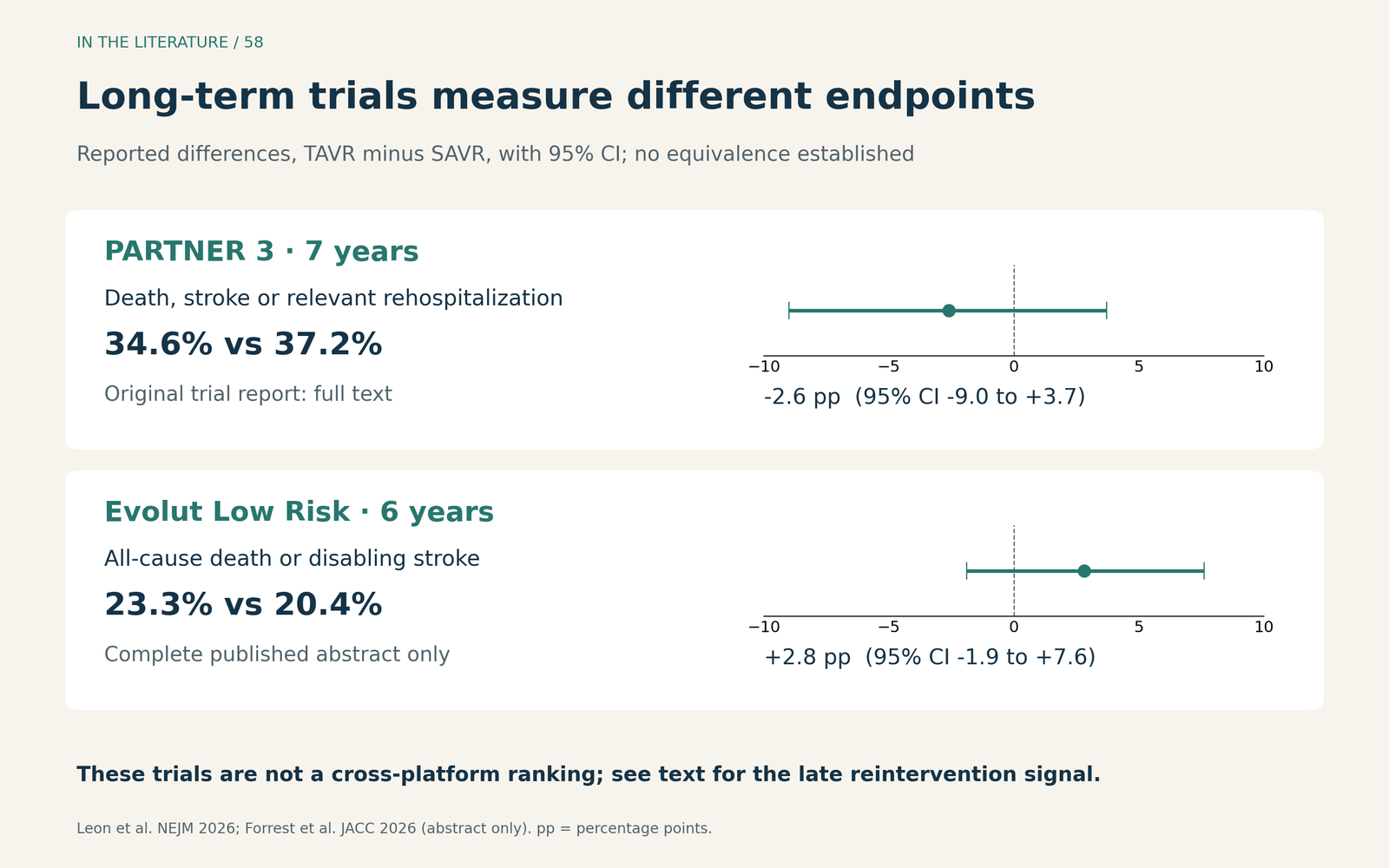
Figure 2. Original display of reported differences, TAVR minus SAVR. PARTNER 3 includes rehospitalization and all stroke; Evolut uses death or disabling stroke. Neither confidence interval establishes equivalence. Evolut information is abstract only. [3, 4] View figure

The Evolut reintervention results deserve explicit discussion. At six years, cumulative incidence was 5.5% versus 3.3% (subdistribution HR 1.66, 95% CI 0.96–2.86). An additional analysis of available seven-year follow-up—555 TAVR and 480 surgical patients—reported 9.8% versus 6.0% (subdistribution HR 1.68, 95% CI 1.10–2.58). The latter is a concerning late signal, not a prespecified seven-year analysis of an entirely mature cohort, and it should not be extrapolated to every transcatheter valve. [4]
What does the evidence in women add?
The RHEIA trial helps address the under-representation of women. It randomized 443 women, with 420 in the as-treated analysis; mean age was 73 years and mean STS surgical-risk score 2.1%. It was not restricted to an exclusively low-risk population. [5]
At one year, the death, stroke or relevant rehospitalization composite was 8.9% with balloon-expandable TAVI versus 15.6% with surgery in the as-treated analysis. The reported difference was −6.8 percentage points (two-sided 95% CI, −13.0 to −0.5; superiority P=.034). The benefit was primarily driven by rehospitalization, without a significant difference in death or stroke individually. This supports TAVI for appropriately selected women; it does not establish a survival advantage or lifelong superiority. [5]
Make the lifetime plan concrete
The Heart Team discussion should answer three practical questions:
- Is the anatomy suitable for the proposed procedure? Assess transfemoral access, bicuspid morphology, annular and outflow-tract calcium, coronary obstruction risk and any aortic or coronary disease needing surgery. When anatomy precludes transfemoral TAVI in an otherwise suitable surgical candidate, the low-risk transfemoral trial results do not justify simply switching to another access route. [1, 2]
- What matters most during recovery? Discuss the less invasive course alongside the patient's risks of conduction disturbance, paravalvular regurgitation and other procedural complications. A favorable composite is useful evidence, but it does not mean every component improves. [1, 3, 5]
- What happens when this valve fails? Review the feasibility of future valve-in-valve treatment, residual valve area, coronary access and obstruction risk. A second transcatheter valve is not automatically feasible or hemodynamically adequate. Mechanical valve options, when appropriate, belong in the earlier prosthesis-choice discussion. [1, 2]
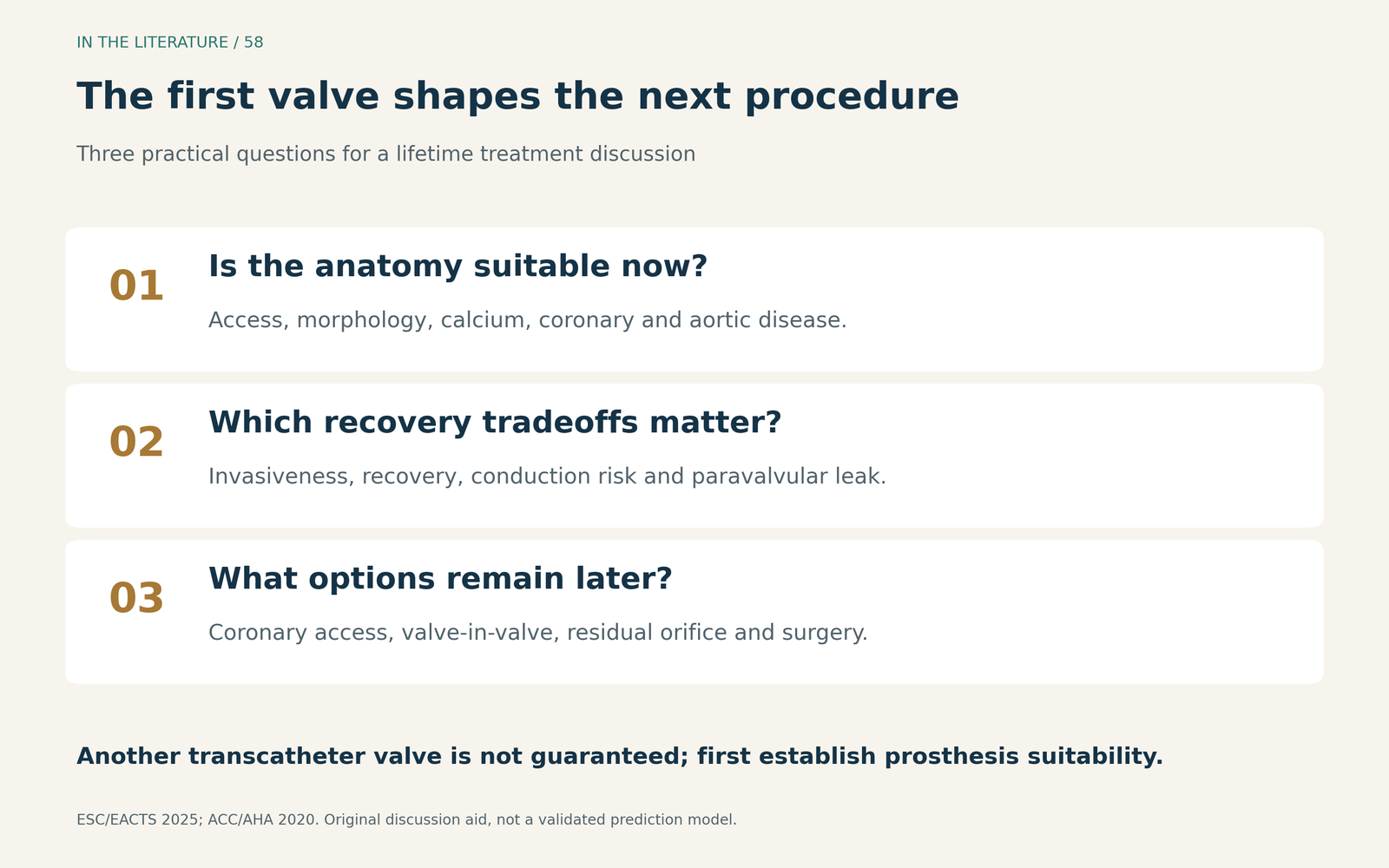
Figure 3. Original clinical discussion guide. The first valve changes the options for future coronary procedures and valve reintervention. It is a guideline-based decision aid, not a validated prediction model. [1, 2] View figure

Three takeaways
- Use low risk as an input, not the treatment decision. Age, expected longevity, anatomy and concomitant disease can favor different strategies despite the same risk score.
- Explain what long-term trials measured. No significant composite difference does not prove equivalence, and late reintervention findings deserve an honest discussion.
- Choose the first valve with the next procedure in mind. The patient should understand both the recovery they face now and the options that may remain later.
References
- Praz F, Borger MA, Lanz J, et al. 2025 ESC/EACTS Guidelines for the management of valvular heart disease. Eur J Cardiothorac Surg. 2025;67(8):ezaf276. doi:10.1093/ejcts/ezaf276
- Otto CM, Nishimura RA, Bonow RO, et al. 2020 ACC/AHA Guideline for the Management of Patients With Valvular Heart Disease: A Report of the American College of Cardiology/American Heart Association Joint Committee on Clinical Practice Guidelines. Circulation. 2021;143(5):e72–e227. doi:10.1161/CIR.0000000000000923
- Leon MB, Mack MJ, Pibarot P, et al. Transcatheter or surgical aortic-valve replacement in low-risk patients at 7 years. N Engl J Med. 2026;394(8):773–783. doi:10.1056/NEJMoa2509766
- Forrest JK, Yakubov SJ, Deeb GM, et al. Six-Year Outcomes After Transcatheter vs Surgical Aortic Valve Replacement in Low-Risk Patients With Aortic Stenosis. J Am Coll Cardiol. 2026;87(23):3210–3221. doi:10.1016/j.jacc.2026.02.5063. Abstract only.
- Tchetche D, Pibarot P, Bax JJ, et al. Transcatheter vs. surgical aortic valve replacement in women: the RHEIA trial. Eur Heart J. 2025;46(22):2079–2088. doi:10.1093/eurheartj/ehaf133