ITL-aea73f66024d
Juan Li, MD · Updated November 17, 2026
Watch the video
Key points
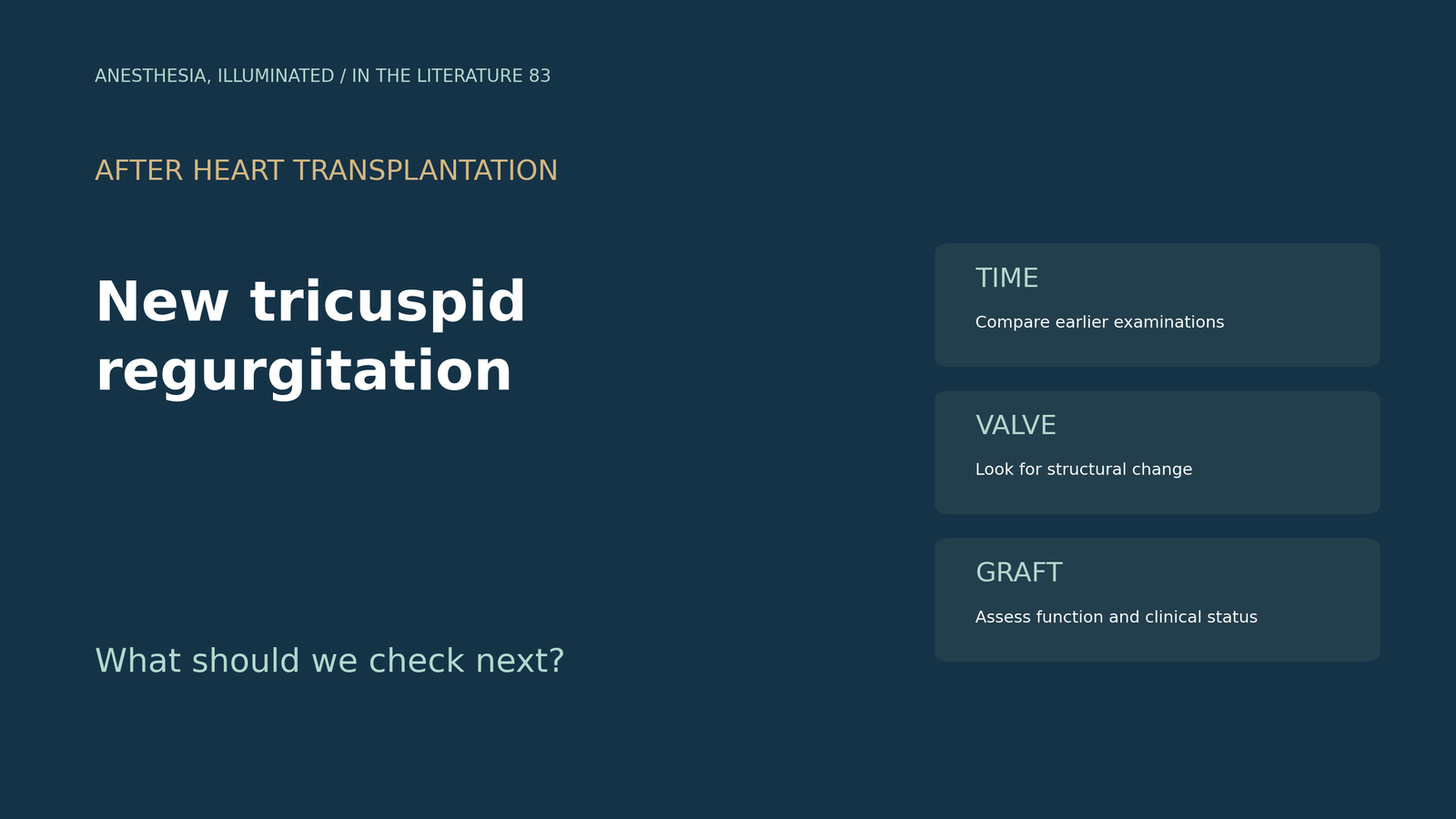
- Interpret new tricuspid regurgitation (TR) alongside valve anatomy, ventricular function and the clinical course; TR alone does not diagnose rejection.1
- Early significant TR can improve, but improvement cannot be assumed for an individual patient or used to defer assessment of deterioration.2
- Serial TR and right ventricular (RV) findings can diverge: persistent TR despite improving RV function warrants reconsideration of its mechanism.3
- Endomyocardial biopsy can damage the valve apparatus, but a history of biopsy does not establish the cause of new TR.14
- Suspected symptomatic acute allograft rejection calls for early biopsy through the transplant team; a valve-injury concern does not replace that diagnostic pathway.1
A transplant recipient's echocardiogram reports more TR than before. The useful next question is what changed in the valve, the transplanted heart and the patient's condition. The same regurgitation grade can accompany transient postoperative dysfunction, persistent geometric distortion or structural injury. Establishing that context determines whether serial reassessment is appropriate or whether the patient needs urgent transplant-team evaluation.1–3
Start with the timeline and the earlier images
Separate TR present immediately after transplantation from TR that appears or worsens later. Compare the current study with the post-bypass and intervening examinations, including ventricular function and leaflet motion. A recent procedure is an important temporal clue; it is not proof of causation.
For moderate or severe TR detected intraoperatively, the 2023 ISHLT recipient-care guideline recommends TTE or TEE reassessment within 24 hours, with close monitoring during the first postoperative days (Class I, level C). This is a specific early postoperative recommendation. It does not mean waiting 24 hours in a deteriorating patient, or applying that interval to every late finding.1
Bishawi and colleagues studied 542 adults undergoing bicaval transplantation, of whom 114 had moderate or severe TR on TEE immediately after bypass. The proportion with significant TR declined during follow-up. However, the retrospective cohort also associated initial significant TR with worse adjusted survival, and incomplete follow-up limits an individual prediction of recovery. Its results support following the course of TR, not dismissing it because early TR sometimes improves.2
Follow the valve and the right ventricle separately
Belani and colleagues examined the first 120 days after transplantation in 576 patients who survived the index admission, identifying sustained, variable, stable and recovered TR trajectories. One-year mortality differed across these groups. The study was observational, and trajectory membership depended on subsequent examinations; these categories are not a bedside prediction score from a single scan.3
The particularly useful observation was a mismatch: in the sustained-TR group, RV function improved without corresponding improvement in TR severity. RV function was assessed qualitatively, so the study supplies no quantitative RV threshold for action. Clinically, this mismatch is a reason to re-examine valve structure and coaptation rather than assuming the leak will disappear as the ventricle recovers. It does not by itself identify a damaged leaflet.3
The two reports came from the same institution with partly overlapping calendar periods; they should not be treated as two wholly independent populations. Neither establishes that correcting TR improves survival, and the newer study does not validate a 90-day intervention deadline.23
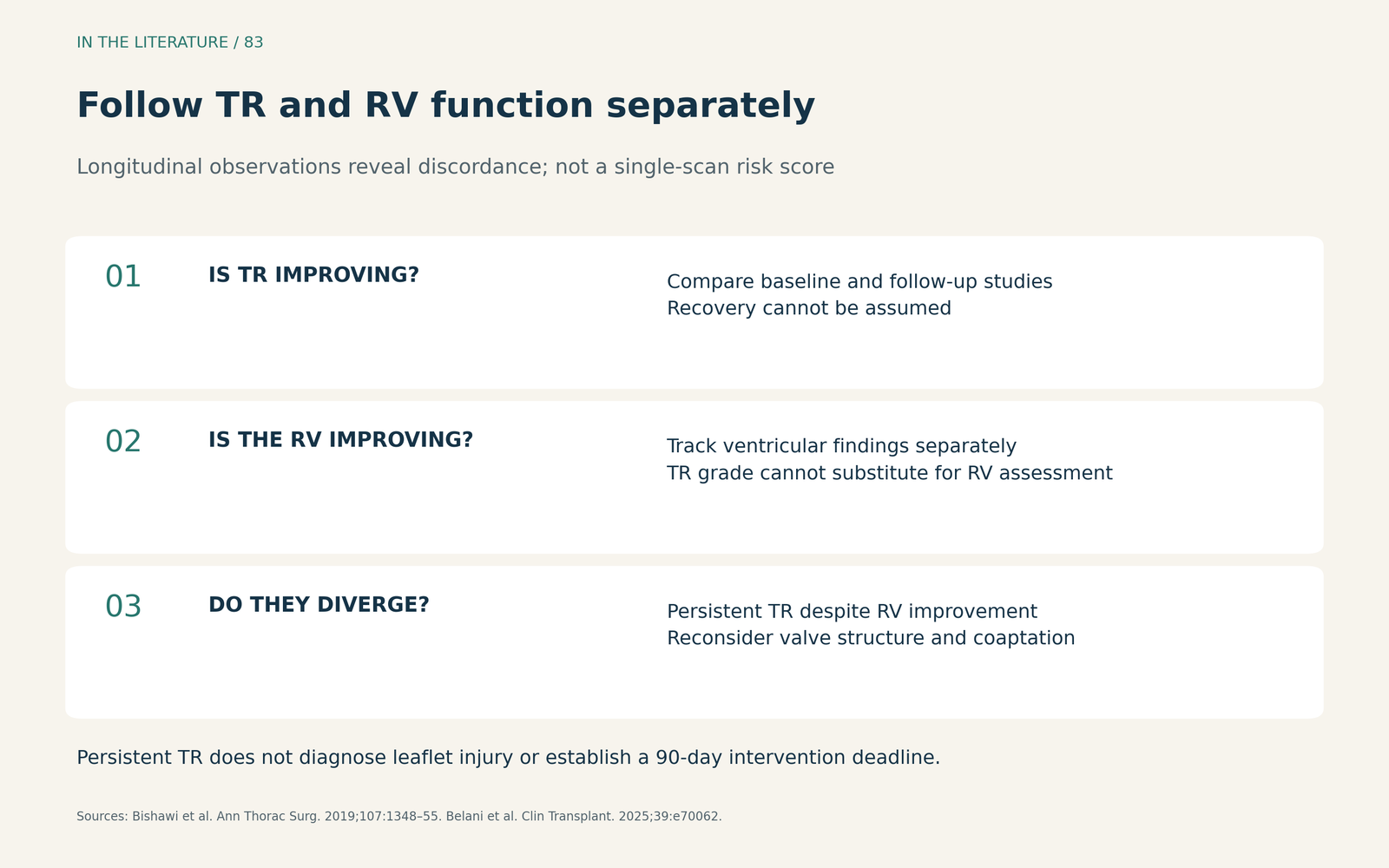
Figure 1. A clinical reading framework derived from longitudinal observations, not a reproduction of patient trajectories or a validated treatment algorithm. Persistent TR despite RV improvement calls for reassessment of mechanism.2,3 View larger

Investigate biopsy-related injury without assuming it
The ISHLT guideline recognizes that repeated endomyocardial biopsies can damage the tricuspid apparatus. Belani's discussion describes disruption of the valve or subvalvular apparatus, impaired coaptation and possible flail leaflets as mechanisms. For a new leak after biopsy, the useful imaging question is therefore whether there is a new structural abnormality compared with the earlier images. Neither TR severity nor the number of prior biopsies answers that question alone.13
Beck-da-Silva and colleagues provide a helpful procedural denominator: 729 rigid-bioptome procedures in 55 recipients, with paired pre- and post-procedure echocardiograms. TR worsened to moderate or severe grades after two procedures (0.27%)—one from absent to moderate and one from moderate to severe. These are procedures, not 729 independent patients.4
This single-center series used a particular rigid device and right jugular access; it did not directly compare rigid and flexible techniques. Its low observed event frequency cannot rule out injury in the patient whose valve morphology has just changed. Conversely, Bishawi's cohort lacked comprehensive biopsy data, so its postoperative TR cannot simply be attributed to biopsy trauma.24
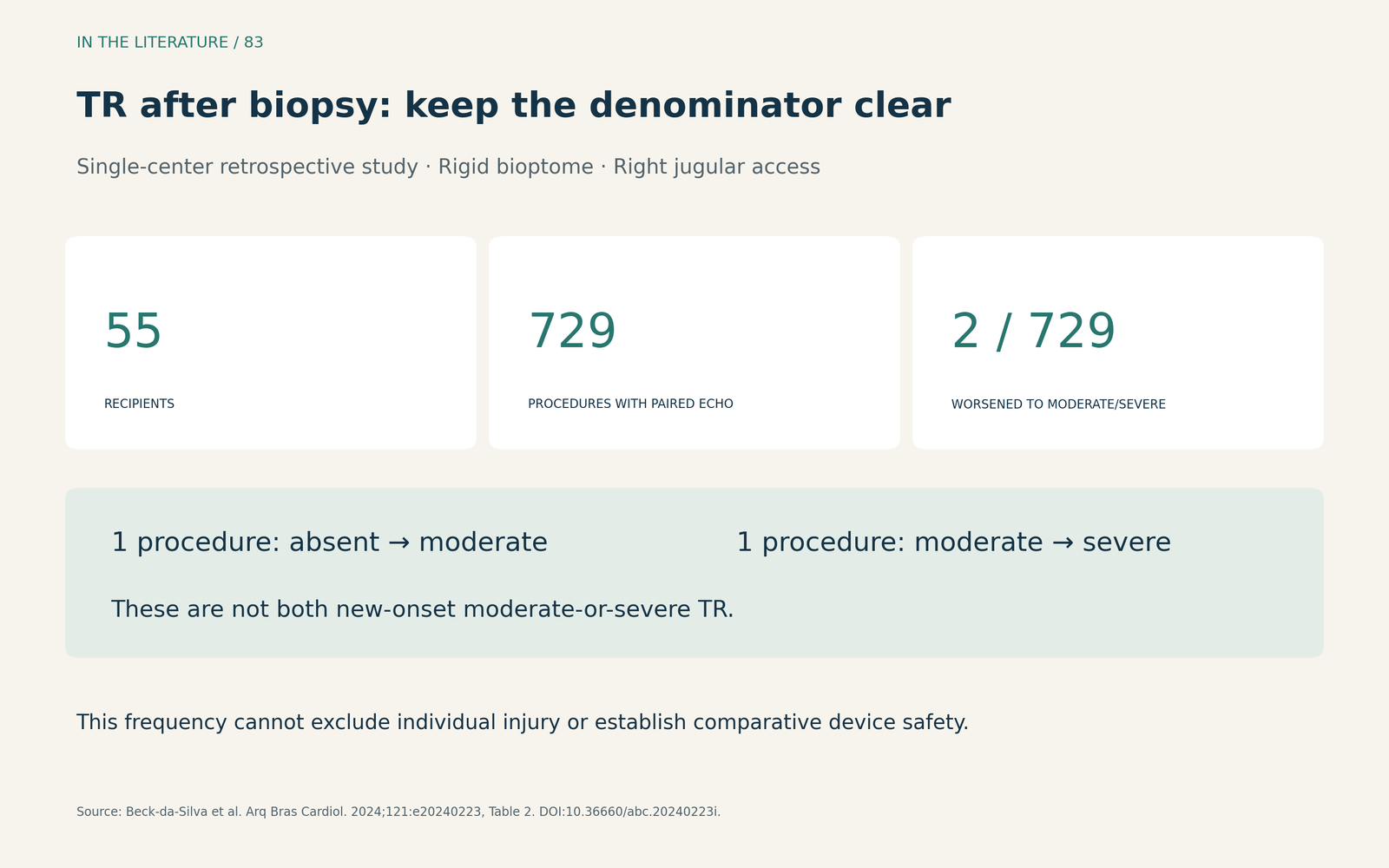
Figure 2. Paired echocardiographic observations after rigid-bioptome procedures. The two transitions are shown explicitly; they are not both new-onset moderate-or-severe TR. The study does not establish causality or comparative device safety.4 View larger

Escalate when the graft or the patient is deteriorating
New congestion, low-output features or ventricular systolic dysfunction shifts the question beyond the valve. The transplant team needs to evaluate the possibility of graft dysfunction and its cause. The ISHLT guideline recommends endomyocardial biopsy as early as possible when symptomatic acute allograft rejection is suspected (Class I, level C). TR alone is neither a diagnosis of rejection nor an automatic biopsy indication.1
Right-heart catheterization at biopsy can add filling-pressure and flow information that complements histology. Hemodynamics and pathology provide complementary information; an isolated TR grade or pressure reading does not establish rejection. Likewise, the possibility of biopsy-related injury should inform how the evaluation is performed, not automatically cancel an indicated rejection assessment.1
For persistent TR, bring a concise comparison to the transplant and imaging teams: when it began, what changed anatomically, how ventricular function evolved, and whether congestion or perfusion worsened. This is a synthesis for clinical communication, not a validated score. It helps frame further evaluation without inventing a universal intervention threshold.1–4
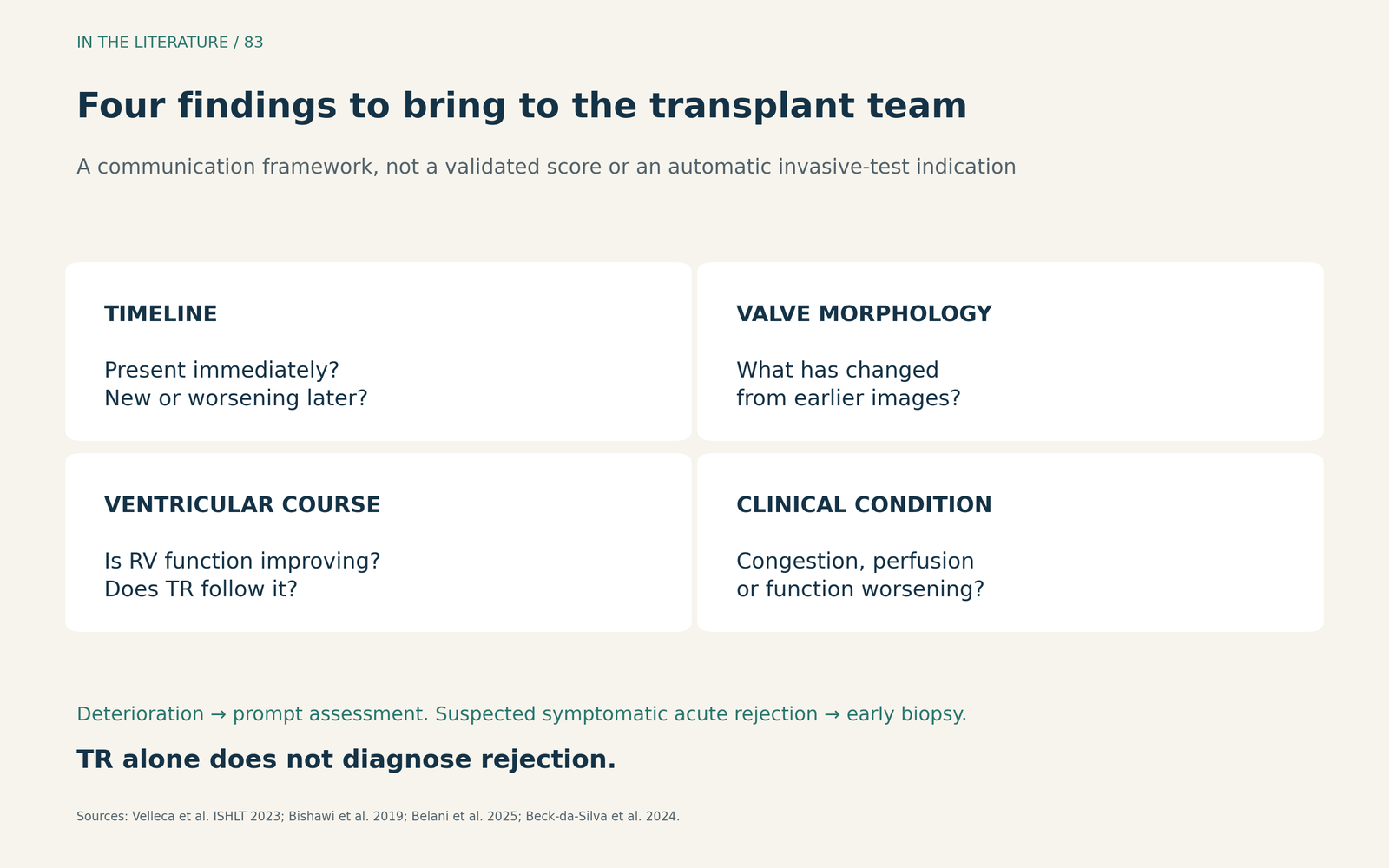
Figure 3. Information to carry into transplant-team assessment. Clinical deterioration requires prompt evaluation; suspected symptomatic rejection follows the guideline diagnostic pathway. The framework does not prescribe an invasive procedure for isolated TR.1–4 View larger

Three takeaways
- Compare examinations, not just grades. Establish timing, morphology and the parallel course of RV function.
- Treat discordance as a reason to look again. Persistent TR with improving RV function, or a new structural change after biopsy, needs a mechanism-focused review.
- Keep graft dysfunction in view. Deterioration warrants prompt transplant-team assessment; suspected symptomatic rejection still requires its own diagnostic work-up.
References
- Velleca A, Shullo MA, Dhital K, et al. The International Society for Heart and Lung Transplantation (ISHLT) guidelines for the care of heart transplant recipients. J Heart Lung Transplant. 2023;42(5):e1-e141. doi:10.1016/j.healun.2022.10.015
- Bishawi M, Zanotti G, Shaw L, et al. Tricuspid Valve Regurgitation Immediately After Heart Transplant and Long-Term Outcomes. Ann Thorac Surg. 2019;107(5):1348–1355. doi:10.1016/j.athoracsur.2018.10.065
- Belani K, Brinker V, Fuller M, et al. Tricuspid Regurgitation after Orthotopic Heart Transplantation: Trajectories and Association With Mortality. Clin Transplant. 2025;39(1):e70062. doi:10.1111/ctr.70062
- Beck-da-Silva L, Bridi LH, Matte BS, et al. Endomyocardial Biopsy Using Rigid Bioptome Technique and the Risk of Tricuspid Regurgitation after Heart Transplantation. Arq Bras Cardiol. 2024;121(10):e20240223. doi:10.36660/abc.20240223i