ITL-f57d1c4cf3a6
Juan Li, MD · Updated November 17, 2026
Watch the video
Key points
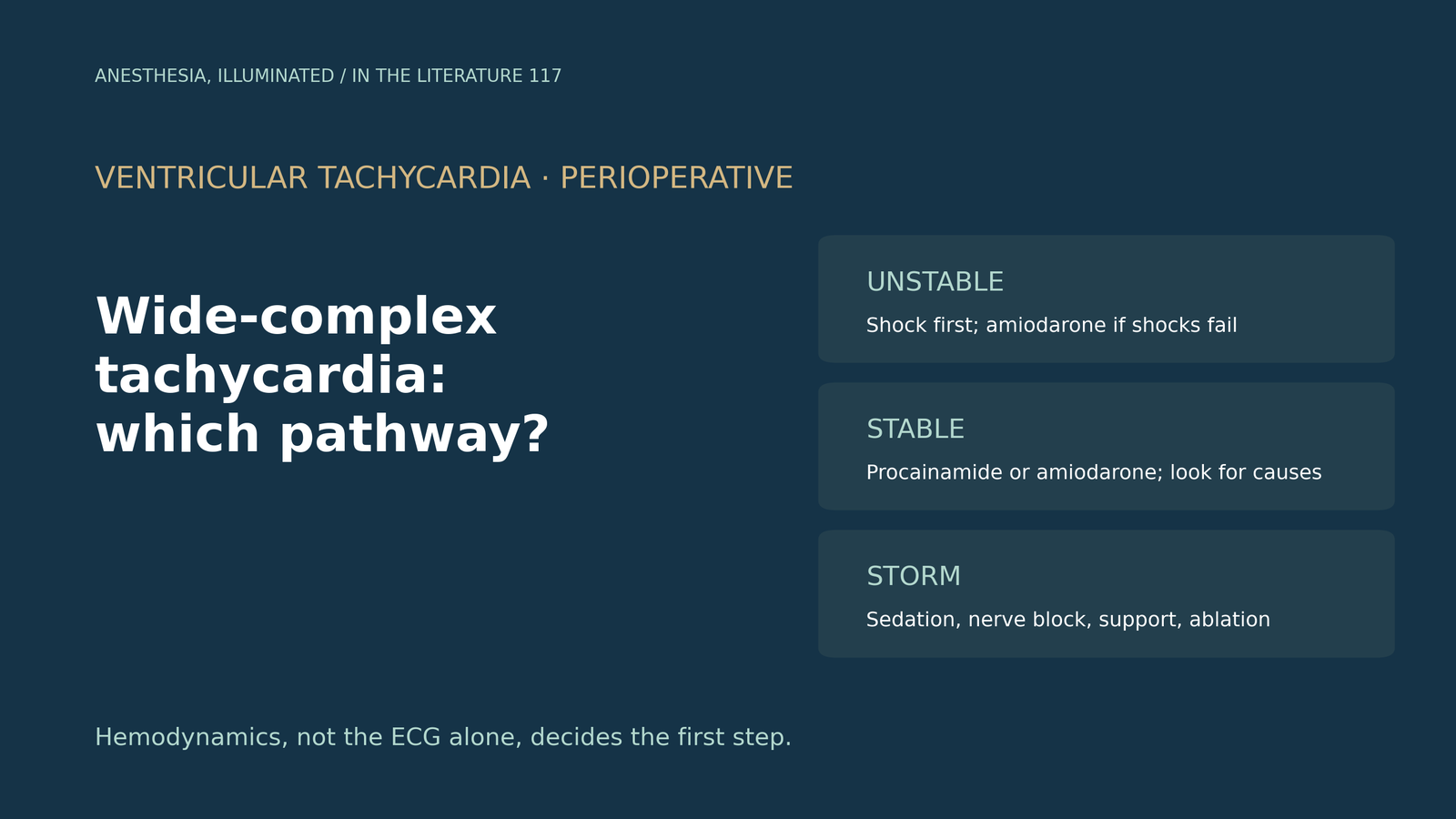
- Hemodynamics decide the first step. For unstable ventricular tachycardia, give CPR and electrical cardioversion, then intravenous amiodarone if cardioversion fails or instability recurs. Recent guidelines make electrical cardioversion the first-line approach.[1], [2]
- Treat a stable, regular wide-complex tachycardia as ventricular tachycardia until proven otherwise; most are. Doppler echocardiography can show atrioventricular dissociation, and was correct in all 10 patients in a small series.[2], [3]
- In the randomized PROCAMIO trial of tolerated wide-complex tachycardia, procainamide caused fewer major cardiac adverse events than amiodarone (9% vs 41%) and terminated more episodes (67% vs 38%), but the trial was small, open-label and stopped early.[2]
- Look for perioperative triggers. Temporary epicardial pacemaker undersensing can put a pacing spike on the T wave and cause polymorphic ventricular tachycardia. Lidocaine, a second-line drug, can accumulate to toxic levels in a sick postoperative patient.[4], [5]
- Electrical storm (3 or more episodes in 24 hours) needs escalation. Stellate ganglion block has been associated with fewer events in case series, and catheter ablation improved only a composite outcome in VANISH2.[1], [6], [7]
A patient on the cardiac surgical ward suddenly develops a regular wide-complex tachycardia. Is it ventricular tachycardia? Should it be shocked or treated with a drug, which drug, and what should be checked at the bedside?[1], [2]
Recognizing it
Ventricular tachycardia after cardiac surgery is uncommon: Katz and colleagues cite a rate of about 2%.[5] The PROCAMIO investigators note that most wide QRS complex tachycardias presenting to emergency departments are in fact ventricular tachycardia, even when tolerated; on expert review, 90.3% of episodes in their trial were classified as ventricular tachycardia.[2]
When the patient is stable and the diagnosis is uncertain, echocardiography can help. Hamon and colleagues used mitral and tricuspid Doppler to look for atrioventricular dissociation. In 10 patients with wide-complex tachycardia (7 ventricular and 3 supraventricular), Doppler echocardiography was 100% accurate, and adenosine during imaging may help when the result is unclear. The technique applies only to clinically stable patients.[3]
Unstable: shock first
McCabe and colleagues, in a 2023 review, describe cardiopulmonary resuscitation and electrical cardioversion for unstable ventricular arrhythmia, followed by intravenous amiodarone if cardioversion fails or the arrhythmia causes recurrent hemodynamic instability. They cite a reduction in ventricular arrhythmias in 40% of patients within 24 hours with intravenous amiodarone.[1]
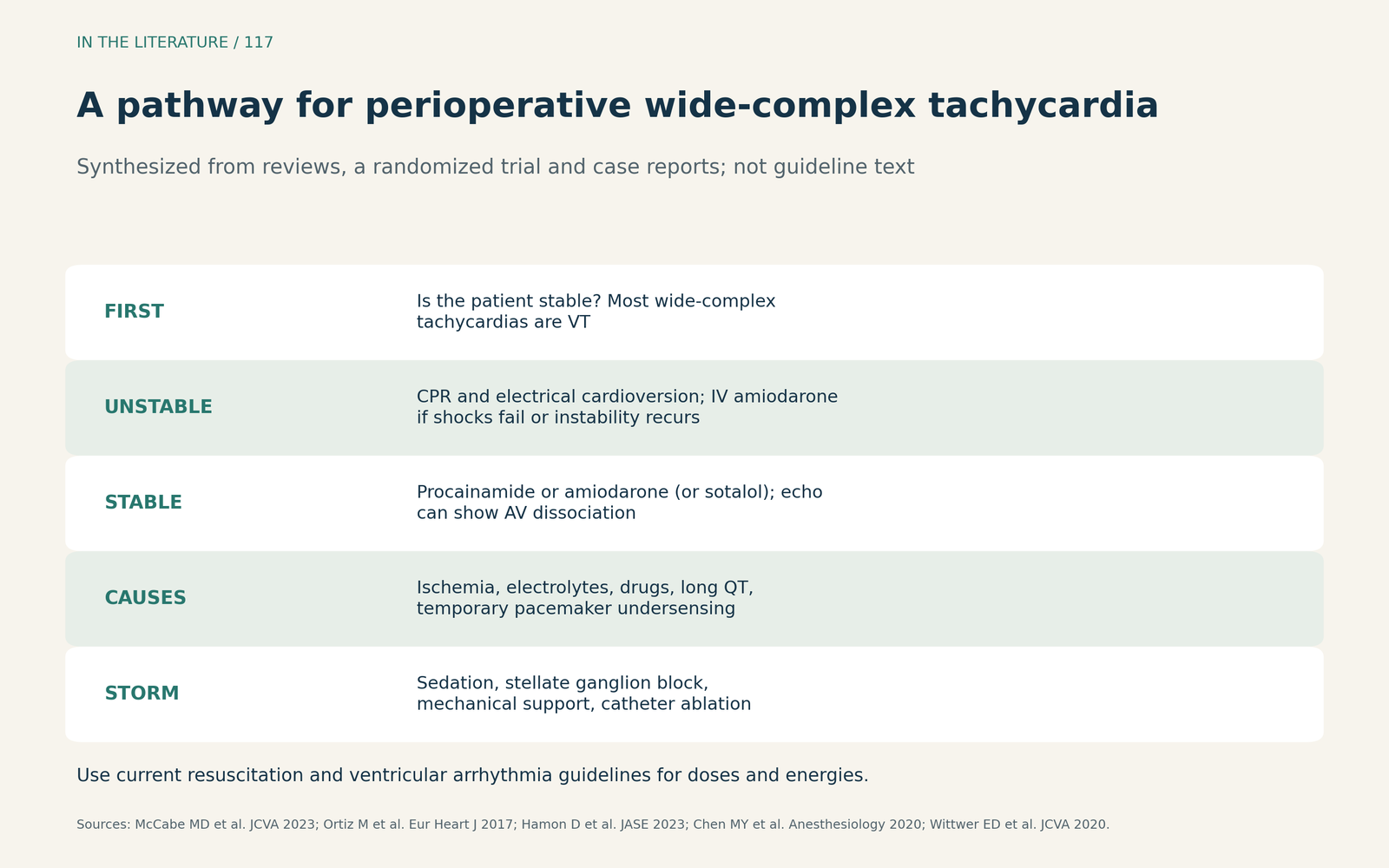
Figure 1. A pathway for perioperative wide-complex tachycardia. Synthesized from a review, a randomized trial and case reports; doses and energies should come from current guidelines.[1], [2], [3], [4], [6] View larger.

Stable: which drug?
McCabe and colleagues state that sotalol or amiodarone may be considered for hemodynamically stable ventricular tachycardia, and that lidocaine is indicated for monomorphic ventricular tachycardia after myocardial infarction.[1] PROCAMIO randomized patients with tolerated wide-complex tachycardia to procainamide 10 mg/kg or amiodarone 5 mg/kg, each over 20 minutes. Of 74 patients included, 62 were analyzed. Major cardiac adverse events within 40 minutes occurred in 9% with procainamide and 41% with amiodarone, most often severe hypotension requiring immediate cardioversion, and the tachycardia terminated in 67% and 38%. The trial was randomized but not blinded and stopped well short of its planned size.[2]
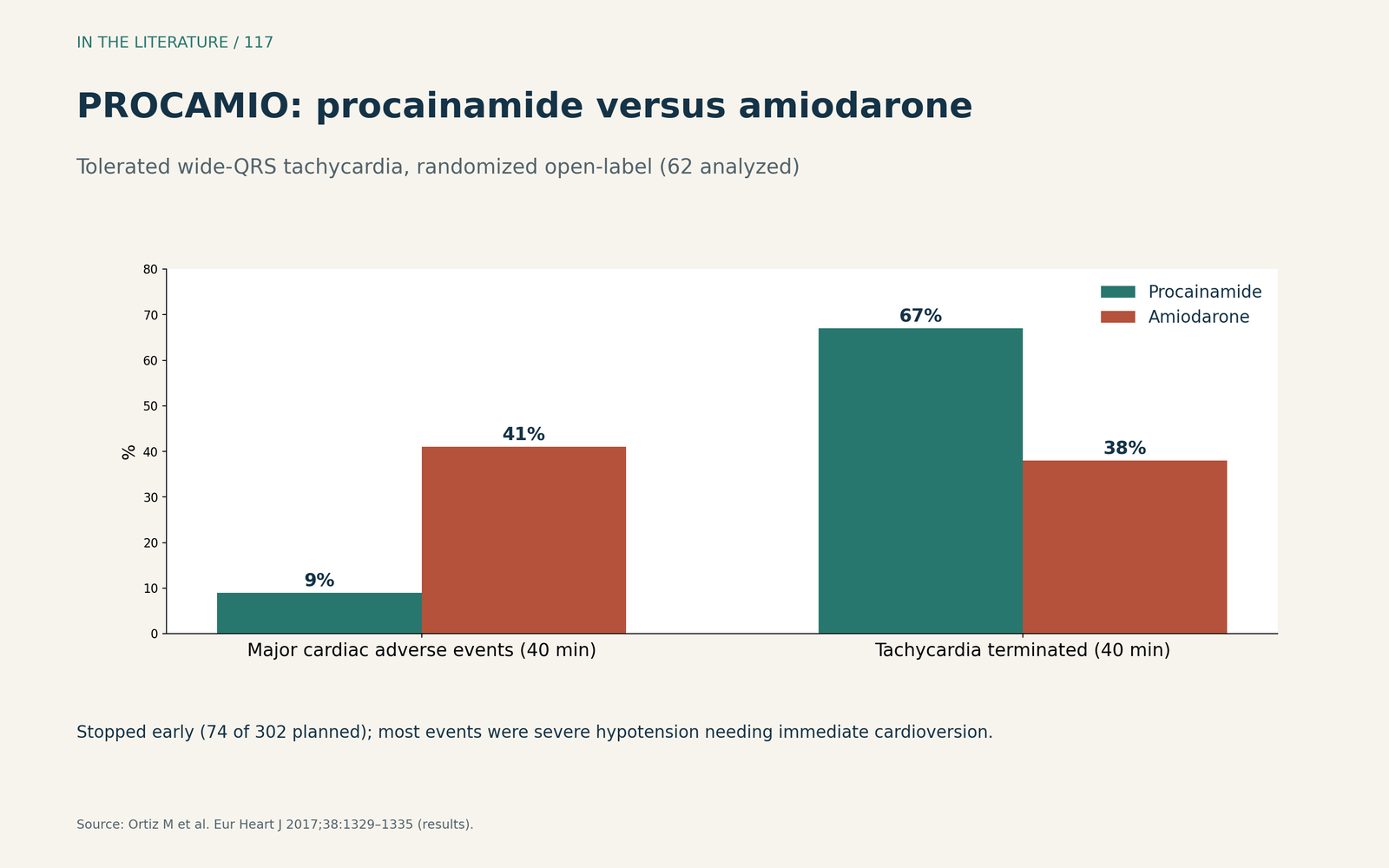
Figure 2. PROCAMIO: procainamide versus amiodarone. Redrawn from the results of Ortiz et al.; tolerated wide-complex tachycardia outside the operating room.[2] View larger.

Perioperative triggers and pitfalls
Chen and Mundangepfupfu describe how inappropriate pacing spikes in the perioperative period are often due to undersensing by a temporary pacemaker; when a pacing spike falls on the T wave, polymorphic ventricular tachycardia can follow.[4] Katz and colleagues report a patient in whom lidocaine was chosen as a second-line drug because of a prolonged QT interval and who developed local anesthetic toxicity with seizures. They note that sotalol and procainamide are more effective than lidocaine, that liver disease and heart failure can reduce lidocaine clearance by 40%, and that toxicity requires early recognition and immediate cessation of the infusion.[5]
Electrical storm
McCabe and colleagues define electrical storm as 3 or more episodes of ventricular tachycardia, ventricular fibrillation or appropriate defibrillator shocks within 24 hours.[1] For refractory cases, Wittwer and colleagues review stellate ganglion block: pooled cases showed a fall from a mean of 16.5 to 1.5 arrhythmia events, 60% of patients were free of ventricular arrhythmia after 24 hours, and survival was 50% when the block worked versus 5.6% when it did not. All of these data come from case series.[6] In VANISH2, as summarized by Dodge and colleagues, catheter ablation reduced the composite outcome (50.7% vs 60.6%; hazard ratio 0.75; 95% CI 0.58–0.97), but no individual component differed significantly, and procedural death occurred in 1.0%.[7]
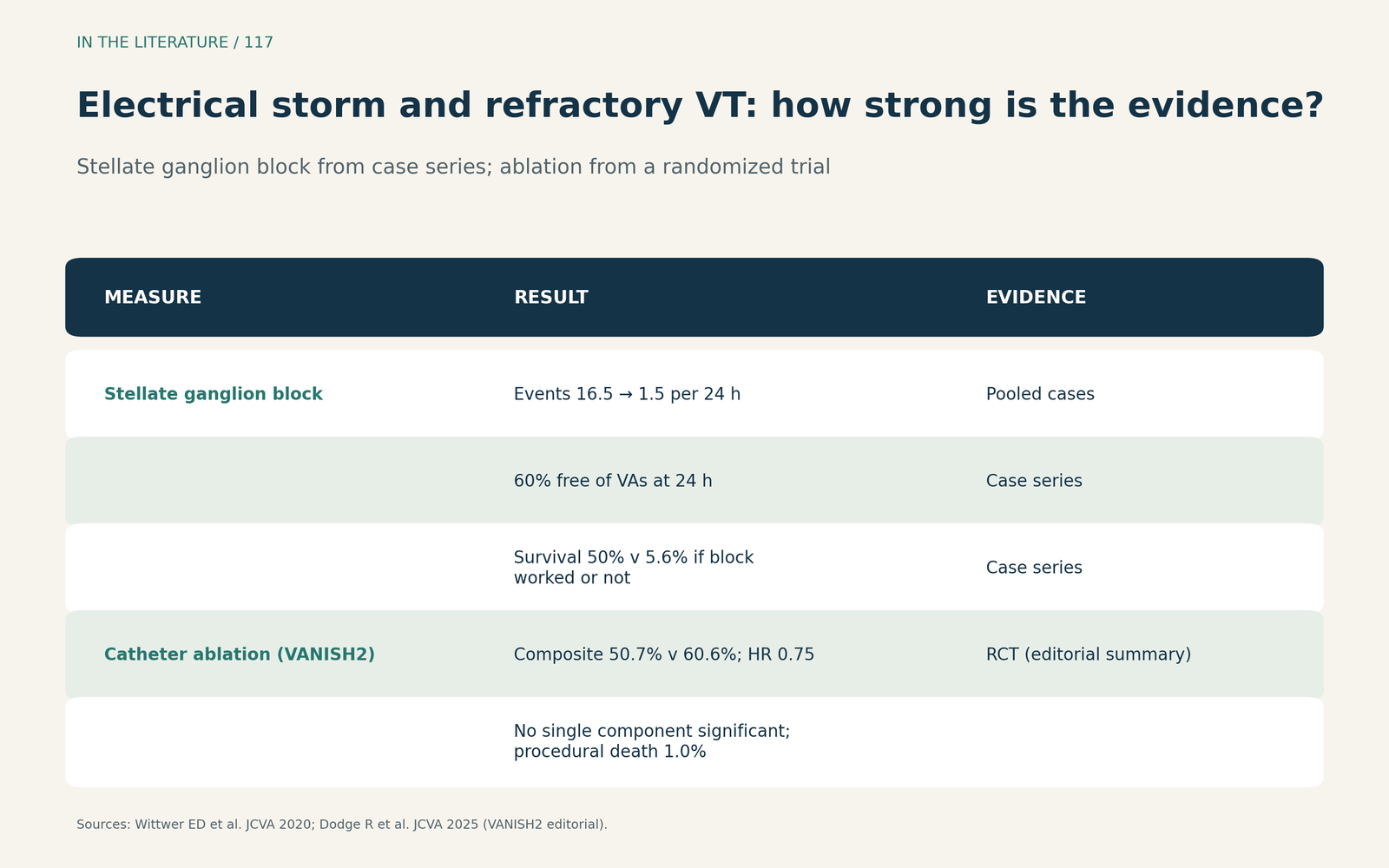
Figure 3. Electrical storm and refractory ventricular tachycardia. Synthesized from Wittwer et al. and the VANISH2 editorial by Dodge et al.[6], [7] View larger.

Three takeaways
- Let hemodynamics choose the first step. Shock the unstable patient; add amiodarone if shocks fail or instability recurs.[1], [2]
- For stable wide-complex tachycardia, assume ventricular tachycardia. Procainamide performed better than amiodarone in PROCAMIO, and echocardiography can help confirm the diagnosis.[2], [3]
- Look for the trigger and escalate early. Check temporary pacing, the QT interval and lidocaine accumulation, and consider stellate ganglion block or ablation for storm.[4], [5], [6], [7]
References
- McCabe MD, Cervantes R, Kewcharoen J, et al. Quelling the storm: a review of the management of electrical storm. J Cardiothorac Vasc Anesth. 2023;37(9):1776–1784. doi:10.1053/j.jvca.2023.05.029
- Ortiz M, Martín A, Arribas F, et al. Randomized comparison of intravenous procainamide vs. intravenous amiodarone for the acute treatment of tolerated wide QRS tachycardia: the PROCAMIO study. Eur Heart J. 2017;38(17):1329–1335. doi:10.1093/eurheartj/ehw230
- Hamon D, Moulin T, Nicolas E, et al. Usefulness of Doppler transthoracic echocardiography for the diagnosis of wide-QRS complex tachycardia. J Am Soc Echocardiogr. 2023;36(8):888–891. doi:10.1016/j.echo.2023.03.005
- Chen MY, Mundangepfupfu T. Sustained ventricular tachycardia secondary to R-on-T phenomenon caused by temporary ventricular epicardial pacemaker undersensing after cardiac surgery. Anesthesiology. 2020;132(2):374. doi:10.1097/ALN.0000000000002990
- Katz DJ, Feduska E, Thoma BN, Goldhammer JE. Local anesthetic toxicity following infusion of lidocaine for postoperative ventricular tachycardia in the cardiovascular intensive care unit. J Cardiothorac Vasc Anesth. 2021;35(6):1833–1838. doi:10.1053/j.jvca.2020.11.040
- Wittwer ED, Radosevich MA, Ritter M, Cha YM. Stellate ganglion blockade for refractory ventricular arrhythmias: implications of ultrasound-guided technique and review of the evidence. J Cardiothorac Vasc Anesth. 2020;34(8):2245–2252. doi:10.1053/j.jvca.2019.12.015
- Dodge R, Holloway J, Tang J, et al. The VANISH2 trial and its implications for cardiac anesthesiologists. J Cardiothorac Vasc Anesth. 2025;39(6):1380–1382. doi:10.1053/j.jvca.2025.02.037