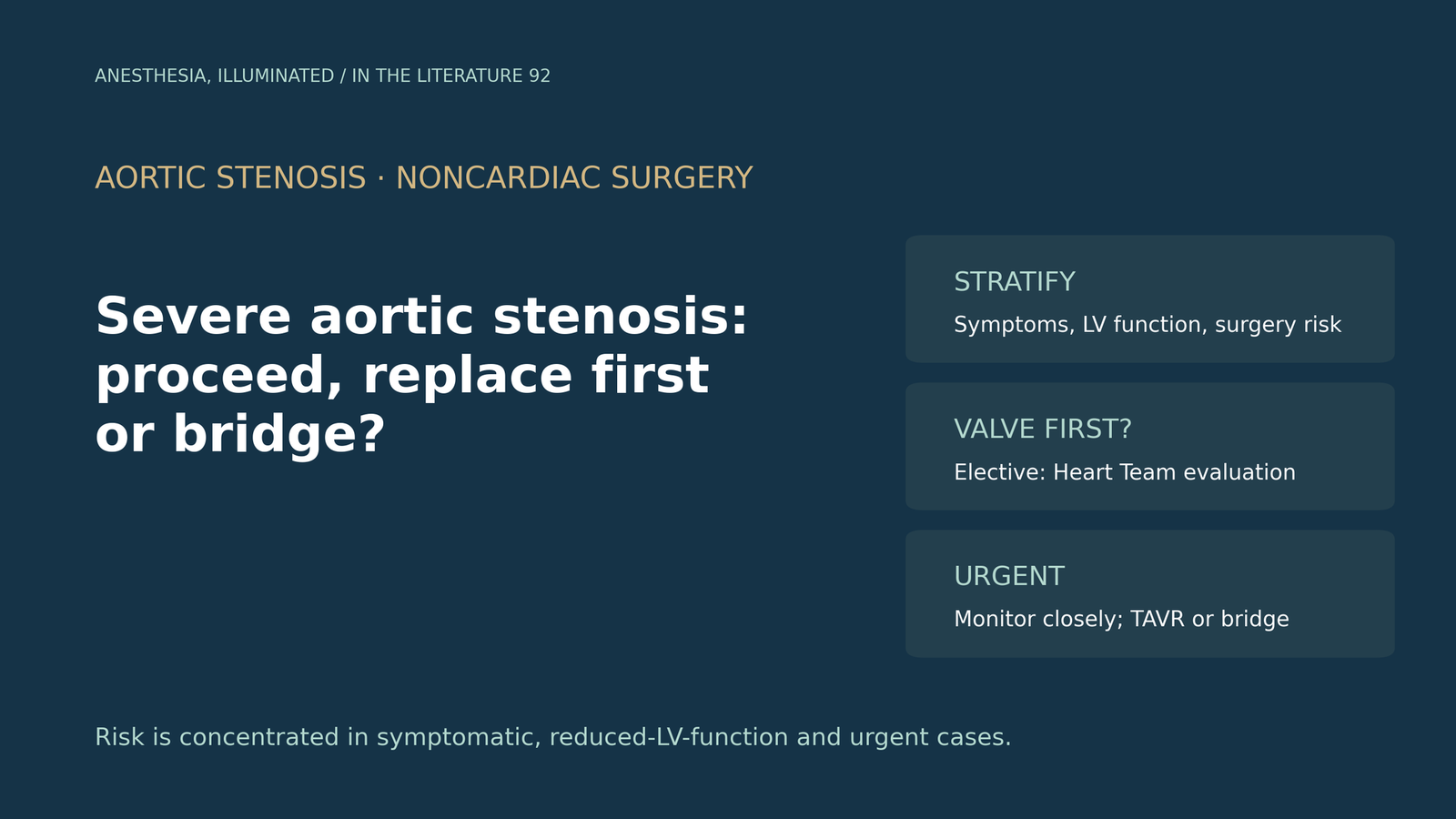
ITL-60e3f233dd46
Juan Li, MD · Updated November 17, 2026
Watch the video
Key points
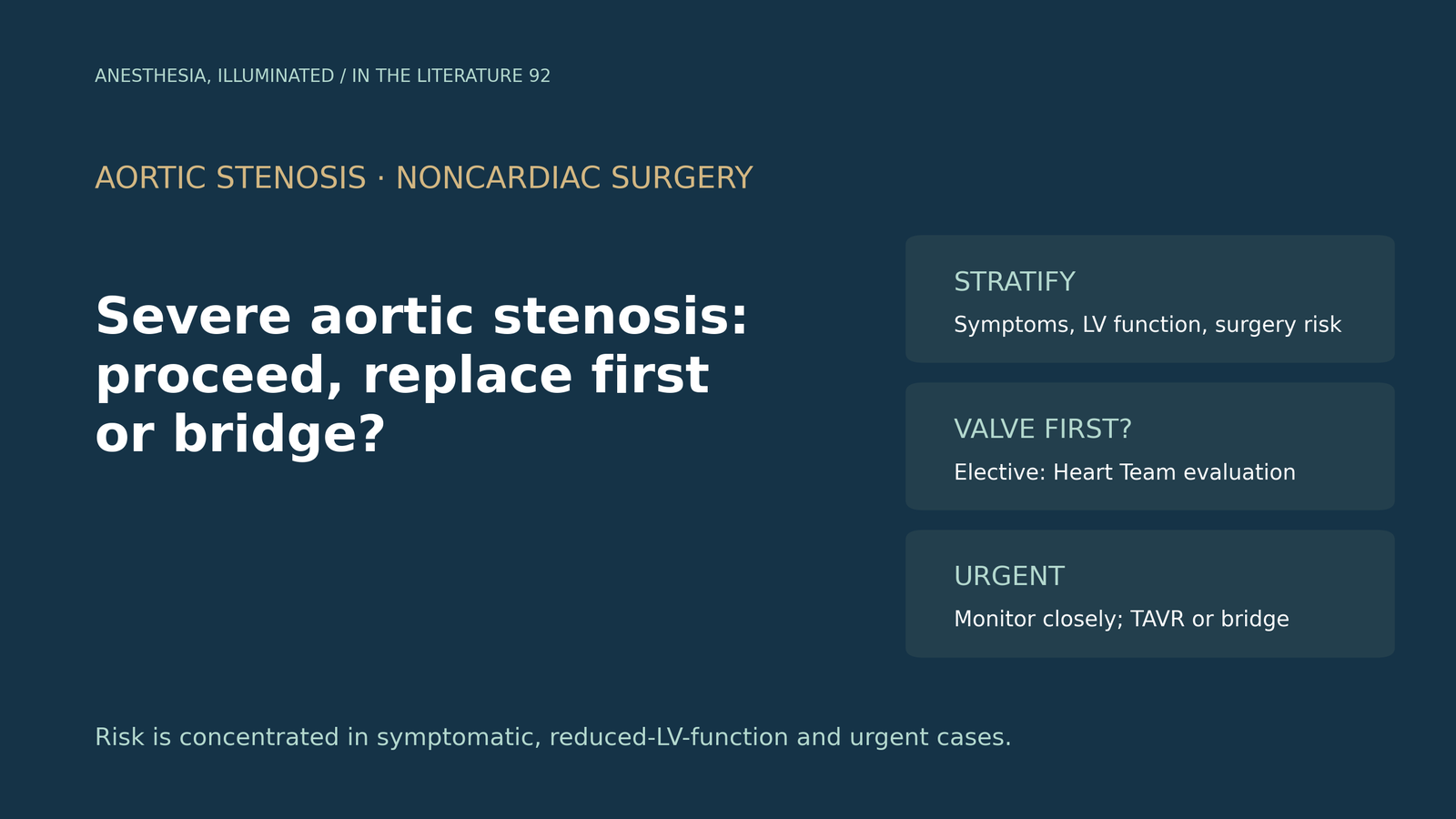
- Severe aortic stenosis (AS) raises perioperative risk, but the excess is concentrated in patients with symptoms, reduced left ventricular (LV) function, more severe stenosis, pulmonary hypertension or urgent surgery.[1], [2]
- The 2026 AHA/ACC perioperative guideline recommends evaluating severe AS for valve intervention before elective noncardiac surgery. Asymptomatic patients with normal LV function may reasonably proceed to elective low-risk surgery.[1]
- Observational data favor treating the valve first in selected patients, but the comparisons are unadjusted or small. Asymptomatic significant AS had cardiovascular event rates similar to matched controls.[3], [4]
- After a successful transcatheter aortic valve replacement (TAVR), noncardiac surgery can proceed early, including within 30 days.[1], [5]
- When surgery cannot wait, as with hip fracture, options are proceeding with close monitoring, fast-track TAVR or balloon valvuloplasty as a bridge; these pathways rest on expert opinion.[1], [6]
An older patient with a known aortic valve area of 0.7 cm² is booked for colectomy, or arrives with a hip fracture. Some will say "cancel and fix the valve", others "operate carefully". How much risk does severe aortic stenosis really add, who should have the valve treated first, and what changes when surgery is urgent?[1], [6]
How much risk does severe aortic stenosis add?
A 2026 systematic review and meta-analysis by Place and colleagues included 19 studies and 100,486 patients. Pooled in-hospital or 30-day mortality was 3.8% with any degree of AS and 9.6% with severe AS. In comparative studies, AS was associated with higher mortality (relative risk 1.58; 95% CI 1.18–2.12), myocardial infarction and heart failure. Only the abstract was available, so study quality and definitions could not be checked.[2]
The risk is not uniform. The 2026 AHA/ACC perioperative guideline notes that risk is higher with symptoms, reduced LV function, more severe stenosis, pulmonary hypertension and urgent or emergency surgery.[1] Bak and colleagues matched 218 patients with asymptomatic moderate or severe AS (43 severe) to 436 controls undergoing intermediate- or high-risk surgery. Thirty-day major adverse cardiovascular events (MACE) were 5.5% versus 4.6% (P = 0.608), although arrhythmias were more frequent (15.1% versus 9.4%). The authors concluded that cardiac damage mattered more than valve hemodynamics. This single-center study had few events and very few severe cases.[4]
Elective surgery: should the valve be treated first?
The guideline defines severe AS as a valve area below 1.0 cm², a mean gradient of 40 mm Hg or more, or a peak velocity of 4.0 m/s or more. Its recommendations are:[1]
- Class 1 (C-LD): patients with severe AS should be evaluated for aortic valve intervention before elective noncardiac surgery.
- Class 1 (C-EO): suspected moderate or severe AS before elevated-risk surgery calls for preoperative echocardiography when no recent study is available.
- Class 2a (C-LD): asymptomatic moderate or severe AS with normal LV systolic function on echocardiography within the past year can reasonably proceed to elective low-risk surgery.
The supporting data are observational. In the CURRENT AS registry described by Taniguchi and colleagues, 8 of 187 patients (4.3%) with untreated severe AS died within 30 days of elective surgery, compared with none of 161 patients with prior valve replacement (P = 0.008). Mortality among untreated patients was 7.2% with symptoms and 3.1% without, a difference that was not statistically significant (P = 0.20). The authors made no statistical adjustment for baseline differences, and almost all prior replacements were surgical.[3] The guideline also cites a cohort in which MACE was 5.4% after prior valve replacement versus 20.5% with untreated AS.[1]
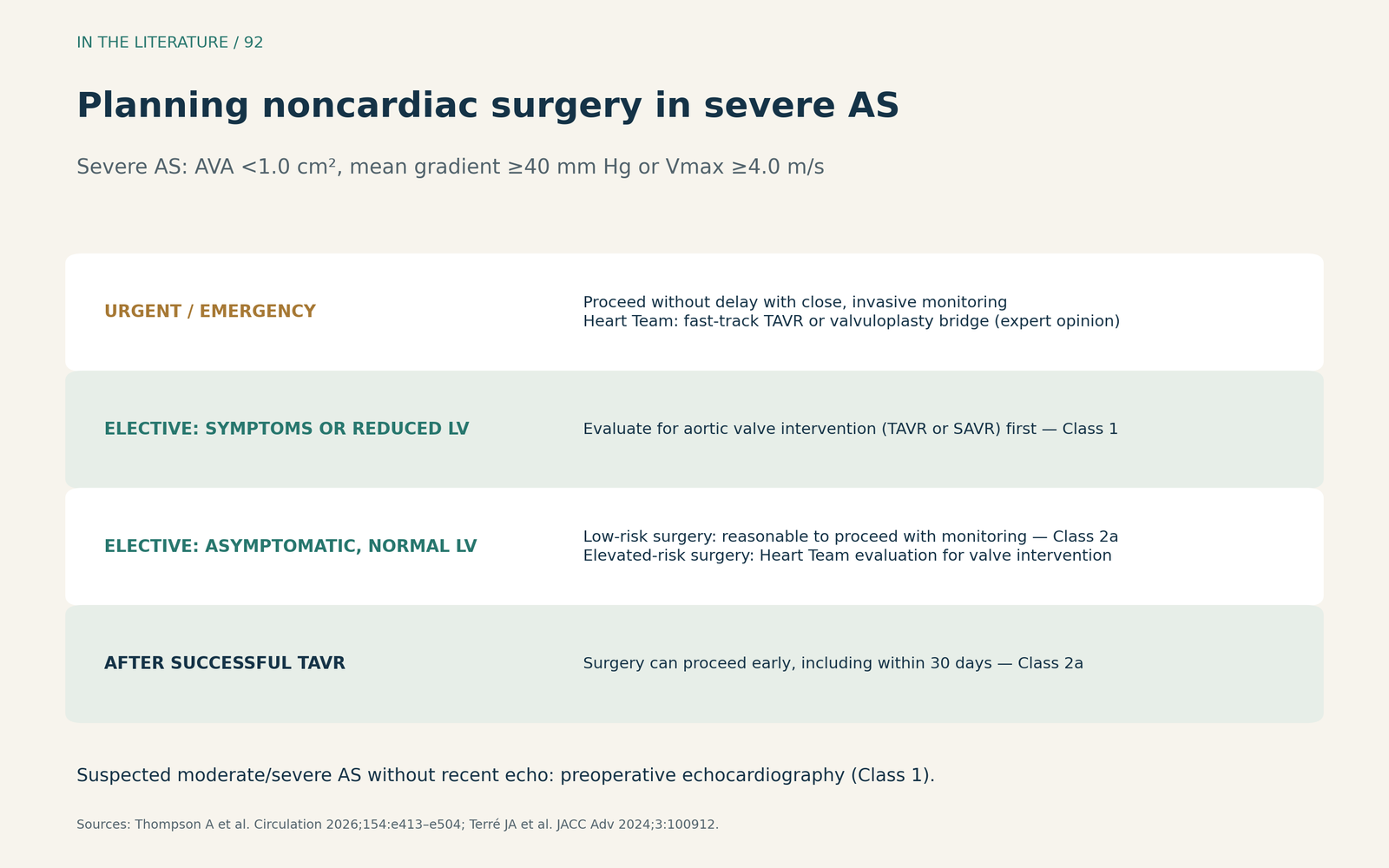
Figure 1. Planning noncardiac surgery in severe AS. Synthesized from the 2026 AHA/ACC perioperative guideline (Figure 2 and Section 6.4) and the hip-fracture review by Terré and colleagues; not a validated algorithm.[1], [6] View larger.

After TAVR, how soon can surgery proceed?
The guideline states that after successful TAVR it is reasonable to perform noncardiac surgery early as clinically indicated (Class 2a, B-NR), and that evidence supports safety within 30 days.[1] In a national readmissions analysis of 3,098 patients who had noncardiac surgery after isolated TAVR, Ebrahimian and colleagues found that surgery within 30, 31–60 or 61–90 days was not associated with higher odds of major adverse events compared with surgery after 90 days. This was an administrative database study available to us as an abstract only, and "not associated" does not prove equal safety.[5]
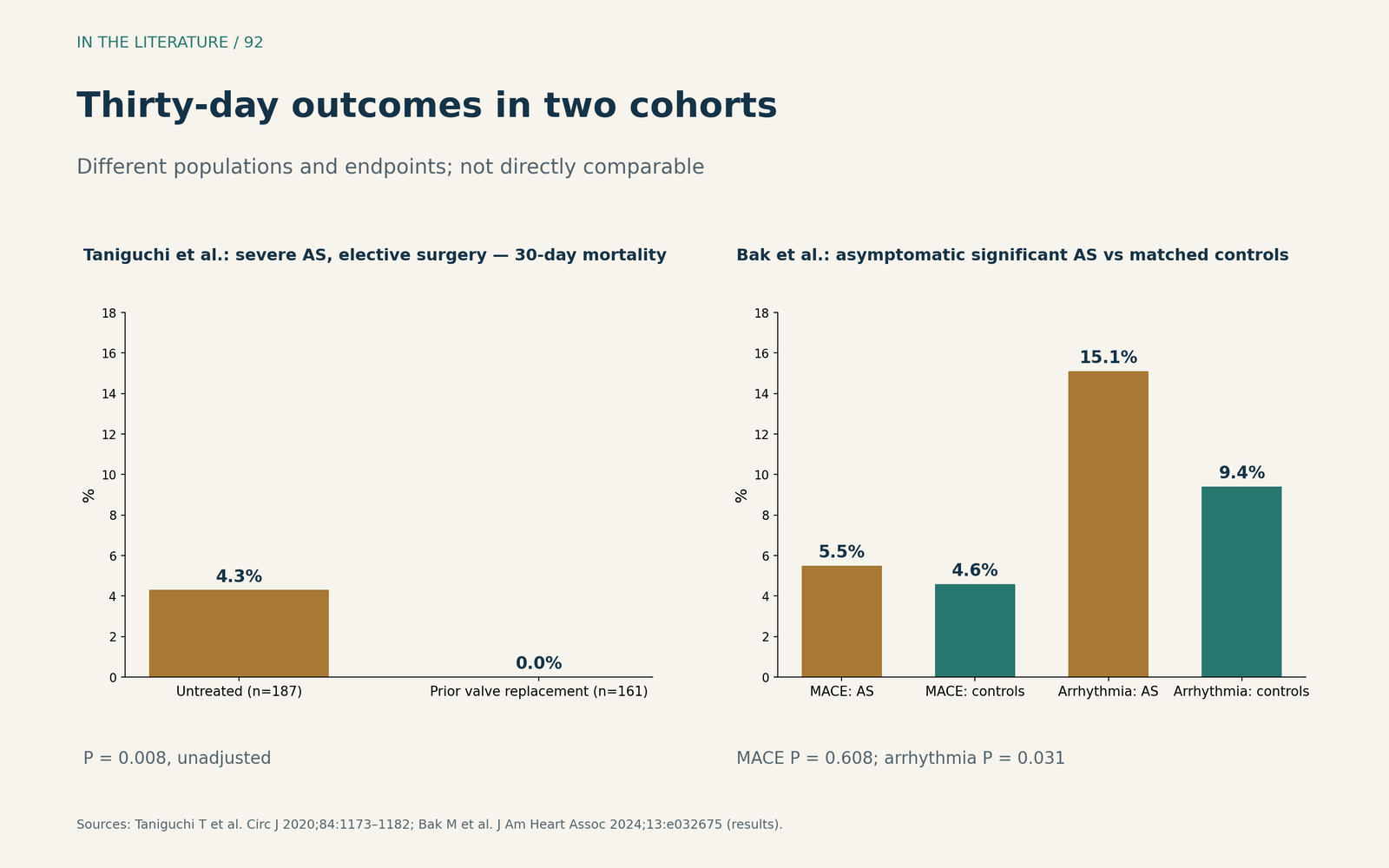
Figure 2. What the cohorts show. Redrawn from the results of Taniguchi et al. (untreated severe AS versus prior valve replacement) and Bak et al. (asymptomatic significant AS versus matched controls); different populations and endpoints.[3], [4] View larger.

When surgery cannot wait: the hip fracture example
Urgent surgery removes the option of a planned valve replacement. In their review, Terré and colleagues describe hip fracture patients with severe AS as having a 3- to 4-fold higher 30-day mortality than those without it, and note a 2.5-fold higher 30-day mortality when hip surgery is delayed more than 4 days. They propose triage into proceeding without delay with invasive monitoring, fast-track "minimalist" TAVR before surgery, or balloon aortic valvuloplasty as a bridge.[6]
Balloon valvuloplasty is not a substitute for valve replacement. The guideline mentions it only as a possible bridge for urgent elevated-risk surgery, without a formal recommendation class, and describes the outcome data as conflicting.[1] Terré and colleagues warn that it can cause acute severe aortic regurgitation and flash pulmonary edema.[6] These pathways are expert opinion and depend on local TAVR access.
In the operating room
The guideline advises close intraoperative and early postoperative monitoring to avoid hypotension, excessive hypertension and tachycardia, as well as dehydration or volume overload. Monitoring may include invasive hemodynamic monitoring and intraoperative transesophageal echocardiography. A pulmonary artery catheter may be considered (Class 2b) when severe valvular disease cannot be corrected before surgery.[1]
No anesthetic technique is recommended specifically for AS. In a Taiwanese claims analysis of 9,741 matched pairs, Tai and colleagues found AS associated with higher 30-day in-hospital mortality (adjusted odds ratio 1.31; 95% CI 1.03–1.67). Among patients with AS, general anesthesia was associated with more complications than neuraxial anesthesia, and the authors argued that neuraxial anesthesia should not be contraindicated. However, AS severity and symptoms were unknown, and sicker patients may have received general anesthesia.[7] Terré and colleagues note that spinal anesthesia is usually not preferred in critical, uncorrected AS.[6] Technique therefore remains an individual choice, made with careful titration and invasive monitoring.
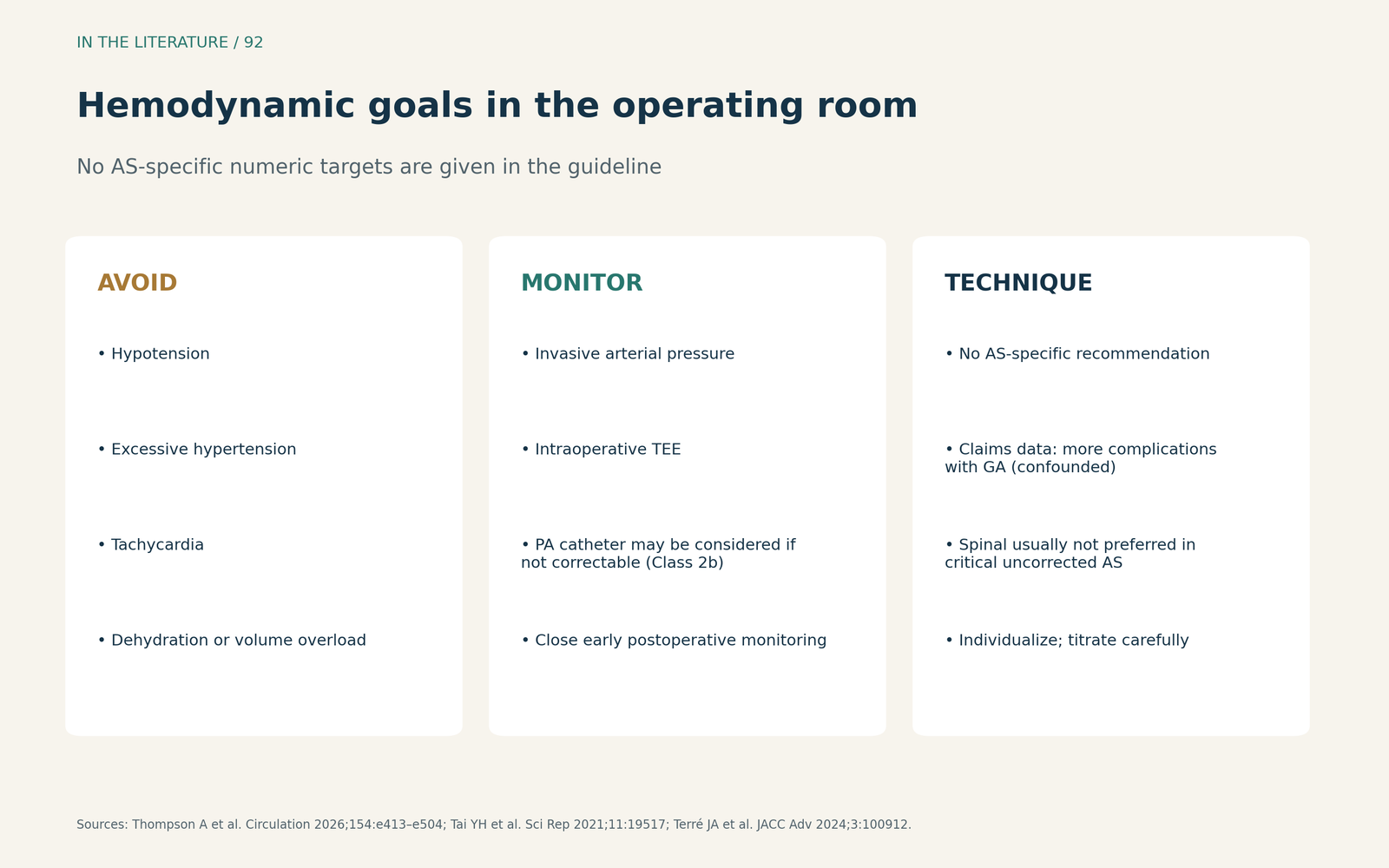
Figure 3. Hemodynamic goals in the operating room. Synthesized from the 2026 AHA/ACC perioperative guideline, with anesthetic-technique evidence from Tai et al. and Terré et al.; no AS-specific numeric targets are given.[1], [6], [7] View larger.

Three takeaways
- Stratify, do not reflexively cancel. Symptoms, LV function, surgical risk and urgency determine risk; asymptomatic AS with normal LV function can usually proceed to low-risk surgery.[1], [4]
- For elective higher-risk surgery, ask about the valve first. Evaluate severe AS for intervention before surgery; after successful TAVR, surgery need not be long delayed.[1], [3], [5]
- When surgery is urgent, plan the hemodynamics. Avoid hypotension, tachycardia and volume extremes with invasive monitoring; consider TAVR or a valvuloplasty bridge only through a Heart Team pathway.[1], [6], [7]
References
- Thompson A, Fleischmann KE, Smilowitz NR, et al. 2026 AHA/ACC/ACS/ASNC/HRS/SCA/SCCT/SCMR/SVM guideline for perioperative cardiovascular management for noncardiac surgery: a report of the American College of Cardiology/American Heart Association Joint Committee on Clinical Practice Guidelines. Circulation. 2026;154(13):e413–e504. doi:10.1161/CIR.0000000000001472
- Place A, Rodrigues TS, Naimo PS, et al. Peri-operative risk of non-cardiac surgery in patients with aortic stenosis: a systematic review and meta-analysis. Anaesthesia. 2026;81(4):570–579. Abstract only. doi:10.1111/anae.70084
- Taniguchi T, Morimoto T, Shiomi H, et al. Elective non-cardiac surgery in patients with severe aortic stenosis: observations from the CURRENT AS registry. Circ J. 2020;84(7):1173–1182. doi:10.1253/circj.CJ-20-0026
- Bak M, Lee S, Park S, et al. Perioperative risk of noncardiac surgery in patients with asymptomatic significant aortic stenosis: a 10-year retrospective study. J Am Heart Assoc. 2024;13(9):e032675. doi:10.1161/JAHA.123.032675
- Ebrahimian S, Chervu N, Balian J, et al. Timing of noncardiac surgery following transcatheter aortic valve replacement: a national analysis. JACC Cardiovasc Interv. 2024;17(14):1693–1704. Abstract only. doi:10.1016/j.jcin.2024.04.049
- Terré JA, Torrado J, George I, et al. Aortic stenosis management in patients with acute hip fracture. JACC Adv. 2024;3(5):100912. doi:10.1016/j.jacadv.2024.100912
- Tai YH, Chang CC, Yeh CC, et al. Adverse outcomes after noncardiac surgery in patients with aortic stenosis. Sci Rep. 2021;11(1):19517. doi:10.1038/s41598-021-98507-6