
ITL-0b4ff6495e90
Watch the video

Figure 1. Risk assessment brings the patient's clinical condition and right-heart imaging into the same conversation. Conceptual illustration.
Key points
- TRIO-RV adds right ventricular free-wall strain divided by estimated RV systolic pressure to a clinical score for long-term mortality in patients with at least moderate tricuspid regurgitation.
- In the derivation cohort, 151 of 375 patients with low or intermediate TRIO scores moved to a higher risk category after the RV measure was added.
- The study used the absolute magnitude of strain. Its 0.43 %/mm Hg threshold is not interchangeable with a TAPSE/PASP threshold.
- A reassuring ratio is only as credible as its inputs: an underestimated pressure can make the ratio look falsely favorable.
- These studies support more complete risk assessment; they do not establish a ratio at which intervention becomes mandatory or futile.
A patient with significant tricuspid regurgitation (TR) has a modest clinical risk score. The report describes preserved longitudinal annular motion, yet the right ventricle is enlarged and the patient is becoming less active. Is the clinical score enough to reassure the team?
The TRIO-RV study offers a useful answer: quantitative RV information can identify risk that a clinical score misses. It also requires careful reading—the outcome was death during follow-up, not operative mortality, and the population included moderate as well as severe TR.[1]
What did adding the right ventricle change?
Jamnongprasatporn and colleagues studied 417 patients with at least moderate TR at one center. During a median 3.96 years of follow-up, 157 died. RV free-wall strain (RVFWS) was measured from an RV-focused apical view; RV systolic pressure (RVSP) was estimated from the TR Doppler velocity and estimated right atrial pressure.[1]
Using a threshold selected from the derivation data, an absolute RVFWS/RVSP below 0.43 %/mm Hg was associated with higher mortality after multivariable adjustment, including the TRIO score: adjusted hazard ratio 2.76 (95% CI, 1.75–4.35). This is an association with the hazard of death over follow-up, not a 2.76-fold increase in an individual's fixed-time probability of dying.[1]
The investigators added three points for a ratio below that threshold. Of 213 patients initially classified as low risk, 69 moved to intermediate risk; of 162 intermediate-risk patients, 82 moved to high risk. Together, that was 151/375, or 40%, of the low- and intermediate-risk group—not 40% of all 417 participants. A subsequent 203-patient cohort from the same center supported the association. That is temporal validation within one center, rather than independent multicenter validation.[1]
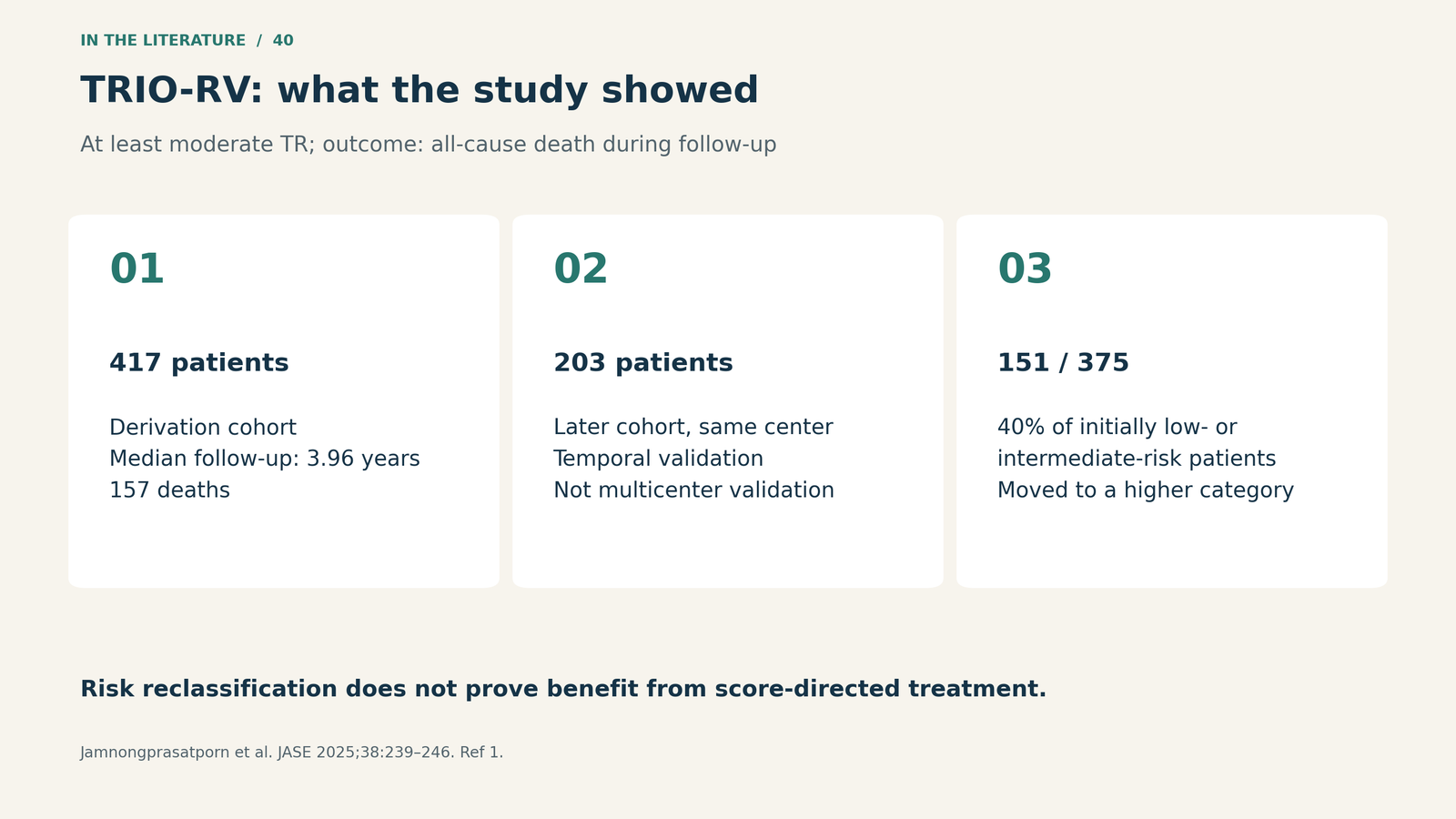
Figure 2. Adding the RV measure changed risk classification in the derivation cohort. Reclassification is not evidence that treating according to the new score improves survival.[1]

Read the numerator and denominator before the ratio
RVFWS is commonly reported as a negative percentage. The study used its absolute magnitude: a strain of −18% contributes 18 to the calculation. With an RVSP of 60 mm Hg, the ratio is 18/60 = 0.30 %/mm Hg. This is a different measure, with different units, from TAPSE/PASP in mm/mm Hg.[1]
Now suppose RVSP is underestimated as 30 mm Hg. The same numerator produces 0.60 %/mm Hg—a much more reassuring-looking ratio without any improvement in myocardial function. This arithmetic example illustrates a measurement problem, not an observed patient in the study.
In significant TR, the Doppler envelope and right atrial pressure estimate deserve particular attention. Early RV–RA pressure equalization can produce a truncated, triangular signal and underestimate the gradient. Other errors can overestimate pressure. The 2025 ASE guideline therefore emphasizes signal quality and the physiological context; severe TR does not make every pressure estimate wrong in the same direction.[2]
A vigorous TAPSE does not settle the question either. In severe functional TR, annular motion can overstate global RV performance. Check it against RV size, fractional area change, strain, and, when available and appropriate, three-dimensional RV ejection fraction. If the images or pressure estimate are inadequate, report the uncertainty instead of giving a precise-looking coupling classification.[2]
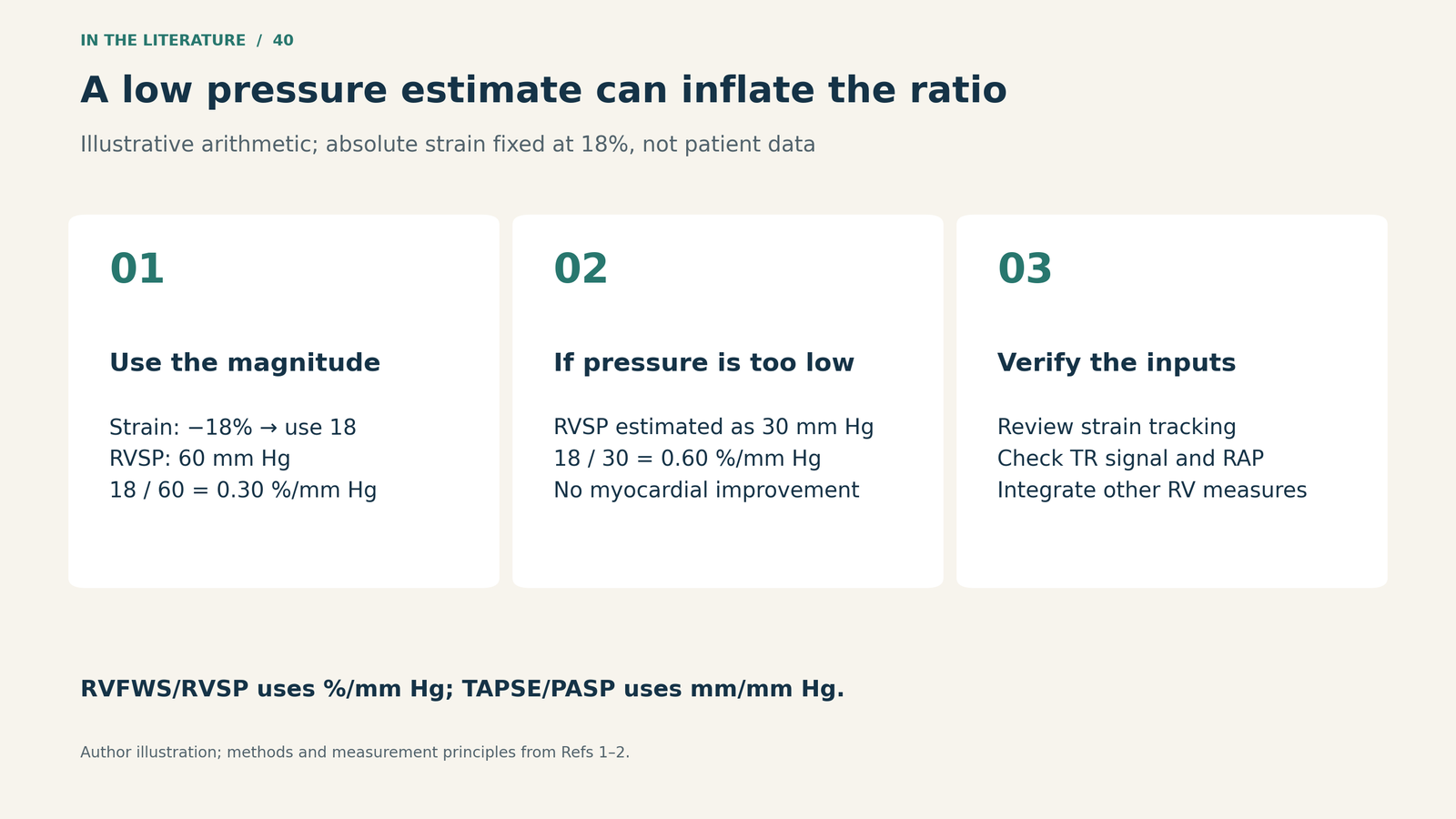
Figure 3. The numerator stays at an absolute strain magnitude of 18%; only the pressure estimate changes. Values are illustrative, not trial observations. A favorable ratio cannot repair an unreliable denominator.[1, 2]

Does newer evidence validate the same score?
A 2026 study by Mistrulli and colleagues examined 93 patients with significant TR receiving medical, surgical, or transcatheter treatment. Adding TAPSE/PASP or RV size-adjusted TAPSE measures improved prognostic discrimination beyond the TRI-SCORE. There were 33 deaths during a median 42.2-month follow-up.[3]
This supports the broader idea that quantitative RV information adds value, but it does not validate TRIO-RV. TRI-SCORE and TRIO are different models: TRI-SCORE was originally developed for in-hospital mortality after isolated tricuspid surgery; TRIO concerns longer-term prognosis in patients with TR. The 2026 analysis also used different RV indices, and RV strain-based measures were not significantly associated with outcomes in that small cohort. Its derived thresholds were exploratory.[1, 3]
Thus, the consistent clinical message is to integrate RV function with clinical risk. The evidence is less settled on which ratio and cutoff should direct a particular intervention.
What should change at the next valve-team discussion?
Start by naming the decision: longitudinal surveillance, assessment for intervention, or estimation of procedural risk. Use a model suited to that question, and describe quantitative RV findings alongside it. A low clinical score should not end the assessment when symptoms, congestion, RV enlargement, or reliable functional measurements are concerning.
Then check whether the information is credible and concordant. An inadequate strain trace or unreliable TR signal is a reason to improve or supplement the assessment. Additional imaging or invasive hemodynamics should answer a specific unresolved clinical question, rather than merely produce a coupling number.[1, 2]
Finally, keep prognosis separate from treatment effect. Neither the TRIO-RV study nor the 2026 TRI-SCORE analysis randomized patients to intervention at a coupling threshold. A low ratio alone cannot establish that a procedure will help, that it is too late, or that treatment should be withheld.[1, 3]
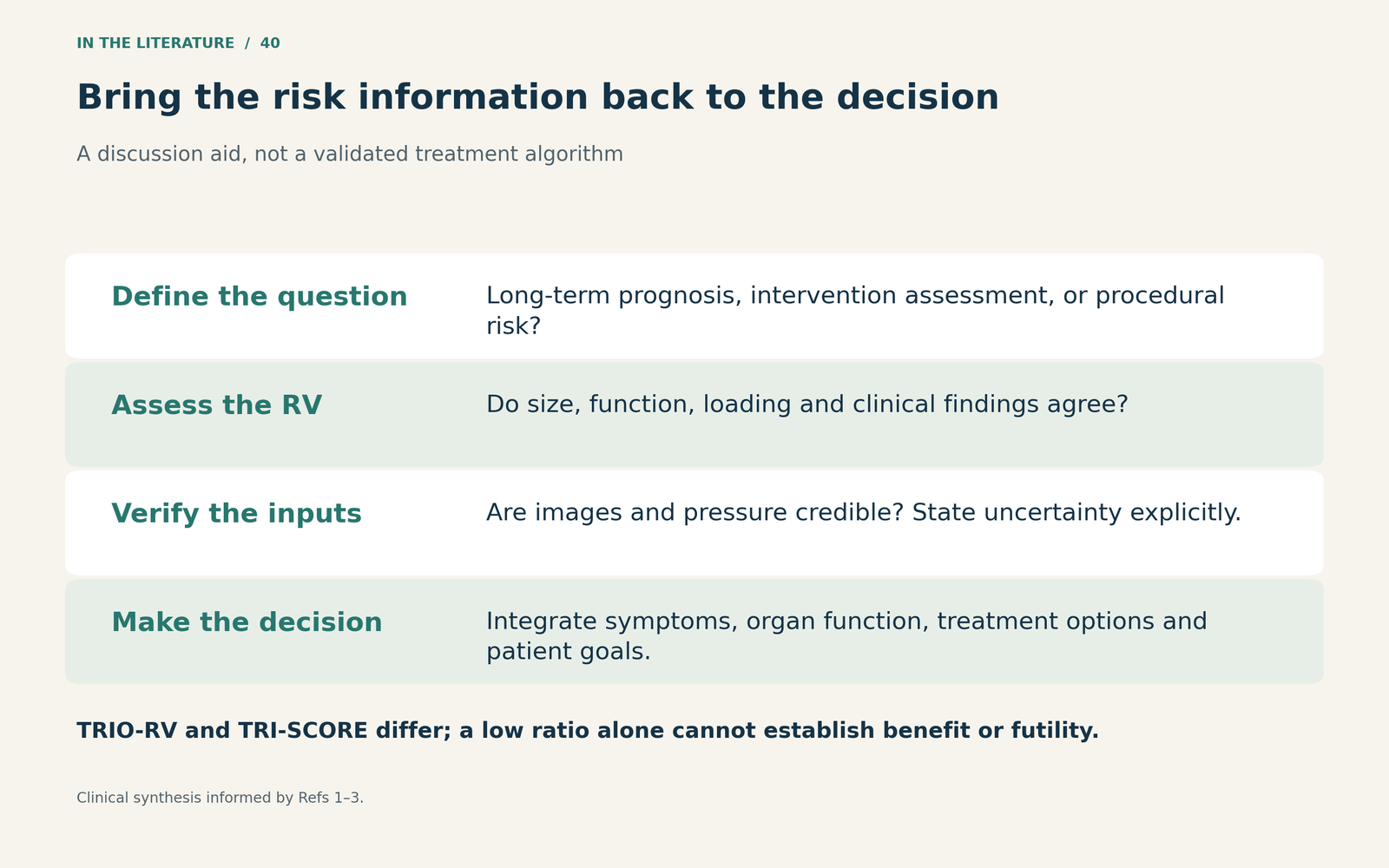
Figure 4. A practical discussion aid: define the outcome, assess the RV, verify the measurements, and make a patient-specific decision. It is not a validated treatment algorithm.

Three takeaways
- Clinical risk and RV performance are complementary. TRIO-RV identifies prognostic information beyond the original clinical score.
- Check the measurement before trusting the threshold. Use absolute strain magnitude, correct units, and a credible pressure estimate.
- Use the result to improve the discussion, not to automate the decision. Risk reclassification does not establish treatment benefit or futility.
References
- Jamnongprasatporn S, Lara-Breitinger KM, Pislaru SV, Pellikka PA, Kane GC, Padang R, et al. Incremental prognostic value of right ventricular–pulmonary artery coupling to a clinical risk score in tricuspid regurgitation: the TRIO-RV score. J Am Soc Echocardiogr. 2025;38(3):239–246. doi:10.1016/j.echo.2024.11.006.
- Mukherjee M, Rudski LG, Addetia K, Afilalo J, D’Alto M, Freed BH, et al. Guidelines for the echocardiographic assessment of the right heart in adults and special considerations in pulmonary hypertension: recommendations from the American Society of Echocardiography. J Am Soc Echocardiogr. 2025;38(3):141–186. doi:10.1016/j.echo.2025.01.006.
- Mistrulli R, Beles M, De Oliveira EK, Vrenozaj R, Gharehdaghi S, Barbato E, et al. Integrating RV–PA coupling and geometry-based indices into the TRI-SCORE improves prognostic assessment in tricuspid regurgitation. Open Heart. 2026;13(2):e003981. doi:10.1136/openhrt-2026-003981.