ITL-0caf3b40e7fe
Juan Li, MD · Updated November 17, 2026
Watch the video
Key points
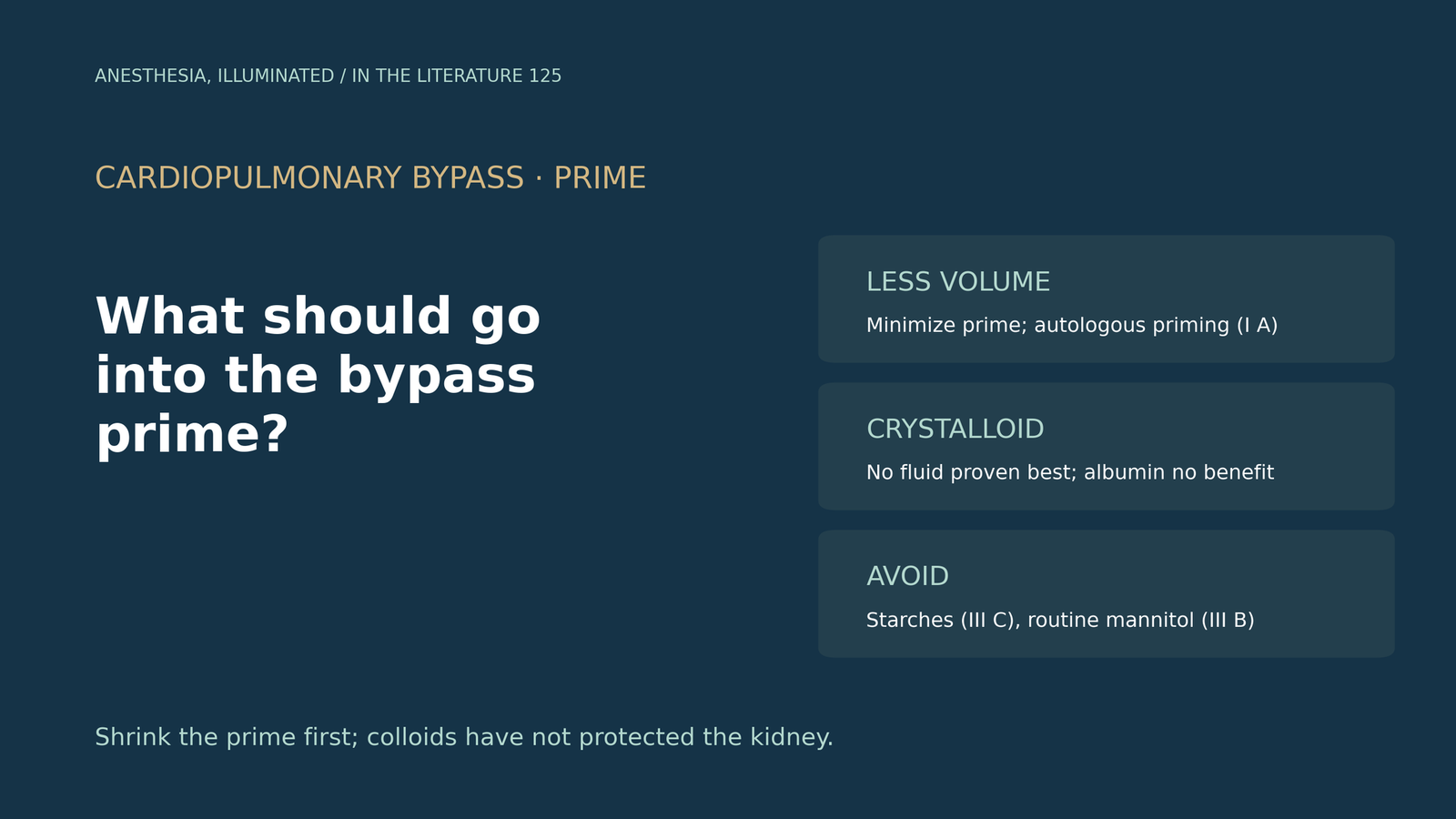
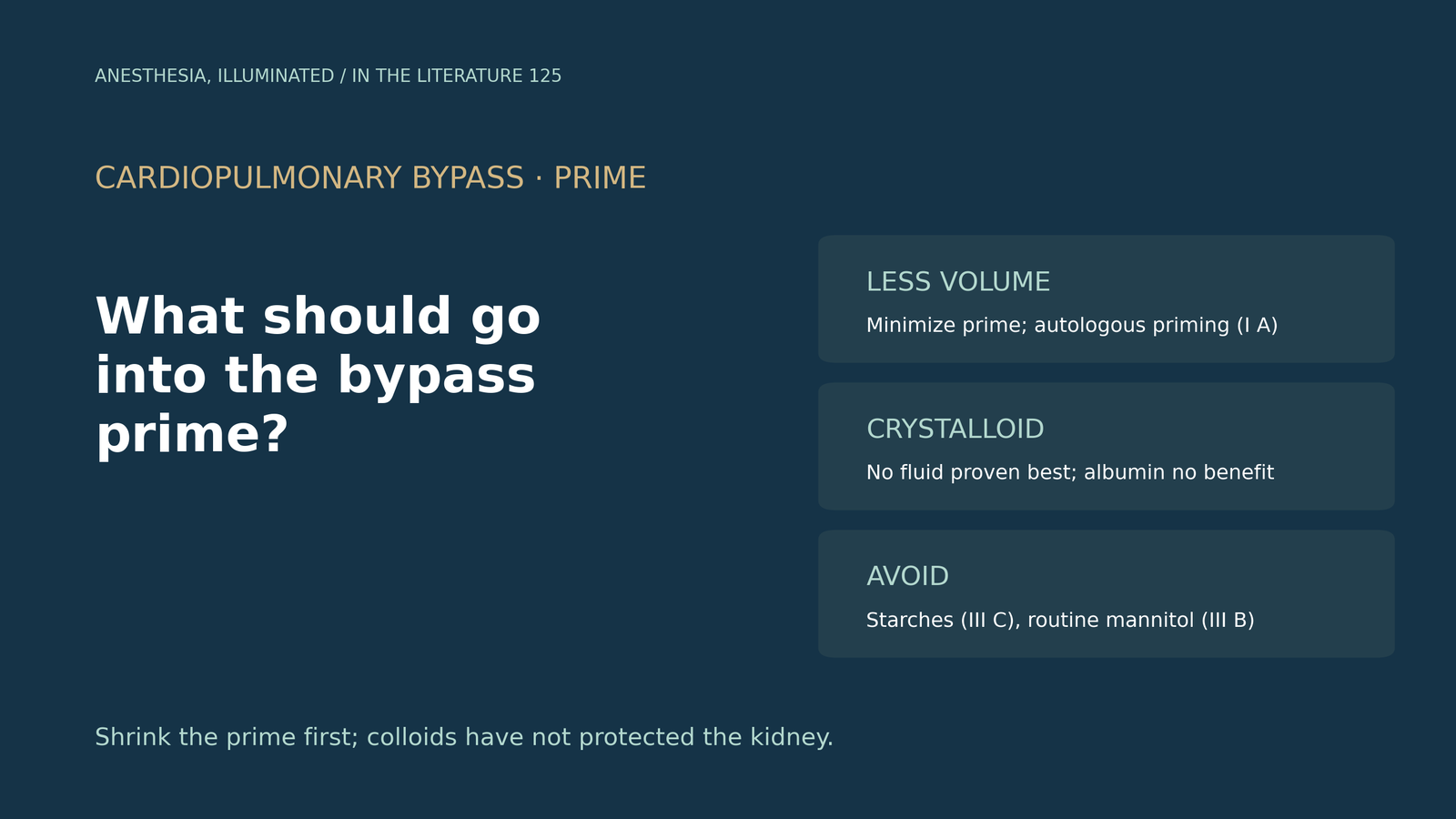
- The 2024 EACTS/EACTAIC/EBCP guideline states that no consensus exists on the best priming fluid. It recommends minimizing prime volume and using autologous priming to reduce transfusion (Class I A), and advises against low-molecular-weight starches (Class III C) and routine mannitol (Class III B).[1]
- Albumin did not improve outcomes. In a 1386-patient randomized trial, 4% albumin as prime and volume replacement gave major adverse events in 37.1% vs 33.8% with Ringer acetate. A meta-analysis found higher oncotic pressure and less positive fluid balance, but the evidence was low certainty and renal data were sparse.[2], [3]
- Colloids can harm the kidney. In a propensity-matched cohort, starch priming carried more AKI than gelatin (5.1% vs 3.0%). In a randomized trial stopped early, a dextran prime gave AKI in 81% vs 53% with Ringer acetate and mannitol, despite a lower fluid balance.[4], [5]
- Less volume matters more than the fluid type. In a systematic review, retrograde autologous priming cut the average prime from about 1631 to 862 mL and reduced red-cell transfusion in most studies.[6]
- In children, adding fresh frozen plasma to the prime did not reduce 24-hour blood loss across 20 trials; guidance cited in the review limits it to neonates.[7]
A small, mildly anemic patient is scheduled for coronary bypass. The perfusionist asks whether to add albumin or a colloid to the prime to limit hemodilution and protect the kidneys. Which fluid, and how much, actually changes outcomes?[1]
What the guideline says
The 2024 EACTS/EACTAIC/EBCP guideline notes that, despite many studies, there is no consensus on the optimal priming solution, and that crystalloids are the preferred prime in European centres. A large randomized trial of albumin did not reduce adverse events; dextran preserved oncotic pressure in one trial but impaired hemostatic variables in another, and allergic reactions to dextran and other colloids should be considered. The guideline recommends minimizing prime volume and using retrograde or antegrade autologous priming as part of blood conservation (Class I A), an MiECC-like optimization of the circuit to reduce blood loss and hemodilution (Class I B), and individualizing any drugs added to the prime (Class I C). It does not recommend low-molecular-weight starches (Class III C) or routine mannitol (Class III B).[1]
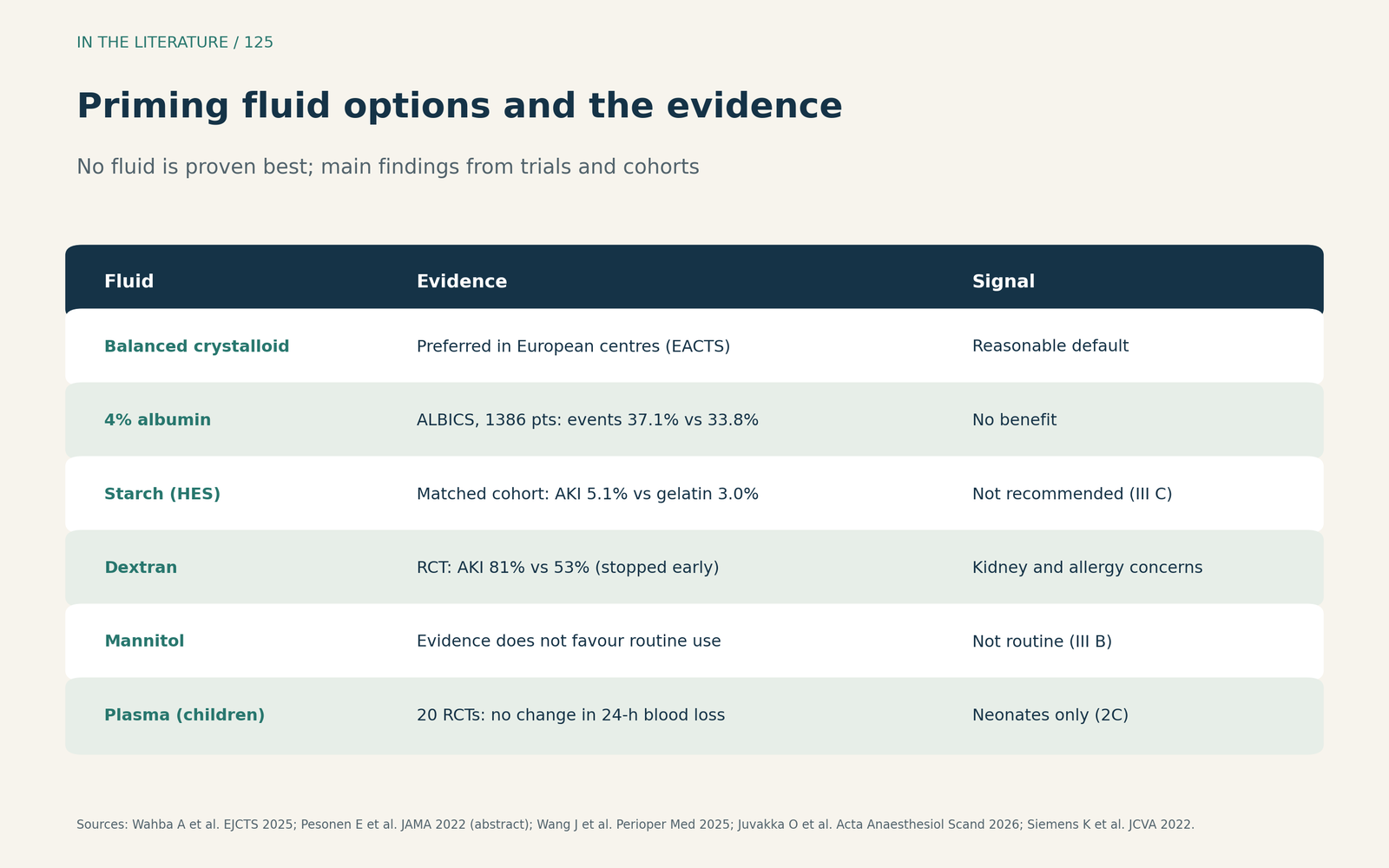
Figure 1. Priming fluid options and the evidence. Synthesized from the 2024 EACTS guideline, ALBICS, Yin et al., Wang et al., Juvakka et al., Siemens et al. and Xian-Yu et al.[1], [2], [3], [4], [5], [7], [8] View larger.

Albumin
In the ALBICS trial, 1386 adults were randomized to 4% albumin or Ringer acetate as both prime and perioperative volume replacement. The albumin group needed less fluid (median 2150 vs 3298 mL), but at least one major adverse event occurred in 37.1% vs 33.8% (relative risk 1.10, not significant), and the authors concluded the findings do not support albumin in this setting.[2] Yin and colleagues pooled 15 trials with 724 patients: albumin raised colloid oncotic pressure by 2.54 mmHg and made fluid balance less positive, but blood-loss data came from only 5 small adult trials, few trials reported renal function, and only one reported AKI.[3]
Synthetic colloids and dextran
Wang and colleagues matched 1880 pairs of patients primed with a starch or with gelatin; AKI was 5.1% vs 3.0% (adjusted odds ratio 1.785). The choice of prime was left to perfusionists, so selection bias is possible.[4] Juvakka and colleagues randomized adults to a hyperoncotic dextran prime or Ringer acetate with mannitol. Fluid balance was almost 600 mL lower and plasma free hemoglobin lower with dextran, yet AKI occurred in 81% vs 53%. The trial stopped after 101 of 366 planned patients.[5] A network meta-analysis of 21 trials advised against high-molecular-weight starch but concluded that no optimal priming fluid is supported by current evidence; it did not analyze oncotic pressure.[8]
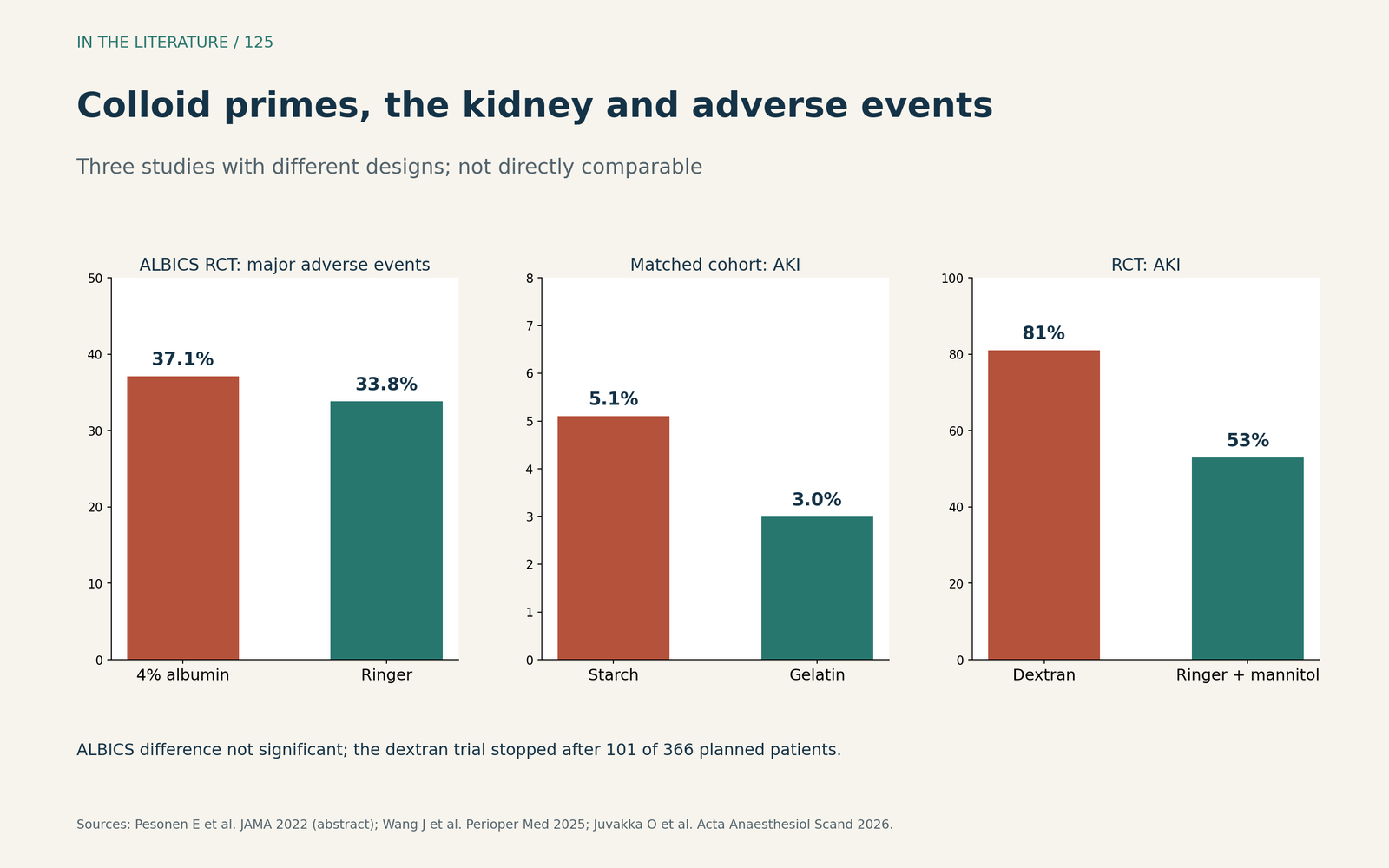
Figure 2. Colloid primes and the kidney. Redrawn from ALBICS, Wang et al. and Juvakka et al.; designs differ across panels.[2], [4], [5] View larger.

Prime volume and autologous priming
Every bypass circuit dilutes the blood. Vranken and colleagues reviewed 8 studies (2 randomized) of retrograde autologous priming: the mean prime fell from about 1631 to 862 mL, and most studies reported fewer red-cell transfusions. The technique is unsuitable for emergency cases or patients with low intravascular volume.[6]
In children, Siemens and colleagues analyzed 20 randomized trials with 1550 patients. No priming solution changed 24-hour blood loss; fresh frozen plasma raised fibrinogen right after heparin reversal, and the guidance they cite recommends plasma in the prime only for neonates (Grade 2C).[7]
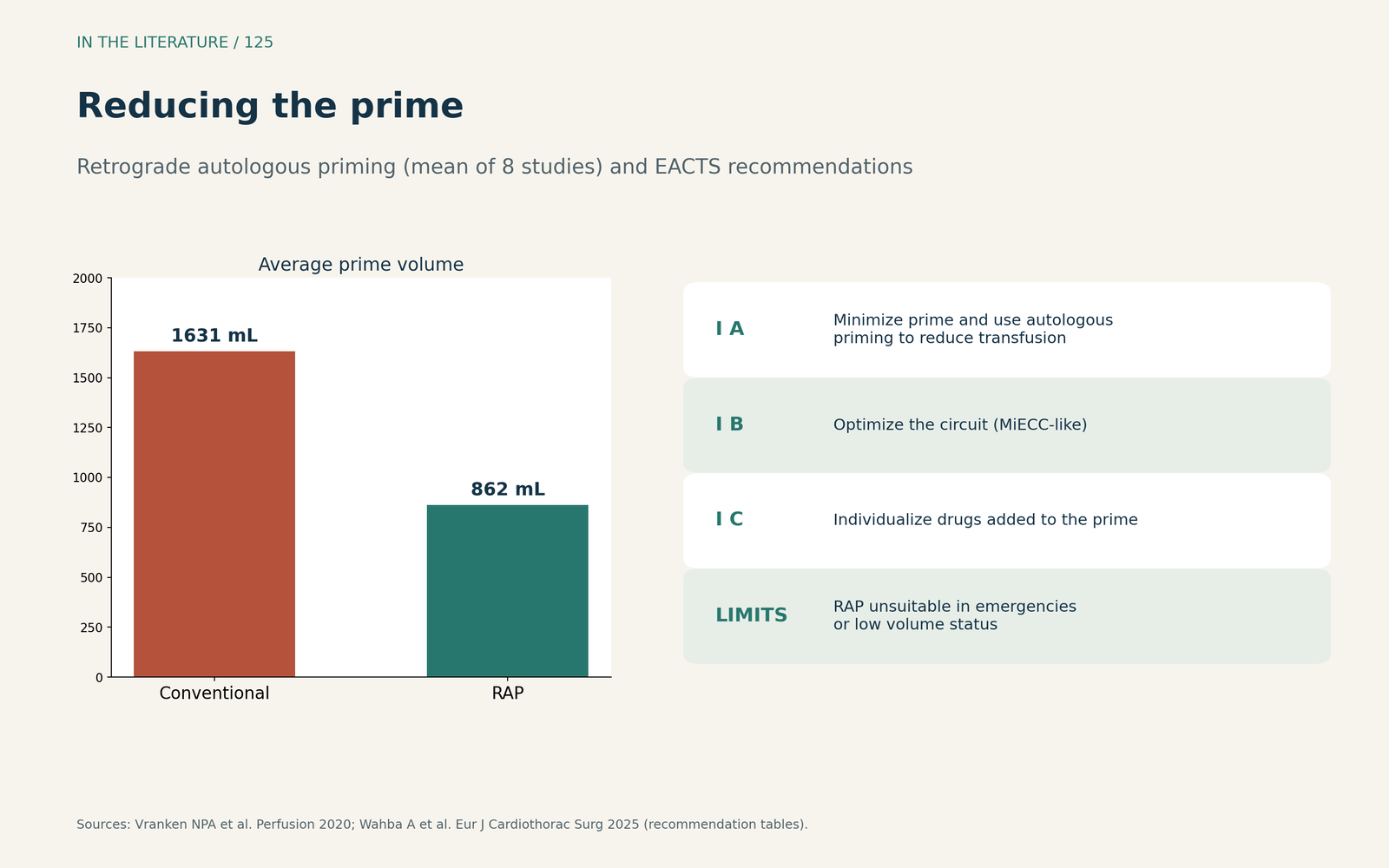
Figure 3. Reducing the prime. Redrawn from Vranken et al.; recommendation classes from the 2024 EACTS guideline.[6], [1] View larger.

Three takeaways
- Shrink the prime first. Minimized circuits and autologous priming reduce hemodilution and transfusion; this is the strongest recommendation.[1], [6]
- A balanced crystalloid is a reasonable default. Albumin did not reduce complications, and starch and dextran primes were linked to more AKI.[2], [4], [5]
- Treat additives as individual decisions. Avoid routine mannitol and starches; reserve plasma in the prime for neonates.[1], [7]
References
- Wahba A, Kunst G, De Somer F, et al. 2024 EACTS/EACTAIC/EBCP guidelines on cardiopulmonary bypass in adult cardiac surgery. Eur J Cardiothorac Surg. 2025;67(2):ezae354. doi:10.1093/ejcts/ezae354
- Pesonen E, Vlasov H, Suojaranta R, et al. Effect of 4% albumin solution vs Ringer acetate on major adverse events in patients undergoing cardiac surgery with cardiopulmonary bypass: a randomized clinical trial. JAMA. 2022;328(3):251–258. Abstract only. doi:10.1001/jama.2022.10461
- Yin J, Sun M, Zeng Y, et al. Safety and efficacy of albumin for pump priming in cardiac surgery: a meta-analysis. J Cardiothorac Vasc Anesth. 2024;38(2):517–525. doi:10.1053/j.jvca.2023.10.008
- Wang J, Bian L, Wang T, et al. Synthetic colloids as priming fluids in cardiopulmonary bypass and postoperative acute kidney injury: a propensity score-matched study. Perioper Med (Lond). 2025;14:22. doi:10.1186/s13741-025-00503-1
- Juvakka O, Wallinder A, Møller-Sørensen PH, et al. Dextran vs. crystalloid priming solution in cardiac surgery: a randomized trial on acute kidney injury. Acta Anaesthesiol Scand. 2026;70(1):e70139. doi:10.1111/aas.70139
- Vranken NPA, Babar ZUD, Montoya JA, Weerwind PW. Retrograde autologous priming to reduce allogeneic blood transfusion requirements: a systematic review. Perfusion. 2020;35(7):574–586. doi:10.1177/0267659119895474
- Siemens K, Donnelly P, Hunt BJ, et al. Evaluating the impact of cardiopulmonary bypass priming fluids on bleeding after pediatric cardiac surgery: a systematic review and meta-analysis. J Cardiothorac Vasc Anesth. 2022;36(6):1584–1594. doi:10.1053/j.jvca.2021.11.031
- Xian-Yu CY, Xu JB, Ma YT, et al. Management of priming fluids in cardiopulmonary bypass for adult cardiac surgery: network meta-analysis. Ann Med. 2023;55(2):2246996. doi:10.1080/07853890.2023.2246996