
ITL-6dc097bb47dc
Juan Li · In the Literature · Updated November 16, 2026
Watch the video

Key points
- Compare the post-TAVR ECG with baseline: pre-existing right bundle branch block, new bundle branch block, and progressive PR or QRS prolongation change the monitoring plan.
- Persistent high-grade atrioventricular block warrants permanent pacing; isolated new left bundle branch block does not automatically establish a permanent-pacemaker indication.
- Temporary pacing capability, inpatient observation, and permanent pacing address different needs. A reassuring single ECG does not replace assessment of the trend.
- Delayed high-grade block can be asymptomatic. Ambulatory monitoring needs timely alerts and a team able to respond.
- Recent streamlined discharge studies support structured reassessment in selected patients; they do not establish that less monitoring is equally safe for every TAVR recipient.
Before leaving the procedure room, separate protection from prediction
A new left bundle branch block (LBBB) after transcatheter aortic valve replacement (TAVR) raises a practical question: does the patient need protection while conduction evolves, a permanent pacemaker, or observation followed by monitored discharge? These decisions should not collapse into a single response to an abnormal ECG.
Lilly and colleagues’ 2020 ACC expert consensus pathway provides a concrete framework. New LBBB, an increase in PR or QRS duration of at least 20 ms, or transient complete heart block makes a secure transvenous temporary pacing lead before leaving the procedure room reasonable. Persistent complete heart block makes secure transvenous temporary pacing indicated. The 20-ms criterion is a change from baseline, not an absolute interval. [1]
Pre-existing right bundle branch block (RBBB) deserves separate attention. The pathway considers maintaining transvenous pacing capability and continuous monitoring for at least 24 hours reasonable even without new PR or QRS changes. If a temporary lead is removed, the recovery setting must still permit emergency pacing. This is a protection strategy, not an automatic 24-hour discharge rule. [1]
Which finding changes the permanent-pacing decision?
Persistent high-grade atrioventricular block warrants permanent pacing. Recurrent episodes of transient high-grade block prompt consideration of a permanent pacemaker before discharge, even without symptoms. Baseline RBBB combined with transient or persistent procedural high-grade block is a particularly high-risk combination; the ACC pathway regards permanent pacing as indicated in the vast majority of these cases. By contrast, a new LBBB is a risk marker requiring reassessment; it does not, by itself, mean that every patient needs a permanent device. New or progressive conduction disease may warrant electrophysiology assessment when the indication remains uncertain. [1]
The useful handover therefore describes both the rhythm and its course: baseline conduction, the maximum change, any high-grade block, recurrence, and whether reliable backup pacing remains available. This is a practical synthesis of the pathway, rather than a new scoring system. [1]
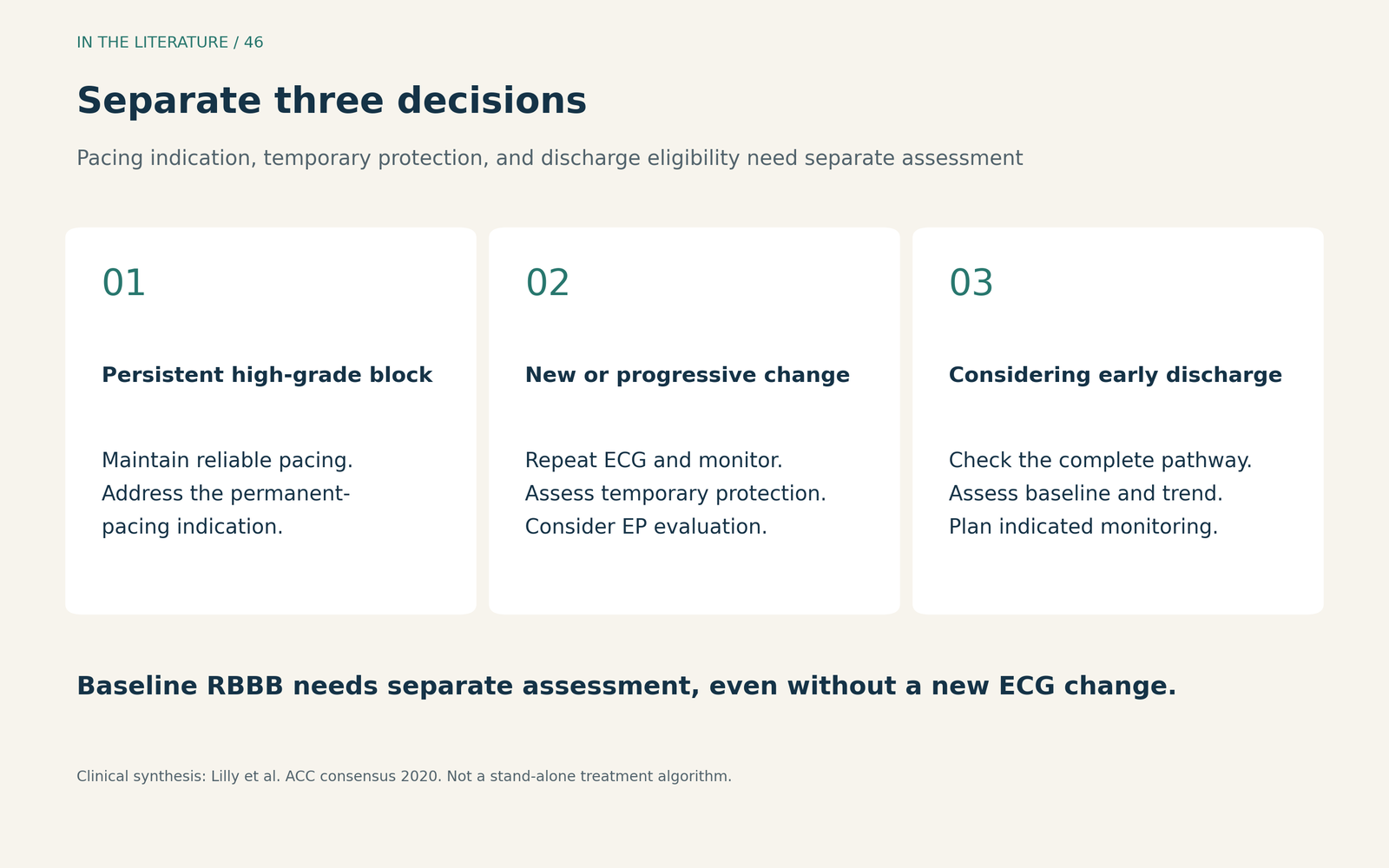
Figure 1. Separate an established pacing indication from a conduction-risk marker and from discharge eligibility. This clinical summary does not replace the complete ACC pathway or individualized electrophysiology assessment. [1] View figure

Count stability, not simply time since implantation
The ACC discharge pathway considers early discharge when there is no primary pacemaker indication, no new first- or second-degree AV block, no new bundle branch block, and no progression of baseline first- or second-degree AV block or QRS prolongation of at least 10%. Baseline RBBB still needs the separate assessment described above. [1]
For the new or progressive abnormalities specified in that pathway, it recommends telemetry until conduction is stable for at least 48 hours, followed by an outpatient monitor for at least 14 days. These are explicitly the 2020 ACC consensus thresholds. They should not be converted into “discharge 48 hours after implantation” if the ECG has continued to deteriorate. Nor is this observation branch a reason to defer treatment when a permanent-pacing indication is already established. [1]
Why feeling well is insufficient after discharge
Alabdaljabar and colleagues’ Structural Heart 2024 study retrospectively evaluated 528 patients selected for 30-day ambulatory monitoring after TAVR. High-grade AV block was detected in 41 patients (7.8%); 28 of those 41 (68.3%) were asymptomatic. These are findings in a selected monitored cohort, not the incidence among all TAVR recipients. Most received balloon-expandable valves, which also limits extrapolation to predominantly self-expanding-valve practice. [2]
Most detected events occurred during the first two weeks, but events continued later. The study supports attention to silent and delayed block; it does not establish that stopping monitoring at two weeks eliminates risk. The monitoring systems notified the treating team when high-grade block was detected. Detection and a response pathway belong together. [2]
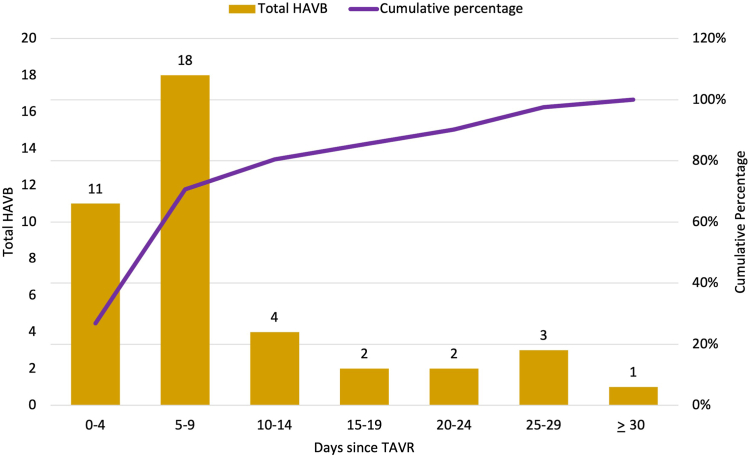
Figure 2. Original Figure 1 from Alabdaljabar et al. Bars show detected high-grade AV block events; the line shows the cumulative percentage among the 41 events, not among all 528 patients. Time starts at TAVR, not discharge. The final interval retains the original “≥30” label. ©2024 The Authors. Reproduced unchanged under CC BY 4.0. [2] View figure

What the newer minimalist algorithm adds
Faizi and colleagues’ Structural Heart 2026 study prospectively evaluated a simplified discharge algorithm in 664 selected pacemaker-naive patients at one center. It excluded recipients of prophylactic permanent pacemakers and patients whose permanent-pacing decision was made during the procedure, as well as patients with important clinical complications. Daily ECG reassessment and selective real-time home monitoring remained part of the protocol. [3]
30 patients (4.5%) left the catheterization laboratory with a temporary pacemaker. The authors compared this with 260 patients (39.2%) estimated to meet earlier consensus criteria. That larger number describes a calculated alternative, not an observed randomized control group; the 4.5% figure also does not include additional temporary pacemakers inserted later during hospitalization. [3]
The study shows how a center can organize discharge planning with selective temporary pacing. It does not demonstrate equivalent safety across competing strategies. Serious delayed harm was reported in the full results, despite the absence of out-of-hospital deaths. Its practical contribution is the structured reassessment and response infrastructure—not permission to omit monitoring whenever the first postprocedure ECG looks acceptable. [3]
Make the discharge plan actionable
For a patient leaving hospital without a permanent pacemaker, document the ECG trajectory, why the observation period is appropriate, and whether ambulatory monitoring is indicated. If indicated, specify the device, duration, and who receives and acts on an alert. Explain what the patient should do for syncope, presyncope, or concerning symptoms, while recognizing that important block may produce no symptoms. The device should support timely clinical action, rather than merely generate a recording for later review. These are implementation implications of the ACC pathway and the monitored-cohort protocols. [1–3]
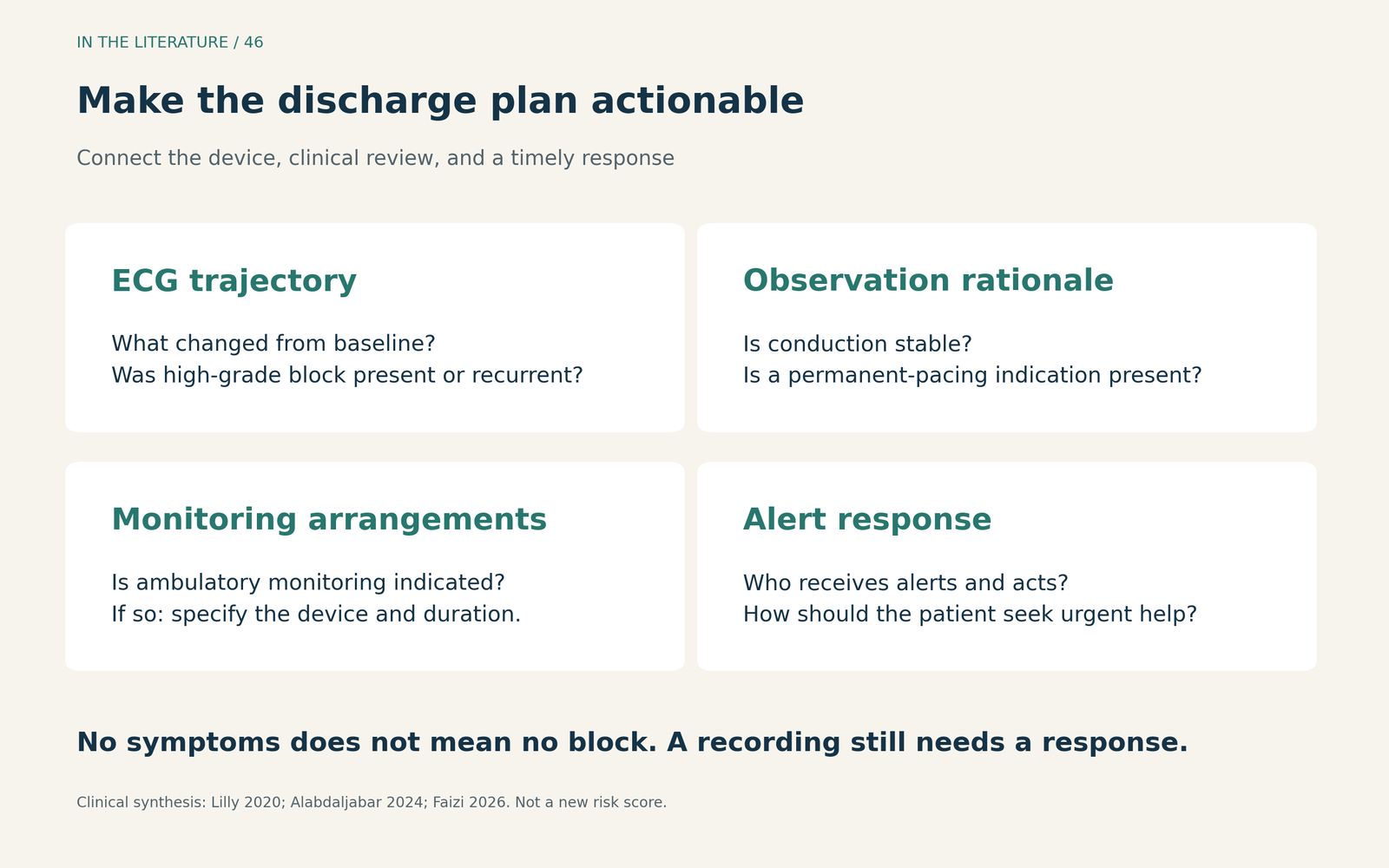
Figure 3. Four components of a usable discharge plan. This is an editorial handover aid; duration and pacing decisions remain tied to the patient's findings and the chosen clinical pathway. [1–3] View figure

Three takeaways
- Name the decision correctly. Persistent high-grade block, temporary pacing protection, and a risk marker such as new LBBB call for different actions.
- Follow the ECG trajectory. Baseline RBBB and evolving PR/QRS changes matter; a stability requirement is not simply elapsed time after TAVR.
- Discharge with a response plan. Delayed block is often silent. A monitor, timely review, and a clear route to urgent care must function together.
References
- Lilly SM, Deshmukh AJ, Epstein AE, et al. 2020 ACC Expert Consensus Decision Pathway on Management of Conduction Disturbances in Patients Undergoing Transcatheter Aortic Valve Replacement: A Report of the American College of Cardiology Solution Set Oversight Committee. J Am Coll Cardiol. 2020;76(20):2391–2411. doi:10.1016/j.jacc.2020.08.050. See also the official ACC decision guide.
- Alabdaljabar MS, Elhadi M, Gulati R, et al. Thirty-Day High-Grade Aortic Valve Block Post-Transcatheter Aortic Valve Replacement in Patients Discharged on Heart Rhythm Monitor. Struct Heart. 2024;8(4):100317. doi:10.1016/j.shj.2024.100317.
- Faizi G, Faiz E, Ali FS, et al. Prospective Evaluation of a Simplified Discharge and Temporary Pacing Algorithm After Transcatheter Aortic Valve Replacement. Struct Heart. 2026;10(6):100834. doi:10.1016/j.shj.2026.100834.