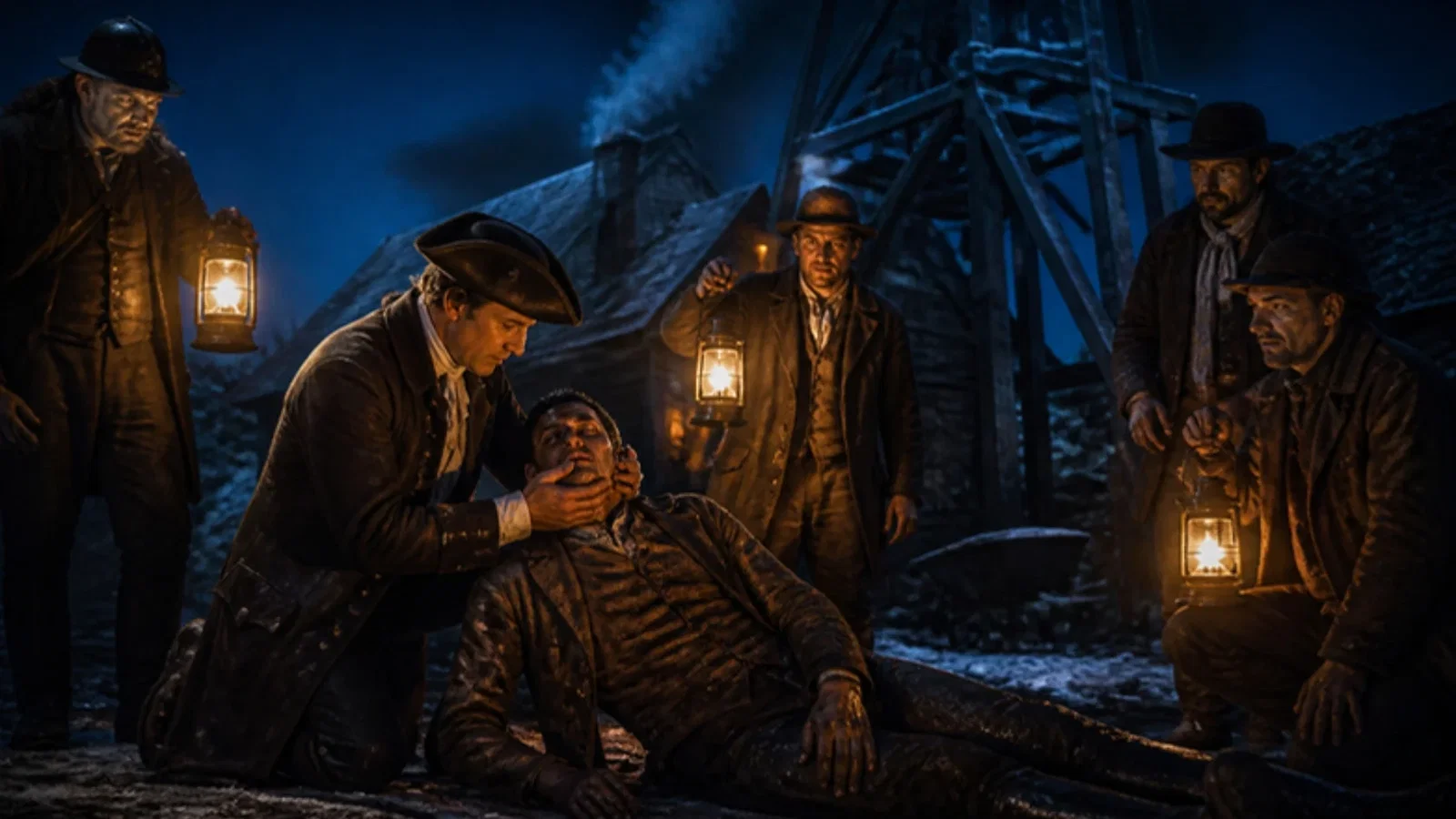
The Alloa surgeon Tossach blew into the mouth of a pulseless miner pulled from a burning pit, and the man recovered; rescue societies later adopted the method.
Reading Library · Anesthesia Epochs · 中文版
Watch the education video (for clinicians)
1732 and 1744: Tossach's Mouth-to-Mouth — Blow Until the Chest Rises · Anesthesia Epochs Education Series
Expired-air ventilation is now so familiar that it is easy to forget it once had to be reported as a curiosity. One of the earliest detailed reports of it comes from a coal pit at Alloa, in Scotland, on 3 December 1732, and it was written by the surgeon who did it, William Tossach. A generation later, societies in Amsterdam and London set out to make such rescues routine. This article reads Tossach's report in the 1744 volume of the Edinburgh Medical Essays and Observations, the methods recommended by the Amsterdam society in their English translation of 1773, and the founding plan of the London society of 1774. [1][2][3]
"A Man dead in Appearance"
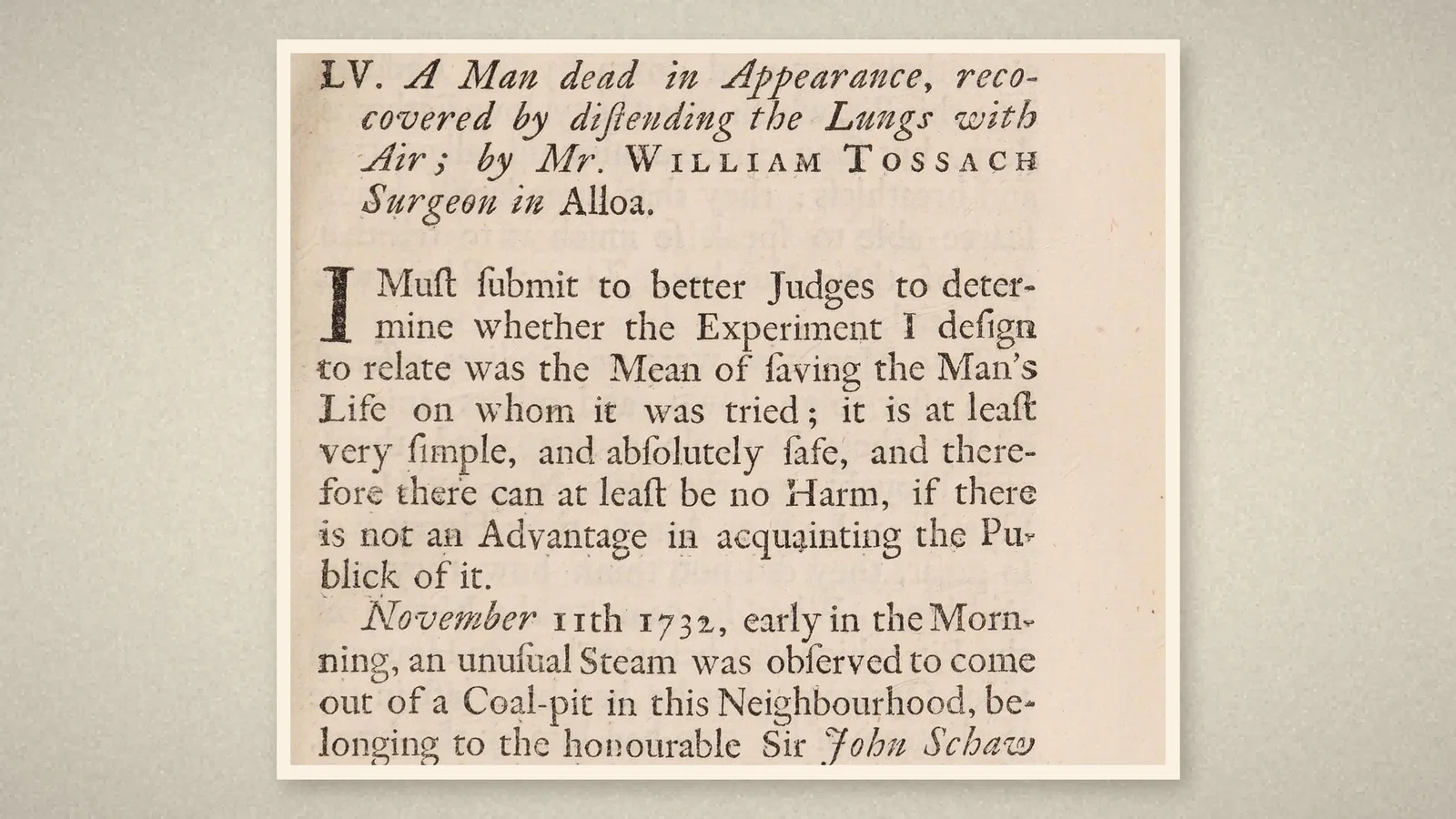
Tossach's report, article LV of the fifth volume, is titled "A Man dead in Appearance, recovered by distending the Lungs with Air". It opens with a careful disclaimer: "I must submit to better Judges to determine whether the Experiment I design to relate was the Mean of saving the Man's Life on whom it was tried; it is at least very simple, and absolutely safe." [1]
The setting is given precisely. Early on 11 November 1732, smoke was seen coming from a coal pit near Alloa belonging to Sir John Schaw of Greenock; coals near the bottom had caught fire. The pit and all those connected with it were shut to smother the fire, and stayed shut until 3 December. When they were opened, the pit that had burned gave off a nauseous steam. After some hours, colliers went down the ladders into this pit, thirty-four fathoms deep, but soon came running up "all panting and breathless", the last of them scarcely able to say that one of their number, James Blair, had been left dead. Two men who were not colliers went down with others and carried Blair up by head, shoulders, legs or arms, between half an hour and three quarters of an hour after the miner had been left at the bottom. [1]
What Tossach did
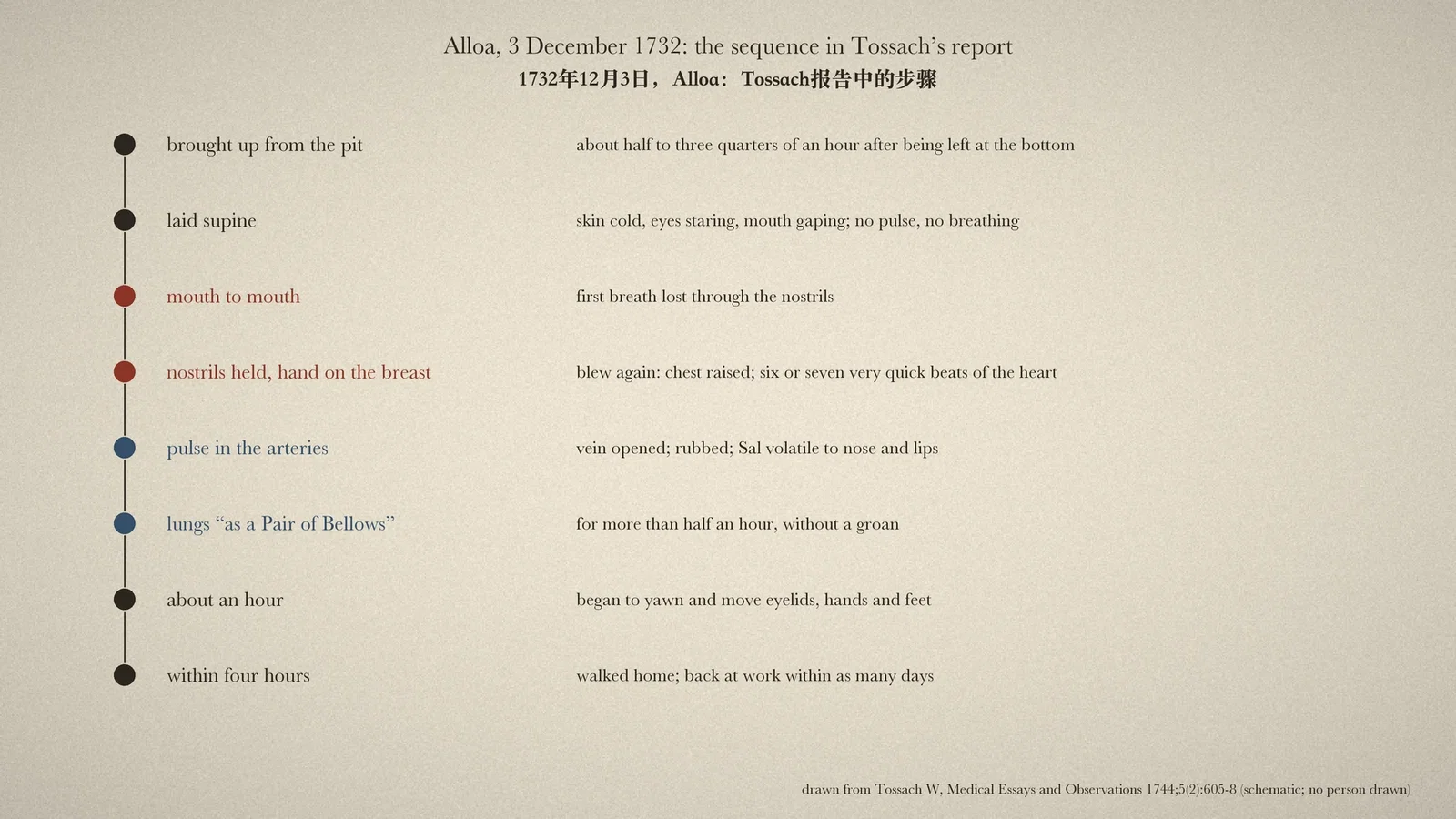
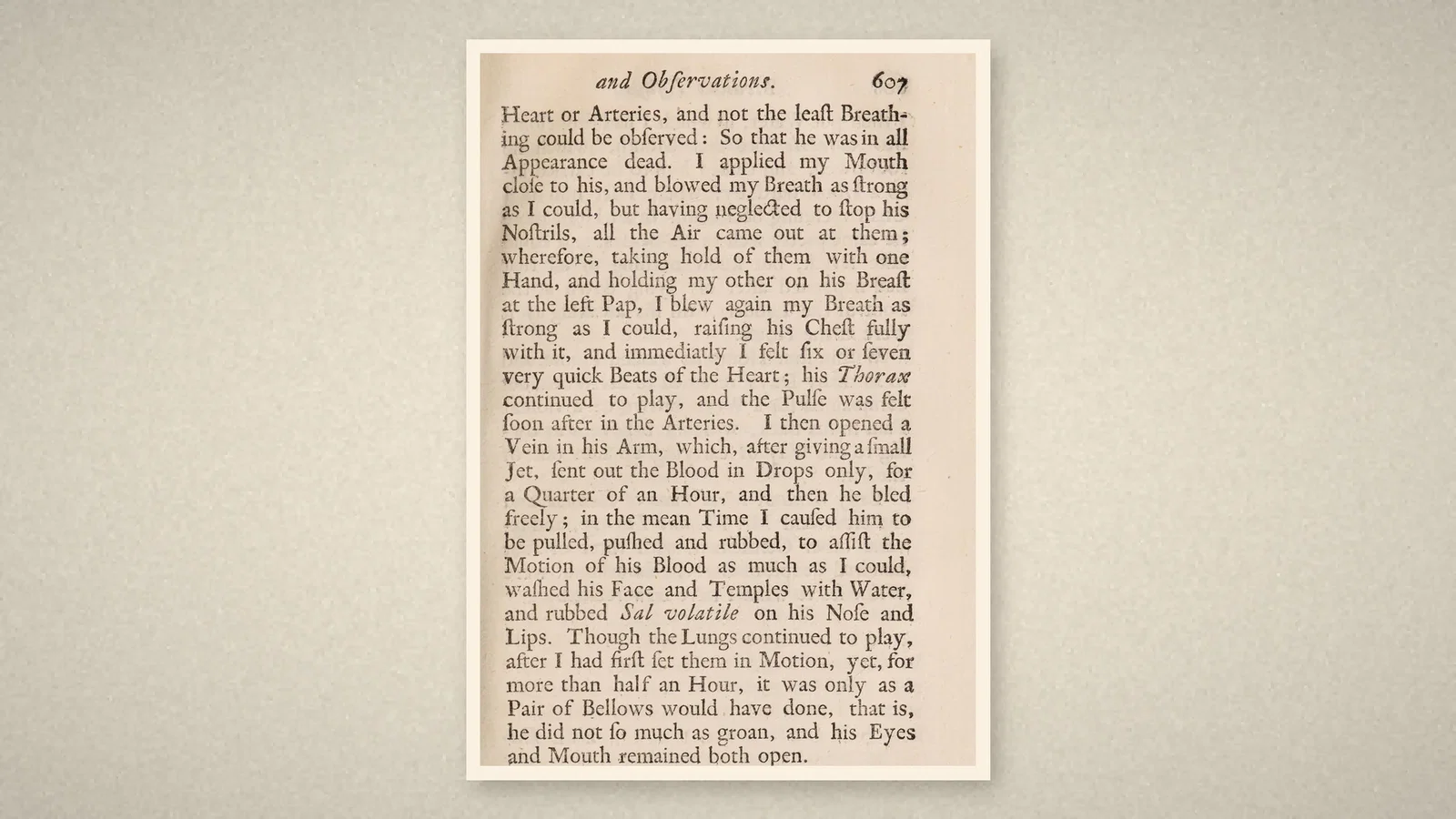
Tossach had Blair laid supine a little distance from the pit. The skin was cold, the eyes staring, the mouth gaping; there was "not the least Pulse in either Heart or Arteries", and no breathing. "I applied my Mouth close to" the miner's, Tossach wrote, "and blowed my Breath as strong as I could"; but the nostrils had not been stopped, and "all the Air came out at them". So Tossach held them with one hand, put the other hand on the left side of the chest, and blew again as strongly as possible, raising the chest fully, "and immediatly I felt six or seven very quick Beats of the Heart". The chest kept moving, and the pulse was soon felt in the arteries. [1]
Then came the treatments of the age. A vein in the arm was opened; it gave a small jet and then bled in drops for a quarter of an hour before bleeding freely. Blair was pulled, pushed and rubbed, the face and temples washed with water, Sal volatile rubbed on nose and lips. For more than half an hour the lungs moved, Tossach wrote, "only as a Pair of Bellows would have done", without so much as a groan. After about an hour Blair began to yawn and to move eyelids, hands and feet; after another hour came recovery of the senses, with no memory of anything after lying down at the foot of the ladders. Within four hours Blair walked home, and in as many days returned to work, complaining for a week or two of a violent pain in the back, which Tossach put down to the way the miner had been carried out of the pit. Lady Schaw, a minister and "three or four hundred People of the Neighbourhood" were named as witnesses. [1]
From one case to a method
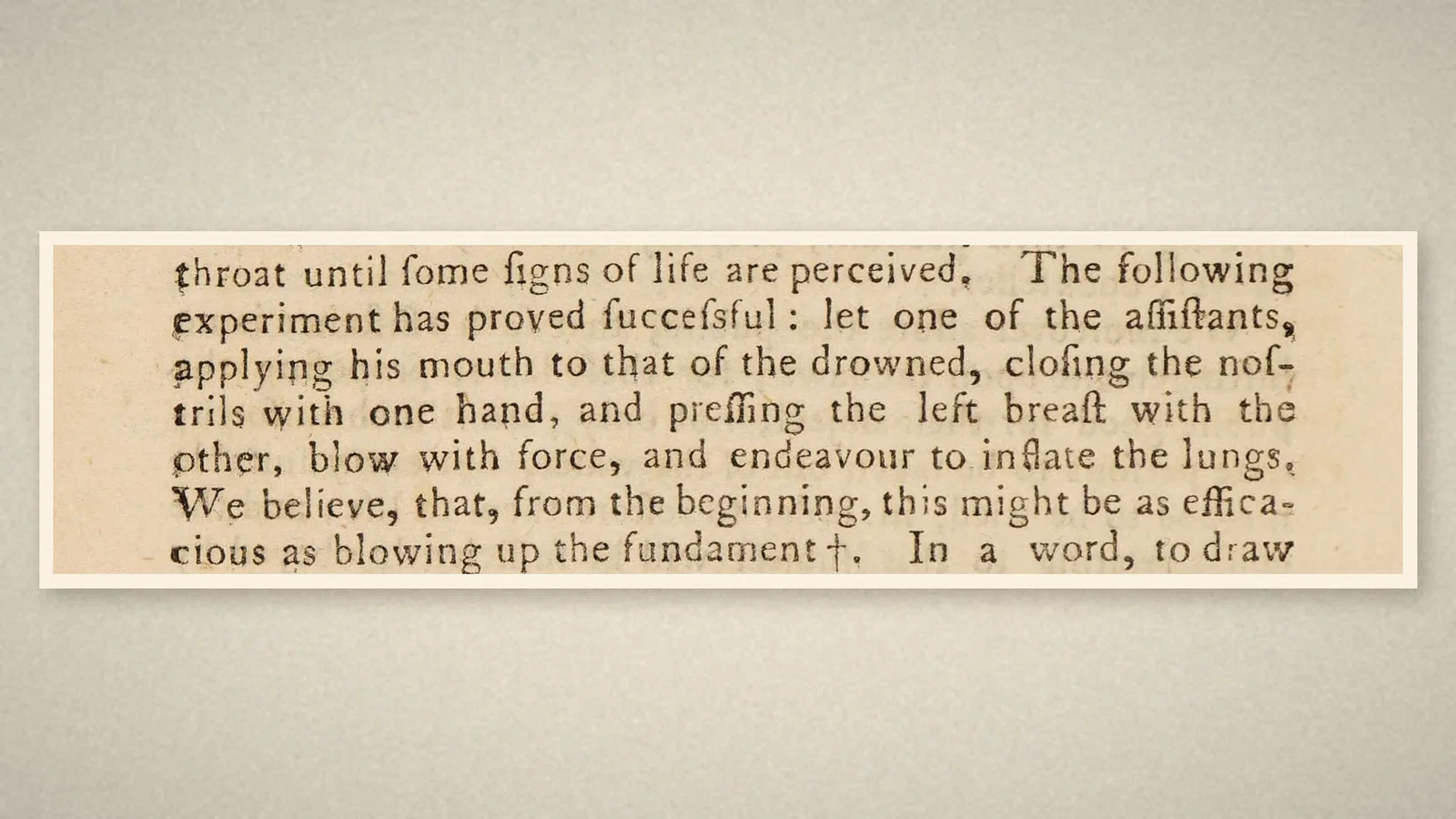
The report sat in a medical miscellany for a generation. In 1767 a group of citizens in Amsterdam, alarmed at how many people drowned in the city's canals, formed a society to encourage attempts at recovery and to reward rescuers. Its Memoirs were translated into English by Thomas Cogan and printed in London in 1773. Among "the most suitable methods", the society listed first blowing into the intestines, through a tobacco pipe, a pair of bellows or the sheath of a knife, preferably with tobacco smoke; then drying, warming and rubbing the body; and then: "The following experiment has proved successful: let one of the assistants", applying a mouth to that of the drowned person, "closing the nostrils with one hand, and pressing the left breast with the other, blow with force, and endeavour to inflate the lungs." The society thought this might be "as efficacious as blowing up the fundament". A footnote in the English edition went further: blowing with force into the lungs was "the most efficacious method", and its writer had often felt the heart and carotid arteries of still-born children beat strongly while it was applied, and stop when it was interrupted. [2]
In 1774 a Society for the Recovery of Persons Apparently Drowned was founded in London. Its pamphlet says the Dutch society had restored "about 150" people in a few years, that cities from Milan to Paris had followed, that Cogan had translated the Amsterdam Memoirs in 1773, and that Cogan and William Hawes had joined to propose a similar institution. The plan was practical: two guineas to be shared among the first rescuers who tried for two hours to recover anyone taken from the water for dead, four guineas if the person lived, a guinea to any publican who took in the body, and medical men stationed near the river with "a fumigator, and other necessaries, always in readiness". The bills of mortality, the pamphlet noted, recorded 123 people drowned within their limits in the previous year. [3]
What the record shows
Tossach's report already contains the essentials of rescue breathing: seal the nose, blow until the chest rises, and keep going. It also shows how evidence of this kind was weighed at the time: a single case, honestly hedged, with named witnesses. The Amsterdam and London societies then did something new, turning scattered cases into a recommended procedure, a reward system and a network of trained helpers, even while mouth-to-mouth inflation shared the list with tobacco-smoke enemas and bleeding.
Sources and reading limits
Read: Tossach's report in Medical Essays and Observations, vol. 5 part 2 (Edinburgh, 1744), pp. 605-608, in full; the Amsterdam society's advertisement and recommended methods in Cogan's English translation of 1773, pp. 2-4, with page images; the London society's founding pamphlet of 1774 (introduction, plan, directors); the 2024 ASA timeline entries, which cite a 1771 printing of Tossach's report.
Not covered: the Dutch original of the Amsterdam Memoirs; Hawes's own writings; later Humane Society reports; the bellows apparatus recommended later. The footnote quoted from the English Memoirs is not signed in this copy. Tossach left open whether the experiment saved the miner's life; the article does the same.
Three illustrations are page crops from the 1744 and 1773 texts; one is drawn from Tossach's report.
- Tossach W. A man dead in appearance, recovered by distending the lungs with air. Medical Essays and Observations (Edinburgh). 1744;5(2):605-8. Internet Archive
- Memoirs of the Society instituted at Amsterdam in favour of drowned persons. For the years 1767, 1768, 1769, 1770, and 1771. Cogan T, transl. London: G. Robinson; 1773. Internet Archive
- Society for the Recovery of Persons Apparently Drowned. Instituted 1774. London; 1774. Internet Archive
- Australian Society of Anaesthetists. Anaesthesia history timeline. 2024. ASA
Continue exploring
Related reading connects shared questions and contexts; it does not by itself establish historical influence.
Anesthesia Epochs · The Source Room · About & Editorial Method
Published November 2, 2026. Sources and reading limits are stated above. Illustrations are labelled as original source images or AI-made. Historical accounts are educational; they are not current treatment instructions.