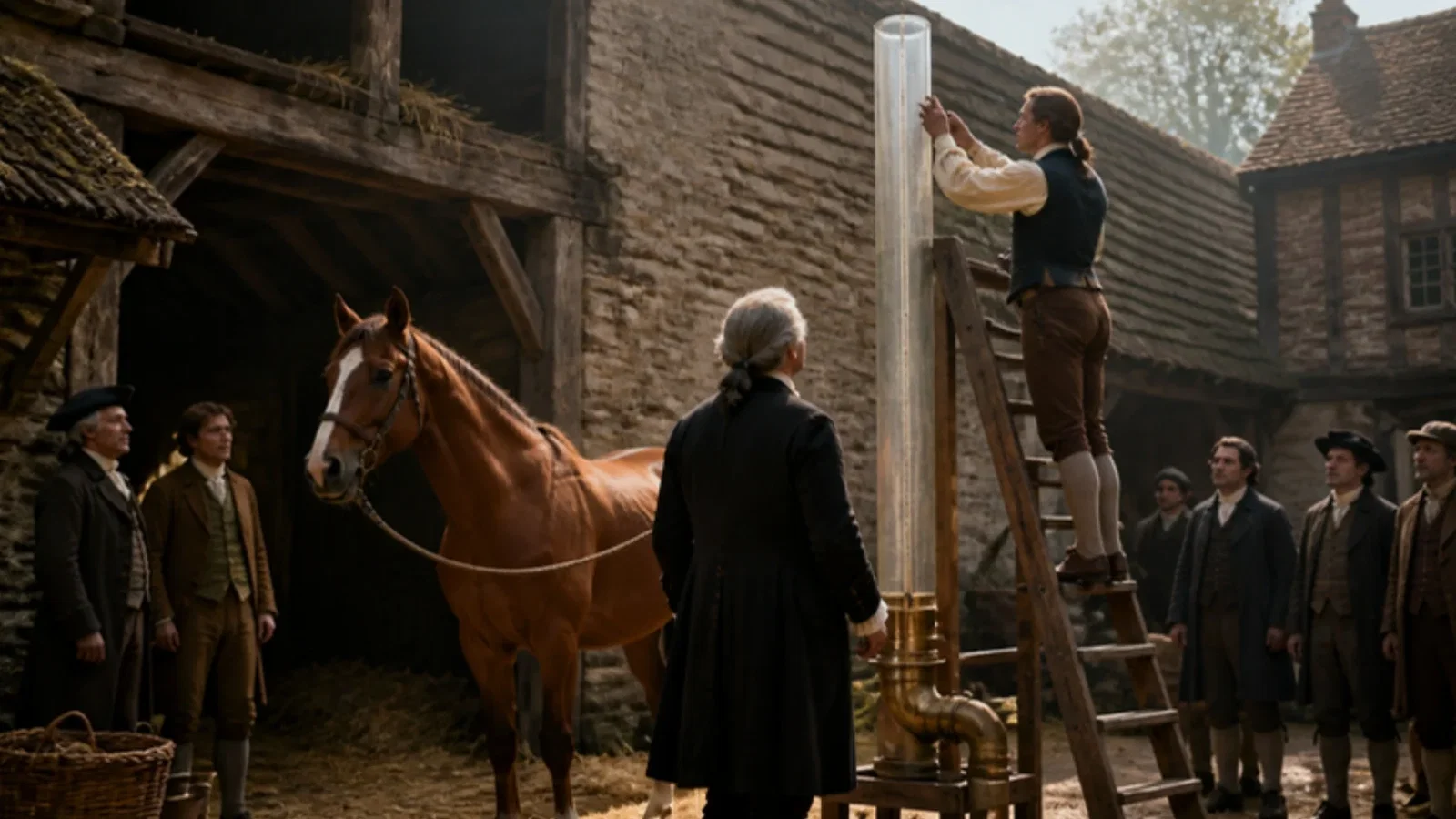
Hales joined a nine-foot glass tube to a mare's crural artery; the blood rose over eight feet, pulsed with each beat, and fell as the mare was bled.
Reading Library · Anesthesia Epochs · 中文版
Watch the education video (for clinicians)
1733: Hales Measures Arterial Pressure — Nine Feet of Blood · Anesthesia Epochs Education Series
An arterial line in the operating room is a cannula in an artery, a column of fluid, and a way of reading the pressure in that column beat by beat. The same three elements appear, at a very different scale, in a book printed in London in 1733 by Stephen Hales, a clergyman and Fellow of the Royal Society. The timeline of the Australian Society of Anaesthetists lists it as the first record of direct intra-arterial measurement of blood pressure. This article reads Hales's first experiment in the original, and the earlier summary of the same measurements that Hales had published in 1727. [1][2][3]
The book
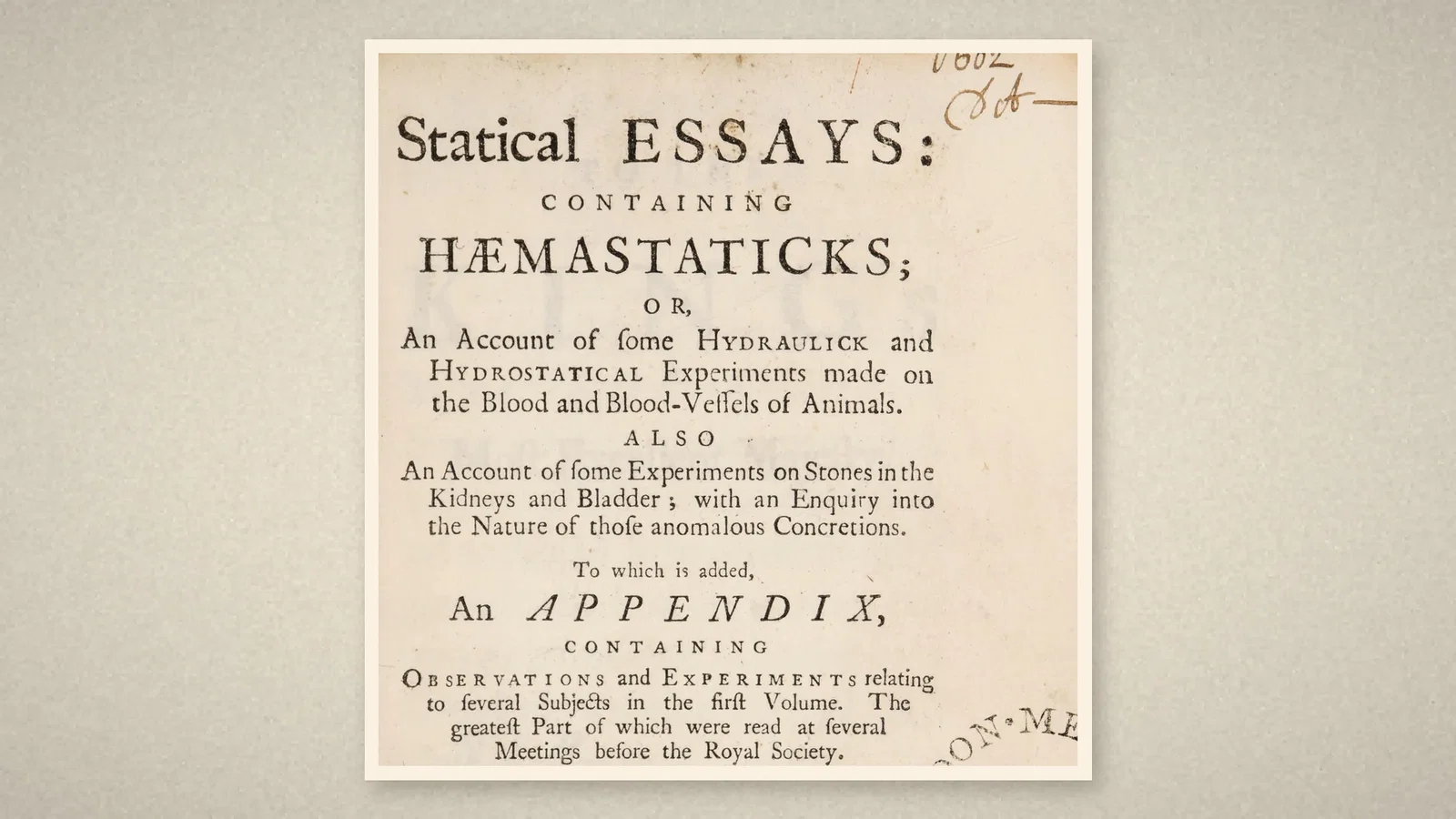
The second volume of Hales's Statical Essays, subtitled Haemastaticks, is "An Account of some Hydraulick and Hydrostatical Experiments made on the Blood and Blood-Vessels of Animals". The title page names "Stephen Hales, B.D. F.R.S., Rector of Farringdon, Hampshire, and Minister of Teddington, Middlesex", and gives the imprint London, 1733. A leaf before it records that the Council of the Royal Society, with Hans Sloane as President, had ordered the volume printed, most of it having been read at the Society's meetings. [1]
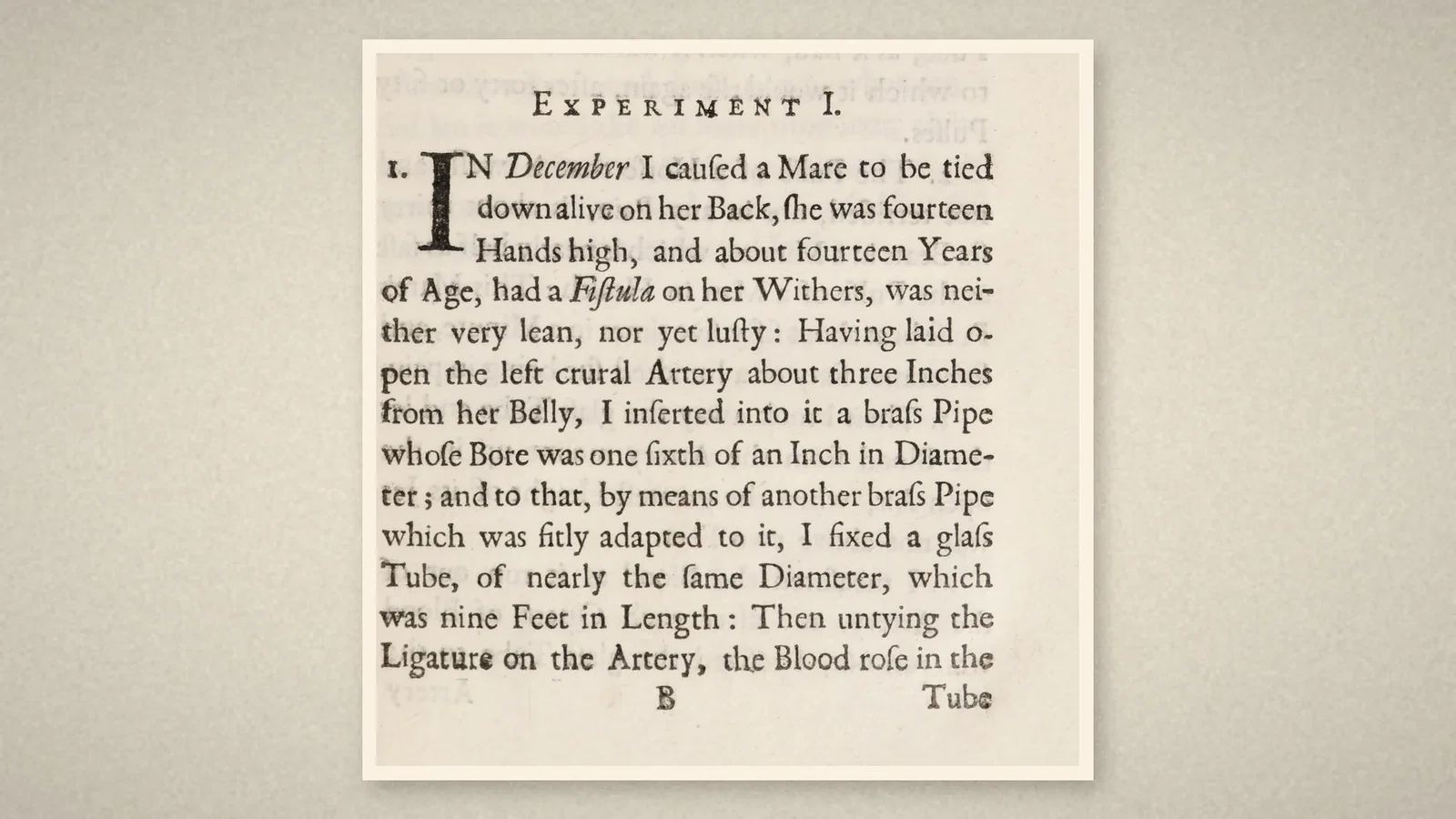
Experiment I
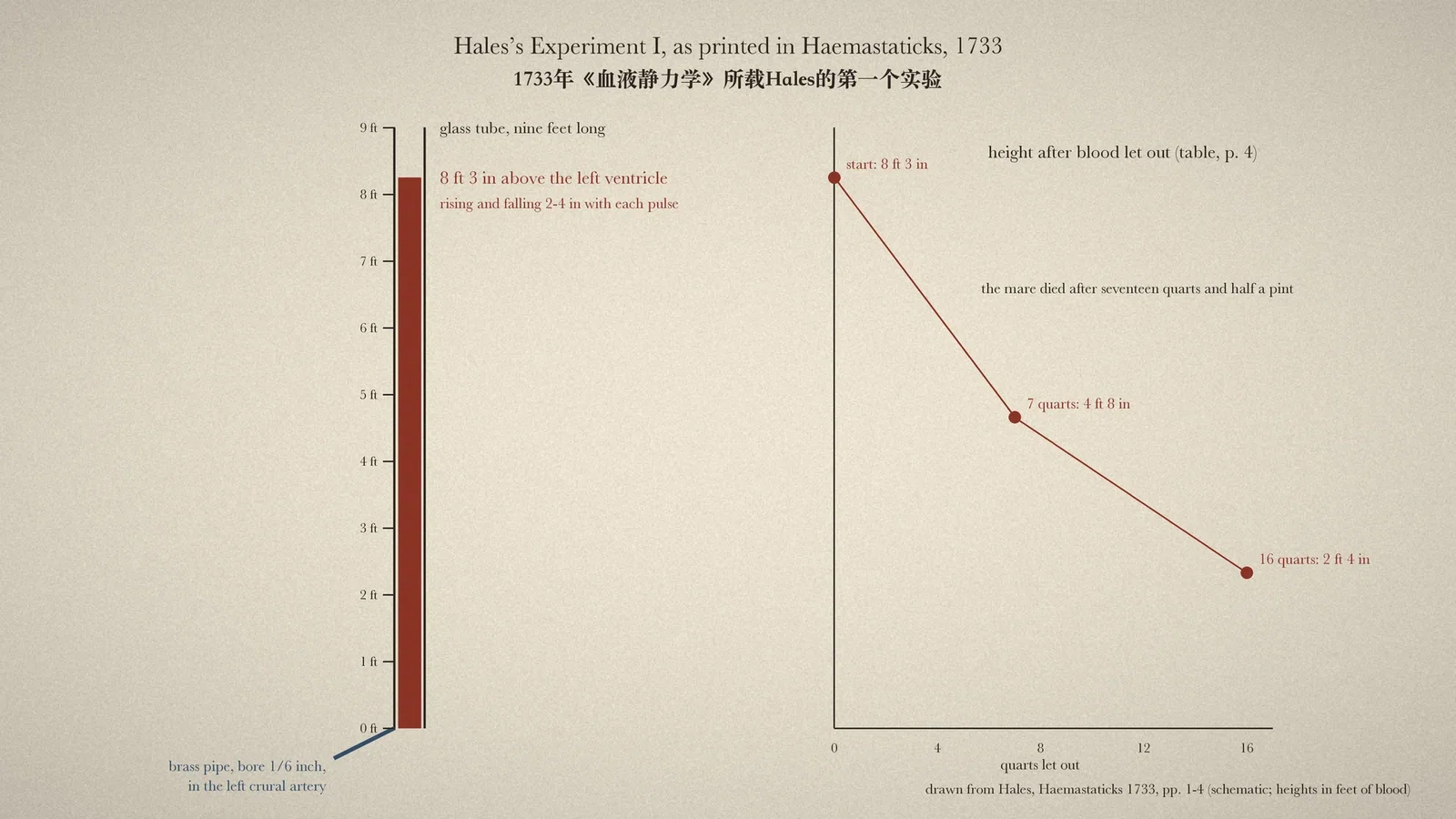
The first experiment begins plainly: "In December I caused a Mare to be tied down alive". The animal was fourteen hands high and about fourteen years old, with a fistula on the withers, "neither very lean, nor yet lusty". Hales laid open the left crural (femoral) artery about three inches from the belly and inserted a brass pipe "whose Bore was one sixth of an Inch in Diameter"; to that, by a second brass pipe, a glass tube of nearly the same diameter was fixed, "nine Feet in Length". When the ligature on the artery was untied, the blood rose in the tube "eight Feet three Inches perpendicular above the Level of the left Ventricle of the Heart". [1]
Hales watched the column closely. It did not reach its full height at once: it rushed halfway up in an instant and then climbed with each pulse by twelve, eight, six, four, two and sometimes one inch. At full height it rose and fell "at and after each Pulse two, three, or four Inches", and sometimes dropped twelve or fourteen inches for a while before rising again. Hales compared rates as well: a horse that is well and not frightened has a pulse of about thirty-six beats a minute, but this one beat about fifty-five, and sometimes sixty or a hundred, being in pain. When the tube was removed, the open jet of blood from the artery rose no more than two feet. [1]
In those few sentences the book records several things that monitoring still depends on: a reference level at the heart, a pressure that is not one number but a wave with each beat, a column that takes time to settle, and readings disturbed by pain and struggle.
Pressure and blood loss
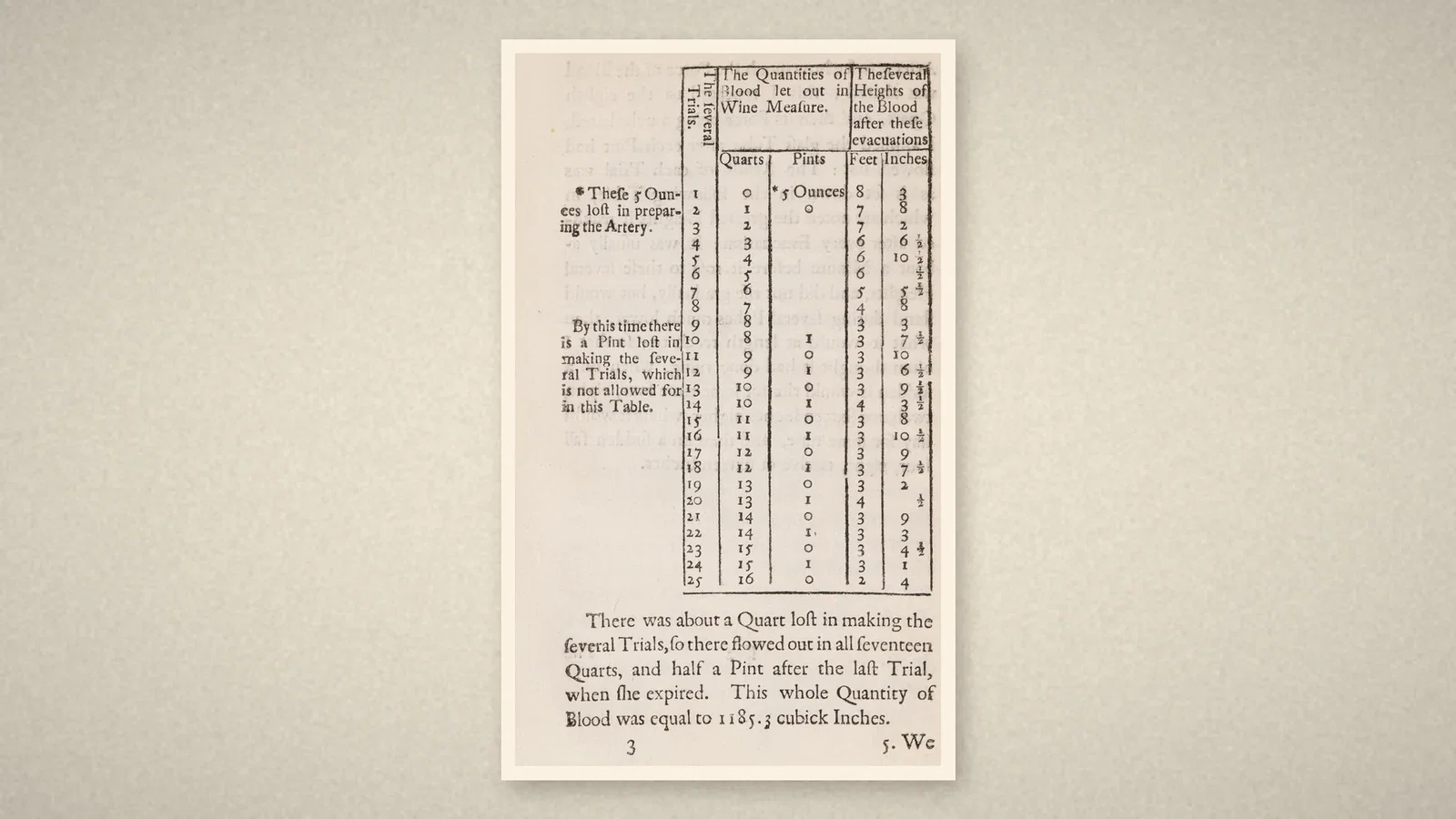
The experiment did not stop there. Hales let the blood run out of the artery, measured it, and after each quart refitted the glass tube "to see how much the Force of the Blood was abated"; after the eighth quart the tube was refitted after each pint. The table on page 4 lists twenty-five trials. The height fell from eight feet three inches at the start to four feet eight inches after seven quarts, and to two feet four inches after sixteen. In all, seventeen quarts and half a pint ran out before the mare died. [1]
Hales noticed that the fall was not proportional to the blood removed. At some trials the height rose again by several inches, which Hales put down to the animal's "violent straining to get loose": the action of the muscles, especially the abdominal muscles, drove blood from all parts "to the Vena Cava", so that the heart received and threw out more at each beat. Deep sighing raised the column for the same reason. [1]
The earlier summary
The heights were not new in 1733. In Vegetable Staticks, printed in 1727, Hales compared the force of rising sap in a vine with "the force of the blood in the great crural artery of a Horse", and summarized how it had been found: the animals tied down alive, the left crural artery laid open, a glass tube "of above ten feet long" fixed to it with brass pipes. In that tube "the blood of one Horse rose eight feet, three inches", that of a little dog six and a half feet, a large spaniel seven feet, and a fallow doe five feet seven inches. The 1733 volume gave the full account of the procedure and of what happened as blood was lost. [2]
What the record shows
Hales's tube was nine feet tall because blood is light compared with mercury, and it could only be used once, on an animal, at the cost of that animal's life. But the experiment set down the logic of invasive pressure monitoring: connect the artery to a fluid column, refer the reading to the heart, watch the wave rather than a single number, and follow the pressure as blood is lost. These were lethal experiments on animals; the article reports them without endorsing them.
Sources and reading limits
Read: Hales's Haemastaticks (Statical Essays, vol. II, London, 1733), title page and Experiment I (pp. 1-6); Vegetable Staticks (London, 1727), Experiment XXXVI, pp. 107-108; the 2024 ASA timeline entry.
Not covered: the later experiments in the 1733 volume, including Hales's estimates for man; later editions; secondary studies. Internet Archive catalogues the 1727 volume as 1731; the article follows the date on its title page. Heights are given in feet and inches of blood as printed and are not converted. The year of the December experiment is not stated in the text.
Three illustrations are page crops from the 1733 volume; one is drawn from it.
- Hales S. Statical Essays: containing Haemastaticks; or, an account of some hydraulick and hydrostatical experiments made on the blood and blood-vessels of animals. Vol. II. London: W. Innys and R. Manby, and T. Woodward; 1733. Experiment I, pp. 1-6. Internet Archive
- Hales S. Vegetable Staticks. London: W. and J. Innys, and T. Woodward; 1727. Experiment XXXVI, pp. 107-108. Internet Archive
- Australian Society of Anaesthetists. Anaesthesia history timeline. 2024. ASA
Continue exploring
Related reading connects shared questions and contexts; it does not by itself establish historical influence.
Anesthesia Epochs · The Source Room · About & Editorial Method
Published November 2, 2026. Sources and reading limits are stated above. Illustrations are labelled as original source images or AI-made. Historical accounts are educational; they are not current treatment instructions.