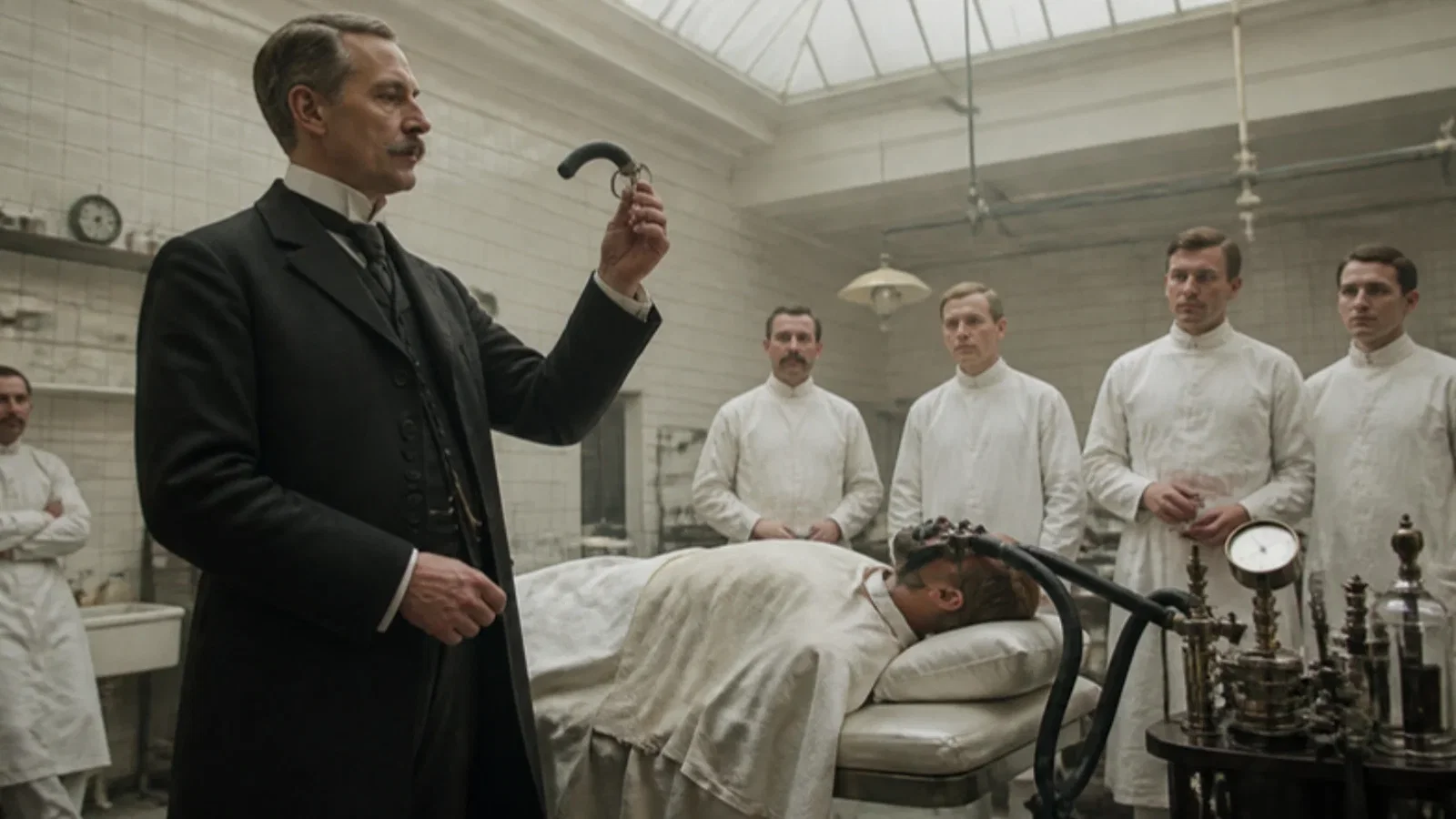
On 15 February 1908 Frederic W. Hewitt, anaesthetist to the King, described in the Lancet an artificial air-way: a grooved metal ring of half-inch bore held between the teeth, carrying a thick-walled rubber tube about three and a quarter inches long cut obliquely like a whistle, passed into the pharynx so that its opening faced the larynx, for patients breathing badly under anaesthesia.
Reading Library · Anesthesia Epochs · 中文版
Watch the education video (for clinicians)
1908: Hewitt's Artificial Air-Way — Frederic Hewitt · Anesthesia Epochs Education Series
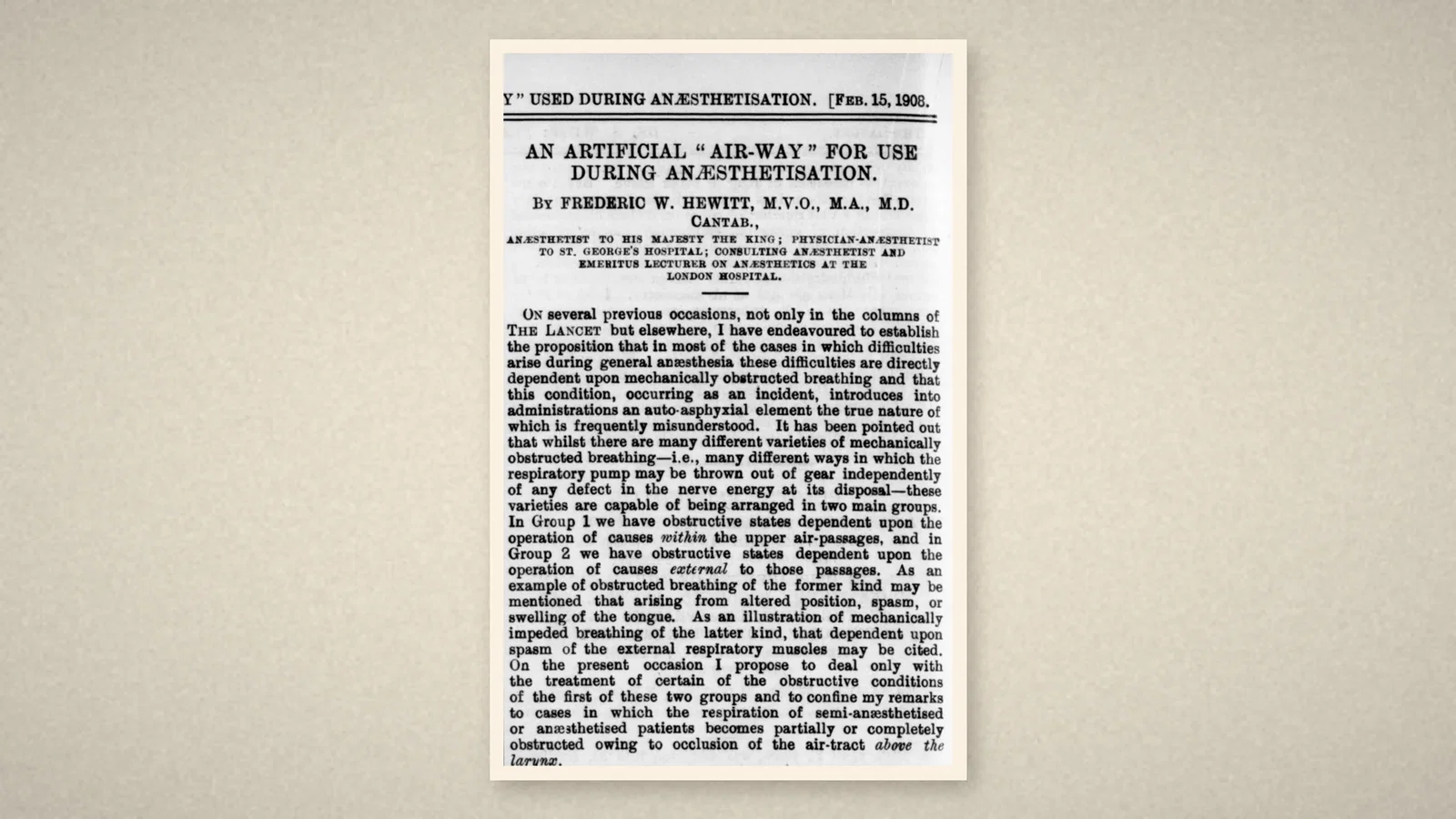
The oropharyngeal airway is so ordinary now that it is easy to forget it had to be argued for. The Australian Society of Anaesthetists' timeline calls the device that Frederic William Hewitt described in the Lancet in February 1908 the "earliest known oropharyngeal airway". This article reads that paper, "An artificial 'air-way' for use during anaesthetisation", printed on 15 February 1908, two columns of argument and one woodcut. [1][2]
Obstruction, not overdose
Hewitt, anaesthetist to the King and physician-anaesthetist to St George's Hospital, began by restating an argument made "on several previous occasions": that "in most of the cases in which difficulties arise during general anaesthesia these difficulties are directly dependent upon mechanically obstructed breathing", which introduces into the administration "an auto-asphyxial element the true nature of which is frequently misunderstood". Obstruction fell into two groups, causes within the upper air-passages and causes outside them, such as spasm of the respiratory muscles; this paper dealt only with occlusion "of the air-tract above the larynx". [1]
If anaesthetics were given through a tracheal cannula, as in physiological experiments, Hewitt wrote, textbook descriptions of anaesthesia would look very different, and "there would be much less intercurrent respiratory disturbance". But in surgery the vapour had to pass through "the ever-varying nasal and oral passages". Obstruction was especially likely in "the thick-set and plethoric", in the Trendelenburg posture, "in which the tongue gravitates towards the palate", and in rectal operations, which tended to cause reflex retraction of the tongue. Anaesthetists pushed the jaw forward, pulled the chin up, fitted a mouth-prop or applied tongue forceps. [1]
Patients under anaesthesia, Hewitt observed, drifted towards nasal breathing, and the nose often could not admit enough air. The abdominal and thoracic muscles then worked harder, and rigidity, cyanosis, dilated pupils and even pallor followed. "Auto-asphyxia thus insidiously arising is not infrequently mistaken for chloroform overdosage, surgical shock, or other conditions." [1]
The appliance
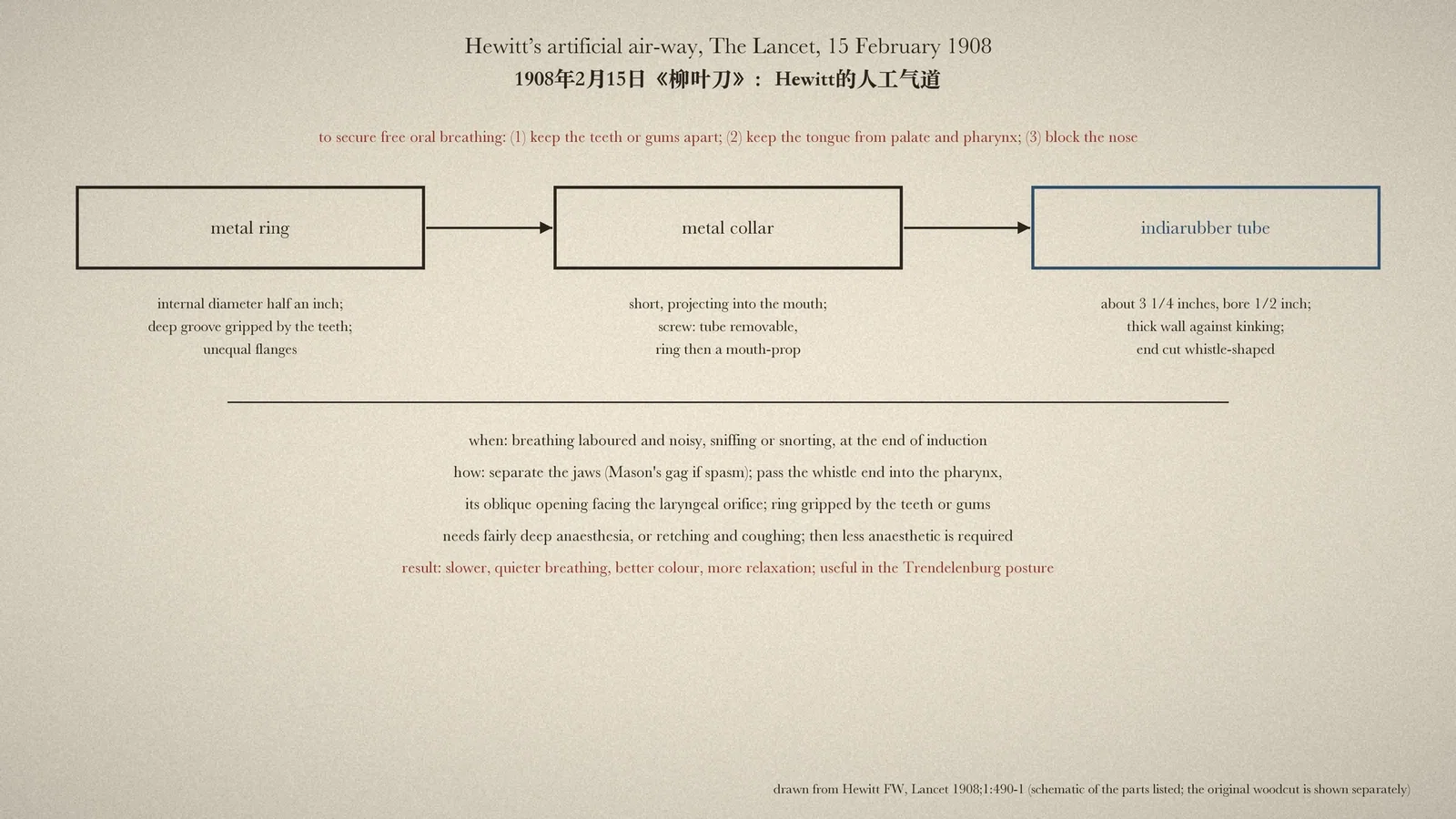
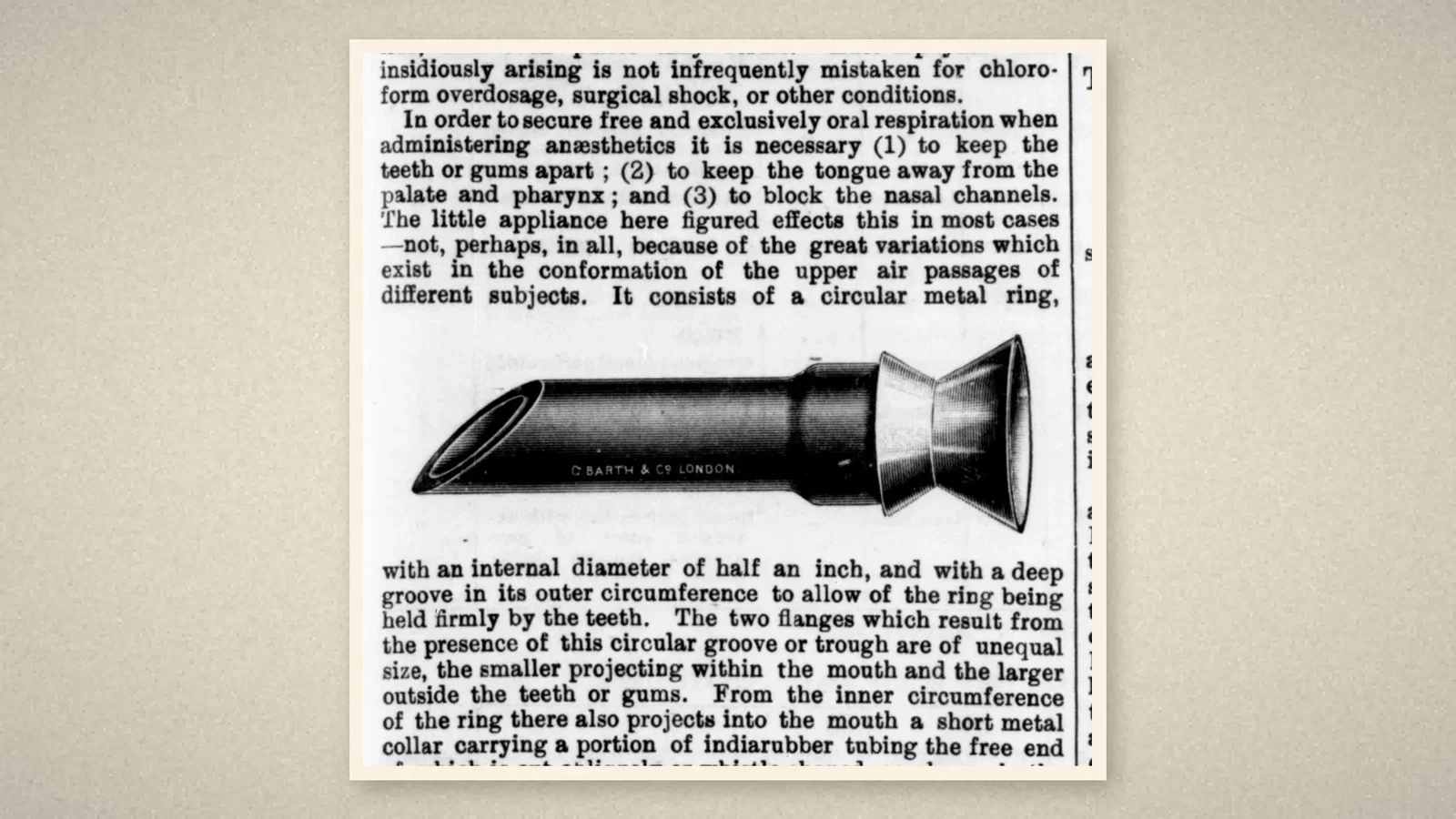
To secure free and exclusively oral breathing it was necessary "(1) to keep the teeth or gums apart; (2) to keep the tongue away from the palate and pharynx; and (3) to block the nasal channels". The appliance consisted of "a circular metal ring, with an internal diameter of half an inch, and with a deep groove in its outer circumference to allow of the ring being held firmly by the teeth", its two flanges of unequal size. From the ring a short metal collar carried a piece of rubber tubing "the free end of which is cut obliquely or whistle-shaped", about three and a quarter inches long, half an inch in bore, with a wall thick enough "to prevent kinking". Unscrewed from the tube, the ring served as a mouth-prop. [1]
When and how
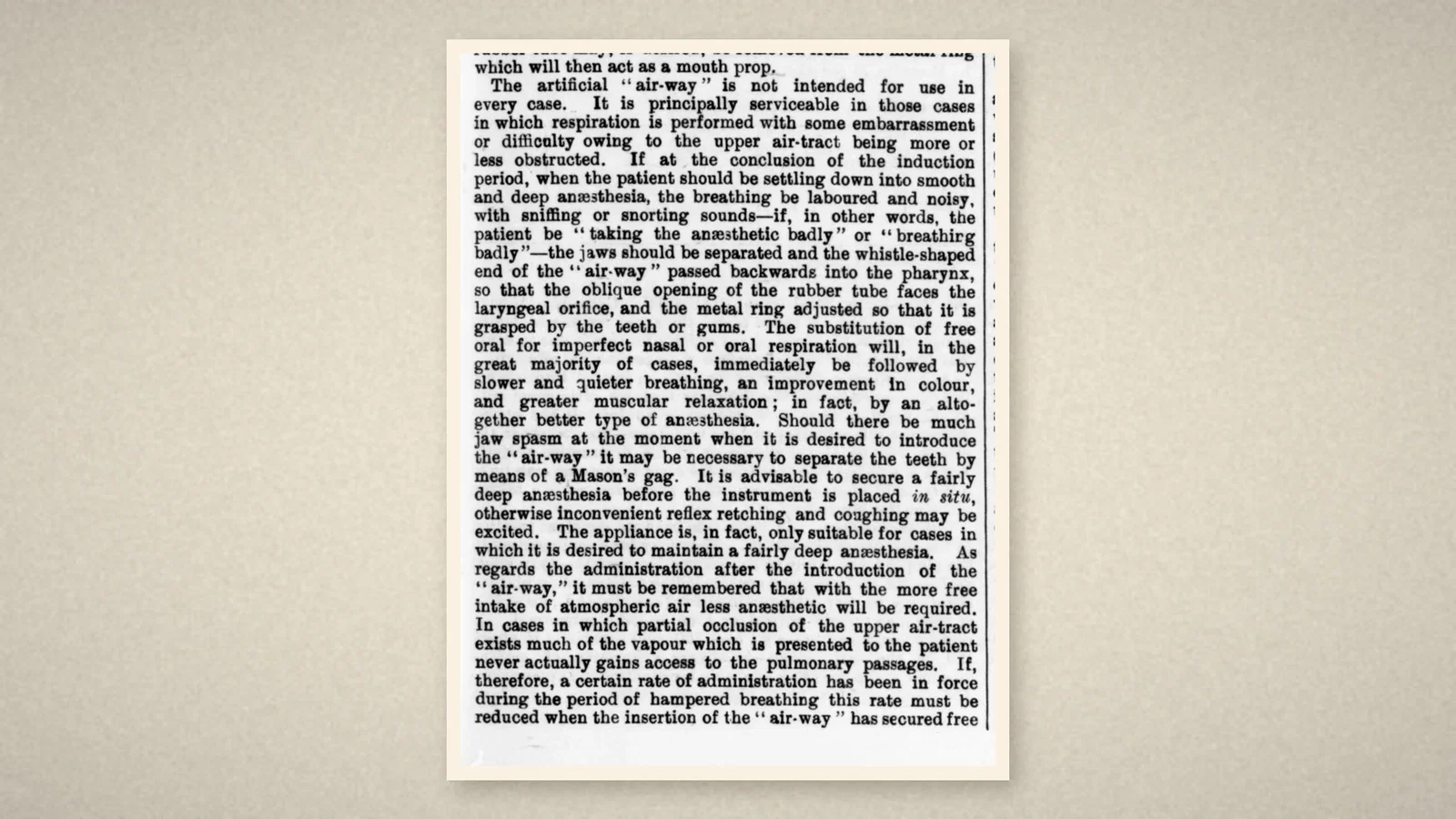
The air-way was "not intended for use in every case". If, at the end of induction, breathing was "laboured and noisy, with sniffing or snorting sounds", if the patient was "taking the anaesthetic badly", the jaws were separated and the whistle-shaped end passed back into the pharynx "so that the oblique opening of the rubber tube faces the laryngeal orifice", the ring gripped by the teeth or gums. In most cases, slower and quieter breathing, better colour and more relaxation followed at once. A Mason's gag might be needed if the jaw was in spasm, and anaesthesia had to be fairly deep before insertion, "otherwise inconvenient reflex retching and coughing may be excited". With free breathing, less anaesthetic was needed, since much of the vapour given during obstruction had never reached the lungs. Hewitt found it especially valuable in the Trendelenburg posture. It was made by Barth and Co. of Poland Street. [1]
What the record shows
Every element of airway management under a face mask is in these two pages: recognising noisy breathing as obstruction rather than as a drug problem; jaw thrust and chin lift as the first manoeuvres; an artificial channel that holds the tongue off the back of the pharynx, sized and stiffened so it does not kink; the warning that inserting it in light anaesthesia provokes coughing and retching; and the observation that relieving obstruction changes how much anaesthetic the patient actually receives. Hewitt's point that unrecognised obstruction mimics overdose remains a teaching point.
Sources and reading limits
Read: Hewitt's paper in the Lancet of 15 February 1908, pp. 490-491, in full, with its woodcut; the ASA timeline entry for 1908.
Not covered: Hewitt's earlier papers on obstructed breathing; the editions of Hewitt's textbook; later modifications of the air-way; the Wood Library-Museum pages, which could not be accessed. The date of 1902 sometimes given is not supported by these pages, and the article uses the 1908 paper. The ASA calls this the earliest known oropharyngeal airway; the article makes no claim of first.
Three illustrations are crops of the 1908 Lancet, including its woodcut; one is drawn from the paper.
- Hewitt FW. An artificial "air-way" for use during anaesthetisation. Lancet. 1908;1:490-1. Internet Archive
- Australian Society of Anaesthetists. Anaesthesia history timeline. 2024. ASA
Continue exploring
Related reading connects shared questions and contexts; it does not by itself establish historical influence.
Anesthesia Epochs · The Source Room · About & Editorial Method
Published November 2, 2026. Sources and reading limits are stated above. Illustrations are labelled as original source images or AI-made. Historical accounts are educational; they are not current treatment instructions.