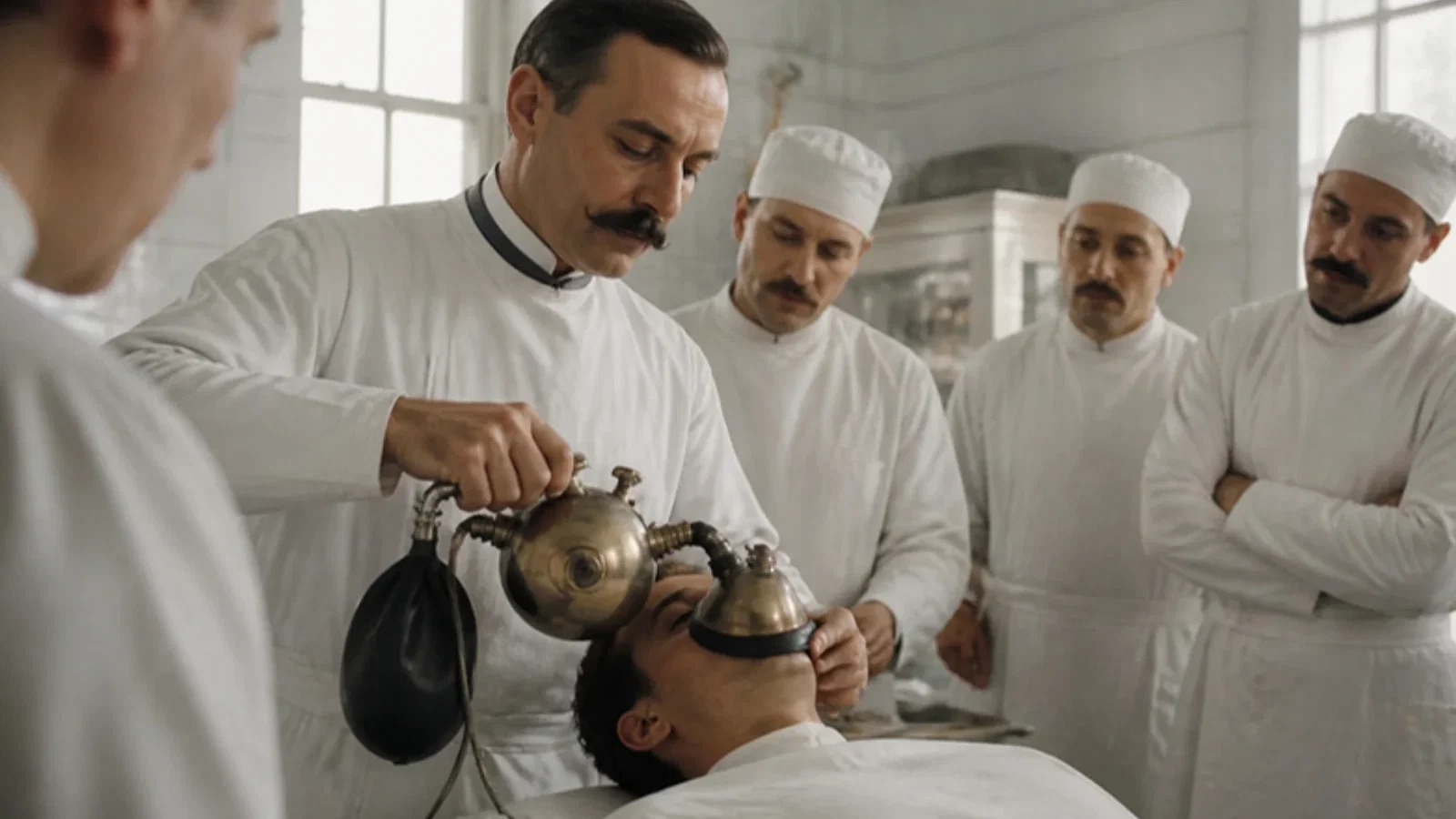
On 11 March 1908 Ombrédanne presented an apparatus for ether anaesthesia to the Société de chirurgie de Paris; on 15 July Nélaton reported that patients breathed a confined atmosphere of pure air, ether vapour and their own expired carbon dioxide, in proportions varied at will, starting on confined air alone and adding ether only after two minutes, in 300 operations over seven months.
Reading Library · Anesthesia Epochs · 中文版
Watch the education video (for clinicians)
1908: Ombrédanne's Ether Inhaler — Paris · Anesthesia Epochs Education Series
In France at the start of the last century, surgeons faced a familiar choice: chloroform, convenient and quick but liable to kill on the table, or ether, safer at the time of operation but unpleasant to give and blamed for deaths from bronchitis afterwards. The Australian Society of Anaesthetists (ASA) dates the Ombrédanne ether inhaler to 1907, names its designer as Professor Louis Ombrédanne (1871-1956), a French paediatric and plastic surgeon, and says the device became popular in military circles and is said to have been used as late as the Falklands War of 1982. This article reads how it first came before the Société de chirurgie de Paris in 1908, in the Society's printed Bulletins. [1][2][3]
A presentation and a report
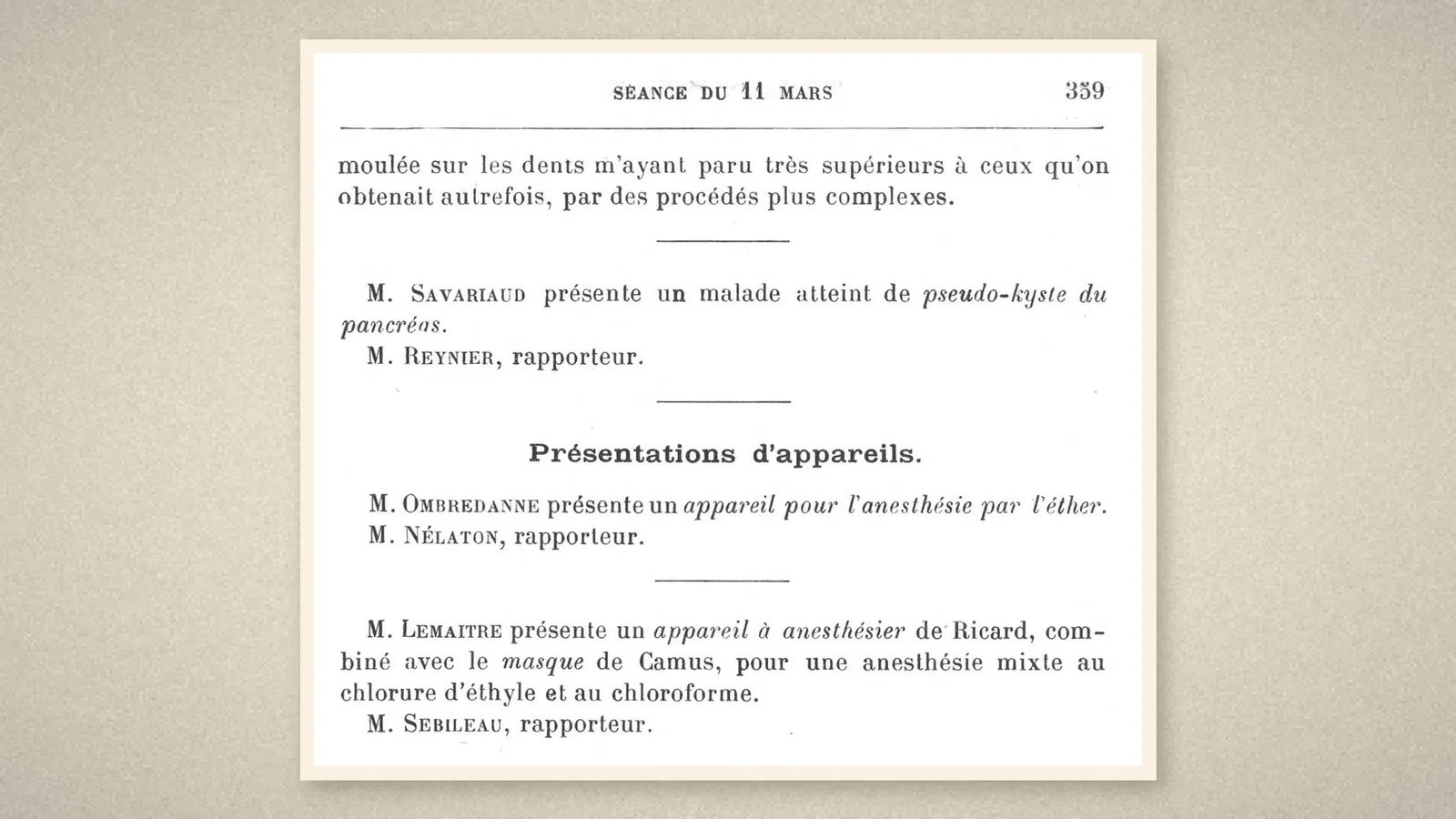
The record of the meeting of 11 March 1908 is one line long. Under "Présentations d'appareils": "M. Ombredanne présente un appareil pour l'anesthésie par l'éther. M. Nélaton, rapporteur." [2]
Nélaton's report came on 15 July. It does not describe the apparatus: Ombrédanne had drawn the Society a schema "whose mere inspection is much more instructive than a difficult and tedious description", and that drawing is not printed. Instead the report recalls "the idea that presided over its construction": to let patients breathe "a mixture of ether vapour, of air charged with carbonic acid and of pure air in proportions that one varies at will". Nélaton had used the apparatus in the surgical service since the previous December. [1]
Three objections to ether
Nélaton set out why chloroform had generally prevailed. First, if ether did not kill on the operating table, it killed, "frankly in about the same proportion", through the bronchitis it caused in the following three or four days. Second, ether given with the Julliard mask, the Landau bag or the "Glover" apparatus (the printed spelling; Clover's inhaler is evidently meant) was "ugly to watch": excitement, stertorous breathing, a cyanosed face, salivation and tracheobronchial rattles. Third, in abdominal operations the patients often strained, a considerable hindrance to the surgeon. Ombrédanne claimed to remove the last two and greatly reduce the first. [1]
The method
Ombrédanne's procedure was to have the patient breathe "a confined atmosphere, composed of pure air, of ether vapour and of carbonic acid supplied by the expired air". Rebreathing was not new: the closed apparatus built in Germany and England, of which the best known was the "Glover" mask, let the patient breathe only ether mixed with expired air. That produced narcosis quickly, but also cyanosis and asphyxia, so the mask had to be lifted until the face turned pink and the patient woke, and then the cycle began again. Ombrédanne had made the idea practical by also admitting a small quantity of pure air. [1]
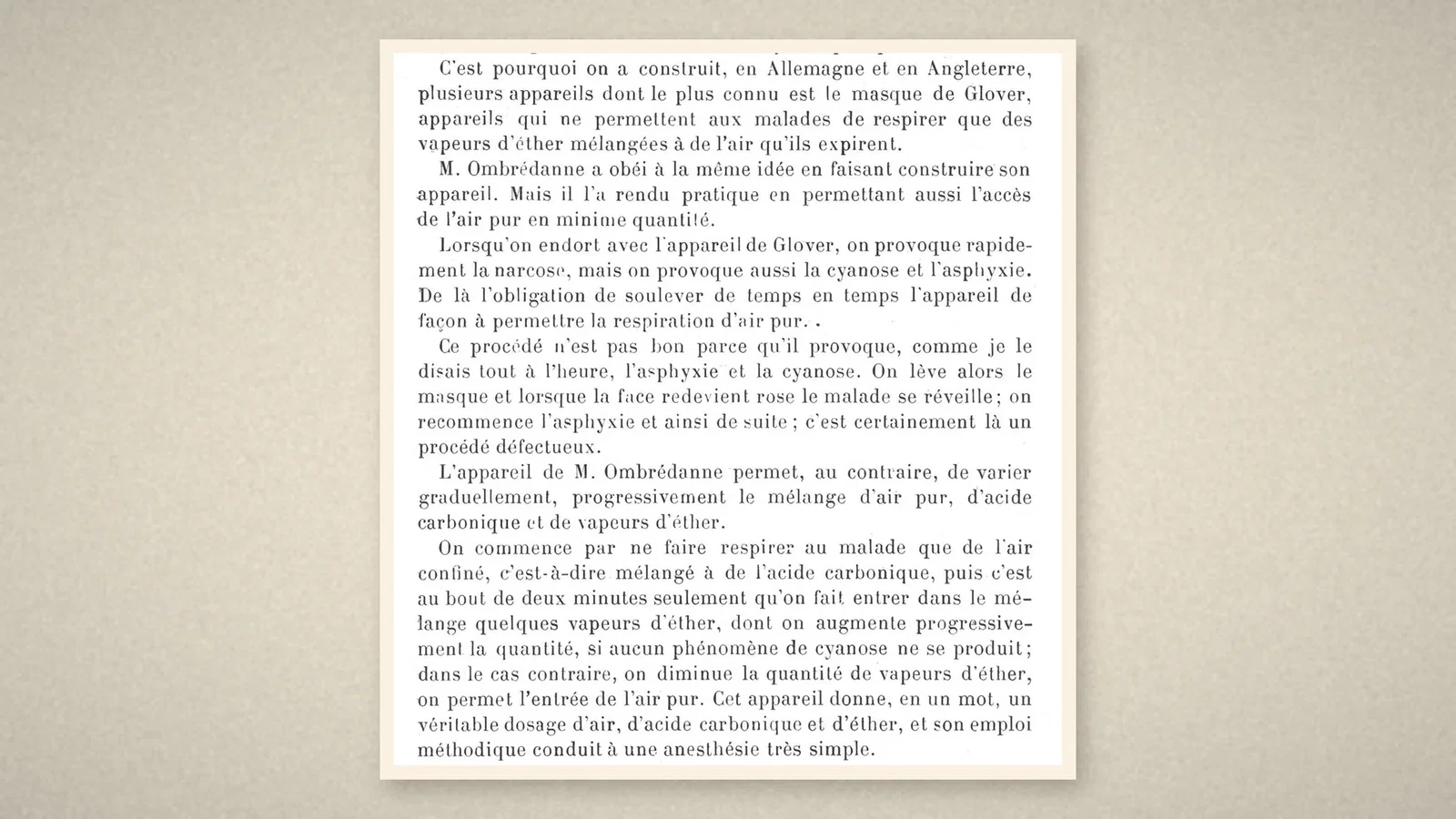
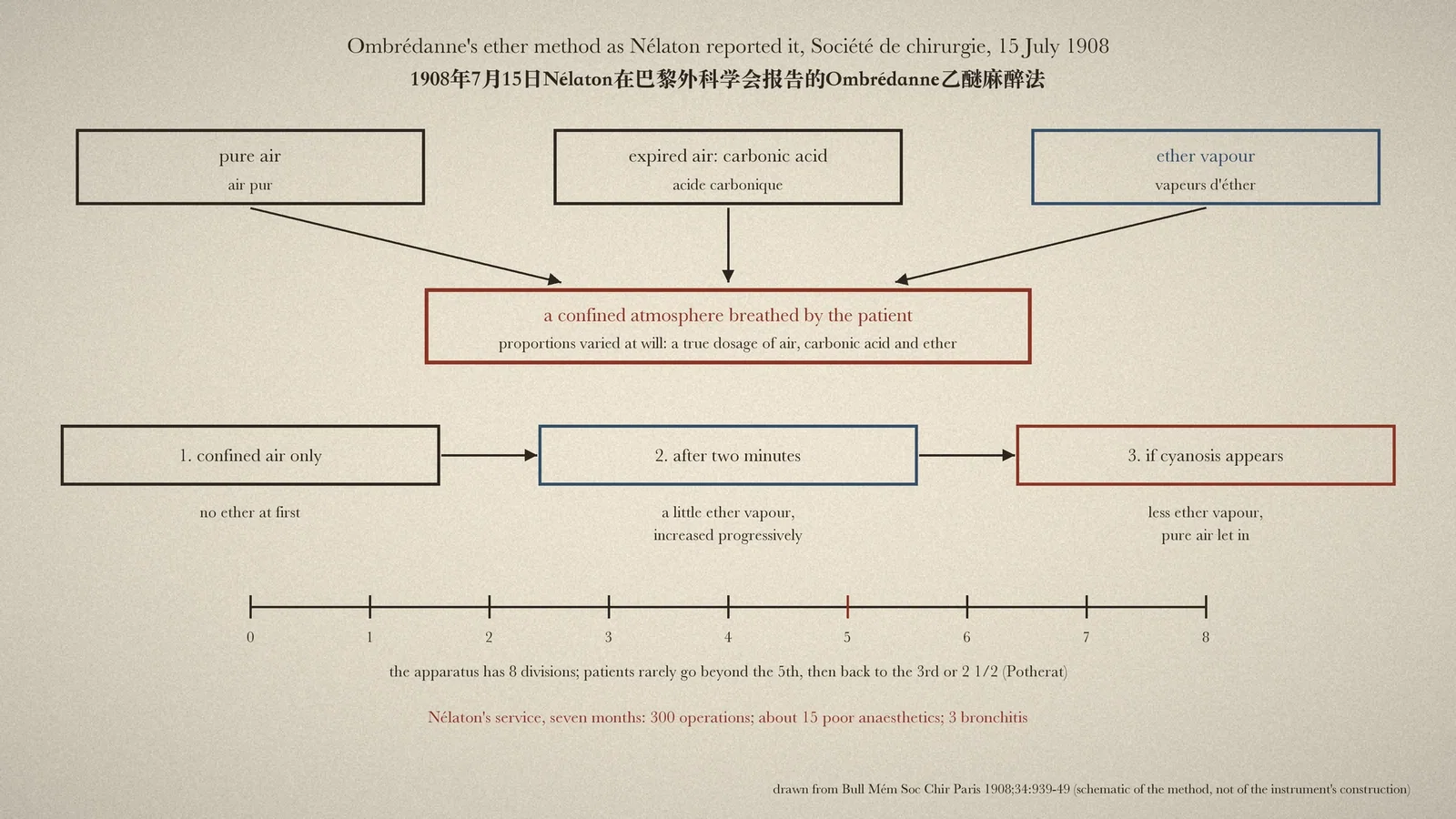
The patient first breathed only the confined air, mixed with carbonic acid; "only after two minutes" did a little ether vapour enter, increased progressively if no cyanosis appeared. If cyanosis did appear, the ether was reduced and pure air let in. "In a word, this apparatus gives a true dosage of air, carbonic acid and ether." Nélaton cited Langlois's summary of recent work by Henderson: small changes in carbon dioxide, unlike large changes in oxygen, profoundly altered breathing and, in turn, the heart. [1]
Results and the discussion
In seven months Nélaton's service had done 300 operations with the apparatus, at all ages and in tuberculous patients as well as healthy ones. Almost all had an anaesthetic "comparable to that given by chloroform", with little or no excitement, no cyanosis, no salivation and no abdominal straining. About fifteen were poor: one man refused the mask and left; ten had real cyanosis and salivation; there were three cases of bronchitis, one of them a serious bronchopneumonia. Nélaton concluded that the accident of ether, bronchitis, was no more frequent with the new apparatus than syncope with chloroform, and preferred "by far" the former. [1]
The discussion was not unanimous. Tuffier called it "an undeniable advance" after five months without a death or serious accident. Pierre Delbet had been less satisfied and had almost given it up: twice in mid-operation Delbet changed to chloroform with Roth's apparatus, and a patient who died the morning after a gastro-enterostomy had acute pulmonary congestion that Delbet attributed to ether. Paul Reynier was surprised to see "carbonic, that is to say asphyxial" anaesthesia added to ether. E. Potherat welcomed one practical point: the ether stayed inside the apparatus, so cautery could be used. Potherat also gave the only detail of construction in these pages: "In Ombrédanne's apparatus there are 8 divisions"; patients rarely needed more than the 5th, and once asleep could go back to the 3rd. [1]
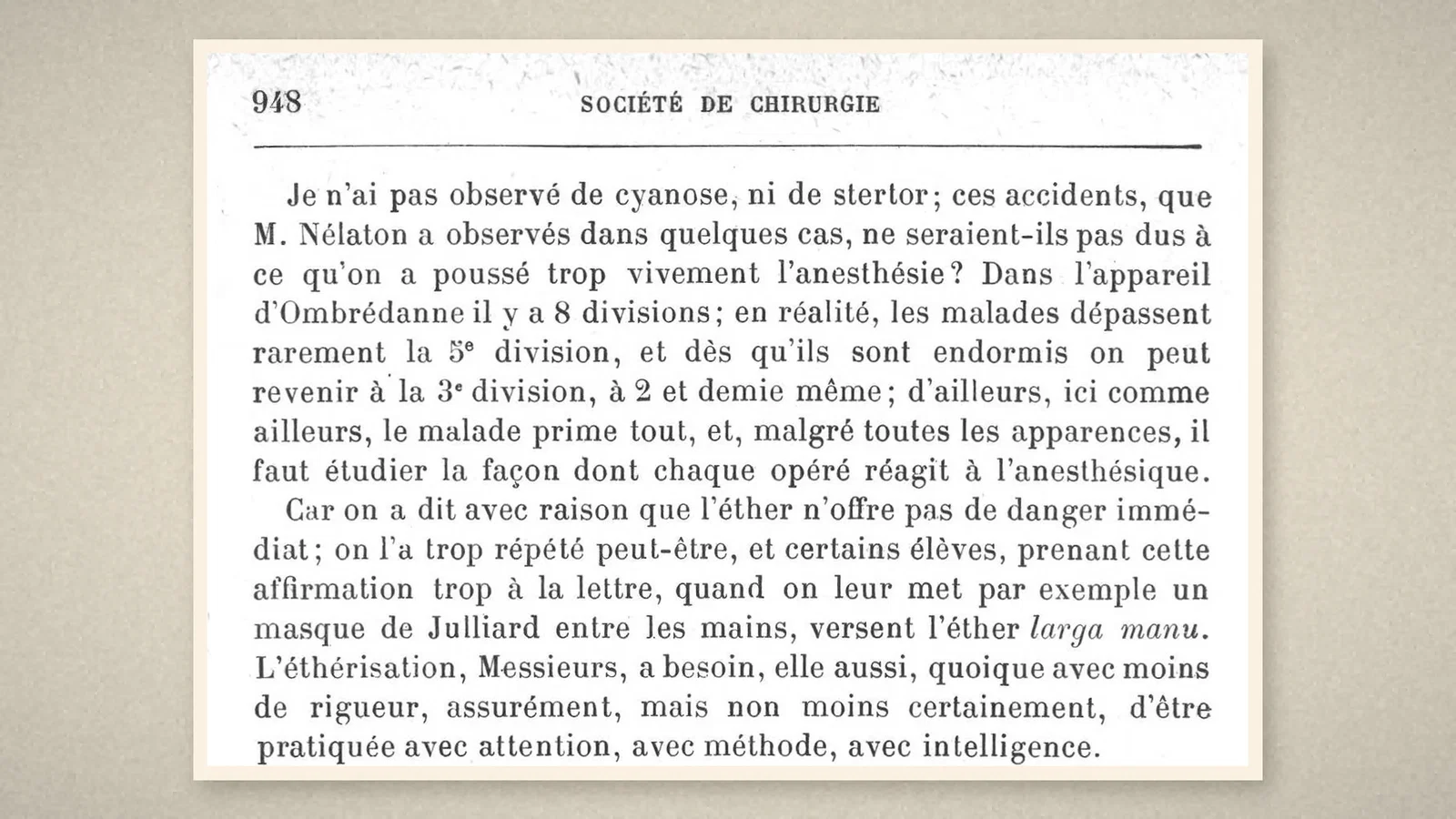
What the record shows
The Ombrédanne story is about control of the inspired mixture. It joins three ideas: rebreathing to conserve vapour and carbon dioxide, a small admission of fresh air against asphyxia, and a graduated control that a student could turn up or down. The 1908 discussion also shows how a new device is judged: a large series from a convinced user, a cautious colleague with a death, a physiological objection, and a practical benefit no one had set out to prove. Reynier's doubt about adding carbon dioxide was the right question; later anaesthesia removed carbon dioxide from the circuit rather than relying on it.
Sources and reading limits
Read: the Bulletins et mémoires de la Société de chirurgie de Paris for 1908, at p. 359 (meeting of 11 March) and pp. 939-49 (Nélaton's report of 15 July and the discussion); the ASA timeline add-ons entry for 1907.
Not covered: Ombrédanne's own description and the schema shown to the Society; the Gazette des hôpitaux account of August 1908; any patent; later descriptions of the inhaler's internal construction. The ASA dates the inhaler to 1907 and says it was designed after two anaesthetic deaths, with a first prototype made from a biscuit tin and a caecal or bladder bag; these details, and the later military use, are not in the 1908 Bulletins and are given here as the ASA's. First use in late 1907 is consistent with Nélaton's "since December", but the article is dated to the presentation of 11 March 1908. The case figures are Nélaton's; the cause of Delbet's patient's death is Delbet's judgement. The article makes no "first" claim. French quotations are translated for this article.
Three illustrations are crops of pages of the 1908 Bulletins; one is drawn from the report and does not depict the instrument.
- Nélaton. Sur un nouveau procédé d'anesthésie par l'éther, de M. Ombrédanne [report]; discussion by Tuffier, Delbet P, Reynier P, Potherat E. Bull Mém Soc Chir Paris. 1908;34:939-49. Internet Archive
- Séance du 11 mars 1908. Présentations d'appareils. Bull Mém Soc Chir Paris. 1908;34:359. Internet Archive
- Australian Society of Anaesthetists. Anaesthesia history timeline: add-ons. 2024. ASA
Continue exploring
Related reading connects shared questions and contexts; it does not by itself establish historical influence.
Anesthesia Epochs · The Source Room · About & Editorial Method
Published November 2, 2026. Sources and reading limits are stated above. Illustrations are labelled as original source images or AI-made. Historical accounts are educational; they are not current treatment instructions.