
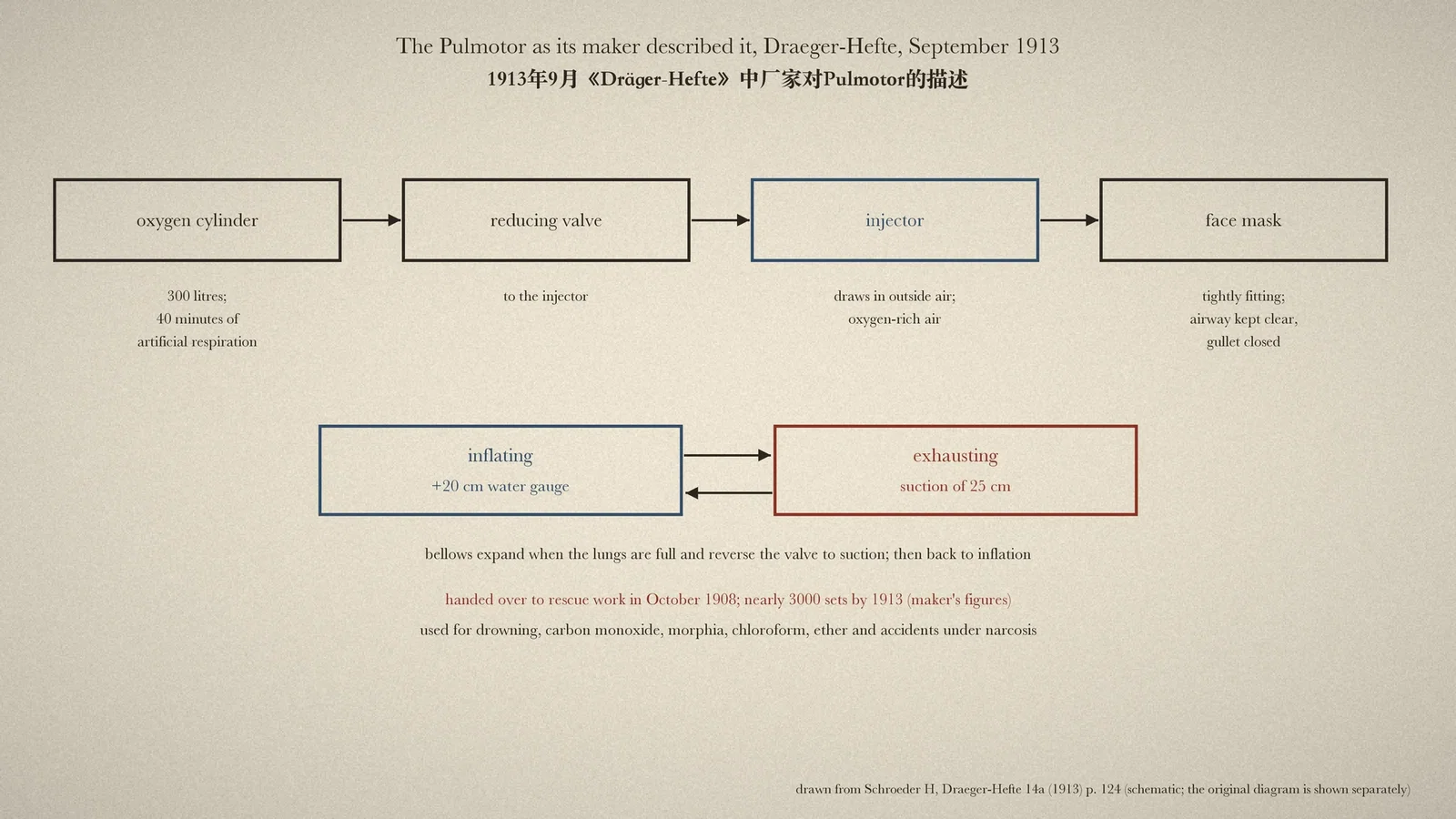
According to Drägerwerk's English special edition of 1913, the Pulmotor was handed over to rescue work in October 1908: a 300-litre oxygen cylinder drove an injector that blew oxygen-rich air through a face mask into the lungs at 20 cm of water, until a bellows reversed the valve and the lungs were emptied under a suction of 25 cm, cycling automatically for 40 minutes.
Reading Library · Anesthesia Epochs · 中文版
Watch the education video (for clinicians)
1908: The Dräger Pulmotor — Drägerwerk, Lübeck · Anesthesia Epochs Education Series
Fell's bellows of 1887 needed a doctor, a tracheotomy and tireless hands (see that article). The Draeger "Pulmotor" promised to do the same work automatically, with a face mask, in the hands of a fireman. The History of Anaesthesia Society timeline calls it "the first Intermittent Positive Pressure Ventilation (IPPV) device" and places it in Germany in 1907. This article reads the Pulmotor as its maker described it, in an English special edition of the company's journal, the Draeger-Hefte, published in Lübeck in September 1913. [1][2]
An oxygen reviving machine
In an article titled "Draeger reviving apparatus", engineer Hans Schroeder explained that the "Oxygen Reviving Machine 'Pulmotor'" differed from all other reviving apparatus "insofar as it not only employs the Oxygen as a reviving agent, but also as a motive power for automatic artificial respiration. The tiring manual work is unnecessary with this Machine." Its use, the article claimed, was "so simple that every layman is able to learn its application". [1]
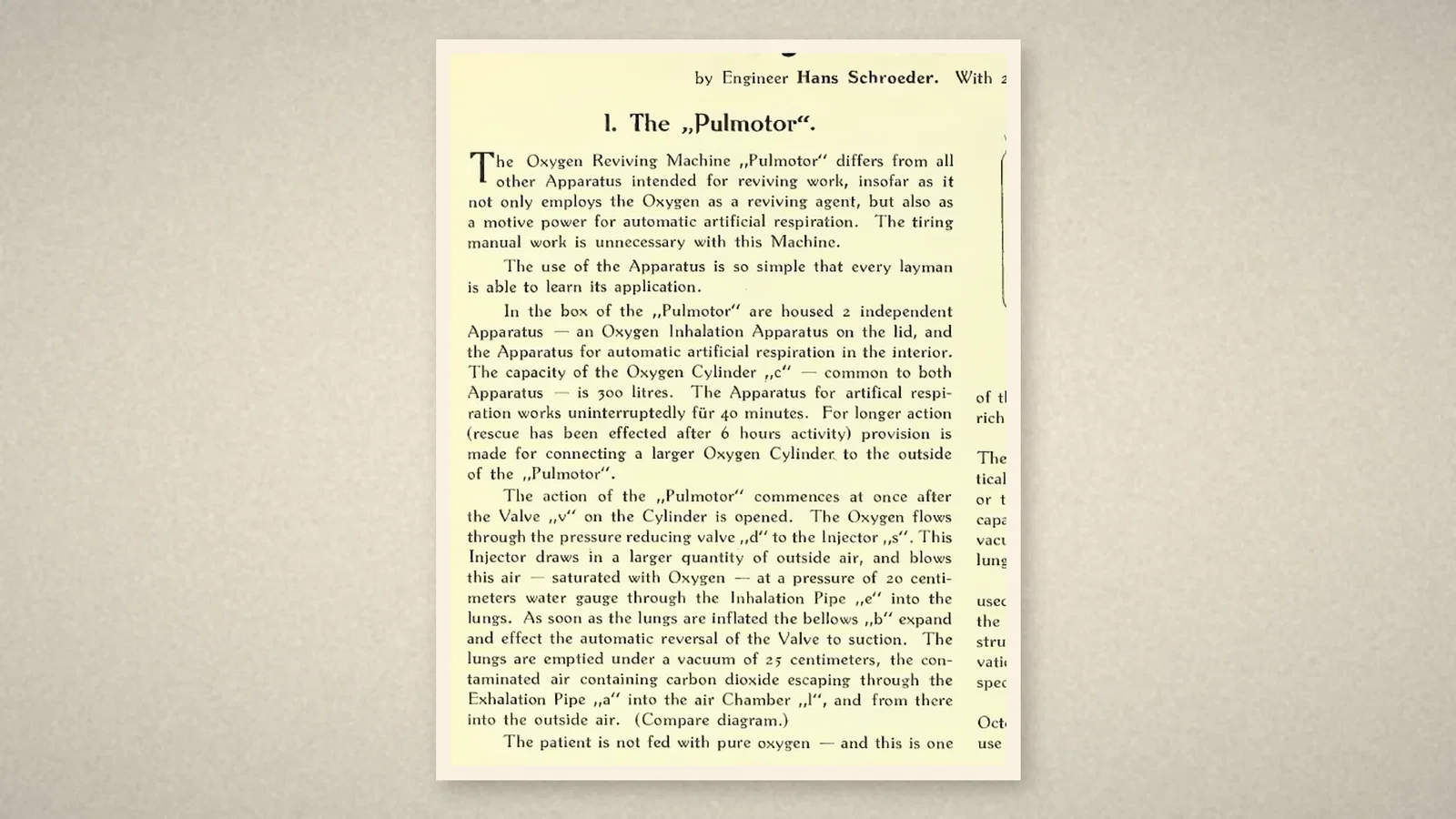
The box held two independent apparatus: an oxygen inhalation apparatus on the lid and the apparatus for automatic artificial respiration inside, both fed by one oxygen cylinder of 300 litres. The respirator ran "uninterruptedly for 40 minutes"; for longer use a larger cylinder could be connected outside, and the article mentions a rescue "after 6 hours activity". [1]
How it worked
When the cylinder valve was opened, oxygen flowed through a pressure-reducing valve to an injector. "This Injector draws in a larger quantity of outside air, and blows this air — saturated with Oxygen — at a pressure of 20 centimeters water gauge through the Inhalation Pipe into the lungs. As soon as the lungs are inflated the bellows expand and effect the automatic reversal of the Valve to suction. The lungs are emptied under a vacuum of 25 centimeters", the expired air escaping through an exhalation pipe into the open. The patient was given "not ... pure oxygen" but "air rich in Oxygen", and residual air could not re-enter the lungs. [1]
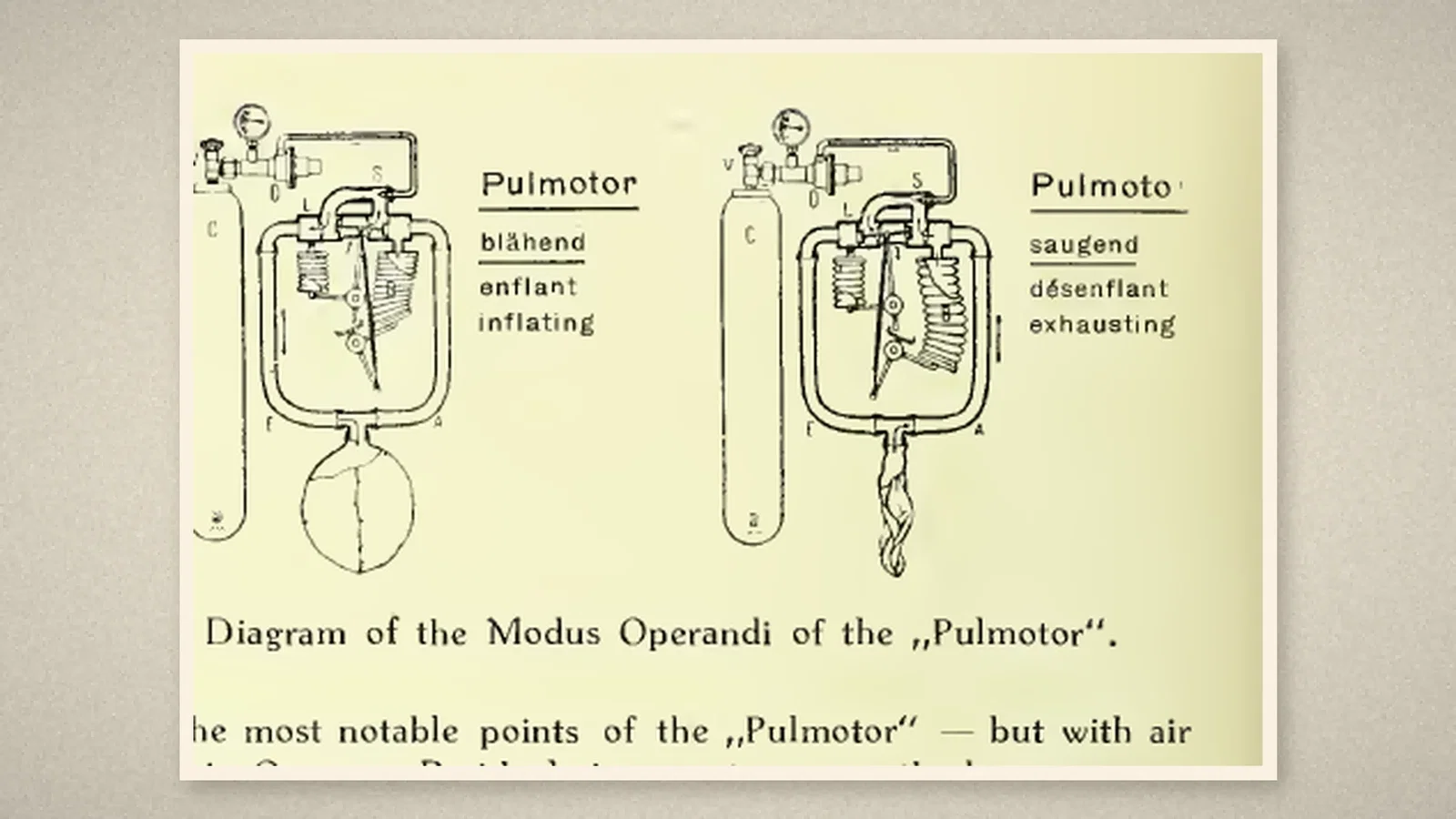
The breathing pipes led to "a tightly fitting Face Mask", and the rhythm "adapts itself automatically to the size of the lungs". The article claimed that pressure and vacuum were independent of lung capacity and "can never have any harmful effect on the tissues of the lungs". The instructions packed with every set stressed above all "keeping the air way clear and ... closing the gullet". [1]
Rescue service, not the operating theatre
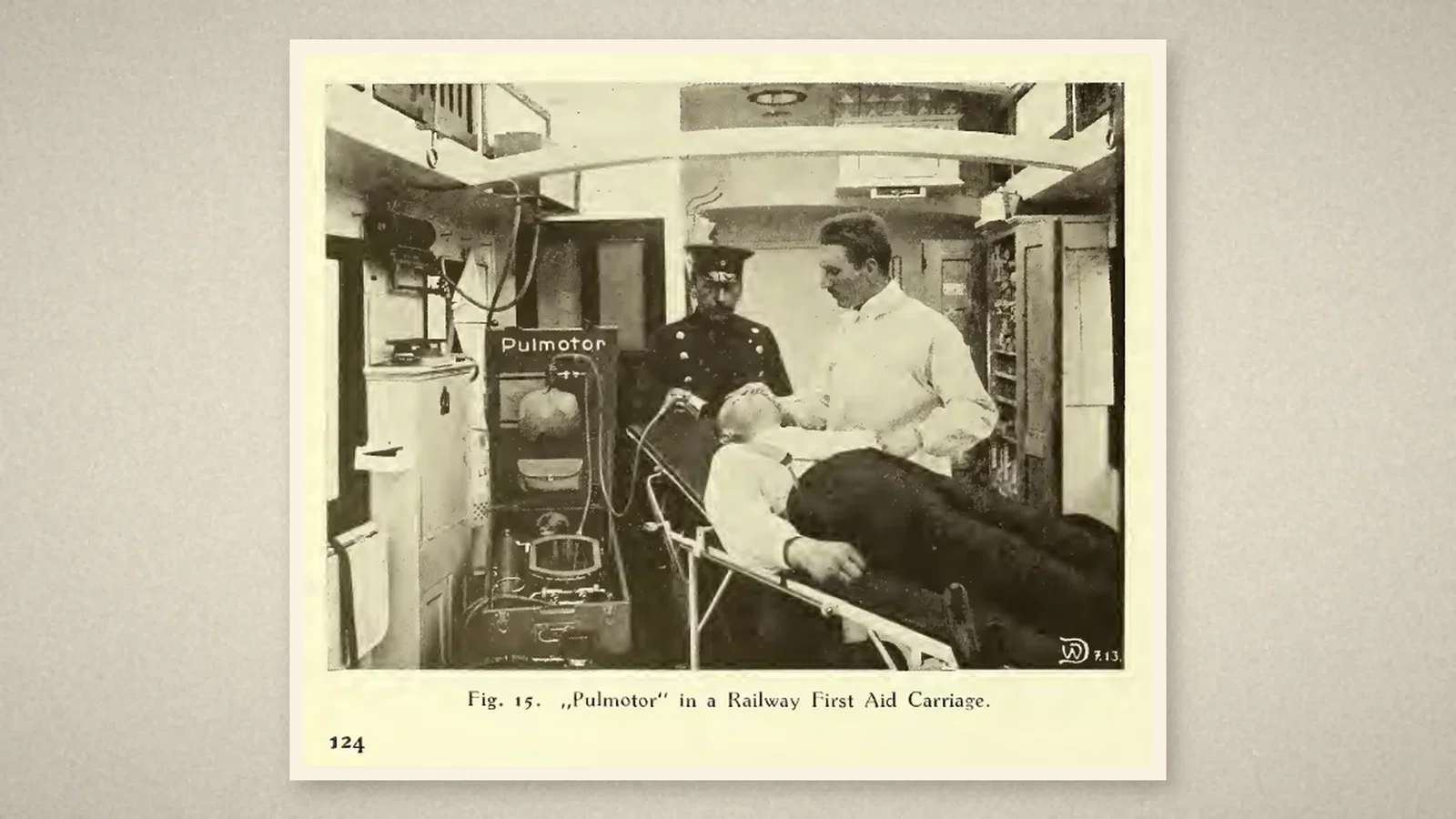
The Pulmotor "was handed over to rescue work in October 1908". By 1913, according to the article, nearly 3000 sets were in use throughout the world, taken up first by the large fire brigades of central Europe, and "227 lives have been saved during the last 19 months". It had been used in asphyxia from hanging and drowning; in poisoning by carbon monoxide, coal gas, smoke, morphia, chloroform and ether; in electric shock; and in "accidents under narcosis". A "Baby Pulmotor" had been used to revive newborn babies. The same publication shows a photograph of the Pulmotor in a railway first-aid carriage. [1]
What the record shows
The Pulmotor brought together, in a portable box, ideas that anaesthetic ventilators would keep: a compressed-gas power source, an injector entraining air to make an oxygen-enriched mixture, a set inflation pressure, an automatic switch from inspiration to expiration, and a face mask with instructions to keep the airway open and close the oesophagus. Its active suction phase, sucking the lungs out at 25 cm of water, did not last; modern ventilators let expiration happen passively. The maker's assurance that its pressures could never harm the lung is the kind of claim that independent evaluation, not a catalogue, has to settle.
Sources and reading limits
Read: the September 1913 English special edition of the Draeger-Hefte, in full, including p. 124 (the Pulmotor article, its diagram and Fig. 15); the HAS timeline entry for 1907.
Not covered: the Dräger patents for the Pulmotor; any Dräger publication of 1907 or 1908; independent clinical evaluations and later criticism. The HAS gives 1907; the 1913 text says the Pulmotor was handed over to rescue work in October 1908, and the article uses that date. The numbers of sets and of lives saved, and the safety claims, are the manufacturer's own. The photograph is a demonstration scene in the maker's publication. The article does not call the Pulmotor the first ventilator.
Three illustrations are crops of p. 124 of the 1913 publication, including its diagram and photograph; one is drawn from the article.
- Schroeder H. Draeger reviving apparatus: 1. The Pulmotor. In: Drägerwerk. The apparatuses of the system Draeger in the international rescue-service. Draeger-Hefte No. 14a (special edition). Lübeck: Drägerwerk; 1913 Sep. p. 124. Internet Archive
- History of Anaesthesia Society. Timeline. HAS
Continue exploring
Related reading connects shared questions and contexts; it does not by itself establish historical influence.
Anesthesia Epochs · The Source Room · About & Editorial Method
Published November 2, 2026. Sources and reading limits are stated above. Illustrations are labelled as original source images or AI-made. Historical accounts are educational; they are not current treatment instructions.