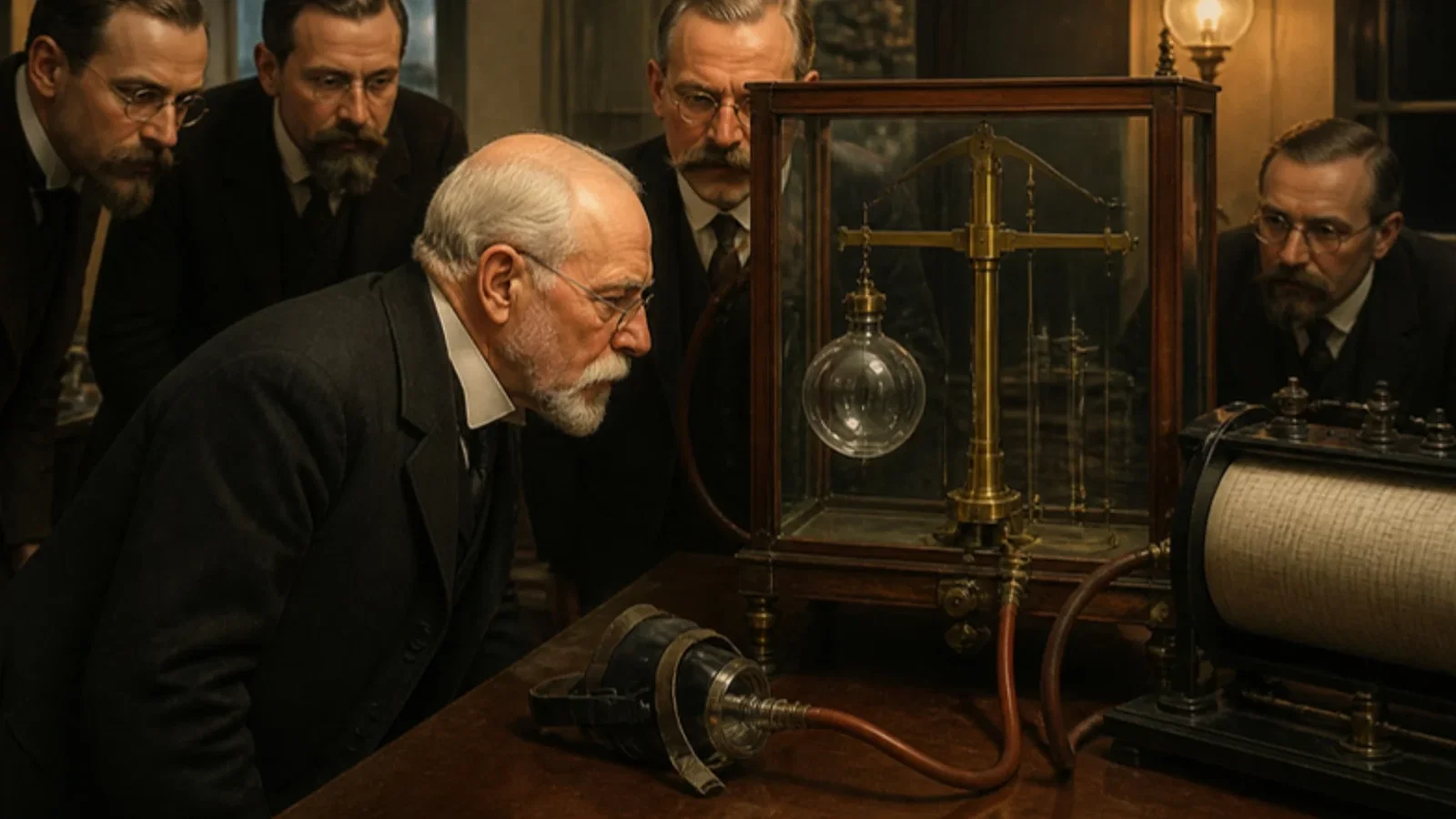
On 22 February 1908 A. D. Waller showed the Physiological Society a 'chloroform balance': a closed 450 c.c. glass bulb hung from the beam of an ordinary cheap balance inside a 30-litre case through which the chloroform-laden air passed on its way to the mask; as the heavier vapour changed the bulb's buoyancy, a pointer showed the percentage and a pen on the beam could record it on a smoked drum.
Reading Library · Anesthesia Epochs · 中文版
Watch the education video (for clinicians)
1908: Waller's Chloroform Balance — London · Anesthesia Epochs Education Series
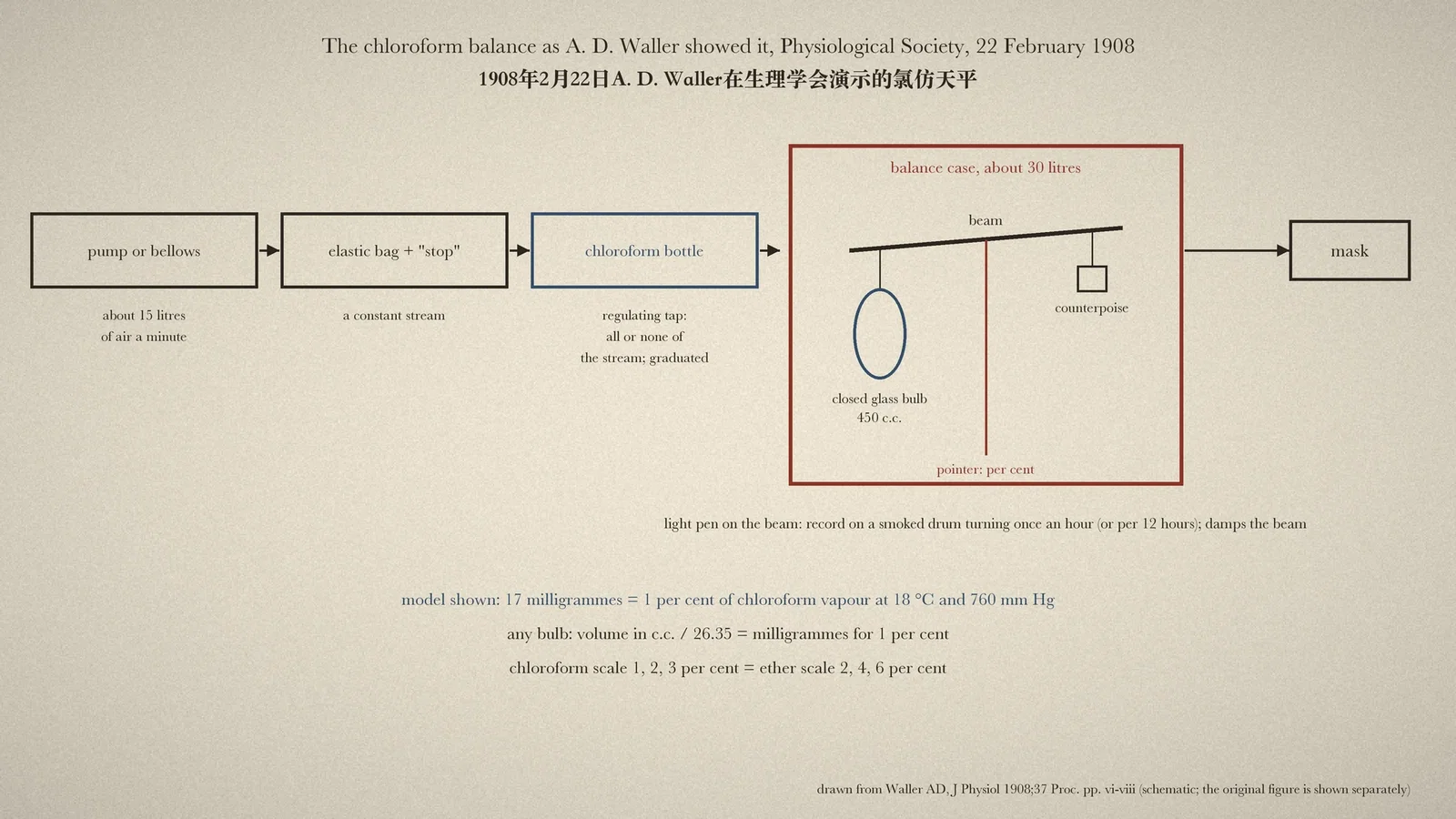
A modern anaesthetic monitor shows the inspired and expired concentration of the volatile agent as a number that updates with every breath. Early in the last century the question of how much chloroform a patient was actually breathing had no such answer: the dose was the number of drops on a mask. The History of Anaesthesia Society (HAS) timeline records that on 22 February 1908 Augustus D. Waller described a "chloroform balance" to the Physiological Society in London, and calls it the first apparatus "to give a continuous and almost instantaneous reading" of the vapour concentration. This article reads Waller's own short communication, printed in the Proceedings of the Society bound with the Journal of Physiology for 1908. [1][3]
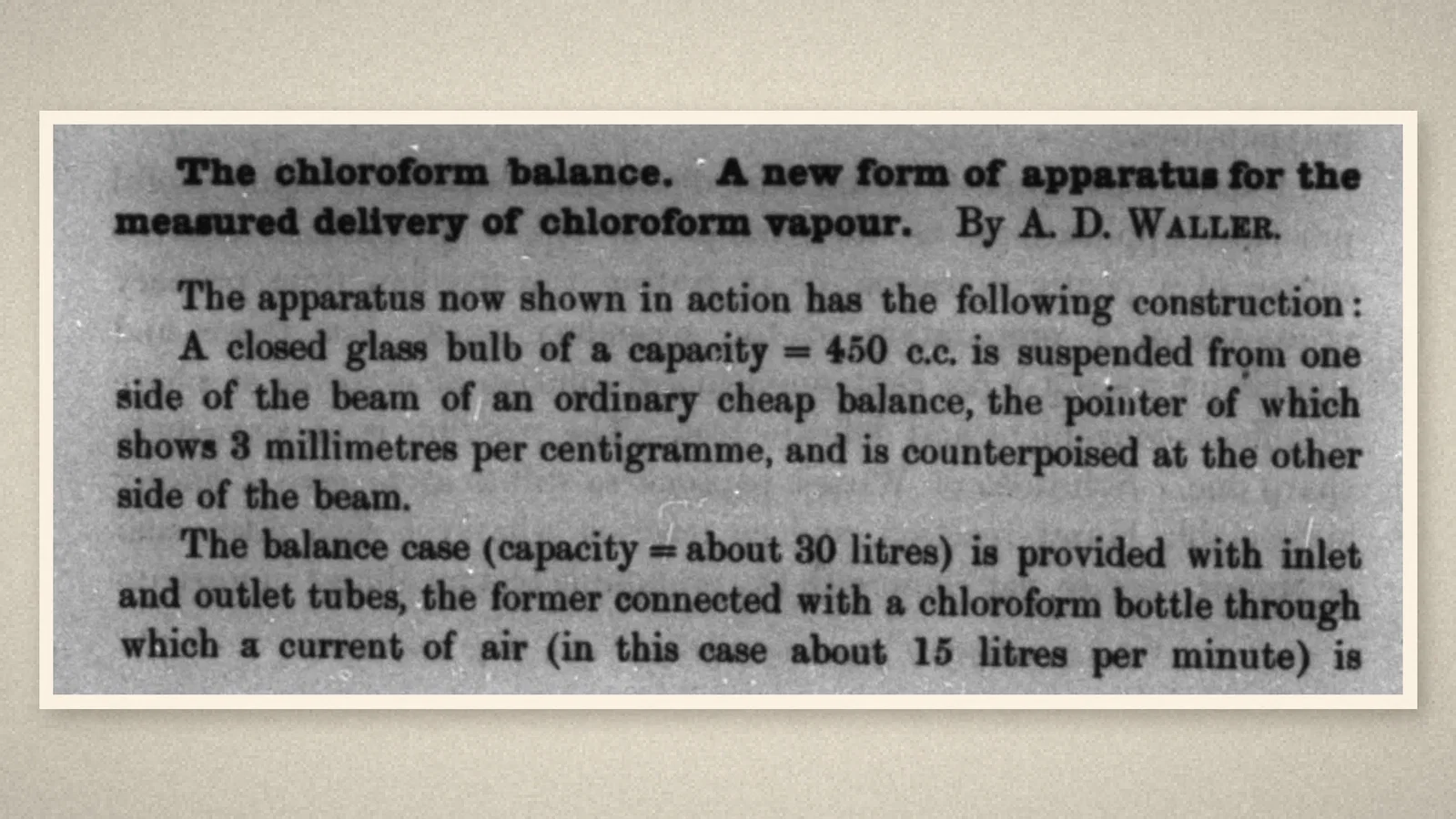
The apparatus
The title is "The chloroform balance. A new form of apparatus for the measured delivery of chloroform vapour", and the apparatus was "now shown in action". Its construction was simple. "A closed glass bulb of a capacity = 450 c.c. is suspended from one side of the beam of an ordinary cheap balance", whose pointer moved 3 millimetres per centigramme, with a counterpoise on the other side of the beam. The whole balance stood in its case, of about 30 litres, which became part of the breathing circuit. [1]
The inlet of the case was connected to a chloroform bottle through which a pump or bellows drove a current of air, about 15 litres a minute in the model shown. An elastic bag and a perforated "stop" in the tube kept the stream constant, and a regulating tap on the bottle passed "all or none of the stream of air" through the chloroform at will; the bottle was graduated. The outlet led to "the mask or tube by which the mixture is delivered". [1]
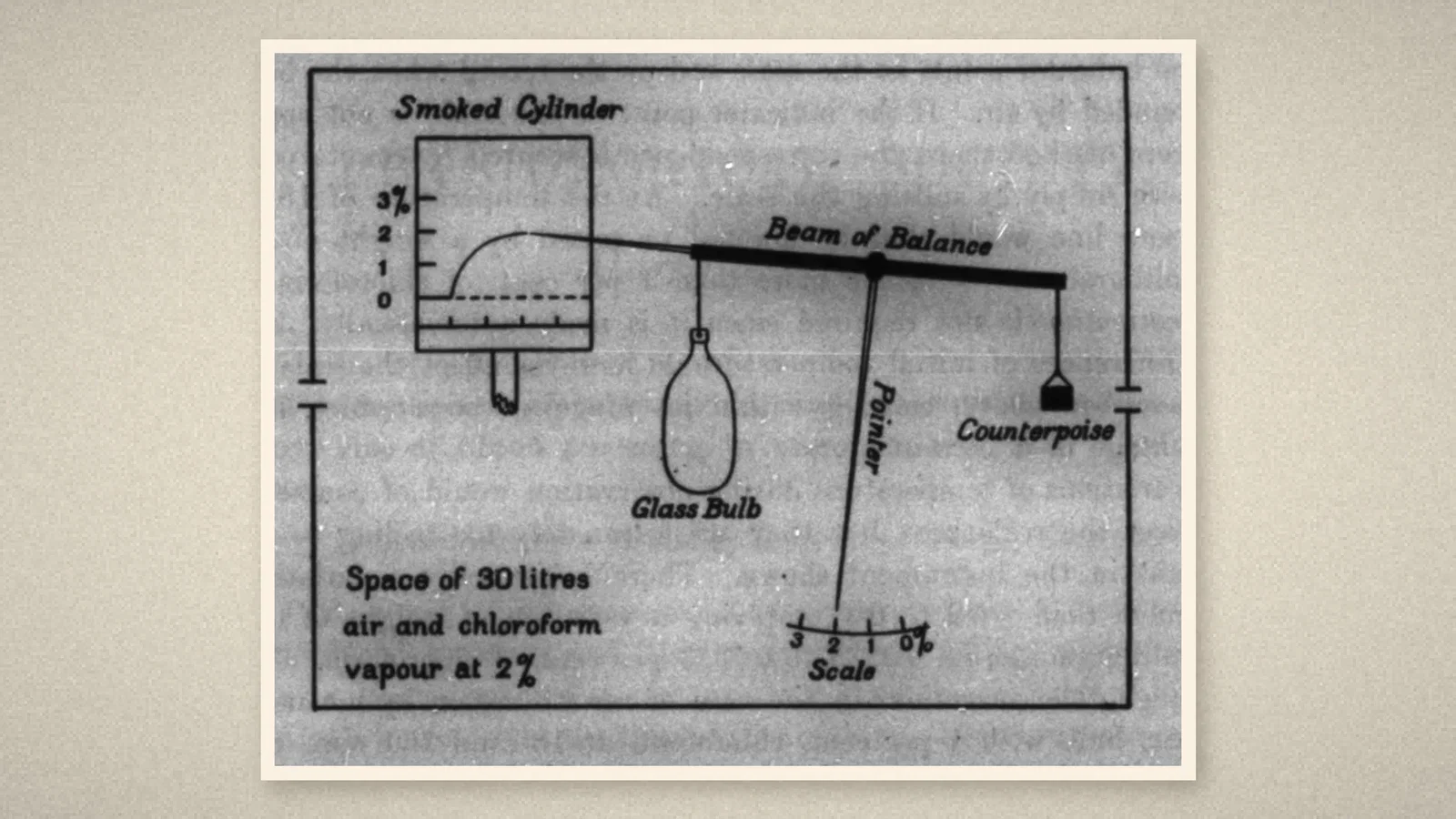
Waller's figure shows the arrangement: a beam of balance with the glass bulb on one arm and the counterpoise on the other, a long pointer swinging over a scale marked 0 to 3 per cent, and a smoked cylinder beside it, all inside a box labelled "Space of 30 litres air and chloroform vapour at 2 %". [1]
Reading and recording
"The percentage of chloroform (or of ether vapour if ether be used) is indicated by the pointer of the balance." It could also be recorded "on the smoked surface of a drum revolving once per hour (or per 12 hours), by means of a light pen fixed to the beam of the balance", a pen that served at the same time to damp the oscillations of the beam. The principle, implicit in the calibration, is that the closed bulb weighs less when the gas around it is denser: chloroform vapour is far heavier than air, so each per cent of vapour in the case tipped the beam by a fixed amount. [1]
Calibration
The instrument was calibrated with weights corresponding to 1, 2 and 3 per cent of chloroform vapour in the volume of air displaced by the bulb. "In the model now shown the calibration has been by 17 milligramme weights each of which represents 1 per cent. of chloroform vapour in air at 18 °C. and 760 mm. Hg." For any bulb, Waller gave a rule: divide the volume in cubic centimetres by 26.35, and the quotient is the number of milligrammes for 1 per cent; for an 870 c.c. bulb, 33, 66 and 99 milligrammes marked 1, 2 and 3 per cent. [1]
Waller went through the errors. Small changes of temperature during an observation, usually not more than 0.2 to 0.3 degrees, meant only 0.4 to 0.6 milligrammes, a few hundredths of a per cent, so "for all ordinary chloroform determinations temperature and pressure corrections are unnecessary". Because ether vapour differs from air by about half as much as chloroform does, "the chloroform scale 1, 2, 3 per cent. is at the same time an ether scale 2, 4, 6 per cent." [1]
Known percentages in patients
The same volume of Proceedings shows where the idea led within the year. On 17 October 1908 N. H. Alcock and J. Blumfeld reported that they had "applied Waller's method of producing chloroform anaesthesia, i.e. the plenum system with known percentage of chloroform vapour, to the human subject": 25 patients anaesthetised in the theatre of St Mary's Hospital. Induction took on average 8½ minutes, from 6 to 12½. In most ordinary cases the percentage was raised gradually to 2½ per cent; some patients needed less and some more, "especially in fat alcoholic persons". After about an hour, usually less than 0.5 per cent was needed, though the percentage had to be varied widely with what the surgeon was doing. Anaesthesia was "more even and regular" than with the open method, because a uniform dosage was easier to supply "than is the case with drop bottle methods however skilfully exercised". The apparatus used was Alcock's own, not Waller's balance. [2]
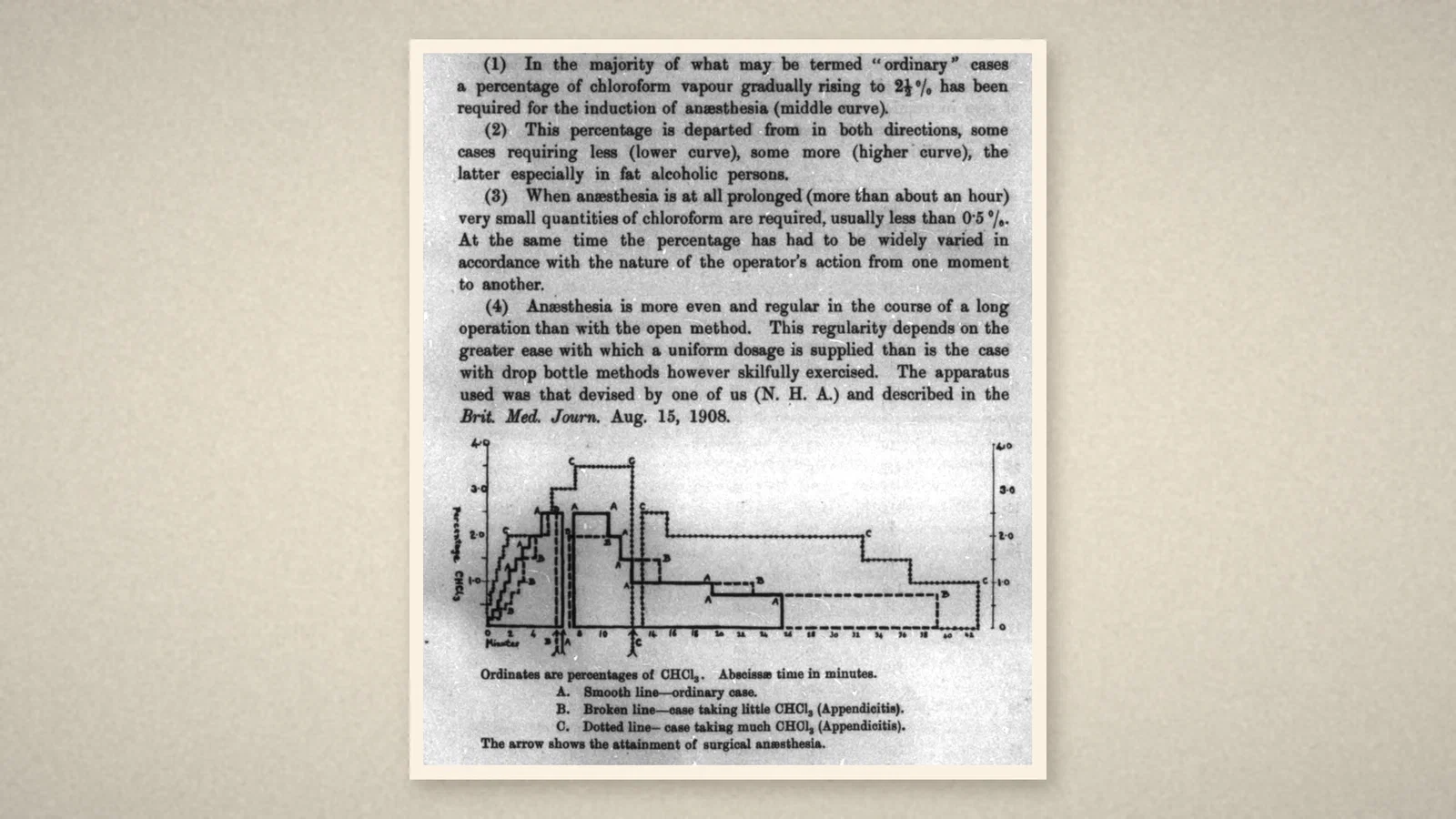
What the record shows
Waller's balance turned a vapour into a number that could be read continuously and written down as a trace. It separated two things that the drop bottle had joined: the amount of liquid used and the concentration actually delivered. Calibration with known weights, a stated error budget and the observation that one instrument could read two agents on related scales are habits that agent monitoring keeps. Alcock and Blumfeld's curves show the clinical consequence: once concentration was known, induction, maintenance and the effect of surgical stimulation could be described in percentages.
Sources and reading limits
Read: Waller's communication of 22 February 1908, J Physiol vol. 37, Proceedings pp. vi-viii, including the figure on p. vii; Alcock and Blumfeld's communication of 17 October 1908, Proceedings pp. lxiv-lxv; the HAS timeline entry.
Not covered: Waller's earlier papers on chloroform dosage; the reports of the BMA Special Chloroform Committee; Alcock's apparatus as described in the BMJ of 15 August 1908; any clinical use of the balance itself. The HAS calls it the first apparatus to give a continuous reading; the article quotes that as the HAS's assessment and makes no "first" claim of its own. The first name Augustus comes from the HAS; the Proceedings print "A. D. Waller". The scan is a dark microfilm copy; numbers were checked against the page images. Percentages are reported as historical findings, not as dosing guidance.
Three illustrations are crops of the 1908 Proceedings, including Waller's figure and Alcock and Blumfeld's curves; one is drawn from Waller's text.
- Waller AD. The chloroform balance. A new form of apparatus for the measured delivery of chloroform vapour. J Physiol. 1908;37(Proc Physiol Soc, 22 Feb):vi-viii. Internet Archive
- Alcock NH, Blumfeld J. Anaesthesia with known percentages of chloroform vapour. J Physiol. 1908;37(Proc Physiol Soc, 17 Oct):lxiv-lxv. Internet Archive
- History of Anaesthesia Society. Timeline. HAS
Continue exploring
Related reading connects shared questions and contexts; it does not by itself establish historical influence.
Anesthesia Epochs · The Source Room · About & Editorial Method
Published November 2, 2026. Sources and reading limits are stated above. Illustrations are labelled as original source images or AI-made. Historical accounts are educational; they are not current treatment instructions.