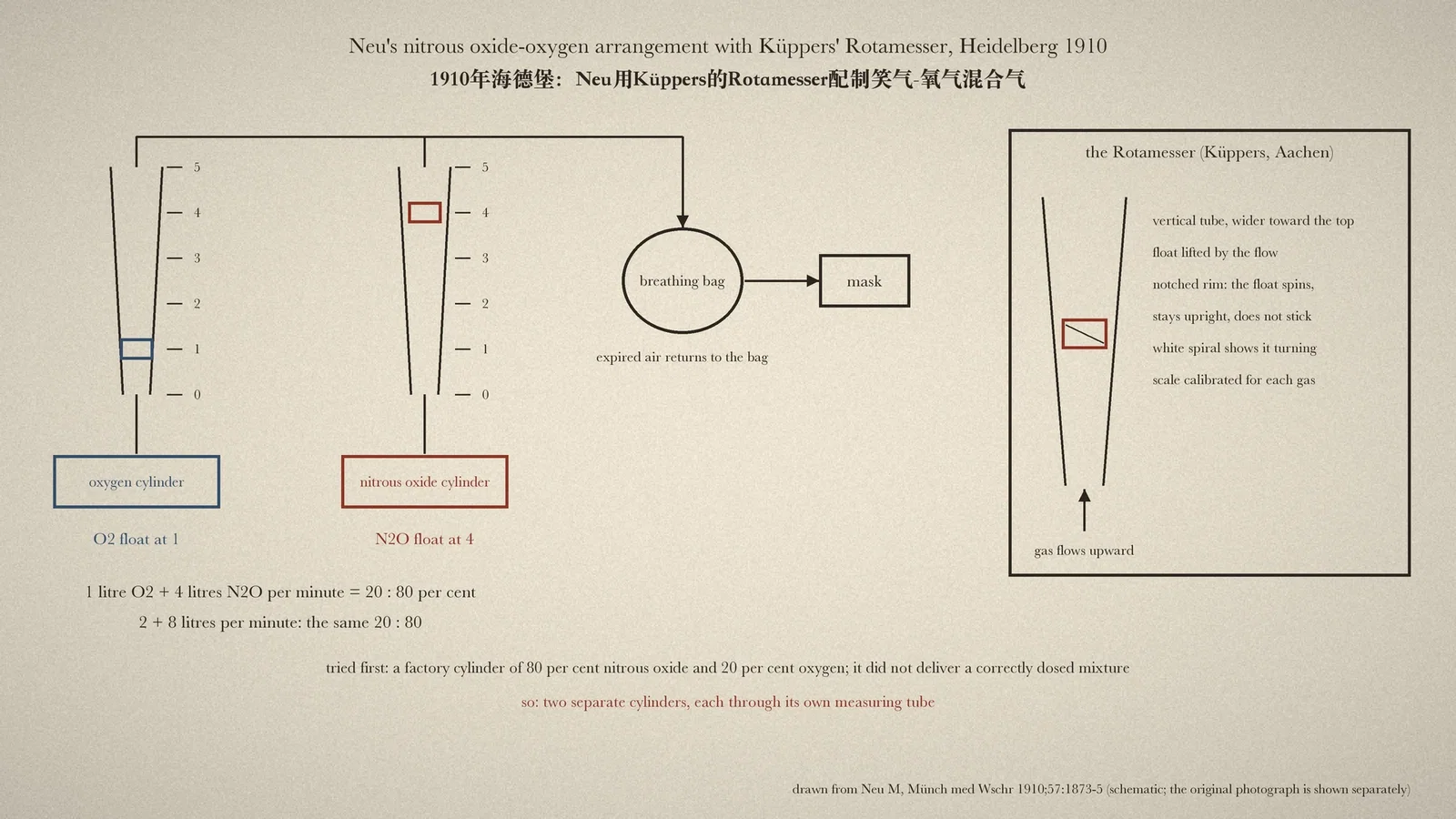
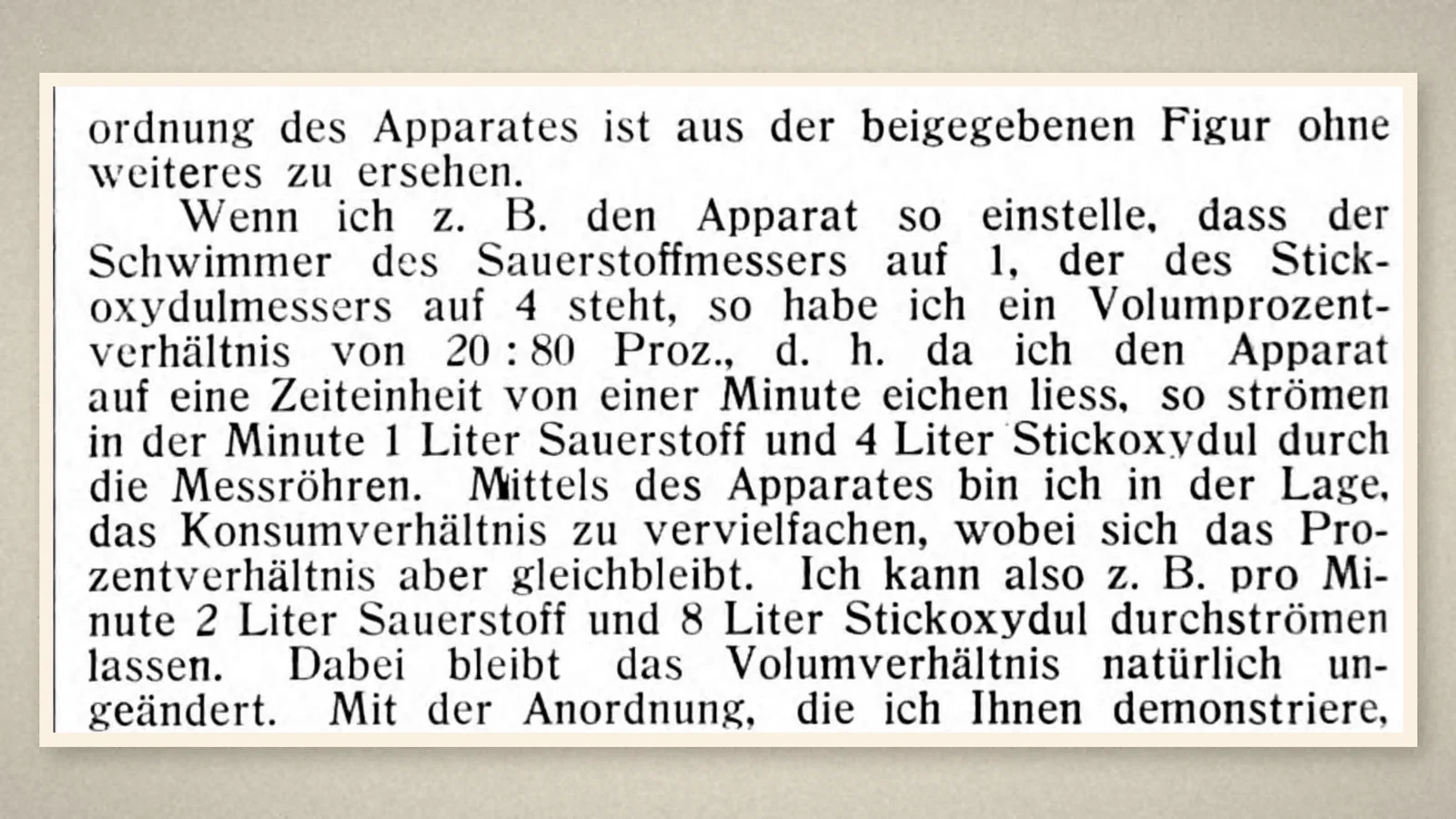
On 26 July 1910 M. Neu of the Heidelberg University Women's Clinic lectured and demonstrated at the Heidelberg natural history and medical society: because a pre-mixed cylinder did not deliver a reliable mixture, oxygen and nitrous oxide came from separate cylinders, each through a 'Rotamesser' made by Küppers of Aachen; with the oxygen float at 1 and the nitrous oxide float at 4 the mixture was 20 : 80, and doubling both flows kept the ratio.
Reading Library · Anesthesia Epochs · 中文版
Watch the education video (for clinicians)
1910: Neu's Rotameter — Measuring Gas Flow · Anesthesia Epochs Education Series
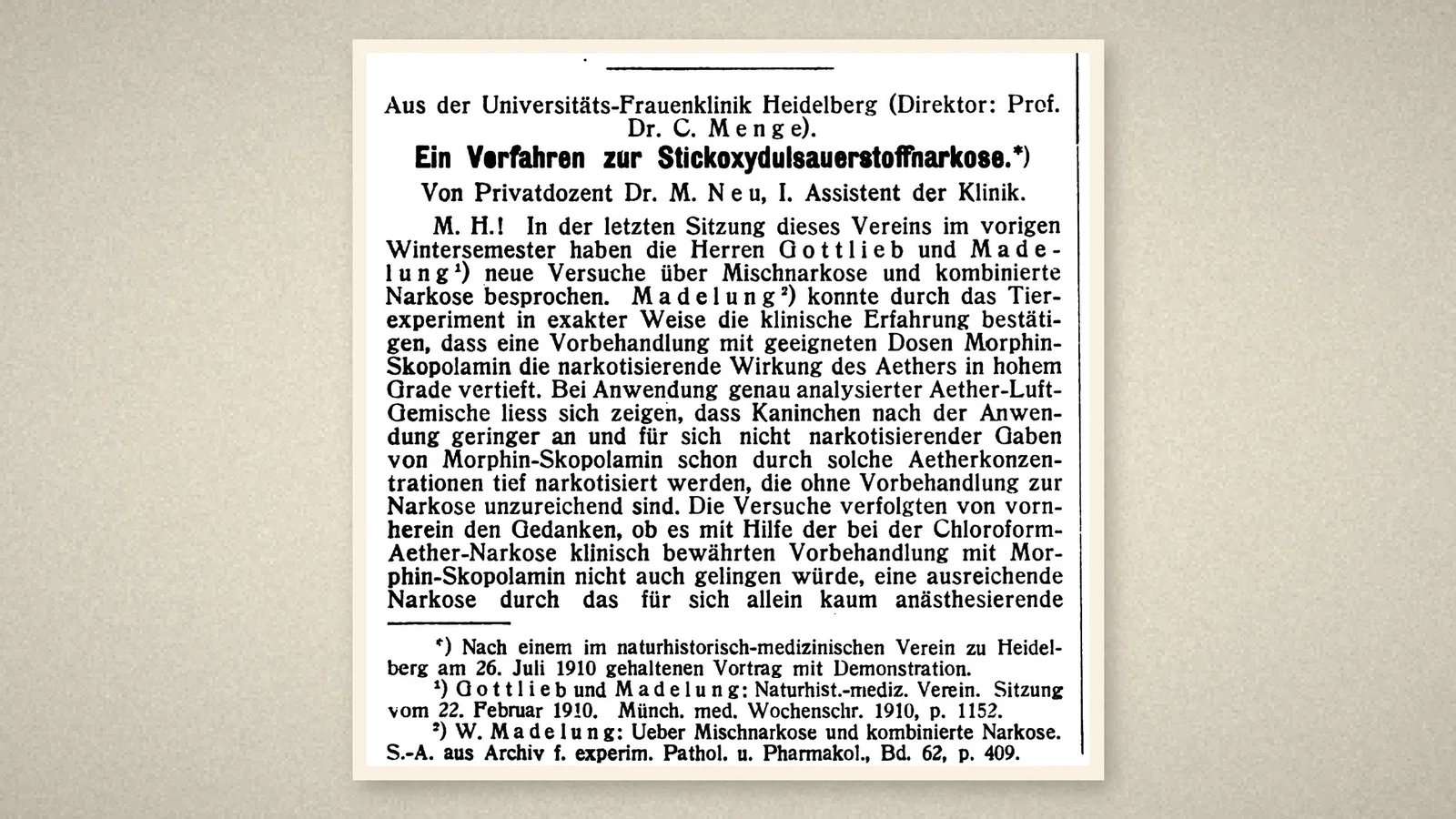
On every anaesthetic machine, until electronic flow sensors began to replace them, a row of glass tubes with spinning floats showed how many litres of each gas were flowing. The Australian Society of Anaesthetists (ASA) timeline records that in 1910 "M Neu in Germany" used rotameters "for first time on an anaesthetic machine", for oxygen and nitrous oxide, and adds that the machine "was too expensive to be successful in the market". This article reads Neu's own preliminary account, a lecture with demonstration given in Heidelberg on 26 July 1910 and printed in the Münchener medizinische Wochenschrift on 6 September. [1][3]
Why a mixture had to be measured
Neu was a Privatdozent and first assistant at the University Women's Clinic in Heidelberg, directed by C. Menge. The starting point was pharmacological. At the same Society, Gottlieb and Madelung had shown in animals that pretreatment with morphine and scopolamine greatly deepened the effect of anaesthetics, so that "laughing gas", a mixture of nitrous oxide and oxygen hardly anaesthetic on its own, produced deep anaesthesia in rabbits and dogs, with rapid recovery. The clinic already gave chloroform or ether after scopolamine-morphine with the Roth-Draeger apparatus, but did not regard that as the ideal anaesthetic, and set out to try the new combination in patients. [1]
The first attempt was the simplest: a factory-made mixture of 80 per cent nitrous oxide and 20 per cent oxygen compressed in one cylinder. The results "were not very encouraging". Nitrous oxide liquefies at 15 °C under 50 atmospheres, and the cylinders had been through large changes of temperature in transport and in the warm operating theatre; the pharmacologists also had less success with the cylinder mixture than with gas they mixed themselves. "It was therefore clear that a correctly dosed gas mixture did not flow out of the cylinder." What was needed was a method "to make an exactly dosed gas mixture from two separate cylinders". [1]
The Rotamesser
Neu found the answer in industrial gas measurement. "Herr Küppers in Aachen" had built an apparatus for measuring gas, called the "Rotamesser", which did not measure total quantity like a gas meter or electricity meter but "the strength of the gas stream", like an ammeter. Neu described the principle. The gas flows up a vertical tube "whose bore widens very gradually upwards" and lifts a float to a height that depends on the flow. Notches cut in the rim of the light float make the passing gas spin it, like Segner's water wheel; spinning keeps it upright and stops it sticking to the walls, and a white spiral on the float shows that it is turning and so that the meter is working. Because the tubes cannot be made perfectly conical, each is calibrated empirically for particular gases. Professor Bunte in Karlsruhe had tested it and found the readings "quite accurate". A footnote explains why the scale must be gas-specific: a denser gas lifts the float higher for the same volume. [1]
Setting a percentage
For an anaesthetist the point was proportion. "If, for example, I set the apparatus so that the float of the oxygen meter stands at 1 and that of the nitrous oxide meter at 4, I have a ratio by volume of 20 : 80 per cent", that is, with the tubes calibrated per minute, 1 litre of oxygen and 4 litres of nitrous oxide a minute. Doubling to 2 and 8 litres multiplied the flow and left the percentages unchanged. Neu quoted a postulate of pharmacology that only apparatus delivering a ready-dosed mixture directly to the airways gives a true account of the concentration in the lungs. The gas ran into a breathing bag, into which the patient's expired air was also driven back, so some carbon dioxide was rebred; Neu thought this helped keep breathing from slowing, and cited Gatch's report in the Journal of the American Medical Association. [1]
The demonstration and the results
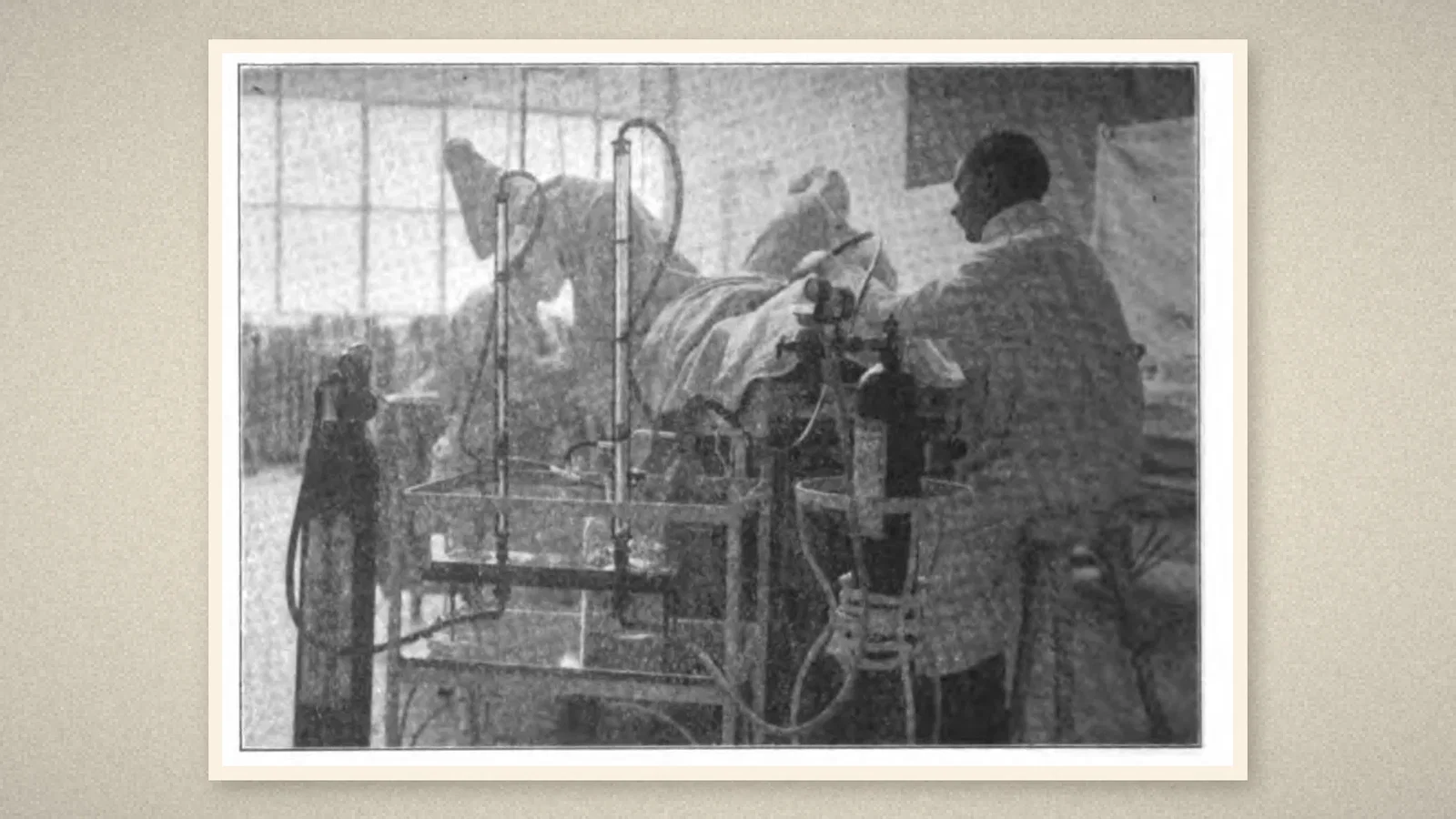
At the meeting, Menge operated under the anaesthetic. In the official protocol, Menge described the wish of gynaecological surgeons for a safer general anaesthetic, recalled recent deaths after chloroform and ether, and said that the problem of supplying an exactly dosed mixture "appears to have been solved in a satisfactory way by Herr Neu". Neu listed about thirty gynaecological operations. Failures had occurred only in abdominal operations with dense pelvic adhesions and strong traction; pulse rate fell with depth, breathing stayed in the normal range, patients woke a few minutes after the mask came off without memory of the operation, and three had vomited. Neu called the results preliminary and was already building a handier apparatus, which the Rotawerke in Aachen had undertaken to make. At a meeting on 20 September 1910 the novelty was summed up as the transfer of gas measurement into nitrous oxide technique and the principle of varying the percentage of the mixture at any moment. [1][2]
What the record shows
The Heidelberg paper contains the logic of the flowmeter bank: separate sources for each gas, a meter that shows flow continuously and visibly, calibration for the particular gas, and a mixture set by the ratio of flows rather than by trusting a pre-mixed cylinder. Neu's reason for distrusting the cylinder, that nitrous oxide can liquefy and separate, is a reason later anaesthetists also met with premixed gases. The spinning float with its spiral mark, showing that the meter is alive, survived for most of the century.
Sources and reading limits
Read: Neu M, Münch med Wschr 1910;57:1873-5, in full, including the photograph on p. 1874; the official protocol of the Heidelberg society for 26 July 1910 with Menge's remarks (pp. 1969-70); the brief report of the 20 September 1910 demonstration; the ASA timeline entry for 1910.
Not covered: Neu's later papers on the apparatus; the Küppers and Bunte reports in the gas-engineering literature; any patent; the commercial Rota apparatus and its price. Neu's first name is not printed in these pages and is not given here. The ASA calls this the first use of rotameters on an anaesthetic machine and says it failed commercially; the article reports both as the ASA's statements. The series is small and preliminary, and the clinical claims are Neu's. Animal drug doses are not repeated. German quotations are translated for this article.
Three illustrations are crops of pp. 1873-4 of the 1910 journal, including its photograph; one is drawn from Neu's text.
- Neu M. Ein Verfahren zur Stickoxydulsauerstoffnarkose. Münch Med Wochenschr. 1910;57:1873-5. Internet Archive
- Naturhistorisch-Medizinischer Verein zu Heidelberg. Nachtrag zur Sitzung vom 26. Juli 1910: Menge, Neu. Demonstration zur Skopomorphin-Sauerstoff-Stickoxydul-Narkose. Münch Med Wochenschr. 1910;57:1969-70. Internet Archive
- Australian Society of Anaesthetists. Anaesthesia history timeline. 2024. ASA
Continue exploring
Related reading connects shared questions and contexts; it does not by itself establish historical influence.
Anesthesia Epochs · The Source Room · About & Editorial Method
Published November 2, 2026. Sources and reading limits are stated above. Illustrations are labelled as original source images or AI-made. Historical accounts are educational; they are not current treatment instructions.