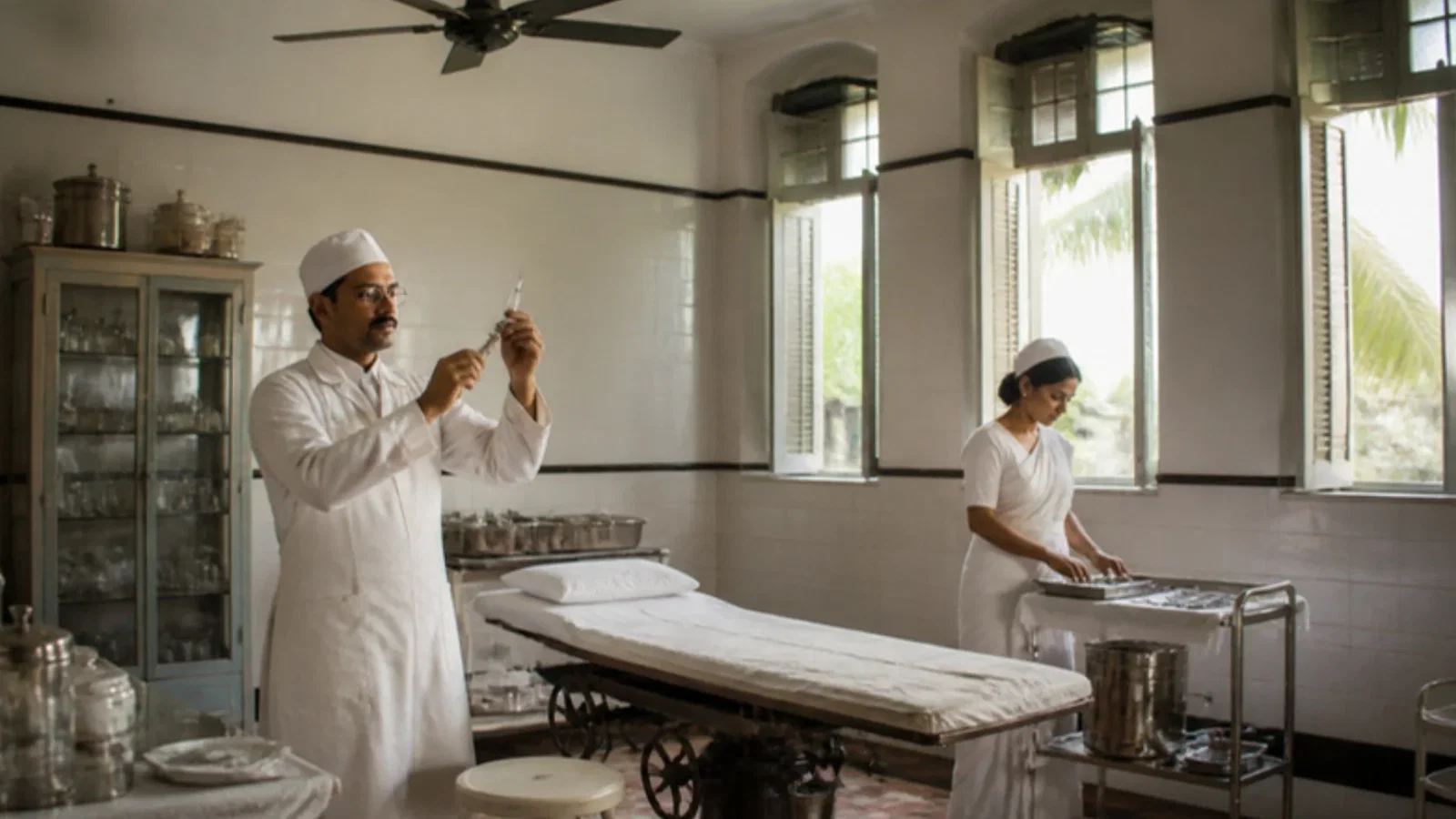
Histories of anaesthesia in India link caudal analgesia with G. R. Kokatnur of Belgaum, and the WFSA's 2025 India chapter dates it to 1924. Kokatnur's own paper, 'Application of sacral anaesthesia in general surgery', read at the Maharashtra and Karnatak Provincial Medical Conference in Sholapur in December 1944 and printed in the Journal of the Indian Medical Association in July 1946, says: 'I have used the method so far from 1924 in not less than 400 cases', for all kinds of perineal operations; it describes the approach through the sacral hiatus, the prone position, the signs of onset and the causes of failure, and admits to keeping patients unaware of when the operation began.
Reading Library · Anesthesia Epochs · 中文版
Watch the education video (for clinicians)
1924: Kokatnur's Sacral Anaesthesia — Belgaum, India · Anesthesia Epochs Education Series
Histories of anaesthesia in India give caudal analgesia a name and a town: G. R. Kokatnur, Belgaum. The WFSA's 2025 history issue lists, in its table of Indian milestones, "1924 Caudal Analgesia Used by Dr. G.R. Kokatnur", and its text says that Kokatnur introduced caudal epidural analgesia in Belgaum and performed hundreds of safe procedures. [3, p. 28]
Where does the year come from? This article found no report by Kokatnur from that time. What survives is a later paper in which the surgeon looks back over twenty years of practice and names the starting year. [1]
The paper of 1944
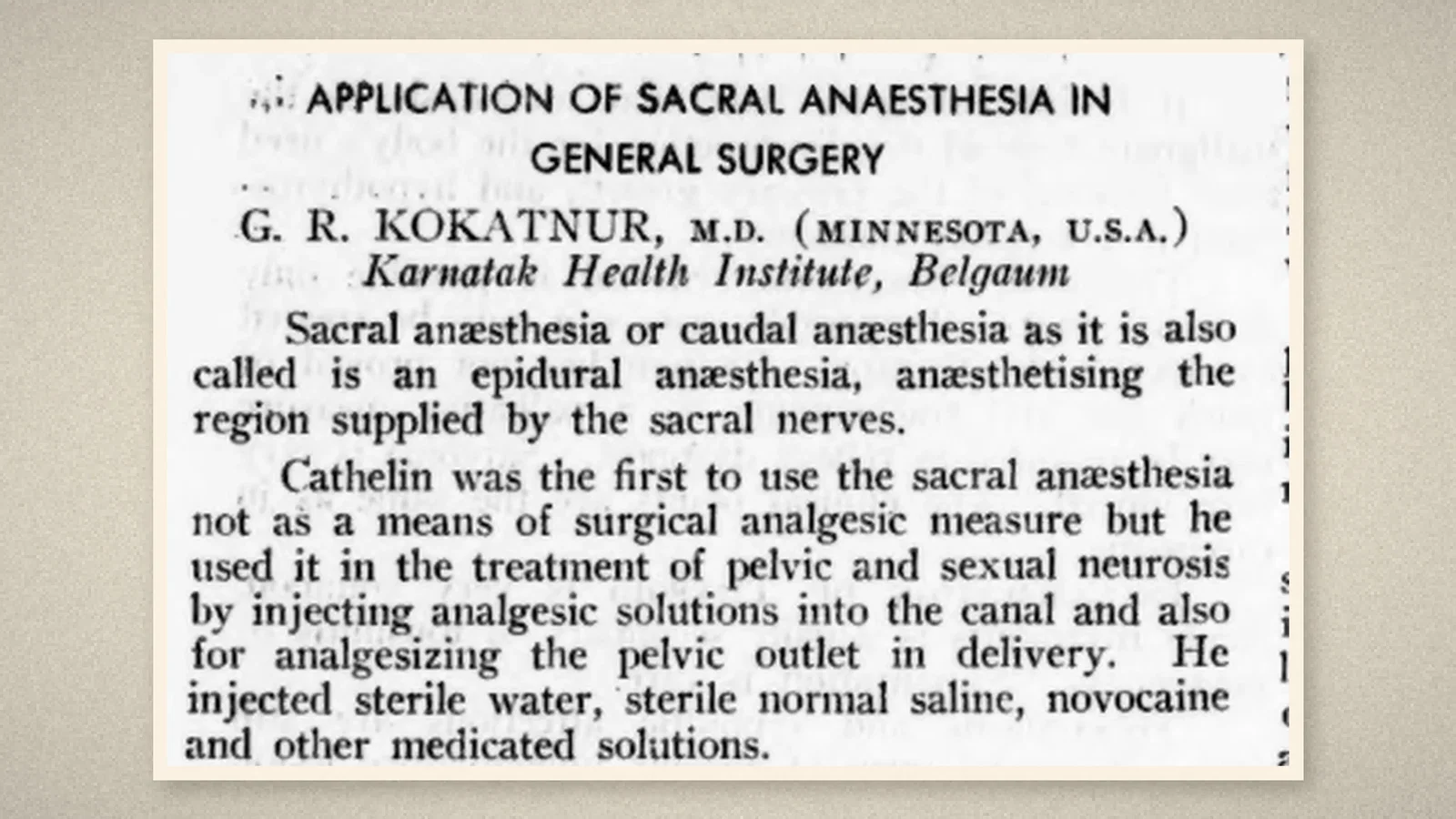
"Application of sacral anaesthesia in general surgery" was read at the 7th Maharashtra and Karnatak Provincial Medical Conference at Sholapur in December 1944 and printed in the Journal of the Indian Medical Association in July 1946. The byline reads "G. R. Kokatnur, M.D. (Minnesota, U.S.A.), Karnatak Health Institute, Belgaum". [1, p. 342]
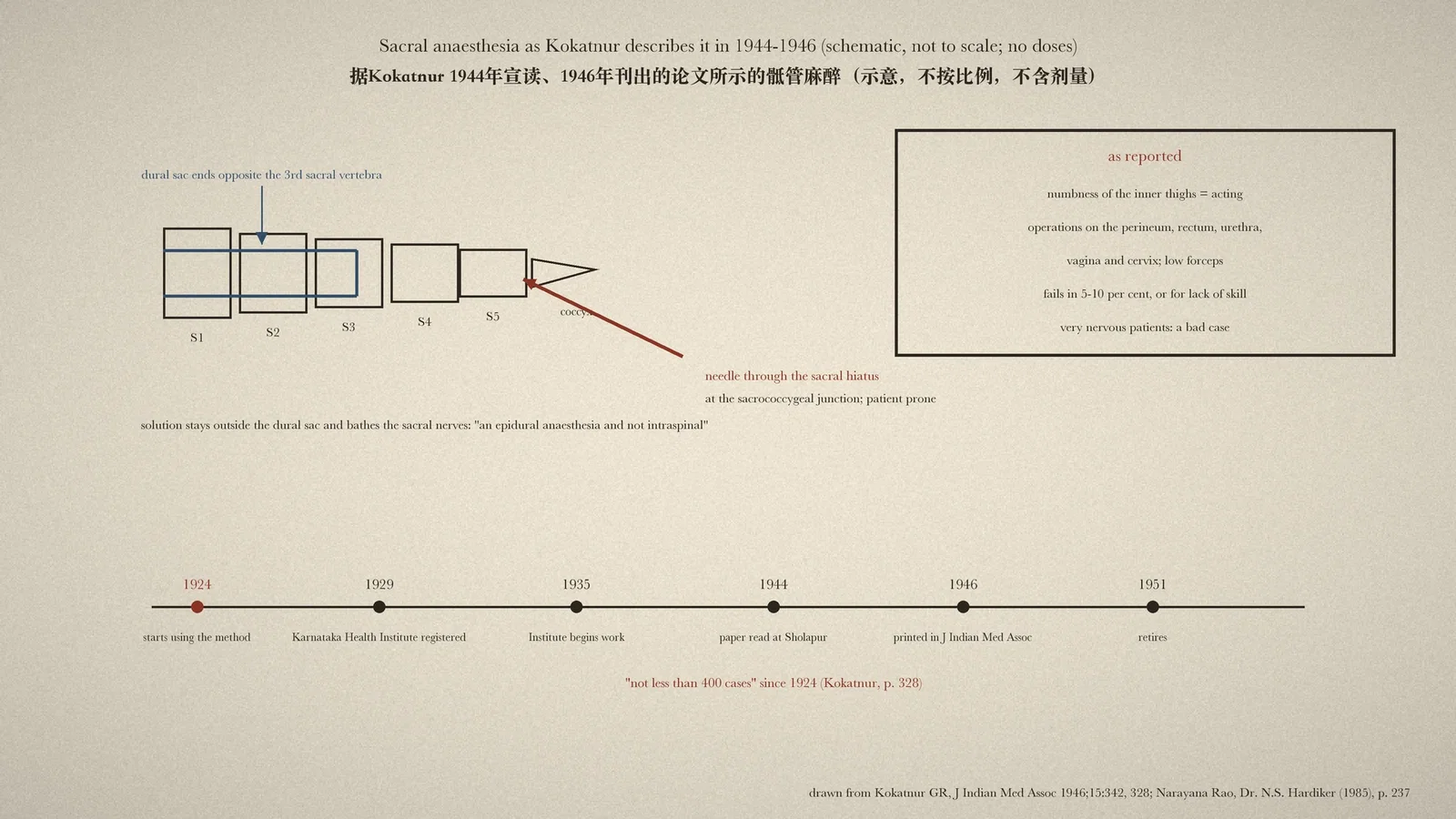
The paper begins with definitions. Sacral or caudal anaesthesia "is an epidural anaesthesia", acting on the nerves supplied from the sacral canal below the end of the dural sac; the solution "does not enter the subarachnoid space", so the method is "an epidural anaesthesia and not intraspinal" and free of the dangers of spinal anaesthesia. Kokatnur credits Cathelin with its earlier use, for pelvic conditions and for the pelvic outlet in delivery. [1, p. 342]
The method had, in Kokatnur's words, become "the method of choice in the surgery of the perineum". The list of operations is long: fissures, piles, fistula in ano, prolapse of the rectum, urethrotomies, operations on the scrotum and penis, perineal prostatectomy, vaginal and cervical operations, cystoscopies and "application of low forceps". For fistula and haemorrhoids it relaxed the anal sphincter so that dilatation was easy. [1, p. 342]
How it was done
The patient lay prone. The operator felt for the sacral hiatus, a depression at the sacrococcygeal junction, cleaned the skin, and passed a long needle through the hiatus into the canal; if the needle was in place, the injection met no resistance, and numbness of the inner side of both thighs showed that the anaesthetic was acting. Kokatnur warned against starting too early, before the block was complete. Morphine and atropine were given beforehand. [1, p. 342]
The paper is frank about failure. A spur over the hiatus, obesity, an angled or abnormal sacrum, or local infection could make the puncture difficult or dangerous; the anaesthesia "may fail in 5-10 per cent cases", to which "may be added the failure to establish it for lack of skill". A very nervous patient was "a bad case for any local anaesthesia". [1, p. 342]
It is frank about something else as well. Kokatnur describes the usual practice of telling patients, once the block was established, that they were only being examined and would be given a few whiffs of chloroform before the operation, so that the operation was completed without the patient knowing it had begun. The paper presents this as a way to win cooperation; a reader now will see it differently. [1, p. 342]
Since 1924
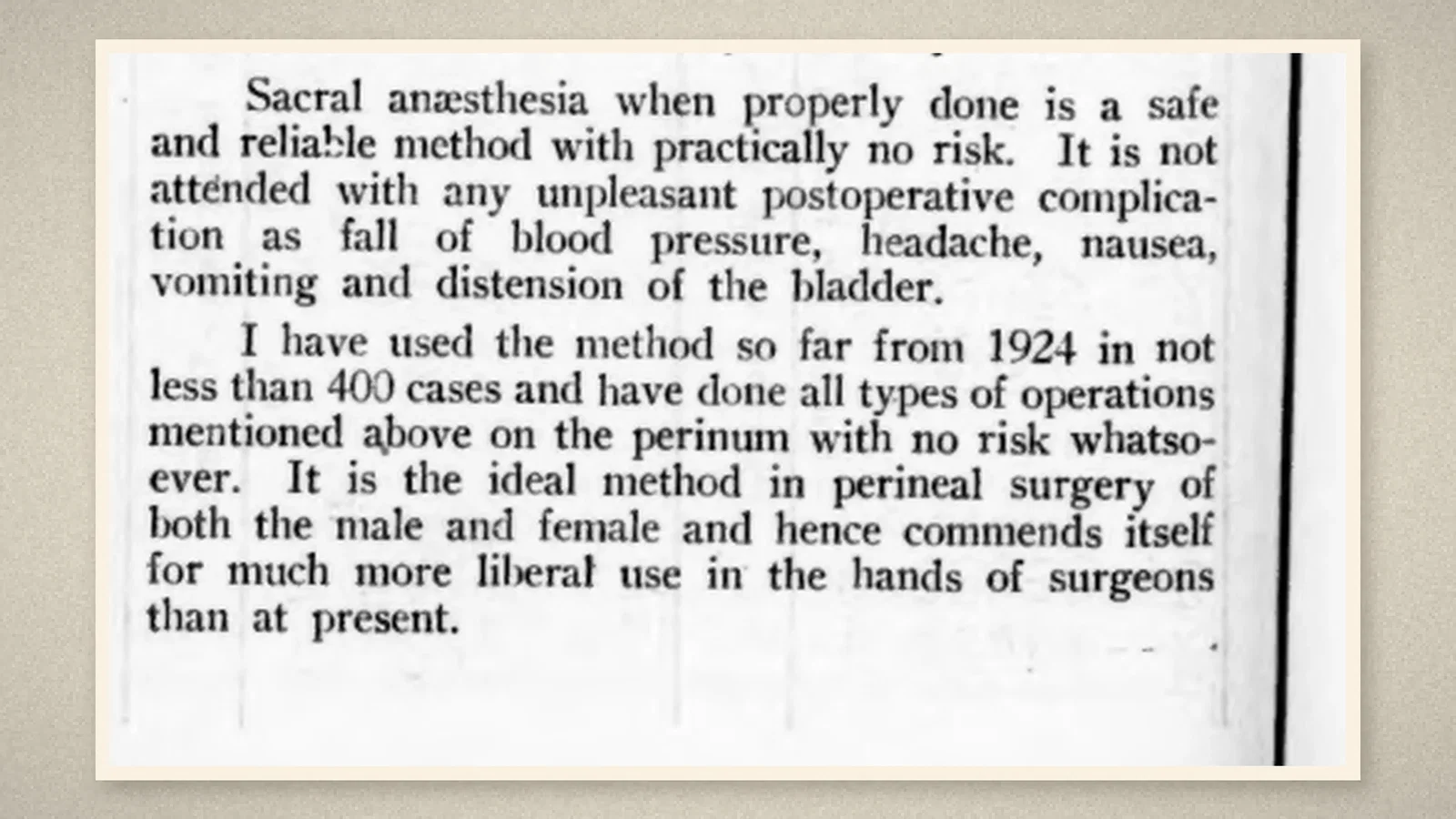
The paper closes on p. 328: "I have used the method so far from 1924 in not less than 400 cases and have done all types of operations mentioned above on the perinum with no risk whatsoever." Kokatnur called it "the ideal method in perineal surgery" and urged surgeons to use it more. [1, p. 328]
The surgeon behind the paper
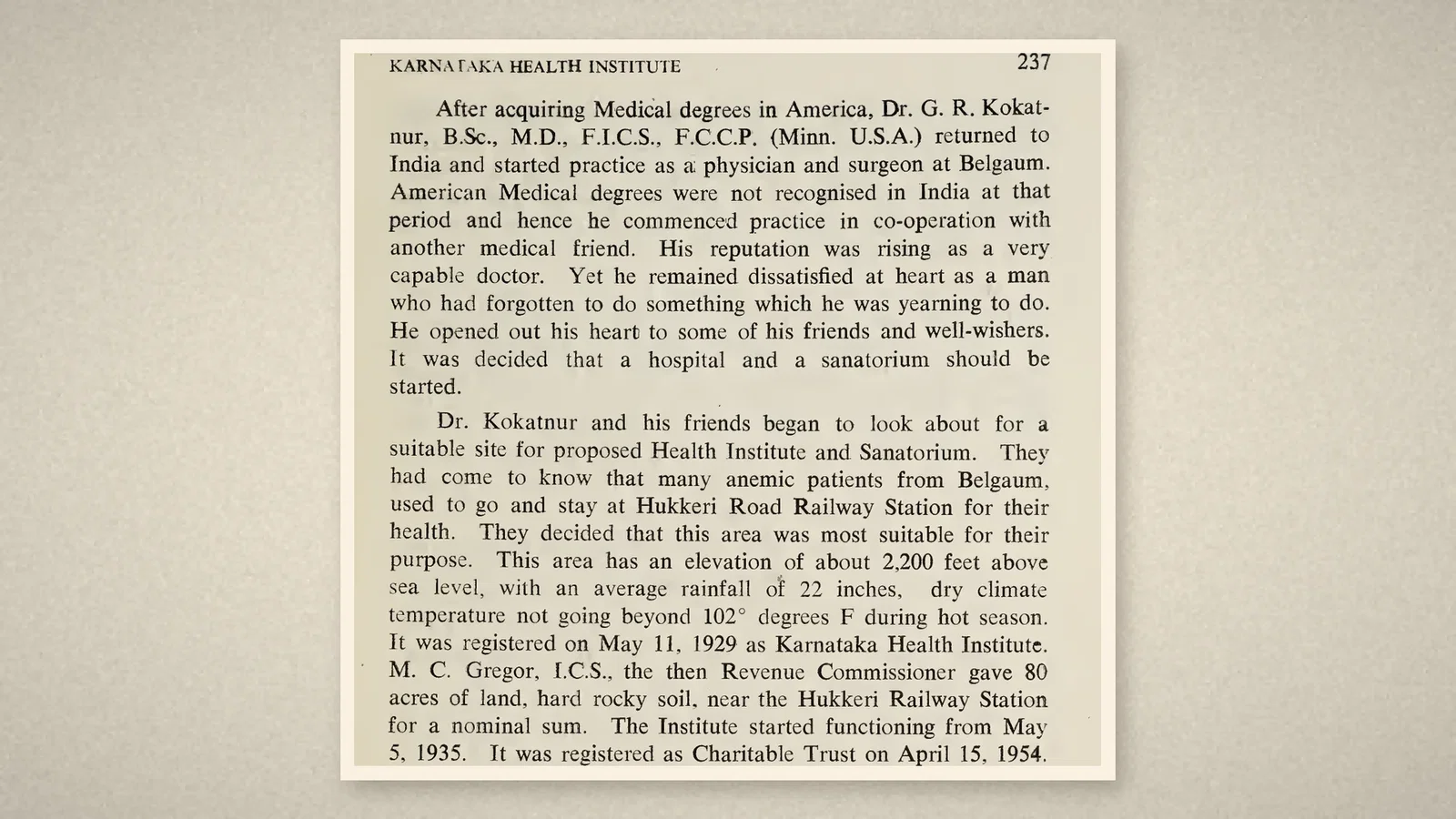
A biography of Kokatnur's friend N. S. Hardiker, published by the Government of India's Publications Division in 1985, adds the setting. Gajanana Ramachandra Kokatnur had medical degrees from Minnesota; returning to practise as a physician and surgeon at Belgaum, Kokatnur found that American degrees were not recognised in India and worked with another doctor. The two friends met at Belgaum in 1924. Kokatnur and friends founded the Karnataka Health Institute, registered on 11 May 1929 and working from 5 May 1935 near Hukkeri Road station, where at first Kokatnur saw patients on a stone slab under a tree; Kokatnur retired in 1951. [2, pp. 236-8]
What the record shows
A surgeon trained abroad, working in a provincial town without a recognised degree, who took up a block of the sacral nerves and used it for two decades on the operations of the perineum, then described it to colleagues: the landmarks, the signs, the failures, and a practice of keeping patients unaware that would not be accepted today. The year 1924 is the surgeon's own.
Sources and reading limits
Read: Kokatnur's paper in J Indian Med Assoc 1946;15(10), p. 342 and the continuation on p. 328, in full, with page images, and the first page of the issue; the Hardiker biography's chapter on the Karnataka Health Institute (pp. 236-8) and its imprint; the WFSA India chapter in Update in Anaesthesia 2025;40, title page and p. 28.
Not covered: any report by Kokatnur written at the time the method was taken up, which could not be obtained, and none was found in the open journal archives searched; the proceedings of the 1944 Sholapur conference; any case records.
Limits: the year 1924 rests on Kokatnur's statement twenty years later; no earlier publication was seen. The WFSA chapter's account agrees with it and may derive from it. The claims of "no risk whatsoever" are the author's and are not tested here. The biography is a life of Hardiker and mentions Kokatnur in passing; a chemist with a similar name, V. R. Kokatnur, who appears elsewhere in the book, is a different person. The drug, strength and volumes in the paper are not repeated here.
Three illustrations are crops of the paper (pp. 342 and 328) and of the biography (p. 237); one is a schematic drawn from the paper.
- Kokatnur GR. Application of sacral anaesthesia in general surgery. J Indian Med Assoc. 1946;15(10):342, 328. Internet Archive
- Narayana Rao VS. Dr. N.S. Hardiker. New Delhi: Publications Division, Government of India; 1985. Internet Archive
- Kamabathula S, Muppana BV, Bala Bhaskar S. The journey of anaesthesia in India. Update in Anaesthesia. 2025;40:27-8 (pages read). WFSA
Continue exploring
Related reading connects shared questions and contexts; it does not by itself establish historical influence.
Anesthesia Epochs · The Source Room · About & Editorial Method
Published November 2, 2026. Sources and reading limits are stated above. Illustrations are labelled as original source images or AI-made. Historical accounts are educational; they are not current treatment instructions.