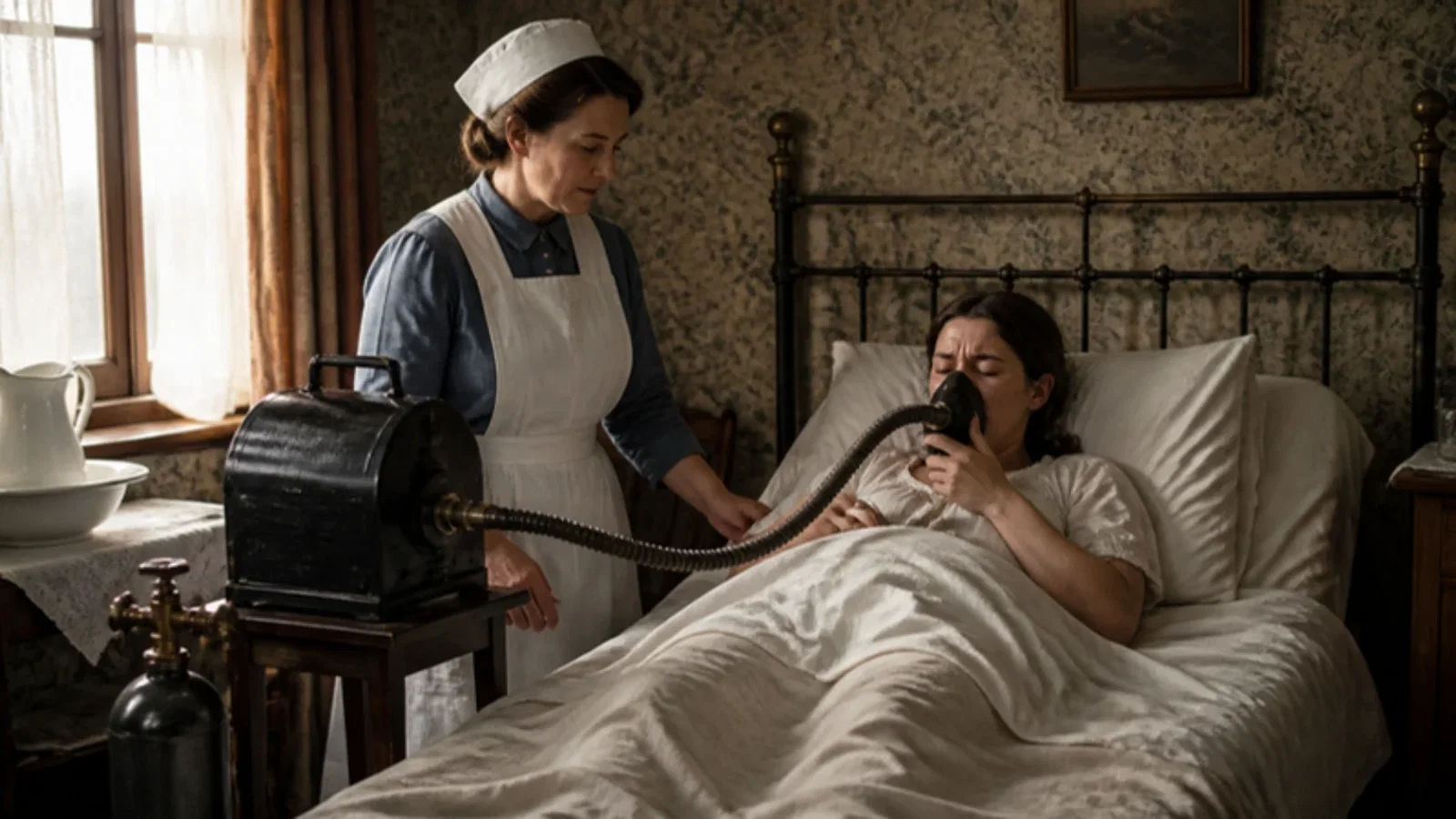
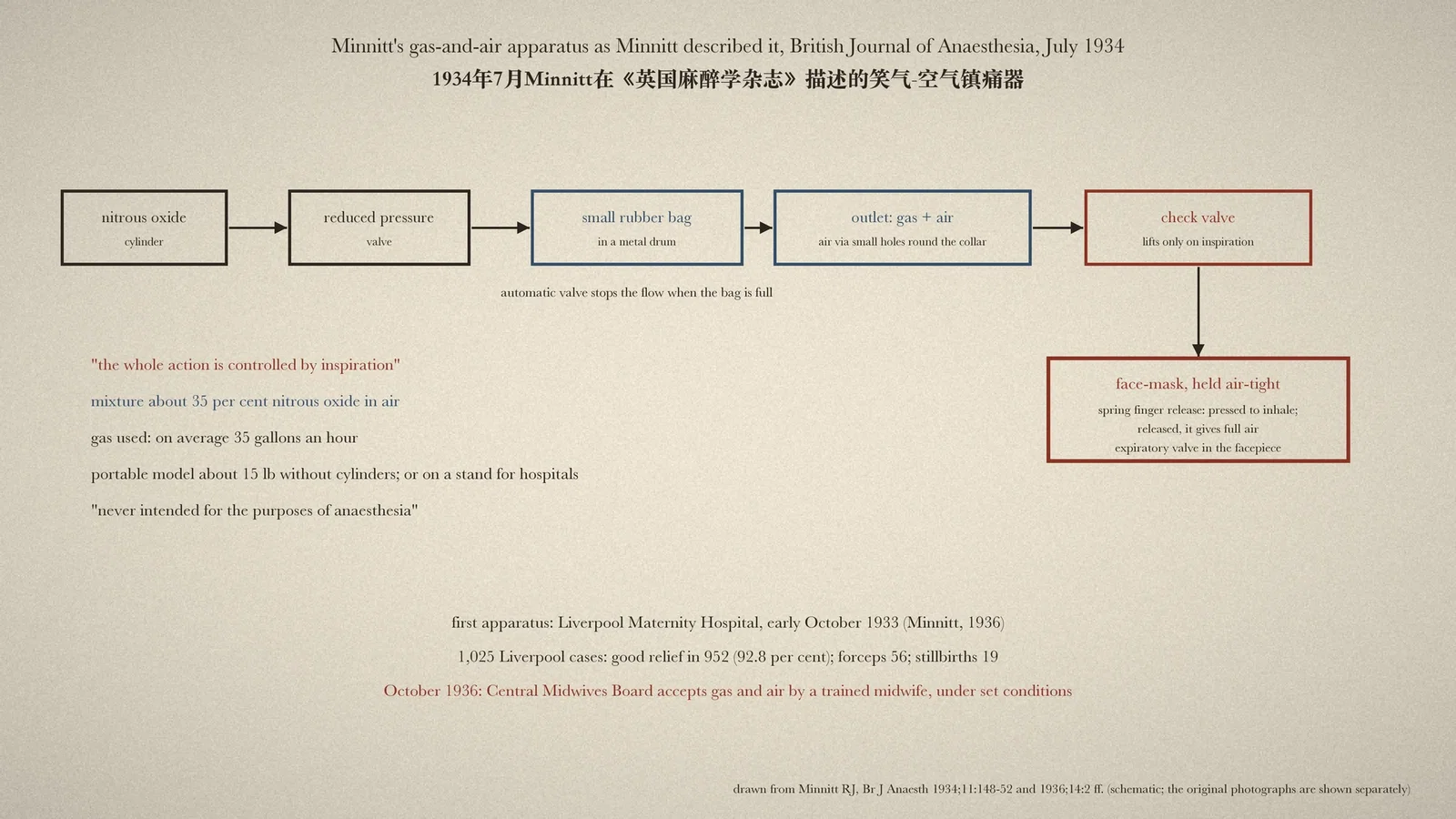
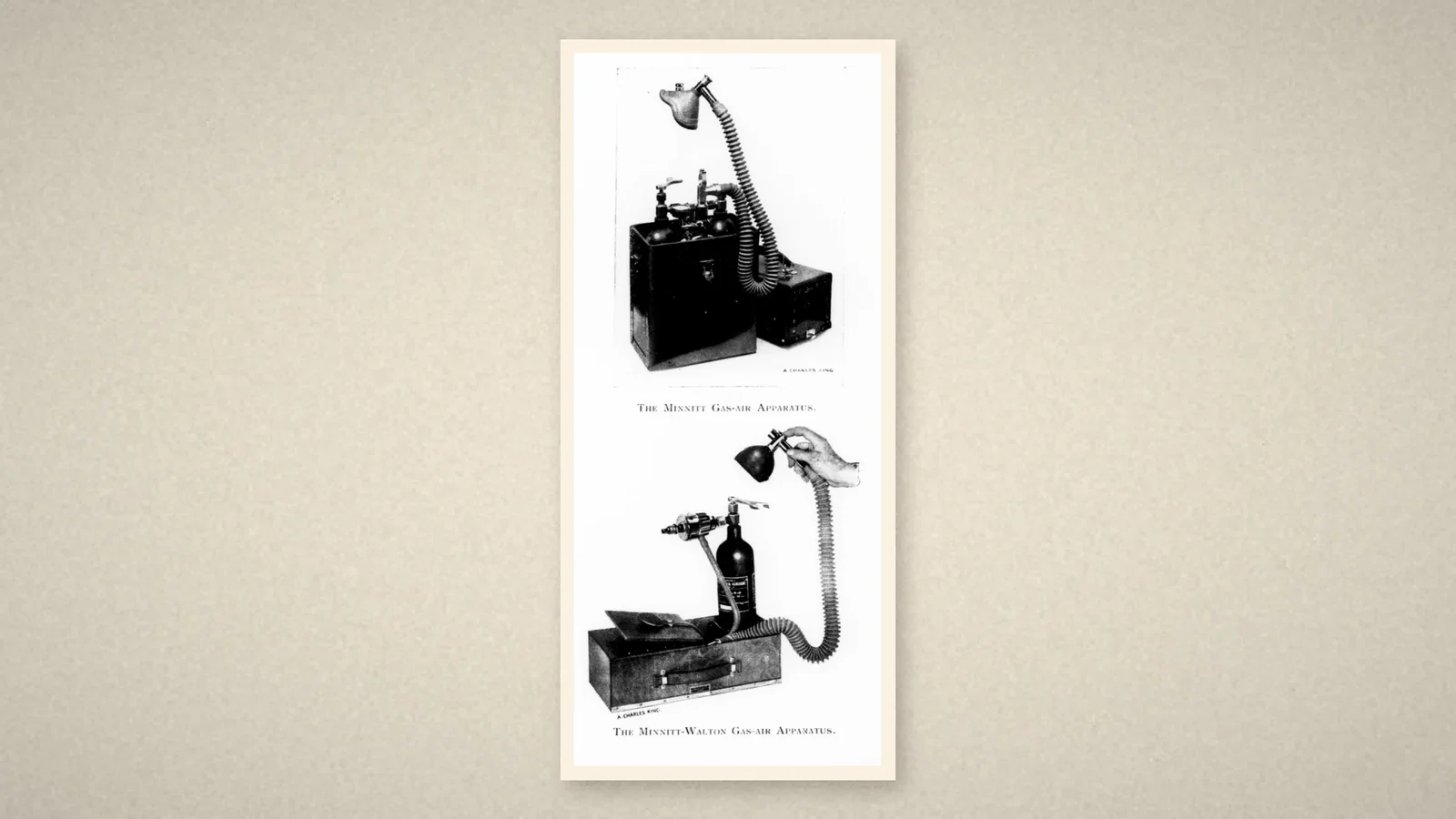
Early in October 1933 R. J. Minnitt of Liverpool, with the instrument maker A. Charles King, adapted a McKesson oxygen therapy apparatus into a gas-and-air machine for labour: a reducing valve fed nitrous oxide into a small bag in a metal drum, a check valve opened only on inspiration while air entered through holes round the collar, giving about 35 per cent nitrous oxide, and a spring finger release on the mask gave air alone if the grip relaxed; in 1936 the Central Midwives Board allowed trained midwives to use it.
Reading Library · Anesthesia Epochs · 中文版
Watch the education video (for clinicians)
1933: Minnitt's Gas-and-Air Apparatus — Labour Analgesia · Anesthesia Epochs Education Series
Self-administered nitrous oxide in labour is so familiar in Britain that its origin is easy to forget. The Australian Society of Anaesthetists (ASA) timeline credits Dr Robert James Minnitt of Liverpool with a "gas (nitrous oxide) & air" apparatus for analgesia during labour, an adaptation of a McKesson oxygen therapy apparatus made with the instrument maker A. Charles King, and adds that it was eventually withdrawn because it could deliver hypoxic mixtures. This article reads Minnitt's own descriptions in the British Journal of Anaesthesia: "Self-administered analgesia for the midwifery of general practice" (July 1934) and "Gas-air analgesia" (October 1936). [1][2][3]
Four conditions
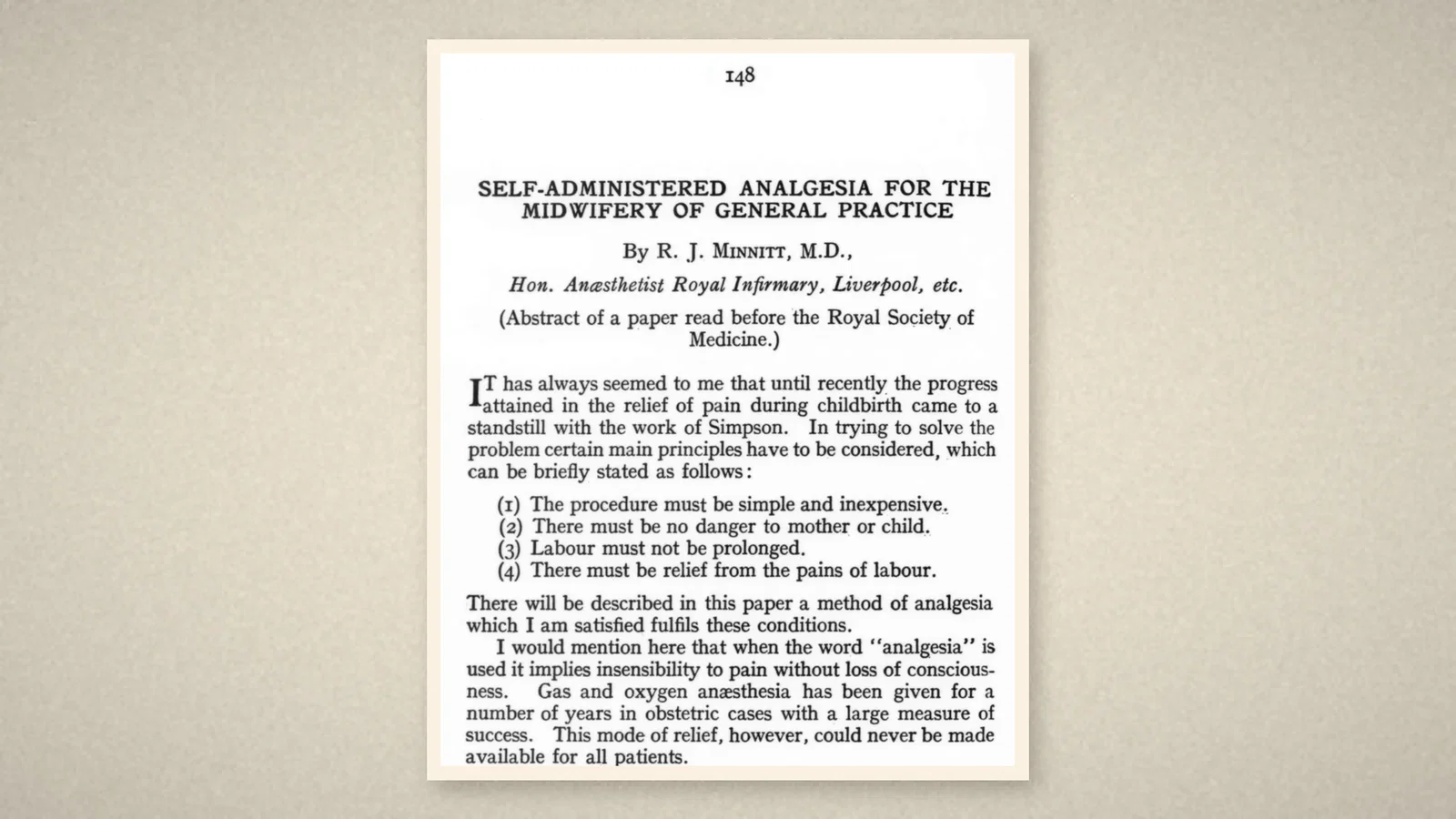
Minnitt, honorary anaesthetist to the Royal Infirmary, Liverpool, began by saying that the relief of pain in childbirth seemed to have "come to a standstill with the work of Simpson". Any method had to meet four conditions: "(1) The procedure must be simple and inexpensive. (2) There must be no danger to mother or child. (3) Labour must not be prolonged. (4) There must be relief from the pains of labour." By "analgesia" Minnitt meant "insensibility to pain without loss of consciousness". Gas and oxygen anaesthesia had been used in obstetrics with success, but "could never be made available for all patients". Dr Howard Jones had suggested gas and air for maternity work, and "after consultation with Mr. A. Charles King, a gas and air machine was devised". [1]
A machine worked by the patient's breath
"The apparatus—an adaptation of the McKesson oxygen therapy apparatus—consists of a reduced pressure valve", which brought nitrous oxide down from the cylinder to "a small rubber bag enclosed in a metal drum"; an automatic valve stopped the flow when the bag was full and let more in as it emptied. The outlet divided into two channels, one for gas and one for air, the air entering "by a series of small holes round the collar", to keep the mixture as constant as possible. A check valve above lifted only when the patient inhaled, preventing escape on expiration: "The whole action is controlled by inspiration." [1]
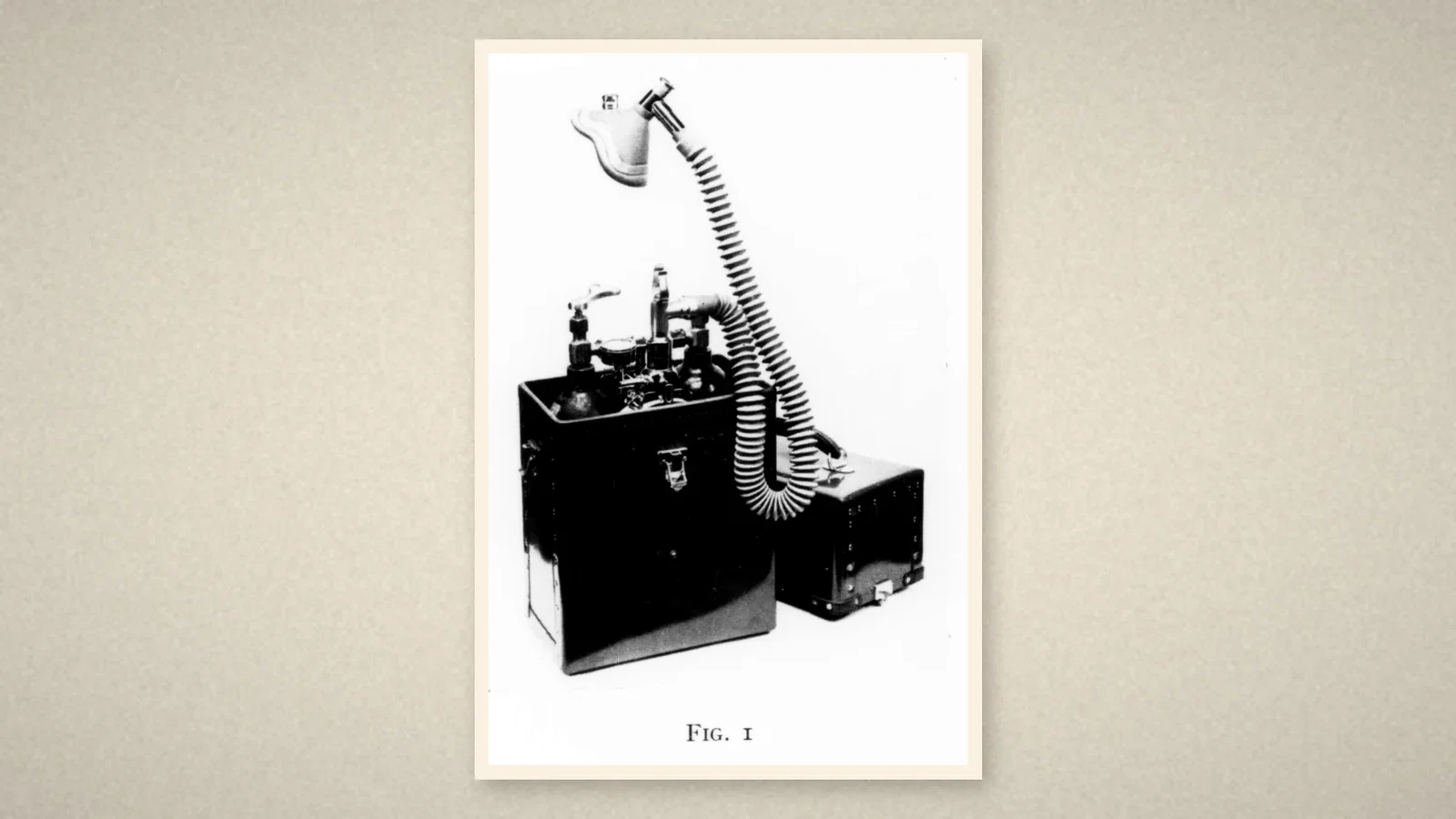
The safety feature was on the mask: "a spring finger release, which is pressed down during inhalation, but supplies full air (therefore throwing the machine out of action) should either the analgesia become deep enough to weaken the force used, or at the will of the patient." Minnitt insisted that the apparatus "was never intended for the purposes of anaesthesia", ruling out its use for version, forceps or extensive perineal repair. There was a portable model in a carrying case, about 15 lb without cylinders, and a hospital model on an aluminium stand. Gas consumption averaged 35 gallons an hour, and the inhaled mixture was "approximately 35 per cent nitrous oxide in air". The only important point of technique was that the mask be kept air-tight against the face. [1]
Testing for harm
Minnitt reported electrocardiograms from six women before, during and after hours of analgesia, which a cardiologist found unchanged, tables of maternal pulse and foetal heart rates, and oxygen estimations in maternal and cord blood. The 1934 text states candidly that in some deliveries "cyanosis of the mother was rather encouraged", and in one case produced, so that a forceps delivery could be done; the maternal oxygen fell, but Minnitt found no significant change in the cord blood. The second stage averaged under two hours in first labours and under one hour in later ones. In the labour ward, Minnitt wrote, "comparative peace and quiet reign". The first trials were at the Liverpool Maternity Hospital, with Dr Hilda Garry, and at the Wellhouse Hospital, Barnet, with Dr John Elam. [1]
From hospital to midwife
In 1936 Minnitt recalled that "early in October 1933 the first Minnitt gas-air apparatus was installed in the Liverpool Maternity Hospital". By then over 400 machines were in use. Hilda Garry's analysis of 1,025 Liverpool cases found relief "good in 952 (92.8 per cent)", with 56 forceps deliveries and 19 stillbirths, one unexplained. The British College of Obstetricians and Gynaecologists had studied 3,865 cases and concluded that gas and air by the Minnitt apparatus was safe and satisfactory, "although the apparatus is expensive and the nitrous oxide costly", and recommended its use by specially trained midwives. In October 1936 the Central Midwives Board resolved that a trained midwife giving gas and air by Minnitt's or a similar apparatus was treatment within the midwife's province, provided the patient had been medically examined and a second qualified person was present. [2]
What the record shows
Minnitt's machine joined three ideas that obstetric analgesia still uses: a demand valve opened only by the patient's own inspiration; a self-limiting design in which drowsiness ends the dose; and a technique simple enough to be delegated to midwives under rules. Its fixed air mixture also shows the danger that later undid it: a nitrous oxide-air mixture with no added oxygen can be hypoxic, and the 1934 acceptance of maternal cyanosis now reads as a warning.
Sources and reading limits
Read: Minnitt RJ, Br J Anaesth 1934;11:148-52, in full; Minnitt RJ, Br J Anaesth 1936;14:2 ff., the opening pages with the apparatus plate; the ASA timeline entries for 1932 and 1933.
Not covered: the full Royal Society of Medicine paper and the Liverpool Medical Institution paper of 22 February 1934 as printed; Garry's and Elam's reports; the College report itself, quoted only through Minnitt; later evidence on hypoxic mixtures and withdrawal of the apparatus. The ASA's 50 per cent minimum air, and its account of withdrawal around 1970 for inspired oxygen as low as 11 per cent, are given as the ASA's; Minnitt's 1934 figure is about 35 per cent nitrous oxide. The safety findings are Minnitt's.
Three illustrations are crops of the 1934 and 1936 issues, including their photographs; one is drawn from Minnitt's description.
- Minnitt RJ. Self-administered analgesia for the midwifery of general practice. Br J Anaesth. 1934;11:148-52. Internet Archive
- Minnitt RJ. Gas-air analgesia. Br J Anaesth. 1936;14:2 ff. Internet Archive
- Australian Society of Anaesthetists. Anaesthesia history timeline. 2024. ASA
Continue exploring
Related reading connects shared questions and contexts; it does not by itself establish historical influence.
Anesthesia Epochs · The Source Room · About & Editorial Method
Published November 2, 2026. Sources and reading limits are stated above. Illustrations are labelled as original source images or AI-made. Historical accounts are educational; they are not current treatment instructions.