Two London pharmaceutical chemists argued from the shapes of morphine, pethidine and their mirror-image isomers that strong analgesics must fit a complementary surface in the nervous system, and drew it: an anionic site, a flat region, a cavity.
Reading Library · Anesthesia Epochs · 中文版
Watch the education video (for clinicians)
1954: Beckett and Casy — An 'Analgesic Receptor Surface' · Anesthesia Epochs Education Series
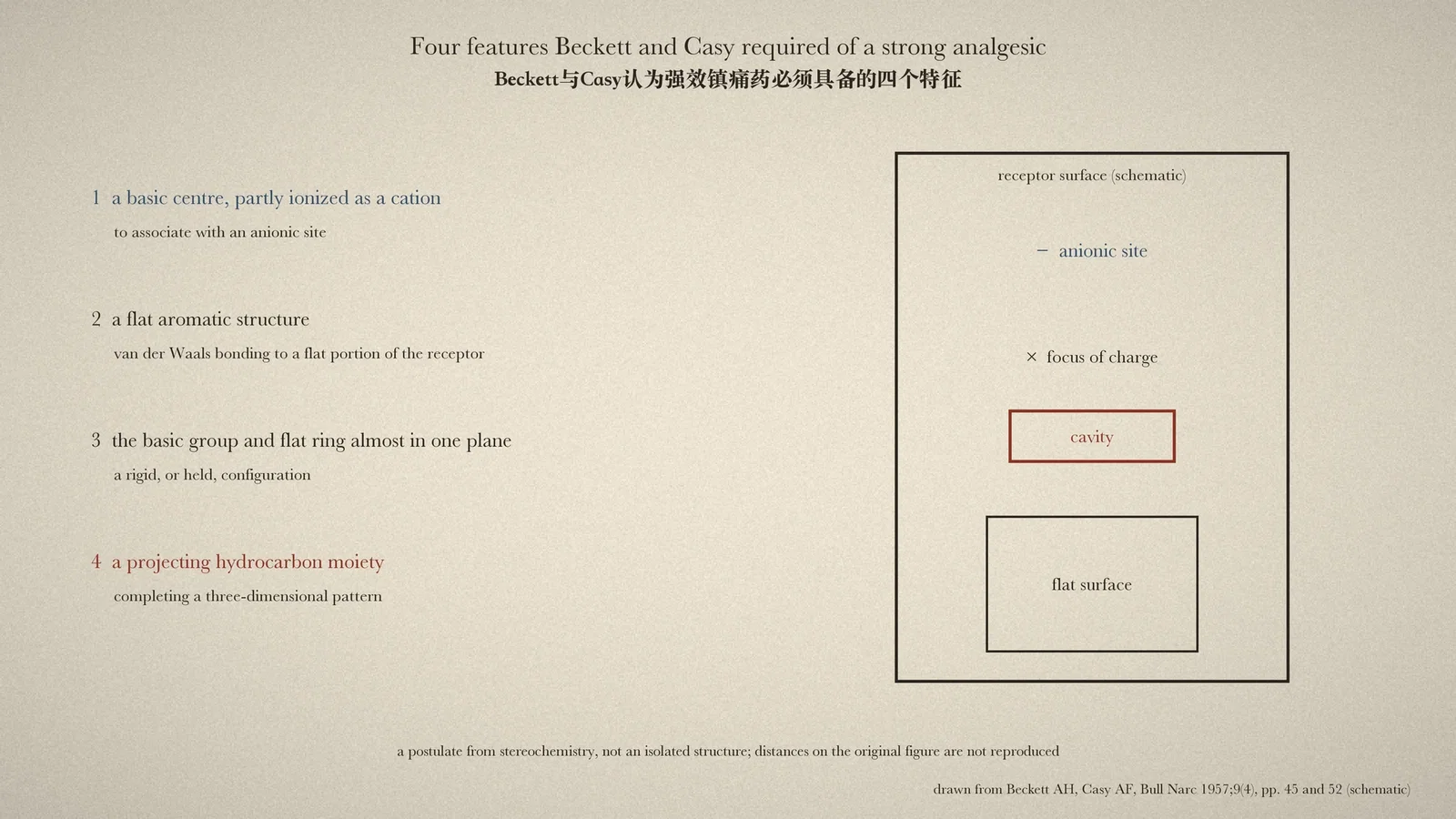
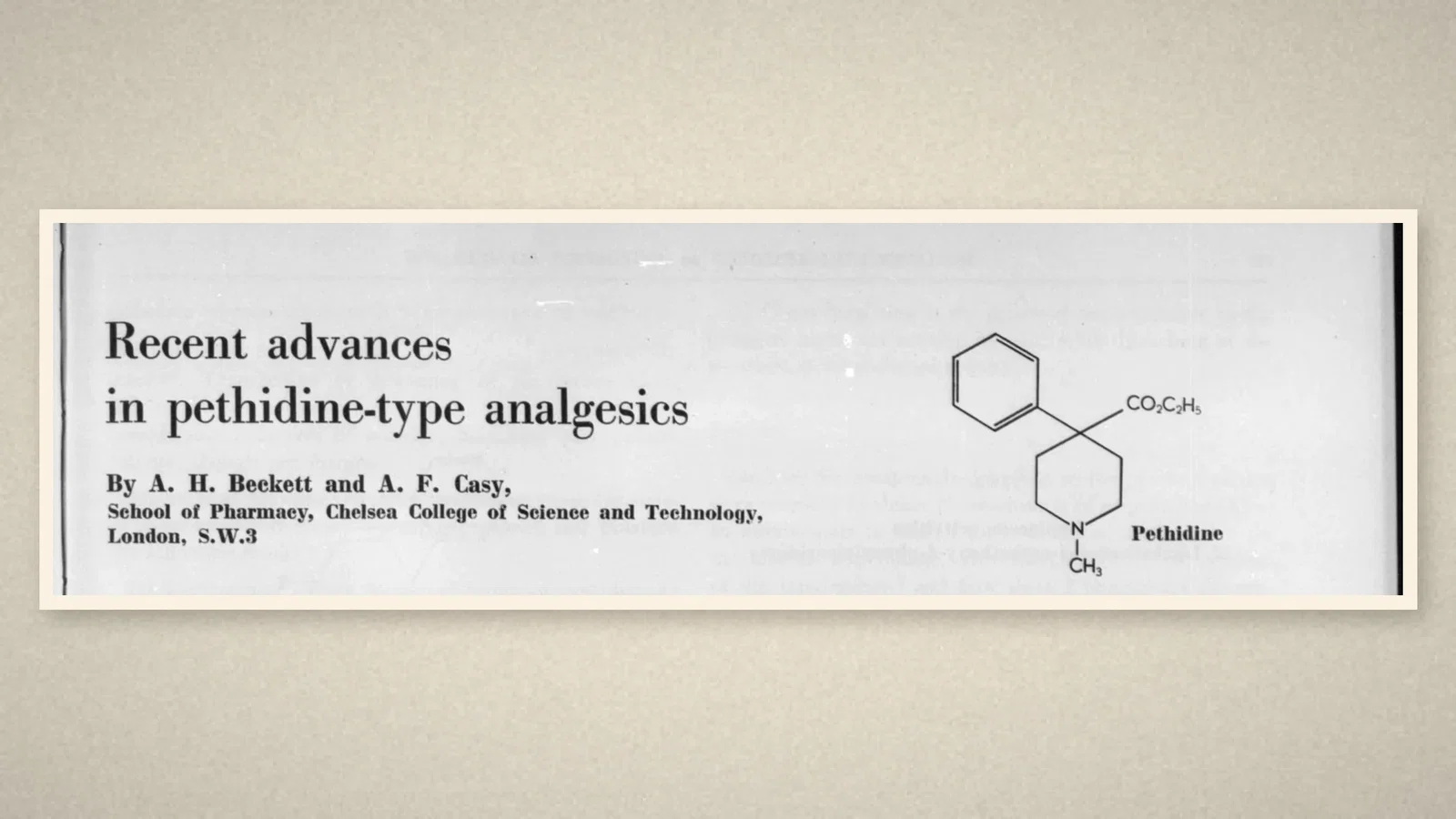
Morphine, pethidine and the new synthetic analgesics of the early post-war years looked quite different on paper, yet they did much the same thing. In 1954 two pharmaceutical chemists in London, A. H. Beckett and A. F. Casy, offered an explanation: strong analgesics share a shape, and they act by fitting a complementary surface somewhere in the nervous system. They called it the "analgesic receptor surface" and drew it. This article could not obtain their two 1954 papers, in the Journal of Pharmacy and Pharmacology and Nature. It reads instead the authors' own restatement of the idea in the United Nations Bulletin on Narcotics in 1957, which cites the 1954 work throughout. [1]
Why shape mattered
Beckett and Casy, writing from the School of Pharmacy at Chelsea College of Science and Technology, argued from stereochemistry. "The decisive role of stereochemical factors in analgesic action is demonstrated by" three lines of evidence: the many pairs of mirror-image isomers "in which most of the activity resides in one of the isomers"; the large differences in activity among the prodine isomers; and the relation between analgesics and their antagonists. Morphine and its antagonist nalorphine have identical configurations; levorphan "is antagonized by" the allyl compound of the same configuration but not by its mirror image. The authors had also related the configuration of the more active isomer in several pairs to D-(−)-alanine. [1]
Four features
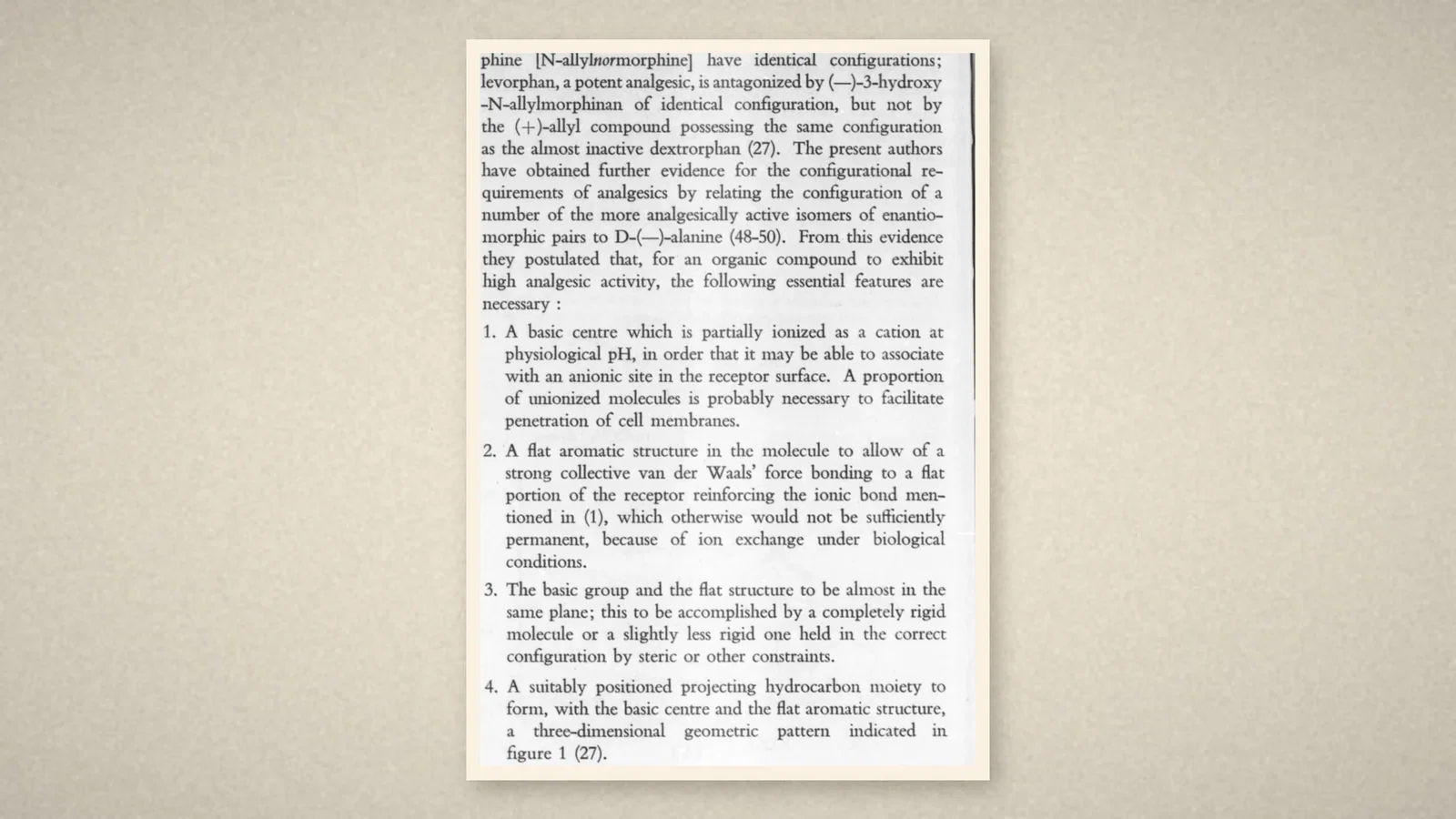
"From this evidence," the 1957 article says, "they postulated that, for an organic compound to exhibit high analgesic activity, the following essential features are necessary". The list is short. [1]
- "A basic centre which is partially ionized as a cation at physiological pH", able "to associate with an anionic site in the receptor surface"; some unionized molecules were thought necessary for crossing cell membranes.
- "A flat aromatic structure in the molecule" allowing van der Waals bonding "to a flat portion of the receptor", which reinforced the ionic bond.
- "The basic group and the flat structure to be almost in the same plane", held there by a rigid molecule or by steric constraints.
- "A suitably positioned projecting hydrocarbon moiety" that, with the basic centre and the flat ring, formed "a three-dimensional geometric pattern". [1]
The drawing
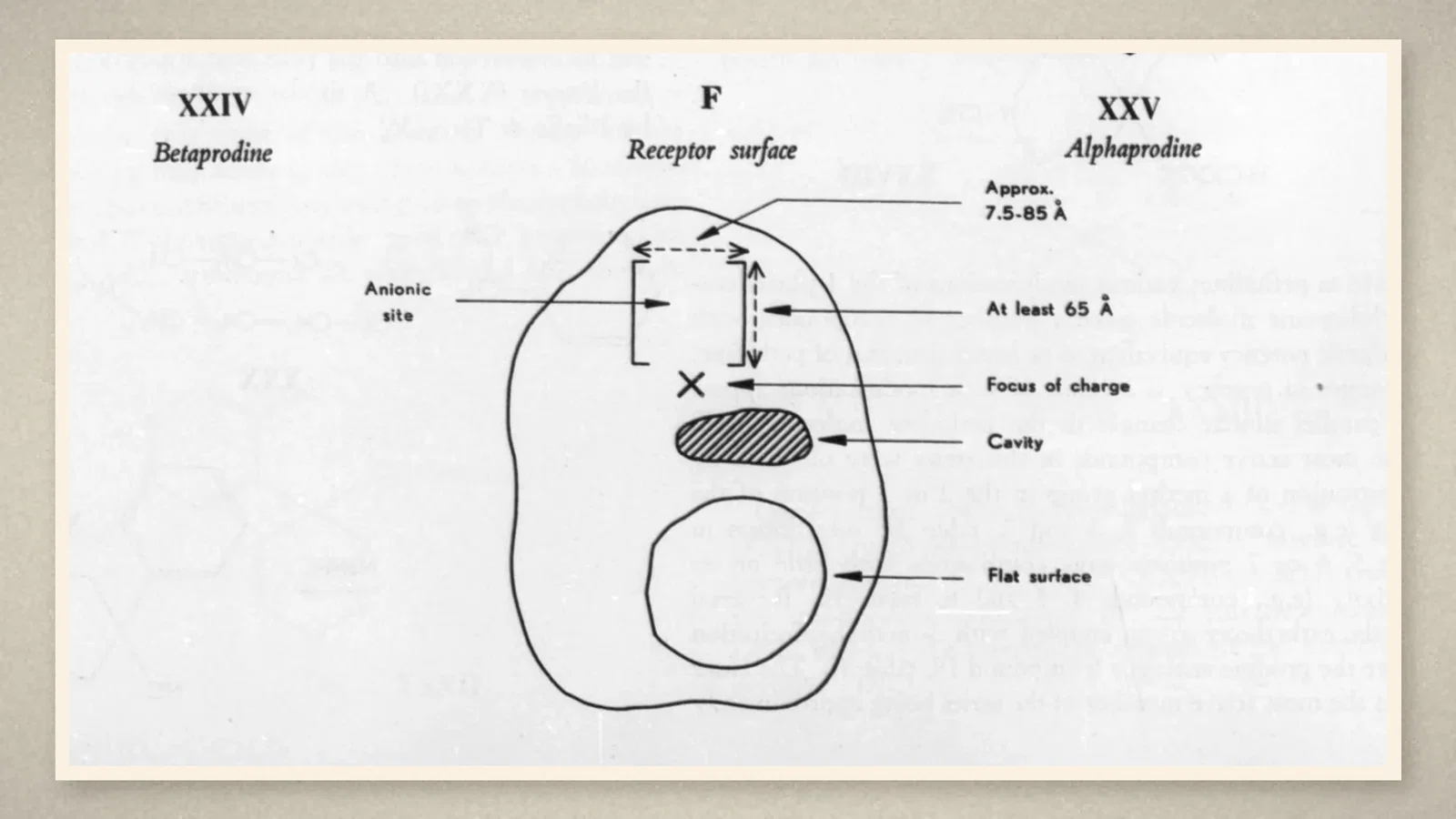
Figure 1 of the 1957 article shows the lower surfaces of several drugs and "the upper surface of the receptor", as complementary surfaces. Panel F, "Receptor surface", marks an anionic site, a focus of charge, a cavity and a flat surface, with two distances in ångström units that are indistinct on the scanned page and are not repeated here. Pethidine, betaprodine, alphaprodine and morphine are drawn beside it to show how each might lie on that surface. The authors used the model to argue which prodine isomer was which, and to explain why pethidine, which can take two shapes, still fits. [1]
A postulate, not a structure
Nothing had been isolated. The receptor was inferred from the drugs: from which isomers worked, which did not, and which antagonists blocked them. The model was nonetheless concrete enough to guide chemistry. In 1969 a University of Alberta thesis supervised by Casy began from the same assumption, that "analgesia results from the interaction of a drug with a specific analgesic receptor located somewhere in the central nervous system", with "a chemical configuration complementary to that of the analgesic drug", and still tested its results against "the original proposals regarding structural features of the analgesic receptor (Beckett and Casy 1954)". [2]
What the record shows
In 1954 the idea that morphine acts on a specific receptor was given a definite form: a few features of the drug, matched to a few features of a surface. The model was built from stereochemistry and structure-activity data, and it was still the reference point for Casy's own student fifteen years later. The later demonstration of opioid binding sites and the body's own opioid peptides belongs to later articles and is not covered here.
Sources and reading limits
Read: Beckett and Casy's 1957 review in the Bulletin on Narcotics in full; the introduction and relevant chapter of Khullar's 1969 thesis.
Not covered: Beckett and Casy's 1954 papers (J Pharm Pharmacol 1954;6:986-1001 and Nature 1954;173:1231), which are not on the Internet Archive or in PubMed Central and could not be accessed. The four features and the figure are quoted from the 1957 restatement, which cites the 1954 work; the article does not claim the 1954 wording was identical. The distances on the figure are not used.
Three illustrations are page crops from the 1957 article; one is drawn from it.
- Beckett AH, Casy AF. Recent advances in pethidine-type analgesics. Bull Narc. 1957;9(4):37 ff. Internet Archive
- Khullar KK. Stereochemical studies of 3-methyl analogues of pethidine [PhD thesis]. Edmonton: University of Alberta; 1969. Internet Archive
Continue exploring
Related reading connects shared questions and contexts; it does not by itself establish historical influence.
Anesthesia Epochs · The Source Room · About & Editorial Method
Published November 2, 2026. Sources and reading limits are stated above. Illustrations are labelled as original source images or AI-made. Historical accounts are educational; they are not current treatment instructions.