
In 1960 Löfgren and Tegnér chose the compound later named prilocaine from a series by its 'anesthetic index'; in 1965 Hjelm and Holmdahl showed that it induces methaemoglobinaemia, probably through a metabolite.
Reading Library · Anesthesia Epochs · 中文版
Watch the education video (for clinicians)
1960: Prilocaine and Methaemoglobin — Chosen by Index · Anesthesia Epochs Education Series
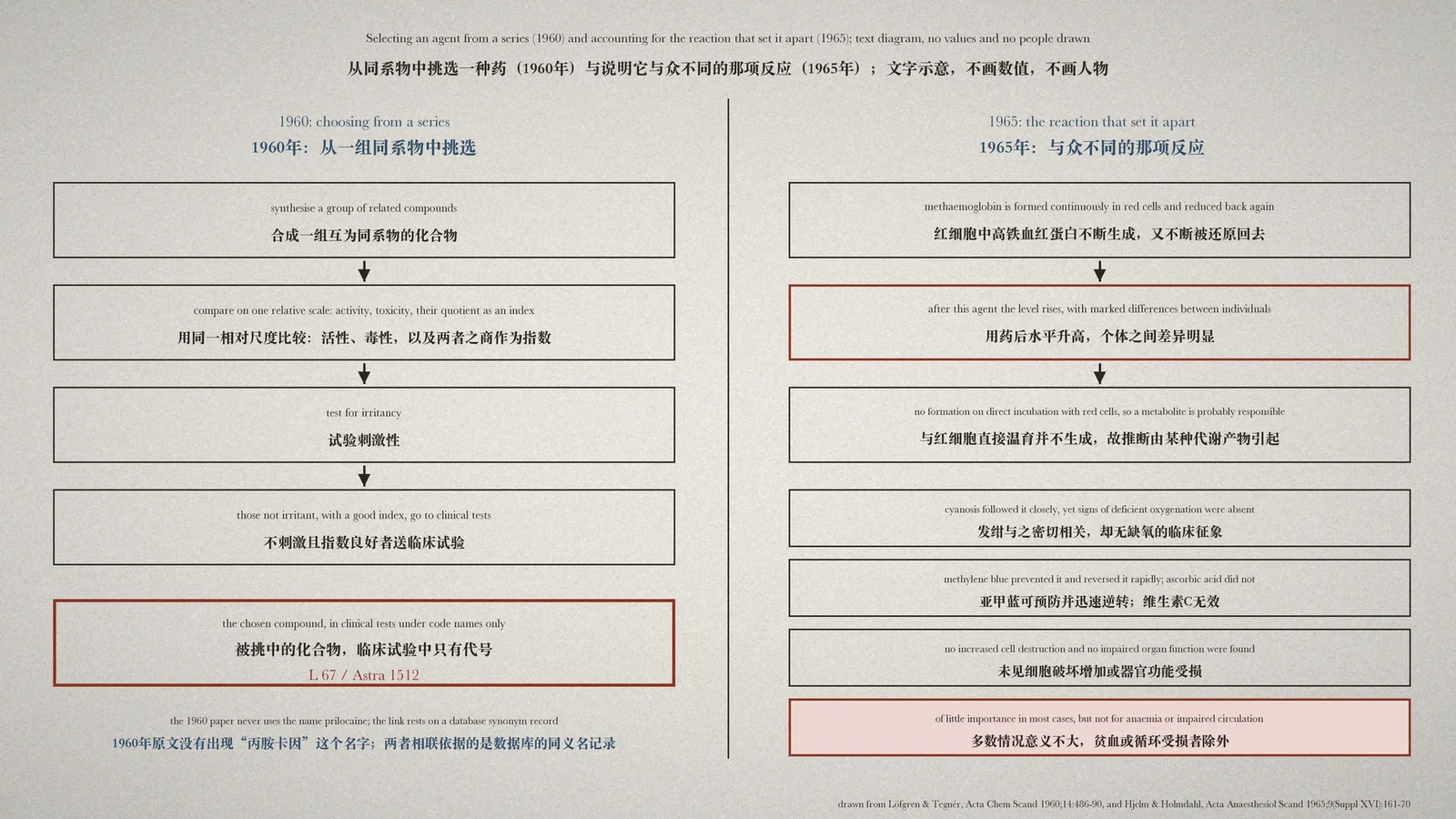
A new drug often reaches practice in two steps: one compound is picked out of a group of near relatives, and then, in use, something is found that sets it apart from its own class. Prilocaine is such a case. In 1960 Acta Chemica Scandinavica carried the twentieth paper in the "Studies on local anesthetics" series by Nils Löfgren and Claes Tegnér of the Institute of Organic Chemistry and Biochemistry at the University of Stockholm, subtitled "A New Useful Local Anesthetic". Five years later Magnus Hjelm and Martin H:son Holmdahl of the University Hospital in Uppsala set out, in a supplement to Acta Anaesthesiologica Scandinavica, the methaemoglobinaemia the agent induces. This article reads both originals. [1, p. 486][2, p. 161]
Choosing one compound from a series
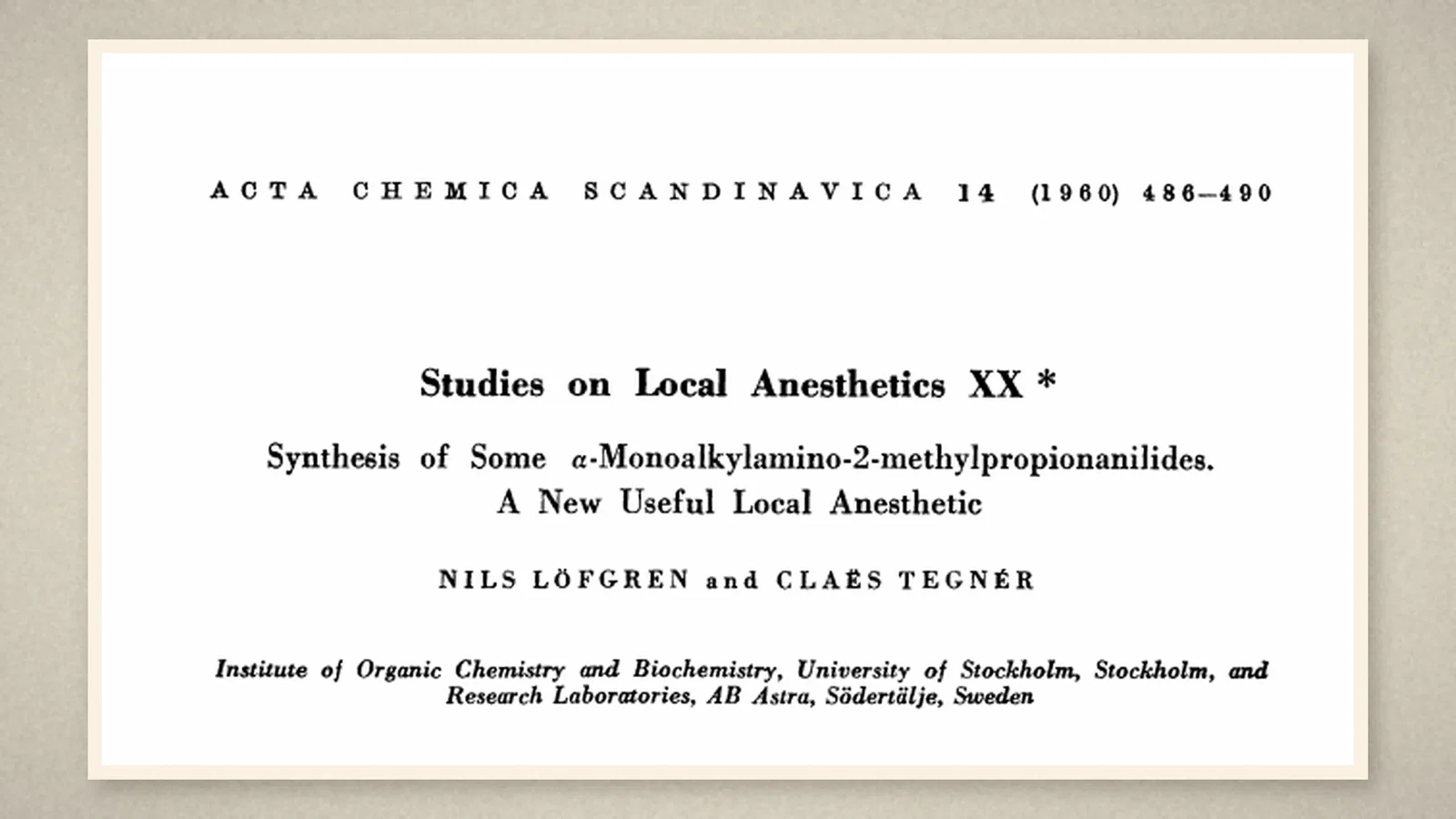
The institute had published several papers of this kind before, one of them describing the preparation of the injectable local anaesthetic that had since become the most important of its sort. The 1960 paper took a group of compounds that were close relatives of one another, synthesised them, and compared them one against another. [1, p. 486]
The manner of comparison is the interesting part. Anaesthetic activity was measured on the rabbit cornea and toxicity in mice, and the paper reports not absolute figures but values relative to that standard agent: a relative anaesthetic activity and a relative toxicity, with the quotient of the two named an "anesthetic index". A whole series could then be set out together, showing at a glance which was stronger, which more toxic, and which struck the better bargain between the two. [1, p. 487]
Activity alone did not settle it. The compounds were also injected into the rabbit ear to test for irritancy, and some proved clearly irritant. Those sent on to clinical tests were the ones that did not appreciably irritate the skin and had a favourable index. [1, p. 487]
The one that was chosen
One compound went into clinical tests under the code names "L 67 or Astra 1512". The paper reports that it produced no sign of irritation when used for infiltration anaesthesia in man and that no side effects were observed; its efficiency was studied in practically all forms of injection anaesthesia, and it acted much like the standard agent, the two producing about the same onset, extent and duration. In dental use it gave a shorter anaesthesia of the soft tissues, which the authors considered the more favourable behaviour. They called it a very promising injection anaesthetic for clinical use. [1, p. 488]
Nowhere does that paper use the name prilocaine. Linking the two articles needs an outside source: the ChEMBL record for prilocaine (CHEMBL1194) lists ASTRA-1512 and L-67 among its synonyms. [3]
Five years later: a reaction unlike its class
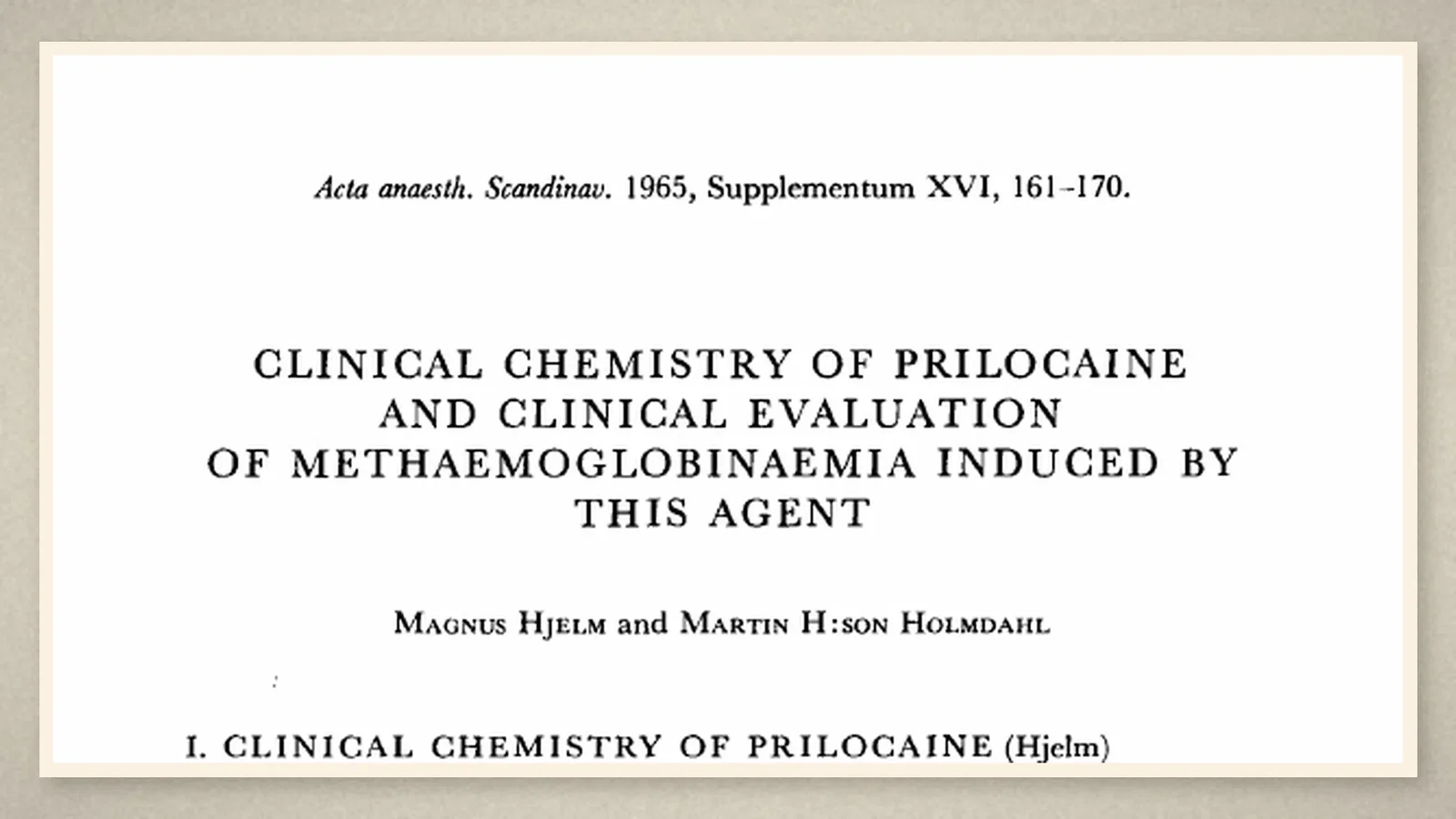
The 1965 paper begins with the background. Methaemoglobin is formed continuously in circulating erythrocytes, and reducing substances furnished by the cells' own metabolism convert it back to haemoglobin, so that it normally makes up only a small part of the total. Higher levels follow if oxidation speeds up or reduction slows down, and drugs or their metabolites are often responsible. [2, p. 161]
The authors studied surgical patients and healthy volunteers given the agent, with another common local anaesthetic as a comparison. A measurable rise in methaemoglobin followed the agent, with marked differences between individuals; the comparison agent induced no significant formation. [2, p. 164]
One observation carried the mechanism. Incubated directly with erythrocytes, the agent does not form methaemoglobin. A metabolite, the authors therefore reasoned, is probably responsible in the body, and they connected this with the known oxidation of aromatic amines by microsomal enzymes to nitroso compounds, which induce reversible methaemoglobin formation catalytically. [2, p. 169]
Visible cyanosis, absent hypoxia
The clinical half is Holmdahl's. The degree and duration of cyanosis were closely related to the course and severity of the methaemoglobinaemia; yet clinical signs of deficient oxygenation were absent even with obvious cyanosis, the pulse rate stayed stable, no one experienced dyspnoea, and the volunteers went on reading and chatting with the staff. Other analyses, those reflecting haemolysis and those reflecting liver and kidney function, showed no significant change, so that the authors found no evidence of increased cell destruction or impaired organ function. [2, p. 169][2, p. 165][2, p. 170]
For management, methylene blue had both a prophylactic inhibitory effect and a rapid therapeutic one, while ascorbic acid was ineffectual. [2, p. 165]
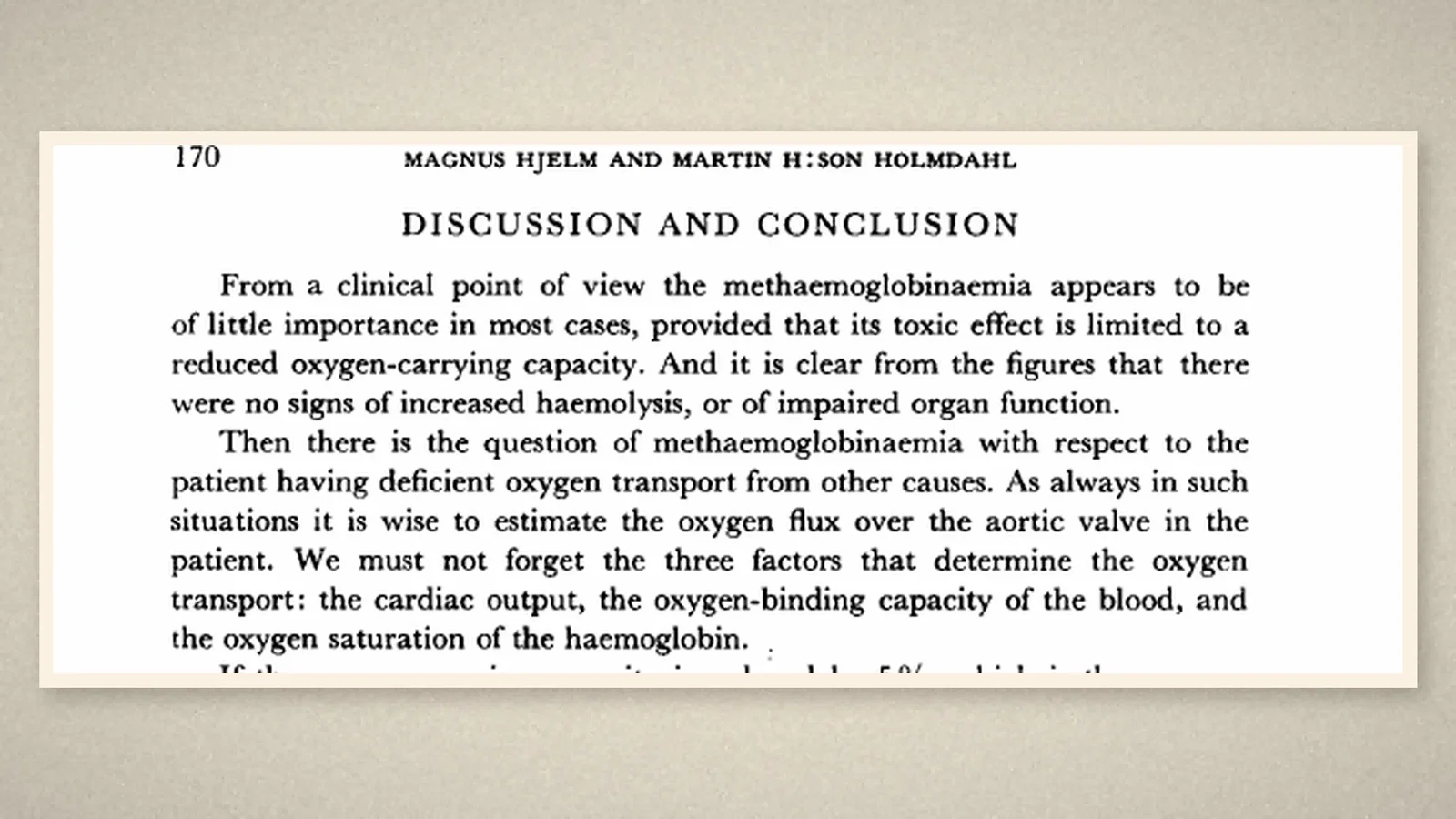
The conclusion is carefully put. Provided its toxic effect is limited to a reduced oxygen-carrying capacity, the methaemoglobinaemia appears to be of little importance in most cases. The authors then place the question among the three factors that determine oxygen transport, the cardiac output, the oxygen-binding capacity of the blood and the oxygen saturation of the haemoglobin: a patient without anaemia or circulatory deficiency compensates easily for the loss with a modest rise in cardiac output, whereas for anaemic patients and those with greatly impaired circulation a fall in oxygen-carrying capacity may be undesirable. Although methylene blue reverses it rapidly, the paper closes, its undesirability must always be weighed carefully against the agent's proven low central nervous toxicity. [2, p. 170]
What the record shows
Together the two papers trace a complete small path: pick a candidate out of a series on a common relative scale, see whether it serves in practice, and then, after it is in use, work out what the one reaction that sets it apart is, where it comes from, whether it can be managed, and for whom it matters. The 1965 paper does not call for the agent to be abandoned; it sets the cost beside the benefit and leaves the weighing to those who use it.
Sources and reading limits
Read: Löfgren N, Tegnér C, "Studies on local anesthetics XX ... A new useful local anesthetic", Acta Chemica Scandinavica 1960, vol. 14, no. 2, pp. 486-90 (received 1 October 1959), in full, with the page image of p. 486 checked; and Hjelm M, Holmdahl MH, "Clinical chemistry of prilocaine and clinical evaluation of methaemoglobinaemia induced by this agent", Acta Anaesthesiologica Scandinavica 1965, Supplement XVI, pp. 161-70 (Wiley PDF, obtained through institutional access), in full, with the page images of pp. 161 and 169 checked.
Identity check: the 1960 paper never uses the name prilocaine, calling the agent compound II and, in clinical tests, "L 67 or Astra 1512". The ChEMBL record for prilocaine (CHEMBL1194) lists ASTRA-1512 and L-67 among its synonyms, and that is the basis on which this article joins the two papers, a step that rests on the database rather than on the 1960 text.
Not covered: the 1959 clinical report by Eriksson and Gordh cited in the 1960 paper; the fuller paper by the same two authors in the main series of the same journal that year.
Limits: no synthesis procedure, no doses, no concentrations, no melting points or analytical values and no result tables are reproduced here; results are given in direction and in qualitative conclusions only. The individual figures for the compounds in the 1960 paper are not repeated.
Three illustrations are taken from the two papers (1960, p. 486; 1965, pp. 161 and 170). One is a diagram drawn from the texts, with no people drawn and no numerical values shown.
- Löfgren N, Tegnér C. Studies on local anesthetics XX. Synthesis of some alpha-monoalkylamino-2-methylpropionanilides. A new useful local anesthetic. Acta Chem Scand. 1960;14(2):486-90. doi:10.3891/acta.chem.scand.14-0486
- Hjelm M, Holmdahl MH. Clinical chemistry of prilocaine and clinical evaluation of methaemoglobinaemia induced by this agent. Acta Anaesthesiol Scand. 1965;9(Suppl XVI):161-70. doi:10.1111/j.1399-6576.1965.tb00536.x
- ChEMBL compound record CHEMBL1194 (prilocaine), synonyms including ASTRA-1512 and L-67. ChEMBL
Continue exploring
Related reading connects shared questions and contexts; it does not by itself establish historical influence.
Anesthesia Epochs · The Source Room · About & Editorial Method
Published November 4, 2026. Sources and reading limits are stated above. Illustrations are labelled as original source images or AI-made. Historical accounts are educational; they are not current treatment instructions.