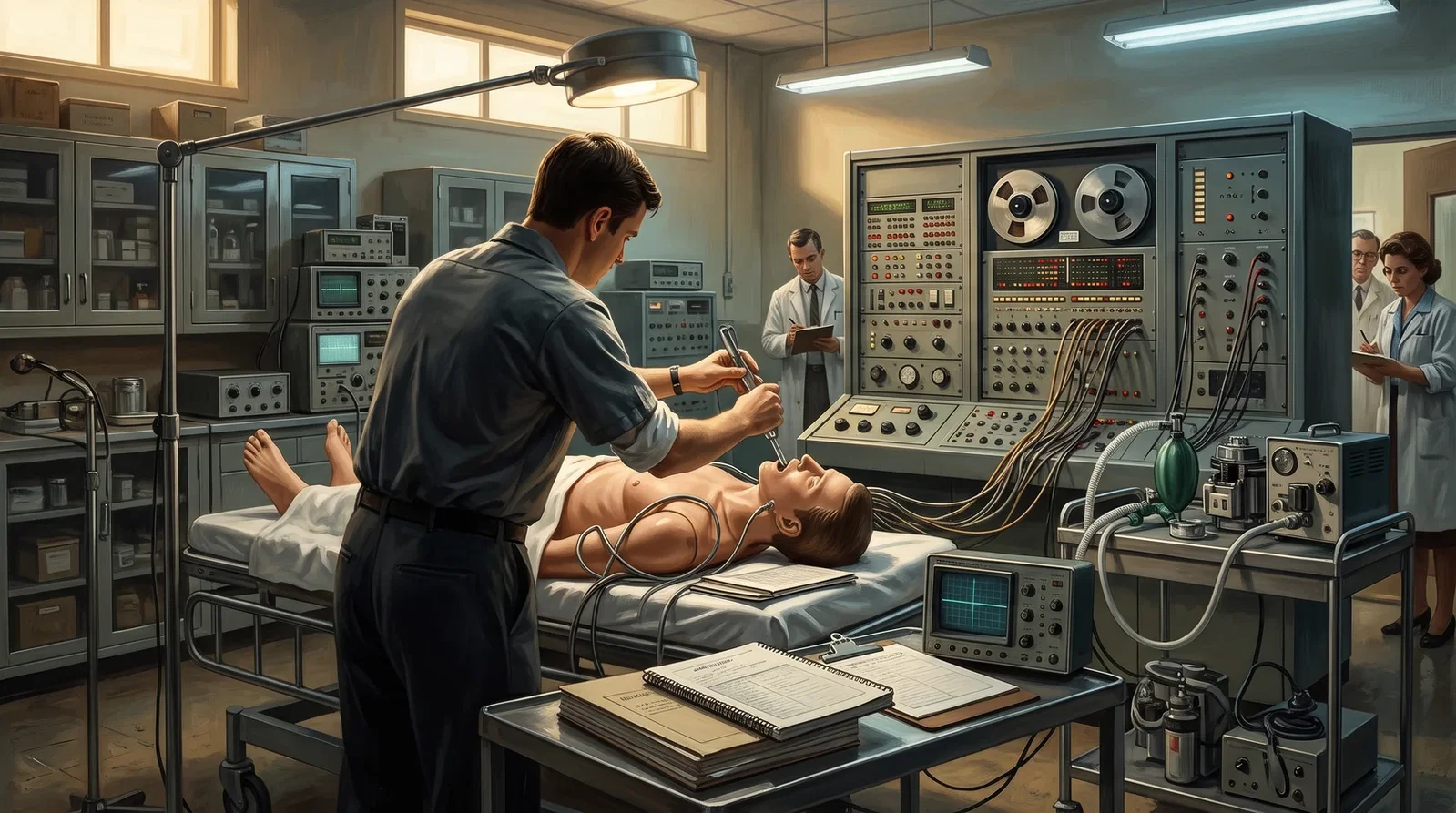
The final report of US Office of Education Cooperative Research Project D-240, 'A developmental study of medical training simulators for anesthesiologists' (Denson and Abrahamson, University of Southern California, 31 January 1968; ERIC ED019253), tells how a question from Tullio Ronzoni of the Los Angeles County Chamber of Commerce about using computers in medical education led Abrahamson, the anaesthesiologist Judson Denson and Aerojet-General to build Sim One, a computer-controlled manikin that breathed, had a heartbeat, pulse and blood pressure, opened and closed its eyes and mouth, and responded to treatment; in a controlled study of 10 anaesthesia residents learning tracheal intubation, the simulator-trained group needed a mean of 9.6 operating-room attempts to reach four consecutive acceptable ratings against 18.6, and saved 22 days on the strictest criterion; most differences were not statistically significant, but the authors argued that simulation saved time and spared patients risk.
Reading Library · Anesthesia Epochs · 中文版
Watch the education video (for clinicians)
1968: Sim One — Intubation Before the Patient · Anesthesia Epochs Education Series
Anaesthesia residents today often practise intubation on manikins before they do it on patients, and many hospitals have whole simulated operating theatres. An early example often cited on this path is "Sim One", built at the University of Southern California between 1966 and 1968. On 31 January 1968 the project's leaders submitted their final report to the US Office of Education, and the full text survives in the Education Resources Information Center (ERIC). This article reads that report. [1, résumé]
A question
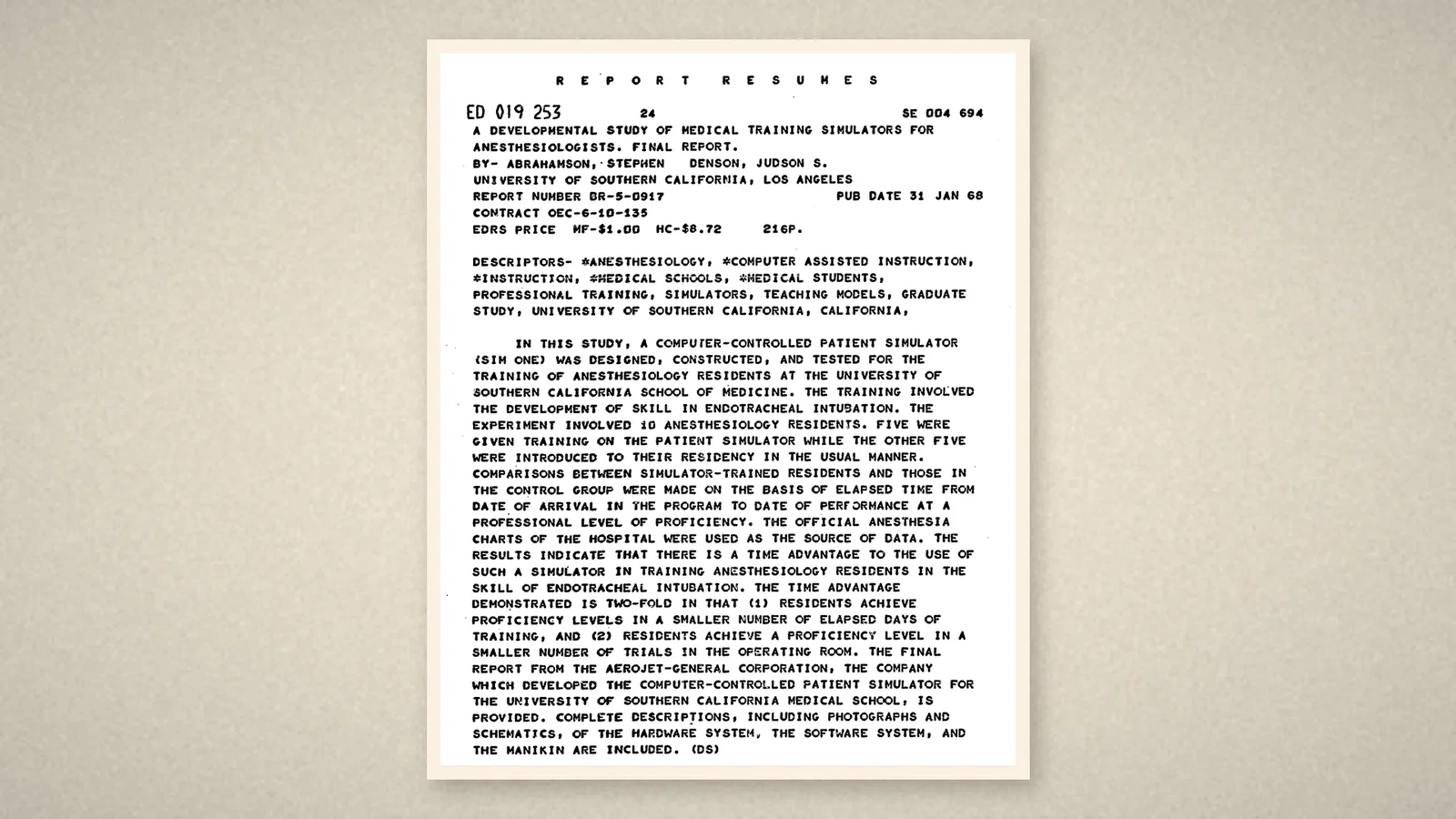
The report, "A developmental study of medical training simulators for anesthesiologists", by Stephen Abrahamson and Judson S. Denson of USC, was the final report of Office of Education Cooperative Research Project D-240, which ran from 1 January 1966 to 31 December 1967. The ERIC résumé says that a computer-controlled patient simulator, Sim One, was designed, constructed and tested for training anaesthesiology residents at the USC School of Medicine in tracheal intubation. [1, résumé][1, title page]
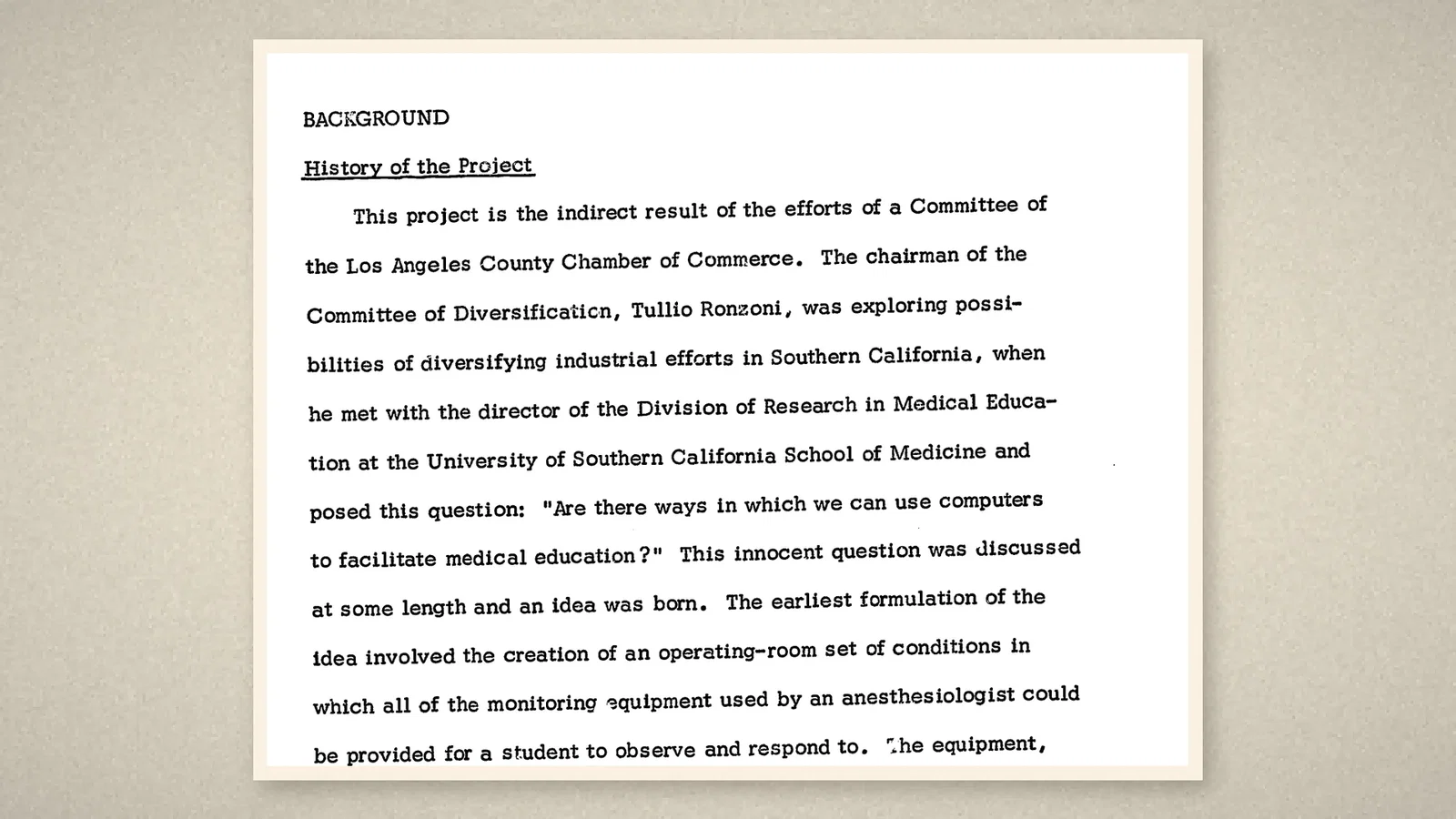
The "Background" section explains that the project was the indirect result of a committee of the Los Angeles County Chamber of Commerce: Tullio Ronzoni, chairman of its Committee of Diversification, exploring ways to diversify industry in Southern California, met the director of the Division of Research in Medical Education at USC and asked: "Are there ways in which we can use computers to facilitate medical education?" The earliest idea was an operating-room setting with all the monitoring equipment an anaesthesiologist uses, controlled by a computer program, so that if a student requested oxygen or a drug, the appropriate patient response would appear on the monitors. [1, p. 1]
J. S. Denson, chief of anaesthesiology at Los Angeles County General Hospital and head of anaesthesia at the USC School of Medicine, then joined, and discussions with computer engineers at Aerojet-General's Von Karman Center broadened the idea to a plastic replica of a patient able to simulate certain life conditions. Abrahamson, Denson and Ronzoni looked for support through the US Public Health Service and the National Institutes of Health, finding interest but no money, until a proposal to the Office of Education's Cooperative Research Project was funded on 2 January 1966. [1, pp. 1-2]
A manikin that breathed
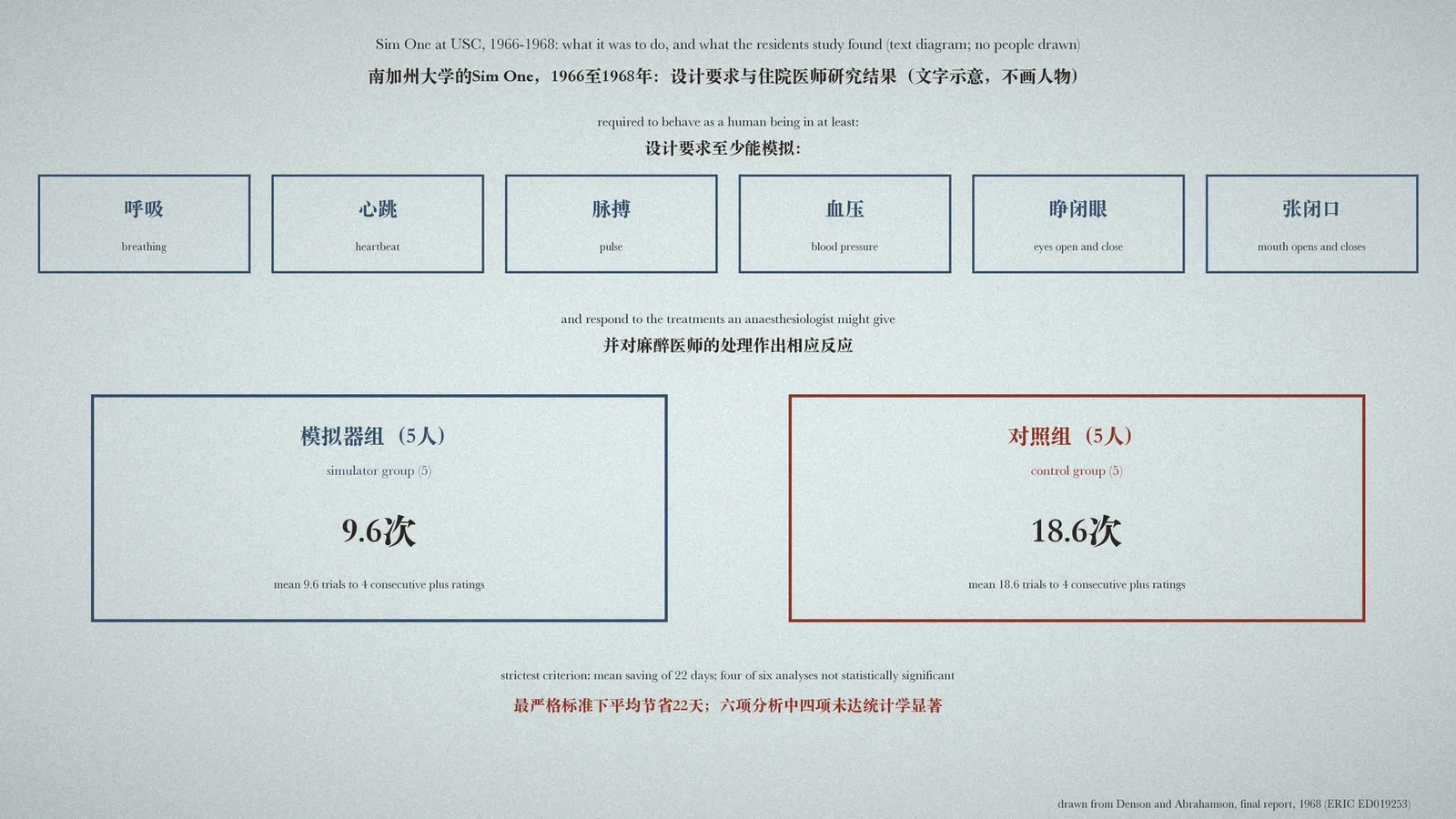
The project began as a "demonstration project" with three purposes: to test the feasibility of simulating a human being, to test the effectiveness of using such a simulator in training, and to demonstrate the finished product. The feasibility test was deliberately complex: the simulator was to behave as a human being at least in breathing, a heartbeat, a pulse, blood pressure, opening and closing the eyes, and opening and closing the mouth; each was to vary within normal range and to extremes in certain conditions, and to respond appropriately to the treatments an anaesthesiologist might give. [1, p. 3]
Ten residents
The skill chosen was tracheal intubation. Of 10 new anaesthesia residents, five were trained on the simulator and five entered residency in the usual way; the hospital's official anaesthesia charts were the source of data for comparing the days and the operating-room trials each group needed to reach professional proficiency. [1, résumé]
To reach four consecutive "plus" ratings, the simulator group needed a mean of 9.6 trials in the operating room and the control group 18.6; on the strictest criterion the simulator group saved a mean of 22 days. [1, p. 28][1, p. 40]
The report's conclusions
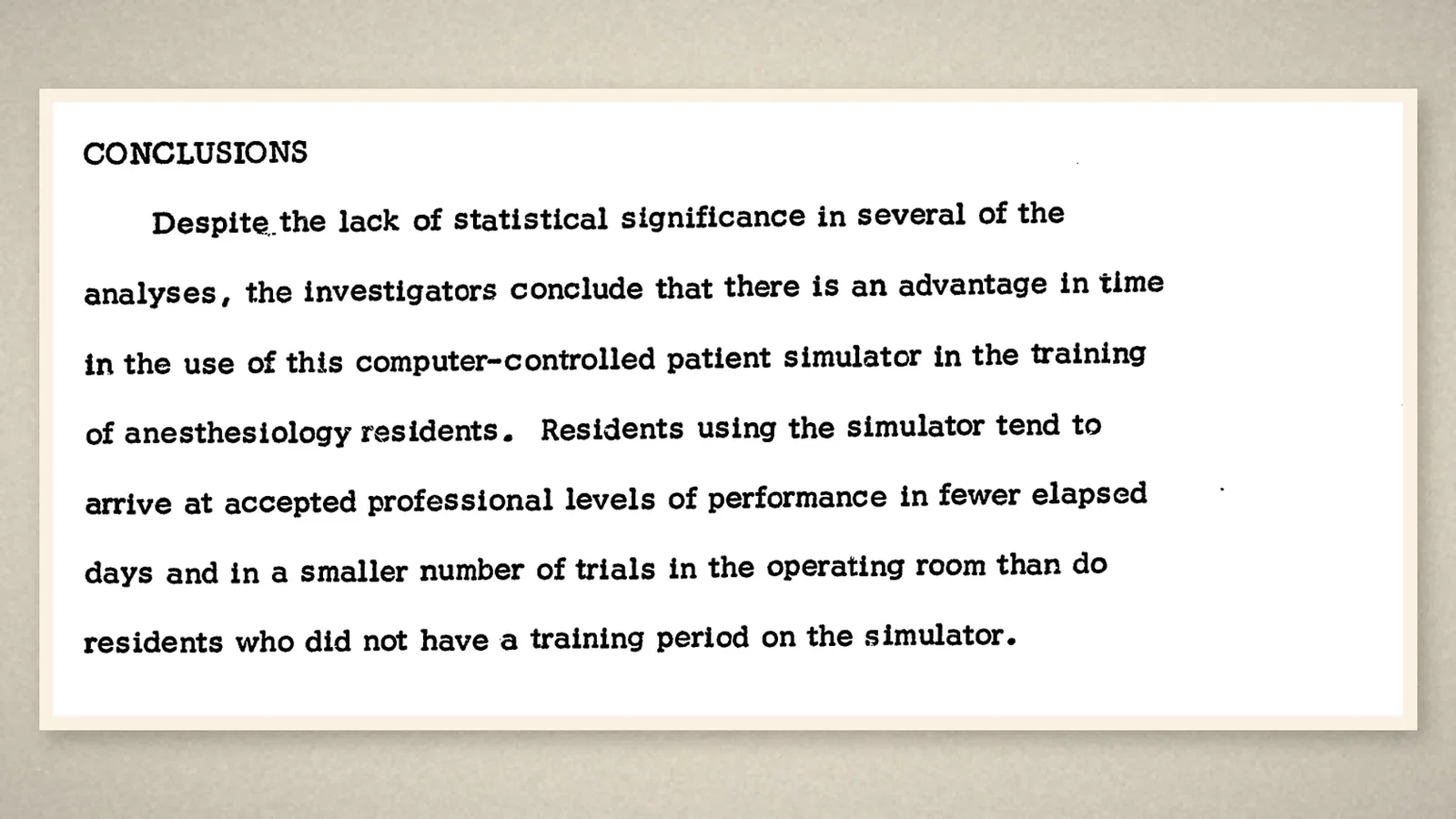
"Despite the lack of statistical significance in several of the analyses," the report concluded, the investigators found a time advantage in training residents on the computer-controlled patient simulator: residents who used it tended to reach accepted professional levels of performance in fewer elapsed days and fewer operating-room trials. [1, p. 39]
The discussion admitted frankly that four of the six analyses did not reach statistical significance, because of large within-group variability and the small number of subjects, though every result lay in the hypothesised direction. It also offered another way to read the numbers: a missing "plus" rating meant that an experienced anaesthesiologist had judged that the resident could not be trusted in the operating room without supervision, so that each beginner not trained on the simulator exposed, on average, about nine more patients to some degree of threat before managing four acceptable intubations in a row. Finally, the report said, the feasibility of simulating a living human being for training had been demonstrated "without question", and the educational experiment had been carried out, if with small numbers. [1, pp. 39-41]
What the record shows
The report turned the idea of letting learners make their mistakes on something that cannot be hurt into countable results, though the conclusion rests on ten people and the authors themselves admitted its statistical weakness. What it leaves is a question and a method: using simulation to reduce the learning cost borne by patients, and testing with data whether it works.
Sources and reading limits
Read: Denson and Abrahamson, "A developmental study of medical training simulators for anesthesiologists", final report (USC, 31 January 1968; ERIC ED019253, full-text PDF): the ERIC résumé; the background, history of the project, original purposes and contract (pp. 1-6); the study design, results and tables (to p. 38, partly skimmed); and the conclusions and discussion (pp. 39-41). Page images of the résumé, background and conclusions pages checked. The Aerojet-General engineering appendix was not read in detail.
Not covered: a BMJ Quality and Safety review (not accessible); Abrahamson, Denson and Wolf's 1969 journal paper.
Limits: this is the project team's own report, and the sample is very small. "An early example" is context. The 1967 prototype and the 1969 paper have different dates; this article follows the 1968 final report.
Three illustrations are taken from the 1968 report (ERIC résumé, p. 1, p. 39). One is a text diagram drawn from the report, with no people and no manikin drawn.
- Denson JS, Abrahamson S. A developmental study of medical training simulators for anesthesiologists. Final report, Cooperative Research Project No. D-240. Los Angeles: University of Southern California; 1968. ERIC ED019253. PDF
Continue exploring
Related reading connects shared questions and contexts; it does not by itself establish historical influence.
Anesthesia Epochs · The Source Room · About & Editorial Method
Published November 4, 2026. Sources and reading limits are stated above. Illustrations are labelled as original source images or AI-made. Historical accounts are educational; they are not current treatment instructions.