Anesthesia and Analgesia: Current Researches for November-December 1970 (vol. 49, no. 6) carried 'A postanesthetic recovery score' by J. Antonio Aldrete and Diane Kroulik of the University of Colorado Medical Center and the Denver Veterans Administration Hospital. The usual anaesthetic record, they wrote, leaves only a few and usually inadequate spaces for the condition of a patient recovering from anaesthesia. In analogy to the widely adopted Apgar score they chose five signs already watched in every recovery room, activity, respiration, circulation, consciousness and colour, each rated 0, 1 or 2, a total of 10 meaning the best possible condition. Scoring was done on arrival and hourly thereafter, the first assessment jointly by the anaesthesiologist and the attending nurse and the rest by that same nurse, entered on a purpose-made data sheet. Among 352 patients, most scored 8 or above on arrival. Ideally every patient should reach 10, the authors concluded, but totals of 8 or 9 were acceptable for discharge from the recovery room, while 7 or less usually indicated continued close observation. They added that the grading was arbitrarily chosen and would probably need revision as experience grew.
Reading Library · Anesthesia Epochs · 中文版
Watch the education video (for clinicians)
1970: The Aldrete Recovery Score — Five Signs, One Number · Anesthesia Epochs Education Series

The operation is over, the anaesthetic is off, and the patient is wheeled into the recovery room. For the next hour or two, how is "how well is this patient recovering?" to be said precisely? The November-December 1970 issue of Anesthesia and Analgesia: Current Researches (vol. 49, no. 6) carried "A postanesthetic recovery score" by J. Antonio Aldrete and Diane Kroulik of the University of Colorado Medical Center and the Denver Veterans Administration Hospital, read that March at the 44th Congress of the International Anesthesia Research Society. This article reads that paper. [1, p. 924]
Why a number was wanted
The article opens with a piece of the same society's history: eighteen years earlier, at its 27th Congress, Virginia Apgar had proposed a new method of evaluating neonates. It had since been universally adopted and, although the original scheme had been revised, it remained the simplest and perhaps most reliable way of describing objectively the condition of an infant at birth. [1, p. 924]
Against that, the usual anaesthetic record provided only a few spaces for the physical status of a patient recovering from anaesthesia, and those were usually inadequate. In analogy to the Apgar method, the authors wrote, they devised a score to provide objective information on the condition of patients arriving in the recovery room. [1, p. 924]
The design constraints are stated plainly. To be practical, the method had to be simple, easy to memorise and applicable in all situations, whether the patient had received general, regional or intravenous anaesthesia; and to avoid adding to the burden on recovery-room staff, only physical signs that are commonly observed were considered. Each sign was rated 0, 1 or 2 according to its absence or presence, the ratings were added, and a total of 10 indicated a patient in the best possible condition. [1, p. 924]
The five signs
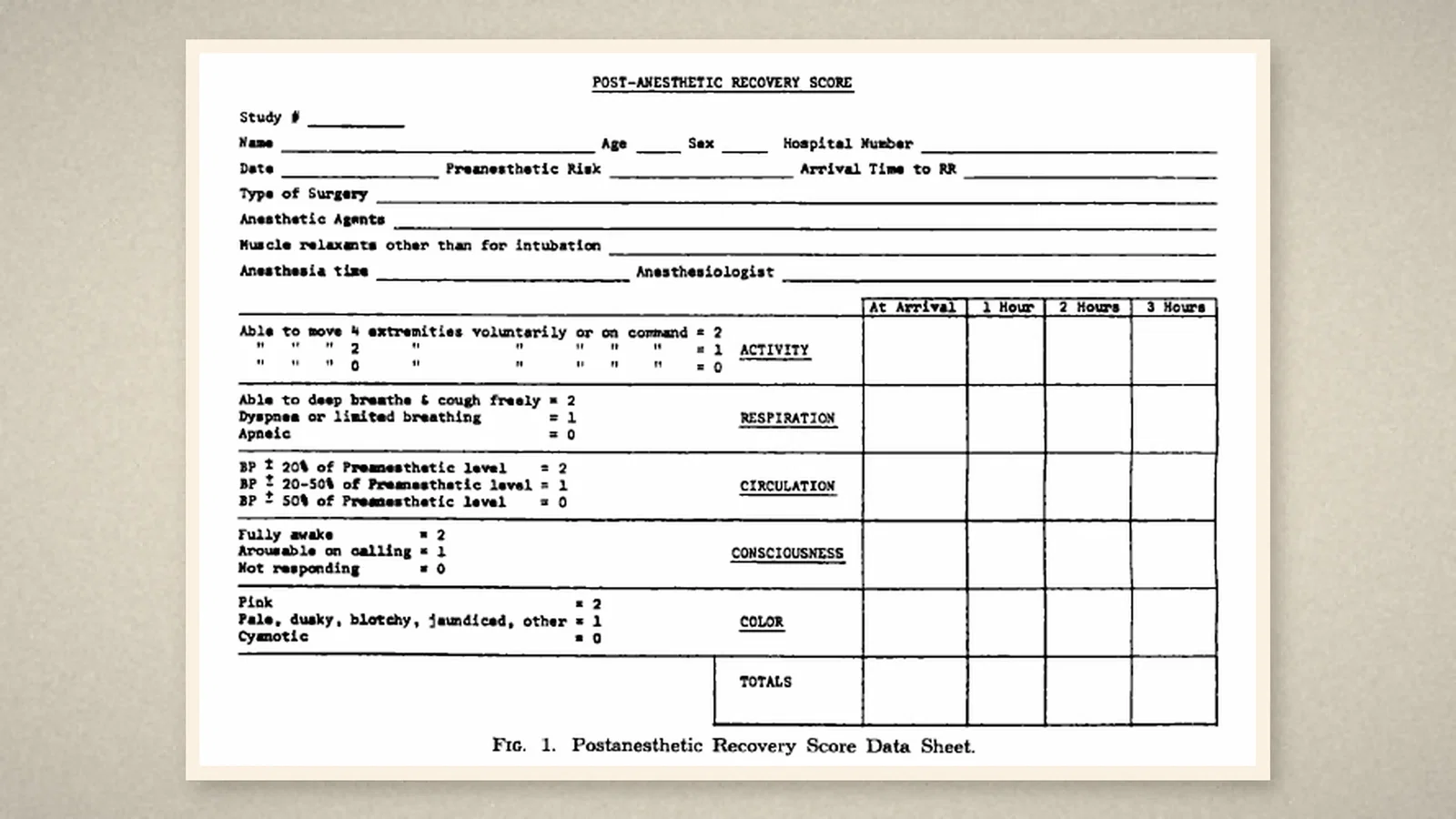
This initial report evaluated five signs. [1, pp. 925-6]
- Activity, assessed by the ability to move the extremities spontaneously or on command: all four limbs scored 2, two limbs 1, none 0. This, the authors noted, allowed patients with subarachnoid or epidural blocks to be evaluated, their total rising as muscle activity in the lower limbs returned.
- Respiration, judged so as to need no complicated gadgetry or sophisticated physical tests: able to breathe deeply and cough freely scored 2; limited respiratory effort, that is splinting, or apparent dyspnoea scored 1; no spontaneous respiratory activity scored 0.
- Circulation, which the authors called probably the hardest to judge by a simple sign. They chose change in arterial blood pressure from the preanaesthetic level, because blood pressure was still considered a reliable clinical tool, was monitored throughout the anaesthetic, and was among the first signs taken on arrival in practically every hospital. Within plus or minus 20 per cent of the preanaesthetic level scored 2, a deviation of 20 to 50 per cent scored 1, and 50 per cent or more scored 0.
- Consciousness: full alertness, shown by the ability to answer questions, scored 2; rousable when called by name, 1; no response to auditory stimulation, 0. Painful stimulation was deliberately discarded, since even decerebrated patients might react to it, since it is not a desirable manoeuvre to repeat often, and since a consistent and reliable method would be hard to develop.
- Colour: an obviously normal, pink skin colour scored 2; any departure that was not frank cyanosis, including pale, dusky, blotchy or jaundiced, scored 1; frank cyanosis scored 0. Where the patient's own pigmentation prevented accurate judgment, the colour of the oral mucosa was observed, and the authors noted that cyanosis is hard to assess in an anaemic, desaturated patient.
Scoring took place immediately on arrival and every hour thereafter until discharge to the ward or the intensive care unit. The first score was made jointly by the anaesthesiologist and the attending nurse, the rest by that same nurse on the same criteria, with the totals entered on a purpose-designed Post-Anesthetic Recovery Score data sheet (the paper's Figure 1). [1, p. 926]
The authors say frankly that the grading system was arbitrarily chosen and would probably be subject to revision as further experience was gained. [1, p. 925]
The series and the discharge rule
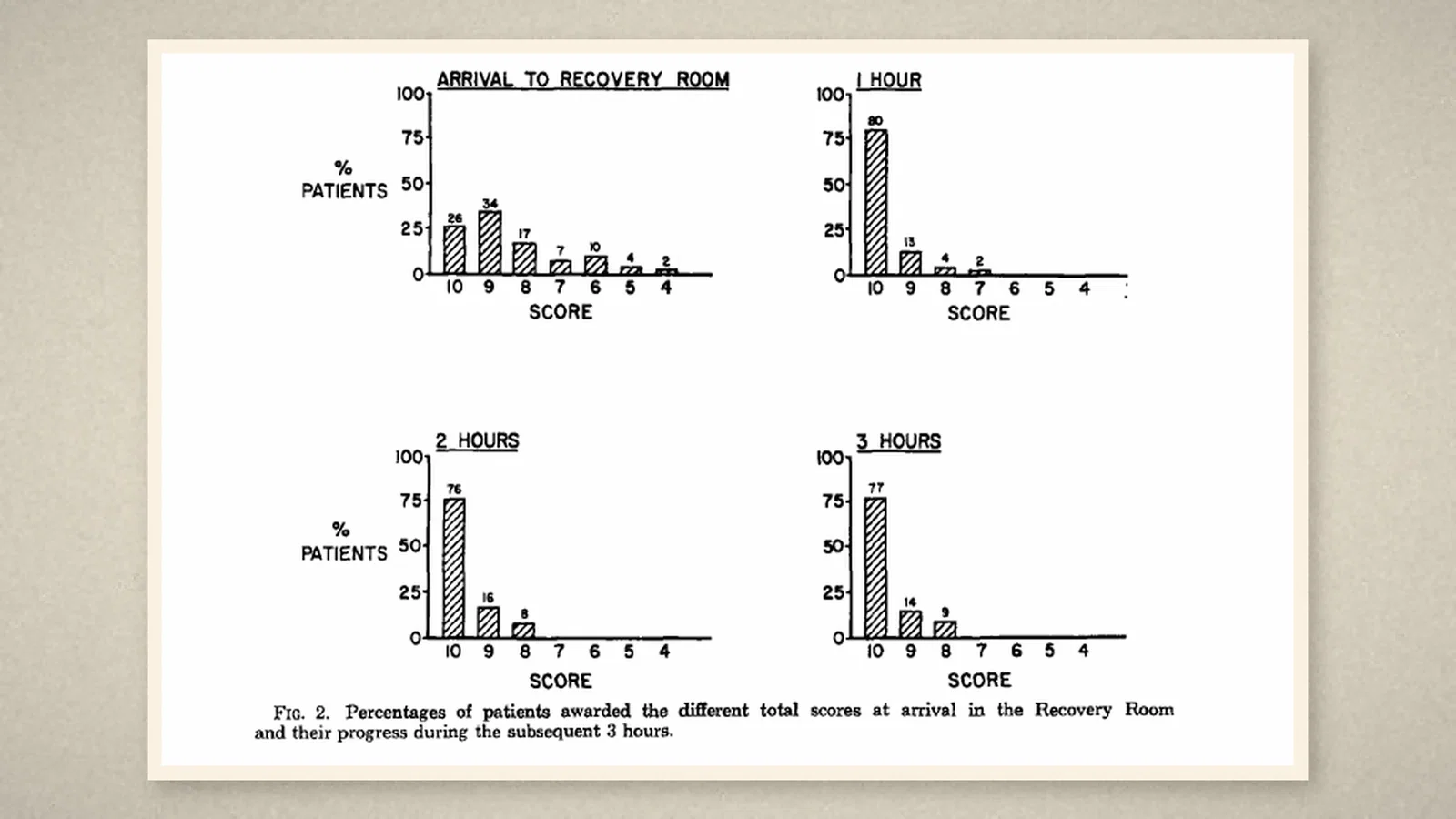
The study took 352 patients from the Denver Veterans Administration Hospital and Colorado General Hospital, with two further groups managed by anaesthesiologists in communities of the Rocky Mountain area. The patients had every form of anaesthesia, given by trainees, staff anaesthesiologists and nurse anaesthetists alike. Of the 352, 276 (78.4 per cent) scored 8 or higher on arrival in the recovery room, and none scored below 4; as the stay lengthened, the proportion in the upper scores rose further, as the paper's Figure 2 shows. [1, pp. 926-7]
The summary states the rule that came into wide use: ideally all patients should have scores of 10, but totals of 8 or 9 were acceptable for discharge from the recovery room, while totals of 7 or less were in most cases an indication for continuous close observation. [1, p. 934]
What the record shows
The paper turns "how is the patient doing?" from a string of adjectives into a number that fits on a form and is understood at a glance at handover. Its method is as notable as its result: no special apparatus, only signs the recovery room already watched; repeated assessment by a nurse against fixed criteria; and an author's own warning that the grading would need revising. The printed discussion that follows makes the context explicit, that as problems of the operating room were solved, a share of the risk and the work moved to the recovery room.
Sources and reading limits
Read: Aldrete JA, Kroulik D, "A postanesthetic recovery score", Anesthesia and Analgesia: Current Researches, November-December 1970, vol. 49, no. 6, pp. 924-34 (Wolters Kluwer PDF, obtained through institutional access), in full, including the signed discussion from Pittsburgh that follows it; page images of p. 924 (title), p. 926 (Figure 1, the data sheet) and p. 927 (Figure 2) checked.
Not covered: Apgar's 1953 paper, and the other recovery-room score the article says was proposed earlier but was too complex to be commonly accepted; both appear in the article only as reference numbers.
Limits: no drug doses are reproduced here; the score's own point values and blood-pressure criteria are the subject of this article and are given as the paper states them. The breakdown of scores by anaesthetic agent and relaxant is summarised rather than reported item by item. Later revisions of the score are outside scope.
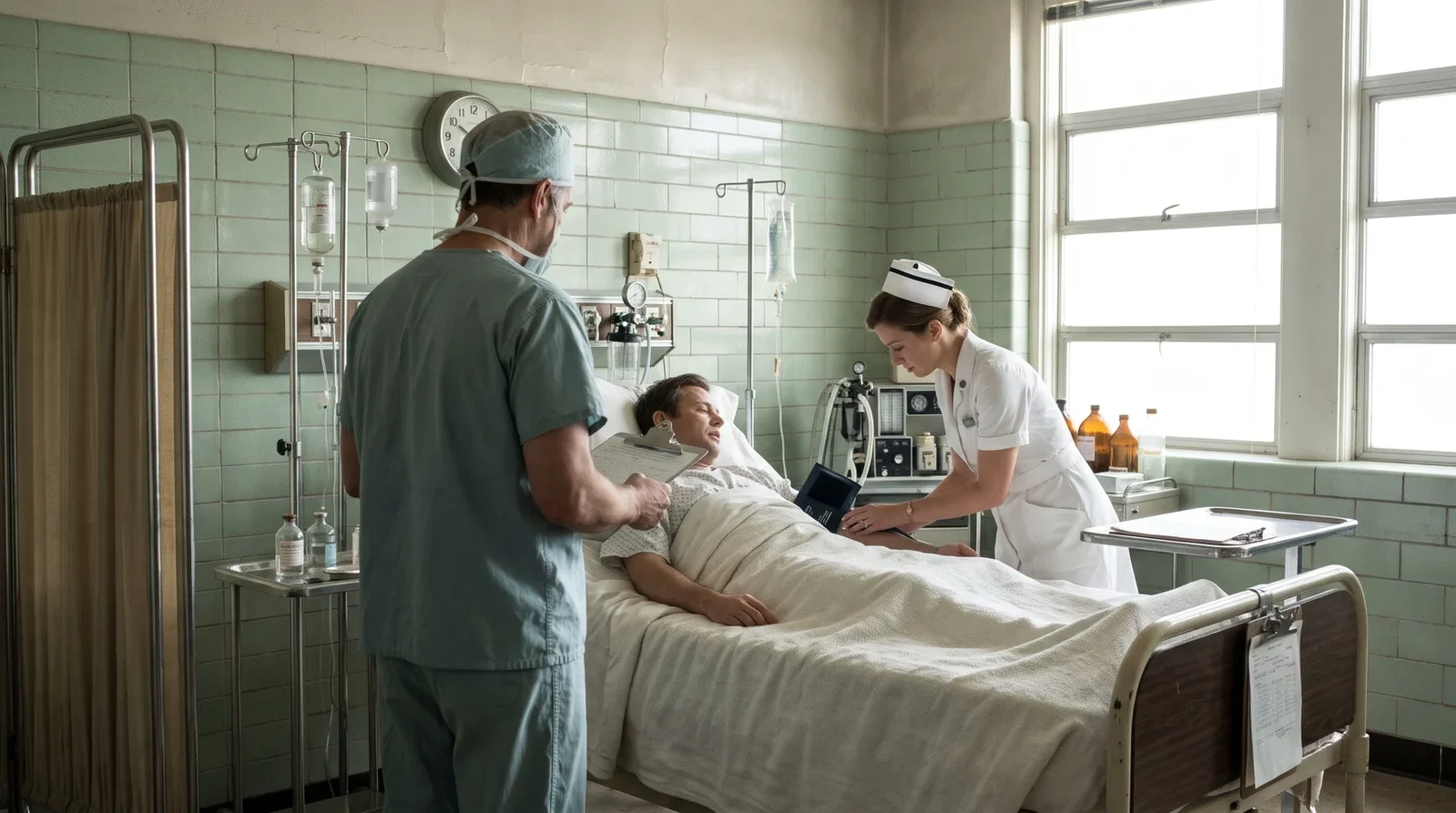
Three illustrations are taken from the 1970 paper (pp. 924, 926 and 927). One is a diagram drawn from the text, with no people drawn.
- Aldrete JA, Kroulik D. A postanesthetic recovery score. Anesth Analg. 1970;49(6):924-34. doi:10.1213/00000539-197011000-00020
Continue exploring
Related reading connects shared questions and contexts; it does not by itself establish historical influence.
Anesthesia Epochs · The Source Room · About & Editorial Method
Published November 5, 2026. Sources and reading limits are stated above. Illustrations are labelled as original source images or AI-made. Historical accounts are educational; they are not current treatment instructions.