
How a threshold for dangerous acid aspiration, taken from an experiment in a rhesus monkey, came to define who was 'at risk' in obstetric anaesthesia, and how later animal studies in rats and monkeys questioned it.
Reading Library · Anesthesia Epochs · 中文版
Watch the education video (for clinicians)
1974: Roberts and Shirley — The Aspiration Threshold · Anesthesia Epochs Education Series
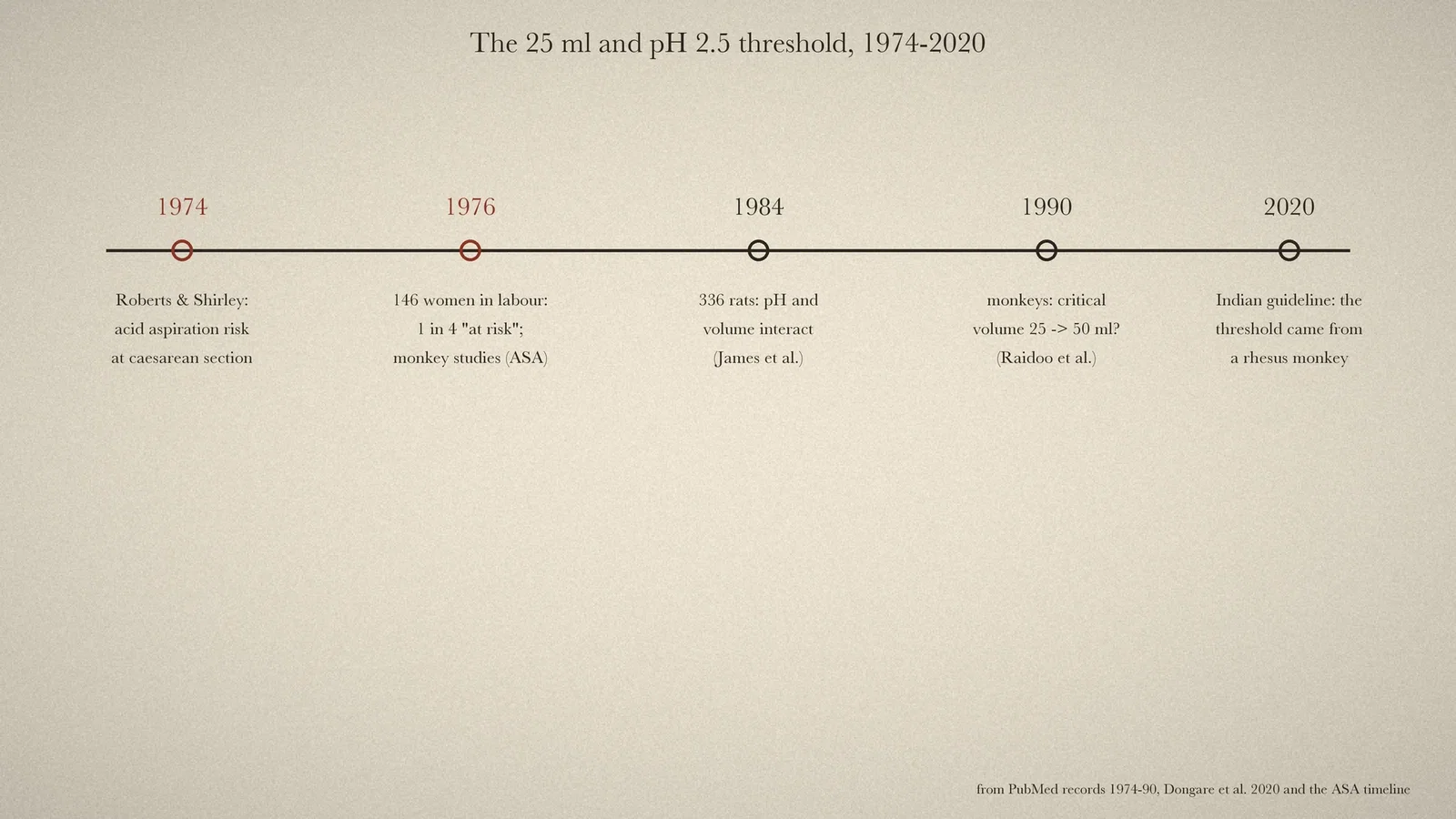
For decades, anaesthetists judged a patient's risk from aspirating stomach contents by two numbers: more than 25 ml of gastric fluid, with a pH below 2.5. An earlier article in this series followed Mendelson's description of acid aspiration in obstetrics. This one follows the numbers: where they came from, how they were used to define women in labour as "at risk" and to argue for antacids, and how later animal studies questioned them. The original 1974 paper could not be read. The account rests on PubMed records, a 2020 Indian guideline that explains the threshold's origin, and the Australian Society of Anaesthetists' timeline.
Two papers
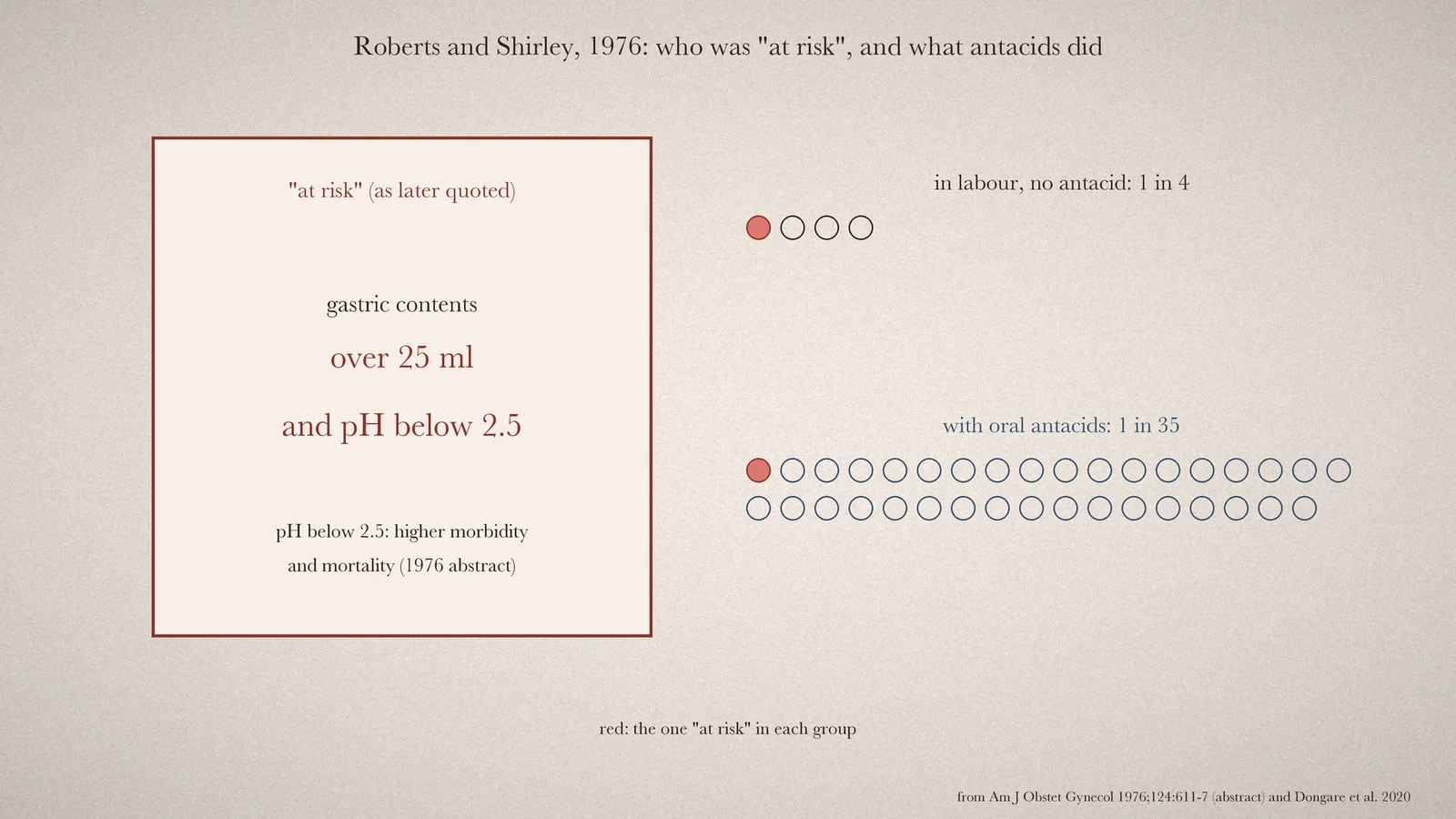
In 1974 R. B. Roberts and M. A. Shirley published "Reducing the risk of acid aspiration during cesarean section" in Anesthesia and Analgesia. PubMed holds no abstract for it. [1] Two years later, writing for obstetricians, the same authors began bluntly: "Aspiration of gastric contents is the commonest cause of maternal anesthetic" death. "If the pH of the contents is below 2.5", morbidity and mortality were likely to be higher. In a study of 146 women in labour, "one in four patients is 'at risk' to acid aspiration". No interval between the last meal and labour or delivery "can guarantee an empty stomach". Oral antacids during labour "reduces the number at risk to 1 in 35". [2]
Where the numbers came from
The volume half of the definition came from an animal. The Indian Society of Anaesthesiologists' 2020 guidelines on fasting put it plainly: "Traditional cut off points of gastric aspirate volumes of >25 mL with pH <2.5" had long been quoted, and "This critical pH and volume was obtained by Roberts and Shirley on a Rhesus monkey" and "were extrapolated to humans". [3] The guidelines add the detail. The "instillation of 25 mL of gastric aspirate into the right bronchus of rhesus monkey produced significant aspiration pneumonitis", and Roberts and colleagues postulated that a "residual gastric volume of more than 25 mL posed a high risk". [3] The ASA timeline dates this to 1976: "Critical volume & pH of acid in the lung needed to produce Mendelssohn's syndrome determined", by Shirley and Roberts, from studies in monkeys. [6, p. 75]
Questioning the rule
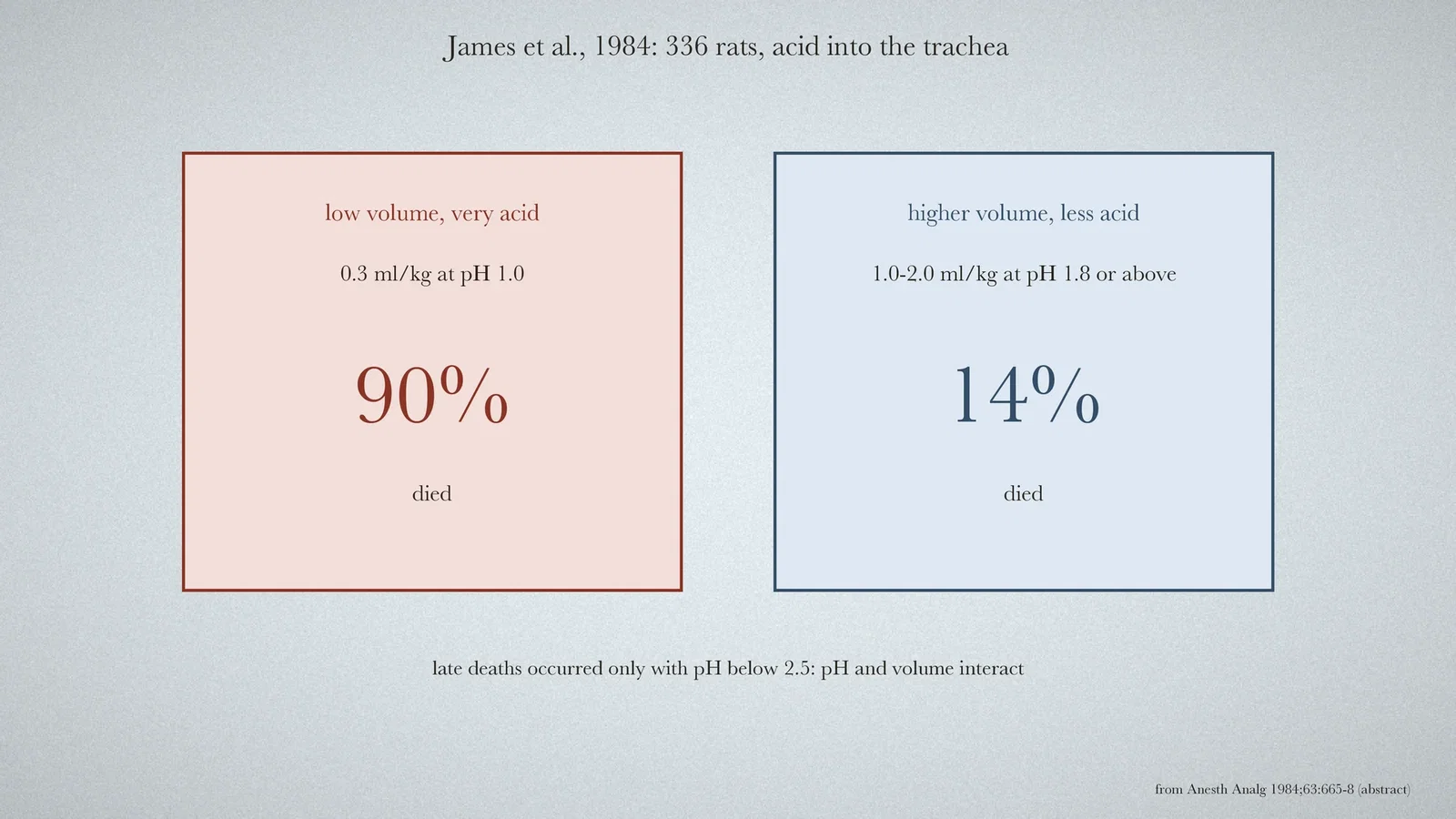
Later animal studies did not overturn the danger of acid, but they challenged the numbers. In 1984 James, Modell and colleagues injected hydrochloric acid solutions "into the tracheas of 336 Sprague-Dawley rats". Late deaths "occurred exclusively in animals aspirating" solutions with a pH below 2.5. A small volume of very acid fluid (0.3 ml/kg at pH 1.0) "resulted in a high mortality rate (90%)", while larger volumes of less acid fluid (1.0-2.0 ml/kg at pH 1.8 or above) "resulted in a low mortality rate (14%)". The authors pointed to "an important interaction between pH and volume": buffered fluid could be tolerated in much larger amounts. [4]
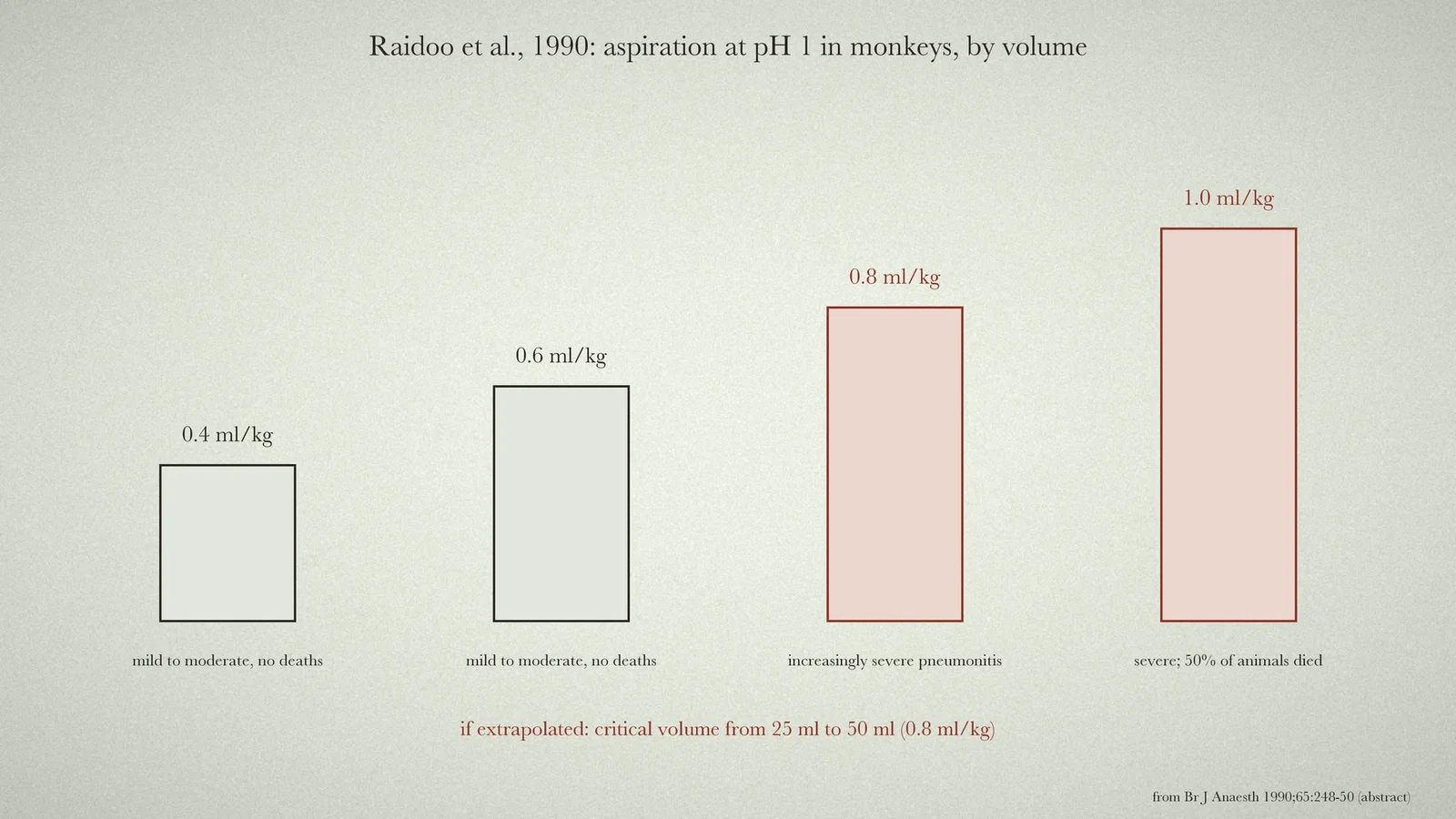
In 1990 Raidoo, Rocke, Brock-Utne and colleagues returned to the monkey for a "reappraisal in a primate model". Aspiration of 0.4 and 0.6 ml/kg at pH 1 "produced mild to moderate clinical and" radiological changes and no deaths. Larger volumes caused increasingly severe pneumonitis, and at 1.0 ml/kg "50% of the animals died". If the results were applied to humans, they wrote, the critical volume "could be increased from 25 ml" to 50 ml (0.8 ml/kg), greatly reducing the number of patients thought to be at risk. [5]
What the record shows
A threshold drawn from an experiment in one species was carried into the care of women in labour. It shaped who was called "at risk" and was used to argue for antacids in labour. Later experiments showed that volume and acidity work together, and suggested that the volume limit may have been set too low. Recent guidelines still describe the old numbers, now with their origin attached.
Sources and reading limits
Read: the PubMed records of Roberts and Shirley 1974 (title only) and 1976 (abstract); the 2020 Indian fasting guidelines (introduction and adult section); the PubMed abstracts of James et al. 1984 and Raidoo et al. 1990; the ASA history timeline (2024).
Not covered: the 1974 paper itself was not read, so how the threshold was first presented is not known first-hand. The monkey experiment is known only through the 2020 guideline and the ASA timeline, and whether it was published separately was not established. The figure of 0.4 ml/kg, often attached to Roberts and Shirley, does not appear in the sources read for their work. Mendelson's report is left to the earlier article. All four illustrations are drawn from the sources, and no animals are depicted.
- Roberts RB, Shirley MA. Reducing the risk of acid aspiration during cesarean section. Anesth Analg. 1974;53(6):859-68. PubMed
- Roberts RB, Shirley MA. The obstetrician's role in reducing the risk of aspiration pneumonitis. With particular reference to the use of oral antacids. Am J Obstet Gynecol. 1976;124(6):611-7. PubMed
- Dongare PA, Bhaskar SB, Harsoor SS, et al. Perioperative fasting and feeding in adults, obstetric, paediatric and bariatric population: practice guidelines from the Indian Society of Anaesthesiologists. Indian J Anaesth. 2020;64(7):556–584. DOI
- James CF, Modell JH, Gibbs CP, Kuck EJ, Ruiz BC. Pulmonary aspiration--effects of volume and pH in the rat. Anesth Analg. 1984;63(7):665-8. PubMed
- Raidoo DM, Rocke DA, Brock-Utne JG, Marszalek A, Engelbrecht HE. Critical volume for pulmonary acid aspiration: reappraisal in a primate model. Br J Anaesth. 1990;65(2):248-50. PubMed
- Australian Society of Anaesthetists. Anaesthesia History Timeline 2024. PDF
Continue exploring
Related reading connects shared questions and contexts; it does not by itself establish historical influence.
Anesthesia Epochs · The Source Room · About & Editorial Method
Published November 2, 2026. Sources and reading limits are stated above. Illustrations are labelled as original source images or AI-made. Historical accounts are educational; they are not current treatment instructions.