
In the summer of 1976 International Anesthesiology Clinics, vol. 14, no. 2, pp. 113-130, carried a long article by Wallace A. Reed and John L. Ford about the place they had built themselves: the Surgicenter in Phoenix, Arizona, which opened on 12 February 1970. It does not open with a clinical problem but with the cost of care, and the thing that actually started it was an encounter in 1968 with an uninsured barber who had brought two children in for myringotomies - an operation that then meant two nights in hospital. Out of that came the question they print in their own words: how many haircuts does it take to pay for a myringotomy? The article is written as a piece of institutional design. It defines what an ambulatory surgical centre is, in numbered conditions: an anaesthesiologist must give the anaesthetic and stay for the operation, there must be at least two operating rooms and a recovery room, and - the condition that defines the whole idea - there are no beds for anyone to stay the night. It shows how the building is laid out, in a numbered floor plan where theatres, sterile area, preoperative area and the adult and paediatric recovery areas sit directly against one another. It explains where the money is saved: twenty-eight staff, a staff-to-patient ratio of one to one against a hospital's two and a half or three to one, one all-inclusive price per operation, and the price list posted on the waiting-room wall. And it is candid about where the real resistance came from - not from surgery but from payment: the federal employees' Blue Cross programme took two years to recognise the facility, and Medicare took over four. The authors report their series of more than 33,000 cases: over 85 per cent under general anaesthesia, seventy unscheduled admissions to hospital, and, by their account, no deaths, no cardiac arrests and no malpractice suit. The article closes by reaching back half a century to credit Ralph M. Waters, whose down-town anaesthesia clinic started in Sioux City, Iowa, in 1919. This article reads that founders' account as what it is.
Reading Library · Anesthesia Epochs · 中文版
Watch the education video (for clinicians)
1976: The Phoenix Surgicenter — A Building With No Beds · Anesthesia Epochs Education Series
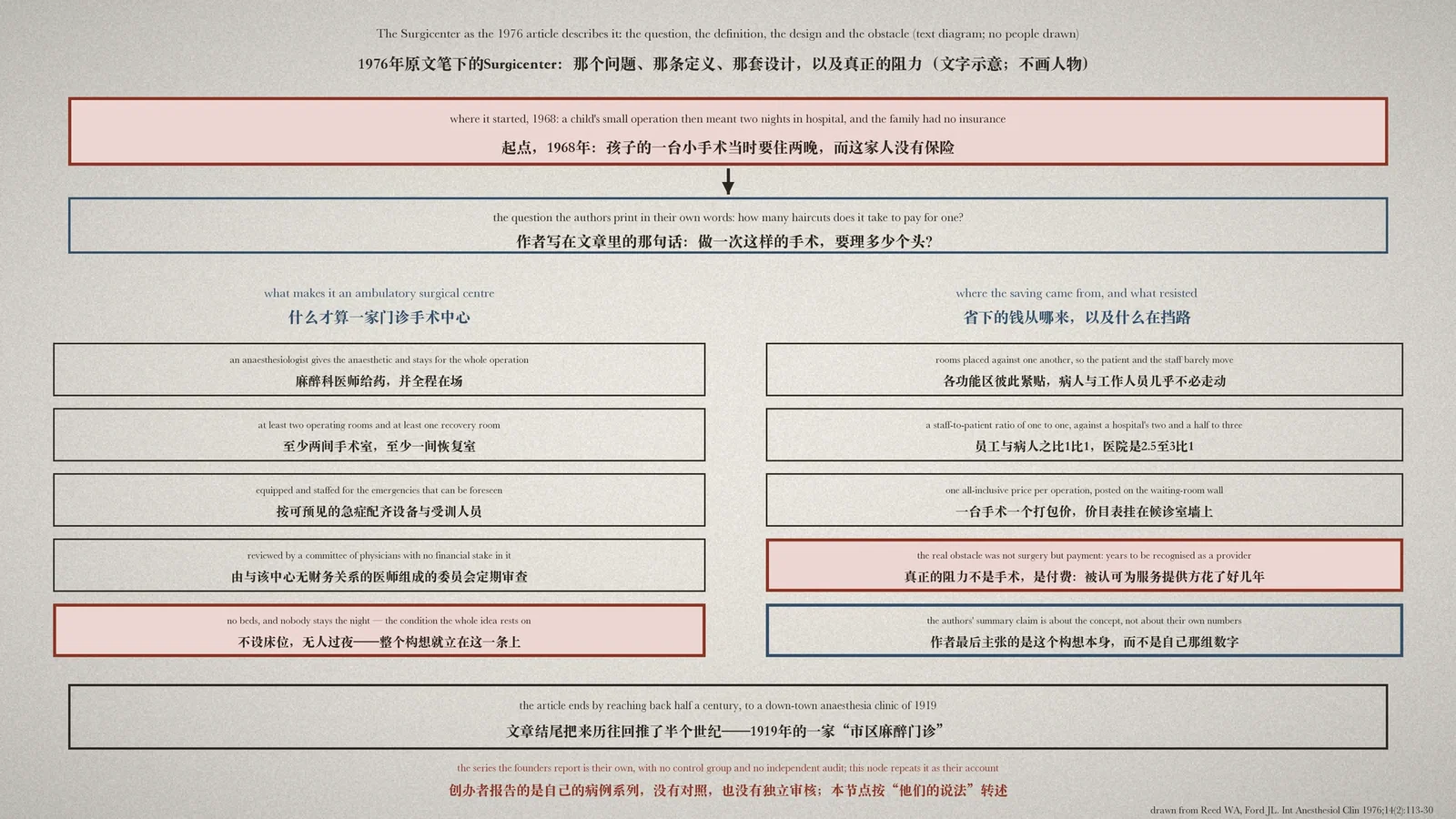
Most of the papers in this library begin with a clinical difficulty: a patient who cannot be intubated, a drug that stops a heart, a measurement nobody could make. This one begins with a bill. In the summer of 1976 International Anesthesiology Clinics gave thirty-odd pages to two Phoenix doctors who had spent six years running a building they had designed themselves, and what they wanted to explain was not an operation but an arrangement. [1, p. 113]
A barber, and a question
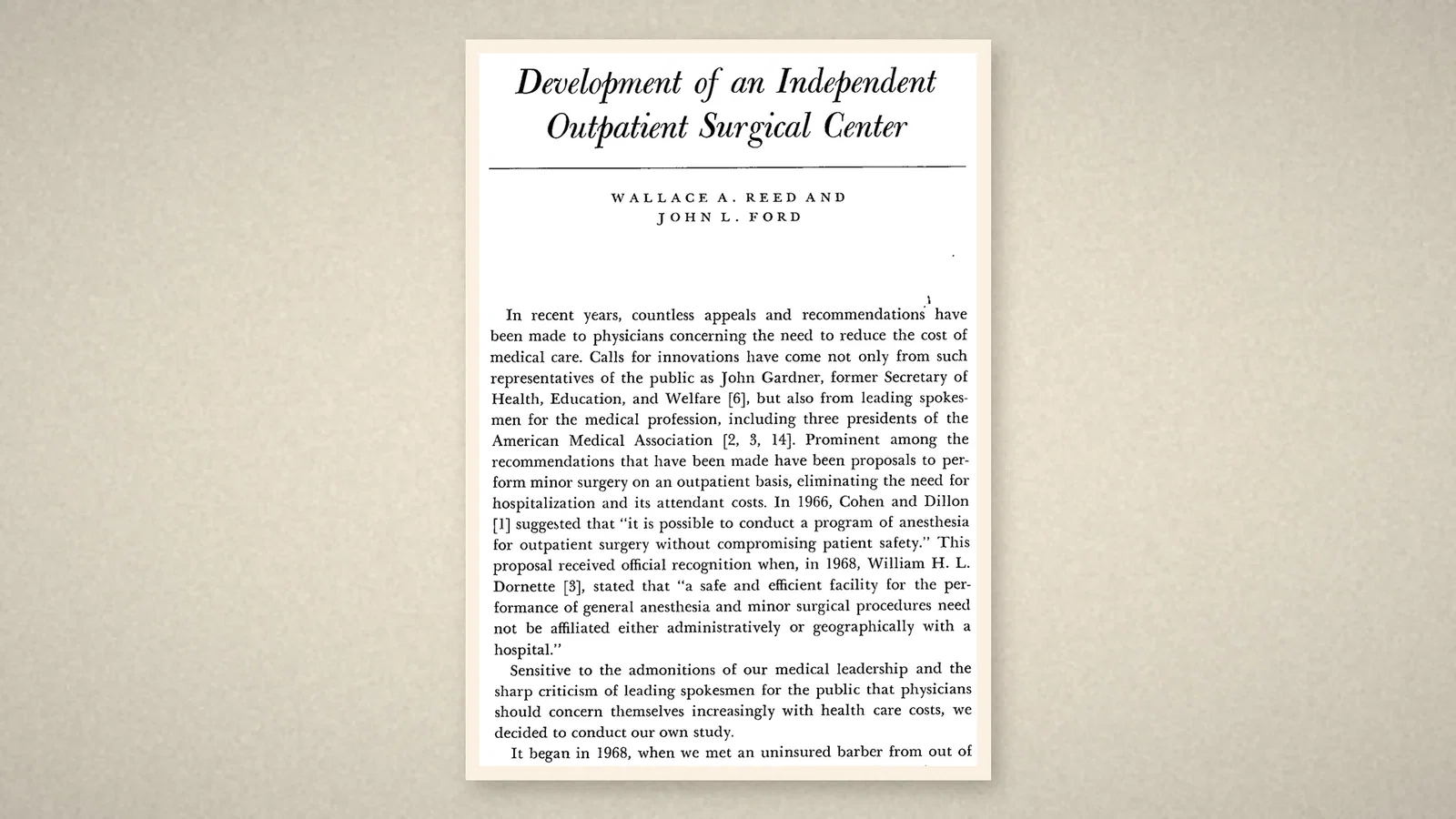
Wallace A. Reed and John L. Ford open where the public argument of the day was: "the need to reduce the cost of" medical care, with appeals from a former Secretary of Health, Education and Welfare and from three presidents of the American Medical Association. [1, p. 113] They then set out the two statements they say gave them licence. One, from 1966, that "it is possible to conduct a program of anesthesia" "for outpatient surgery without compromising patient safety". The other, from 1968, and far more radical: that such a facility "need not be affiliated either administratively or geographically with a" hospital. [1, p. 113]
But the thing that actually started it was smaller and more particular. "It began in 1968, when we met an uninsured barber from out of" town who had brought two of his children in for myringotomies — an operation which at the time meant two nights in hospital for a child. [1, p. 113] Out of that came the sentence they chose to print: "How many haircuts does it take to pay for a myringotomy?" [1, p. 114]
They are unusually frank about what they thought they were doing and what it cost them. "improving medical care delivery was as important in these times as the discovery of a new instrument" or drug, they write, and they describe "placing our savings and reputations on the line" at the height of their careers. [1, p. 114] The first of their five objectives is not about money at all: "To elevate the status of surgical care for ambulatory patients". Cost comes third: "To reduce the cost of care to patients". [1, p. 114]
A definition, in eleven numbered conditions
What makes the article more than a memoir is that it stops and defines its object. An ambulatory surgical centre, as they set it out, is an institution that does a list of specific things — and the list is where the anaesthetic interest lies.
An anaesthesiologist must "administer the anesthetics and remain present during the surgical procedure". The place "Provides at least two operating rooms and at least one recovery room". It must be equipped and staffed for foreseeable emergencies, and reviewed periodically by physicians with no financial connection to it. [1, p. 115]
And then the condition that carries the whole idea: it "Does not provide beds or other accommodations for patients to stay overnight". [1, p. 115] Everything else follows from that sentence. Take away the beds and you take away the night staff, the kitchen, the laundry, the inpatient record — and with them the reason the operation cost what it cost. The facility is conceived, they write, "as an extension of the surgeon's own office". [1, p. 114]
A building that is an argument
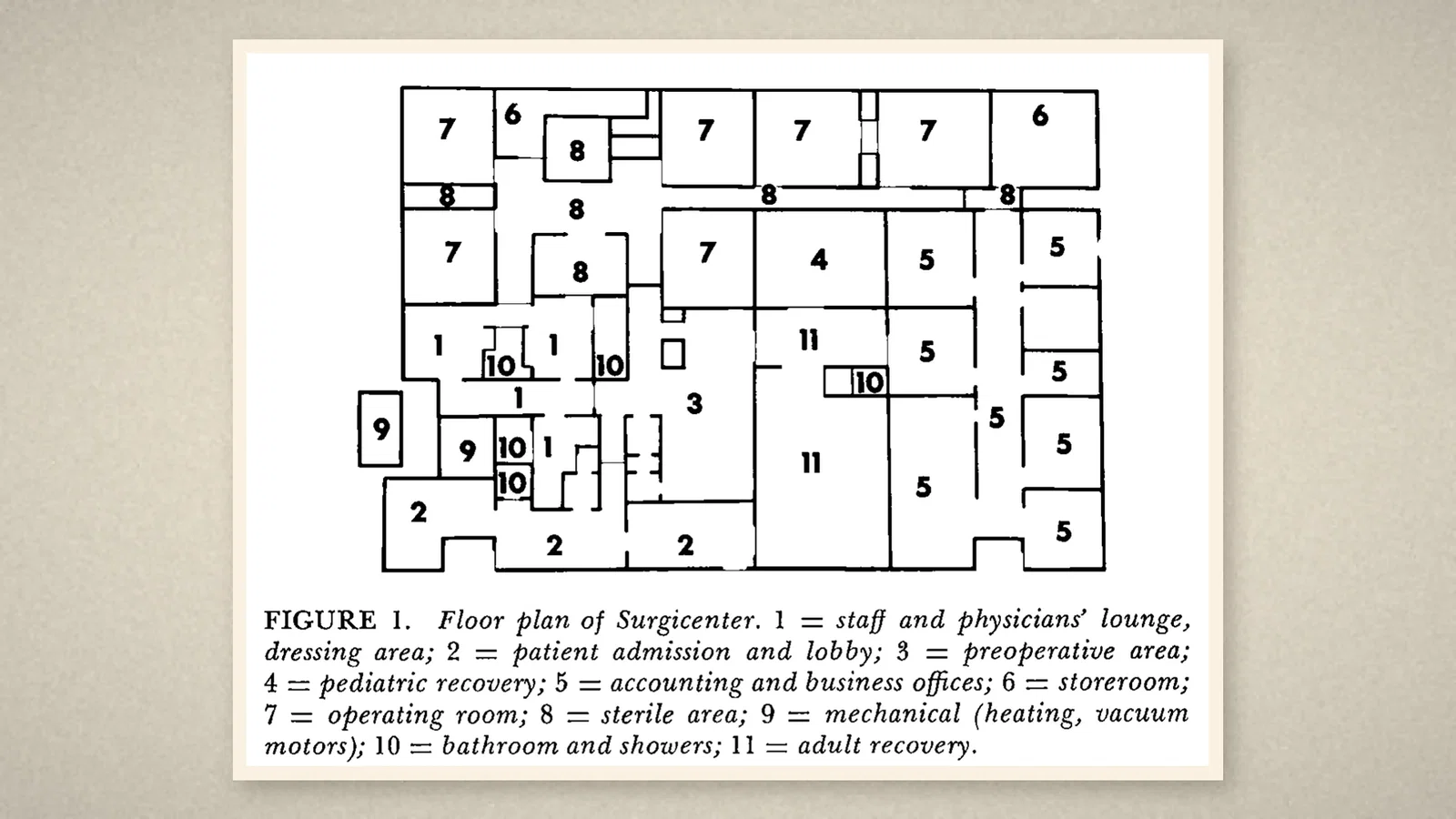
The floor plan is worth looking at as a piece of reasoning. Operating rooms and sterile areas, the preoperative area and the adult and paediatric recovery areas sit directly against one another; admission and lobby are on one side, business offices along the other. Nothing is far from anything. The stated consequences are mundane and add up: the patient moves less, the surgeon can see the family before and after without losing time in transit, and no extra staff are needed to move anyone, because the circulating nurse and the recovery nurse or anaesthetist can do it between them. [1, p. 117]
The savings they list are similarly unglamorous. Conductive flooring was left out. There is no cafeteria. Drapes and gowns are disposable and what laundry remains is done on site. A twelve-hour day removed the need for round-the-clock laboratory and x-ray cover. [1, pp. 116-117] Anaesthesia is described in the same register: simple monitoring so that induction is not delayed, and a technique built from short-acting agents, which they name with a coined word — "We have described the technique as paramalgesia". [1, p. 119]
The staffing comparison is the sharpest number in the article. "Hospitals have an employee/patient ratio of 2.5 to 3.0" to one; "our ratio is 1: 1". [1, p. 123] And one decision stands out as a piece of deliberate plain dealing: there is a single all-inclusive price for each operation, and "A list of charges is prominently displayed on the wall of the waiting room". [1, p. 124]
What actually stood in the way
Here the article becomes most useful as history, because the obstacle was not surgical. It was being paid.
"The doors of the Phoenix Surgicenter were opened on February" 12, 1970. [1, p. 121] Even with state approval and the local planning council behind them, "it was two years before the Blue Cross portion of the federal employees program recognized the" facility as a qualified provider — "and it took Medicare over four". [1, p. 121] Several hundred commercial insurers had each to be dealt with separately. Their advice to anyone following them is to settle this before putting up the building.
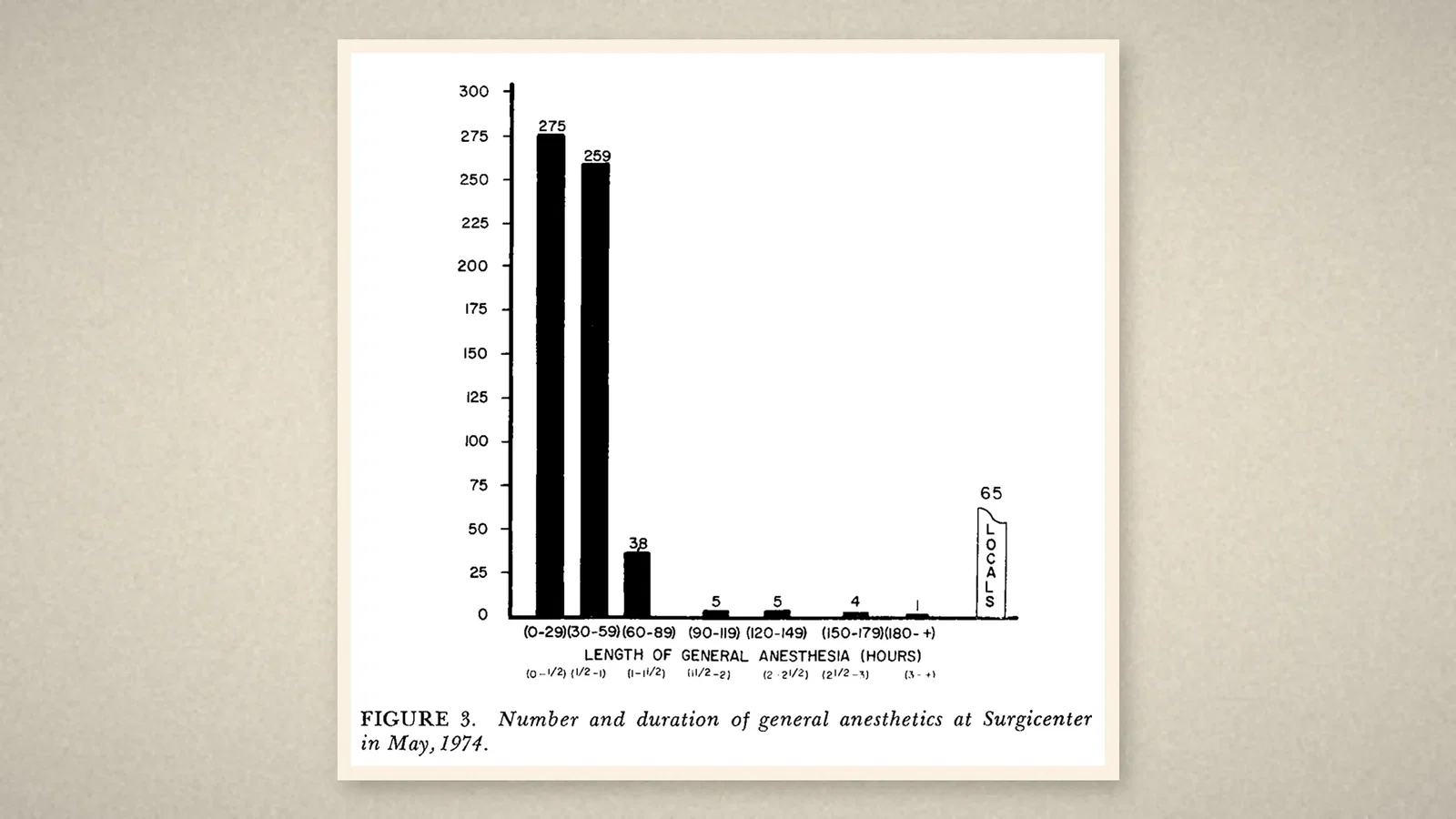
Figure 3 shows what the work looked like in one month in May 1974: almost everything in the two shortest duration bands, the longer bands falling away to nearly nothing, and a separate column for the cases done under local anaesthesia. That shape — a great many short cases, very few long ones — is the operational fact that makes the whole arrangement possible.
By the time of writing, more than "33,000 patients have been" treated, "over 85 percent under general anesthesia". [1, p. 121] "Unscheduled hospitalization occurred in 70 of 33,000 patients". They report no "fatalities or cardiac arrests in the series", and a record "without a fatality and without a malpractice" suit. [1, pp. 123, 127]
What this article keeps, and what it withholds
Two things are worth taking away, and one caution.
The first is that this is an anaesthesia paper even though it contains almost no anaesthesia. Its subject is the conditions under which an anaesthetic is given: who is in the room, how far the patient is wheeled, whether there is a bed at the end of the corridor, who pays. The authors address their colleagues directly on this — "This type of practice is a challenge to anesthesiologists in many" ways, with closer contact with patients and families and new responsibility for screening and discharge. [1, p. 129]
The second is the ending, which reaches back further than you expect. "we wish to pay tribute to Dr. Ralph M. Waters", whose down-town anaesthesia clinic was started in Sioux City, Iowa, in 1919. Waters, they write, was "good half century ahead of his time". [1, p. 129] A paper about a new institution closes by saying the idea was not new, only unheeded.
The caution is the obvious one, and the article keeps it in view throughout. This is the founders' own account of their own facility, written by the two men whose savings were in it. The safety record, the case numbers and the absence of suits are their report, with no control group, no independent audit and nothing to compare against. Their summary claim is careful in a way the body sometimes is not: what they say is that "the validity of the concept of the free-standing" "ambulatory surgical facility has been proved" — a claim about an idea rather than about their statistics. [1, p. 129]
Sources and reading limits
Read: Reed WA, Ford JL, "Development of an Independent Outpatient Surgical Center", International Anesthesiology Clinics, Summer 1976, vol. 14, no. 2, pp. 113-130, in full — all eighteen printed pages, with the three figures and their legends, the three tables, the summary and the references. The copy is a scan of the printed article with no text layer.
Source note: the article is not freely available; the copy used here was obtained through institutional access.
Not covered: the authors' earlier papers on the same facility and their handbook chapter on planning such a building, all cited here for detail this article does not repeat; the 1966 paper and the 1968 address it credits for the idea; Waters' own 1919 paper; and any inspection report, independent audit or contemporary reply. Nothing here should be read as independent confirmation of the figures reported.
Limits: the series, the safety record and the staffing comparison are reported as the founders state them, about a facility they owned and ran. No drug doses, concentrations or laboratory values are reproduced here; the anaesthetic technique is given only in the words the article itself uses. This article makes no claim about whether this was the earliest facility of its kind, and the article itself makes none.
Three illustrations are crops of the original page images (pp. 113, 117 and 124). One is a diagram drawn from the text, with no people drawn.
- Reed WA, Ford JL. Development of an independent outpatient surgical center. International Anesthesiology Clinics. 1976;14(2):113-30. doi:10.1097/00004311-197614020-00007
Continue exploring
Related reading connects shared questions and contexts; it does not by itself establish historical influence.
Anesthesia Epochs · The Source Room · About & Editorial Method
Published November 5, 2026. Sources and reading limits are stated above. Illustrations are labelled as original source images or AI-made. Historical accounts are educational; they are not current treatment instructions.