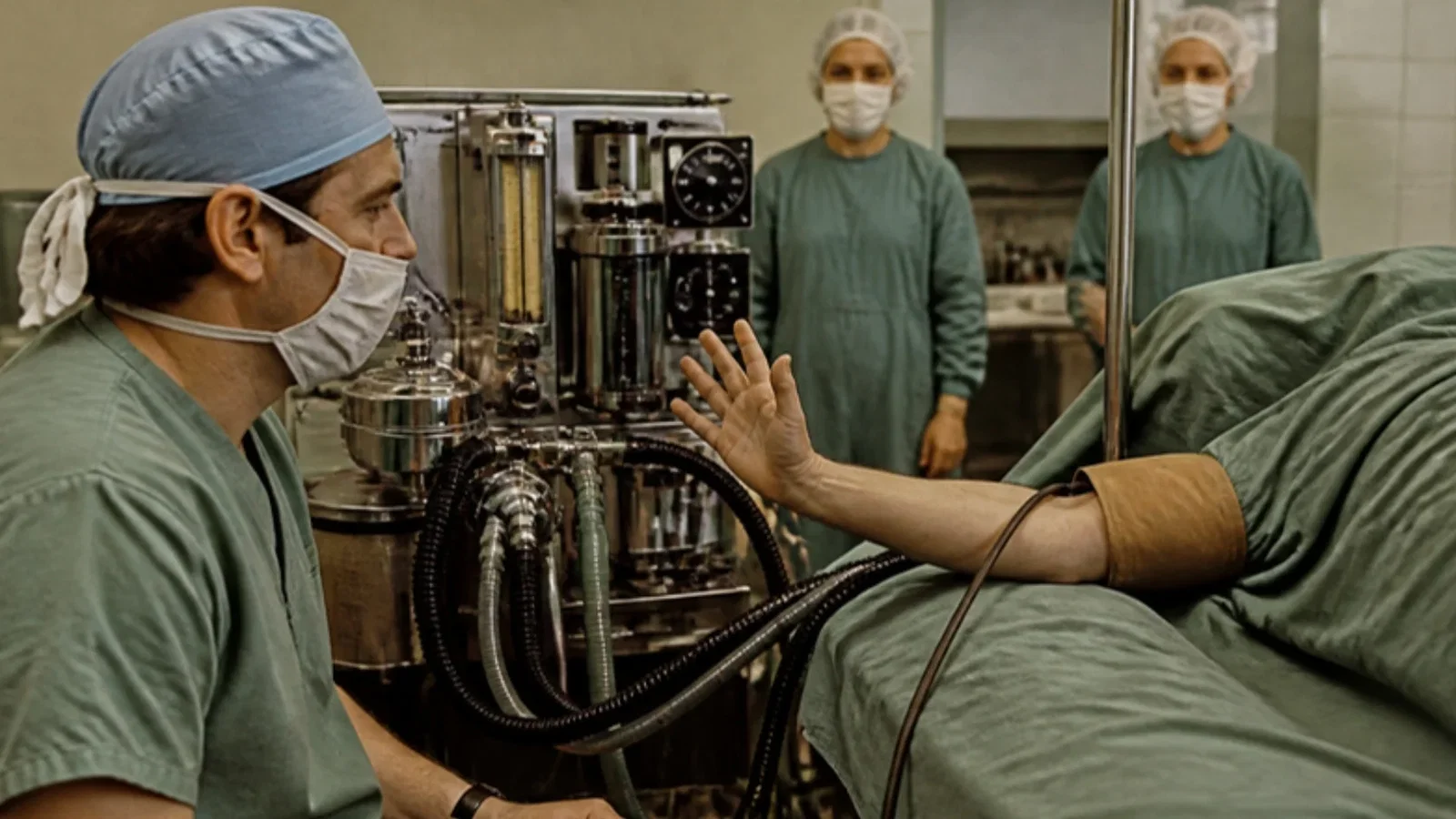
A blood-pressure cuff inflated on one arm before the muscle relaxant kept that hand able to move; in twelve mothers having caesarean sections under light anaesthesia, four moved their hands and fingers on command, yet none remembered anything afterwards.
Reading Library · Anesthesia Epochs · 中文版
Watch the education video (for clinicians)
1977: Tunstall's Isolated Forearm Technique — Aberdeen · Anesthesia Epochs Education Series
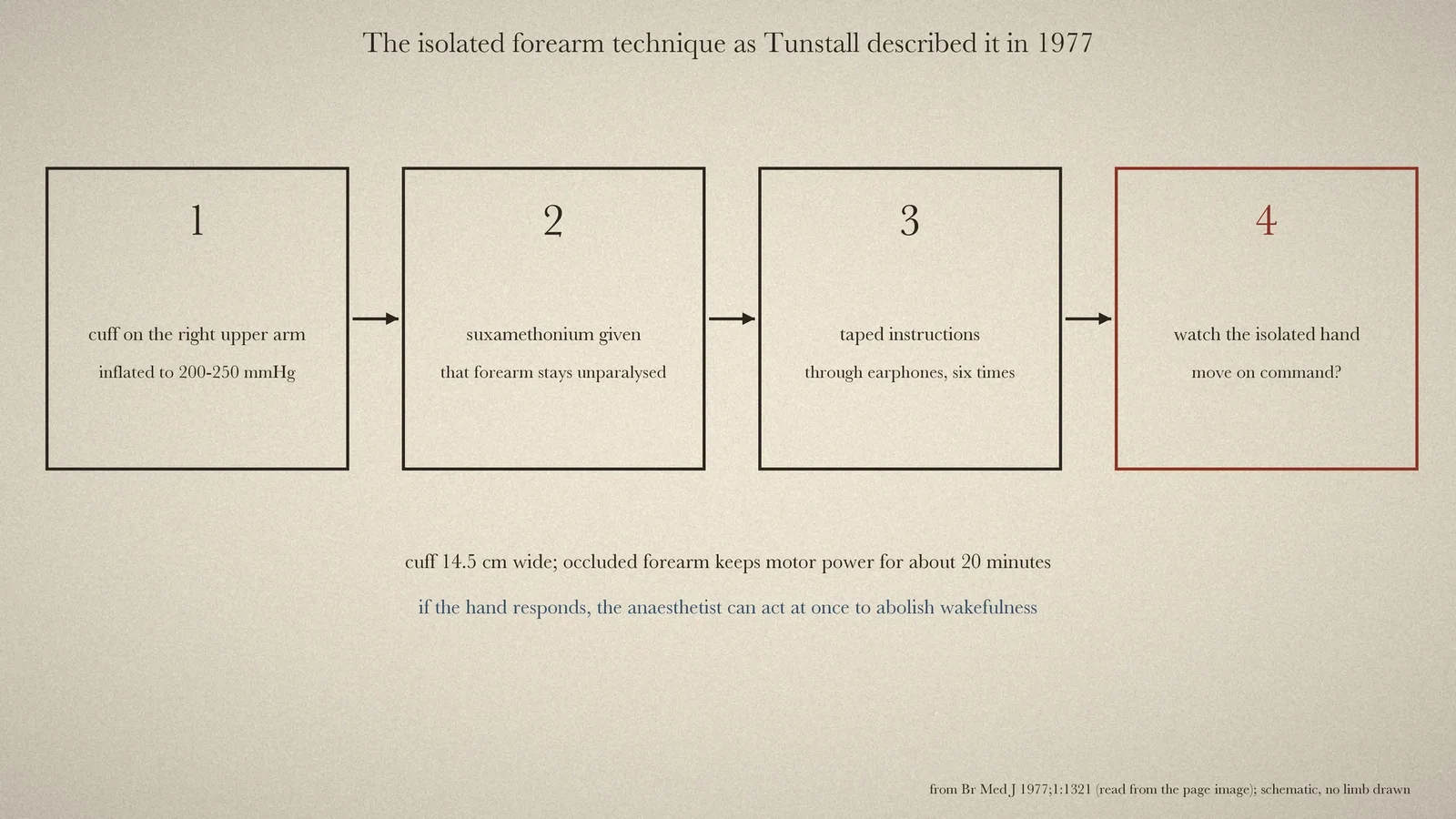
A patient given a muscle relaxant cannot move. If the anaesthetic is too light, that patient may be awake and unable to tell anyone. An earlier article in this series followed the letters about "insufficient anaesthesia" in the BMJ in 1950, and another followed Michael Tunstall's premixed nitrous oxide and oxygen of 1961. This article follows Tunstall's 1977 report of a way to ask a paralysed patient directly: leave one forearm unparalysed. The report, a single page in the British Medical Journal, was read in full from its scanned image. Later descriptions come from two open-access papers by J. J. Pandit.
The problem in obstetrics
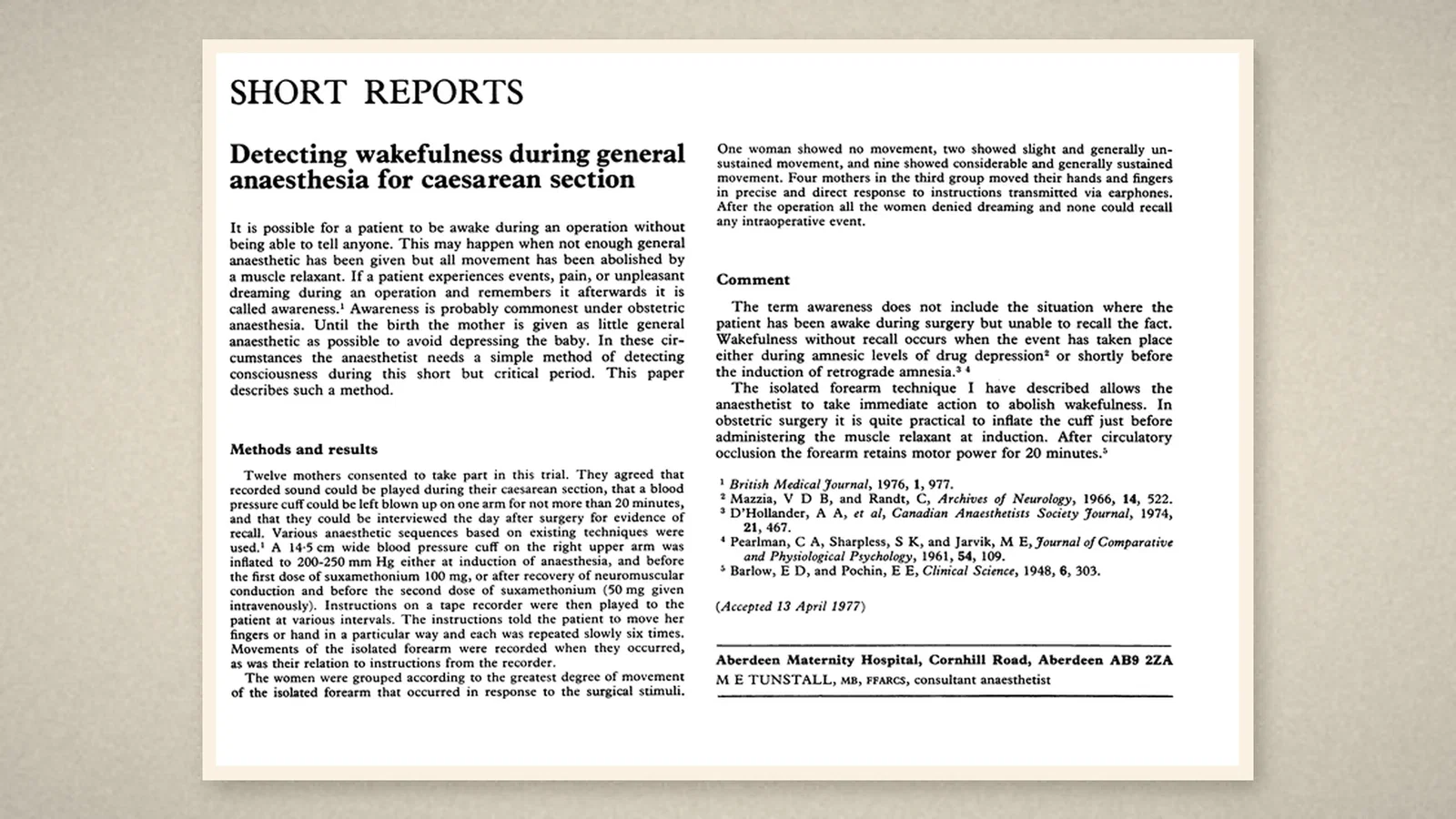
Tunstall began with a definition. "It is possible for a patient to be awake during an operation without being able to tell anyone." This happens when not enough anaesthetic has been given but all movement has been abolished by a relaxant, and if the patient later remembers, "it is called awareness". Awareness, Tunstall wrote, is probably commonest under obstetric anaesthesia, because until the birth the mother is given as little anaesthetic as possible to avoid depressing the baby. The anaesthetist therefore needed a simple way to detect consciousness during that short, critical period. [1, p. 1321]
The method
Twelve mothers having caesarean sections agreed to take part. They agreed to hear recorded sound during the operation, to have a blood-pressure cuff left inflated on one arm for no more than 20 minutes, and to be interviewed the next day about recall. A 14.5 cm cuff on the right upper arm was inflated to 200-250 mmHg, either at induction before the first dose of suxamethonium (100 mg) or after neuromuscular conduction had recovered and before the second dose (50 mg). The blood carrying the relaxant could not reach that forearm. Taped instructions, each repeated slowly six times, told the mother to move her fingers or hand in particular ways, and the movements of the isolated forearm were recorded. [1, p. 1321]
The results
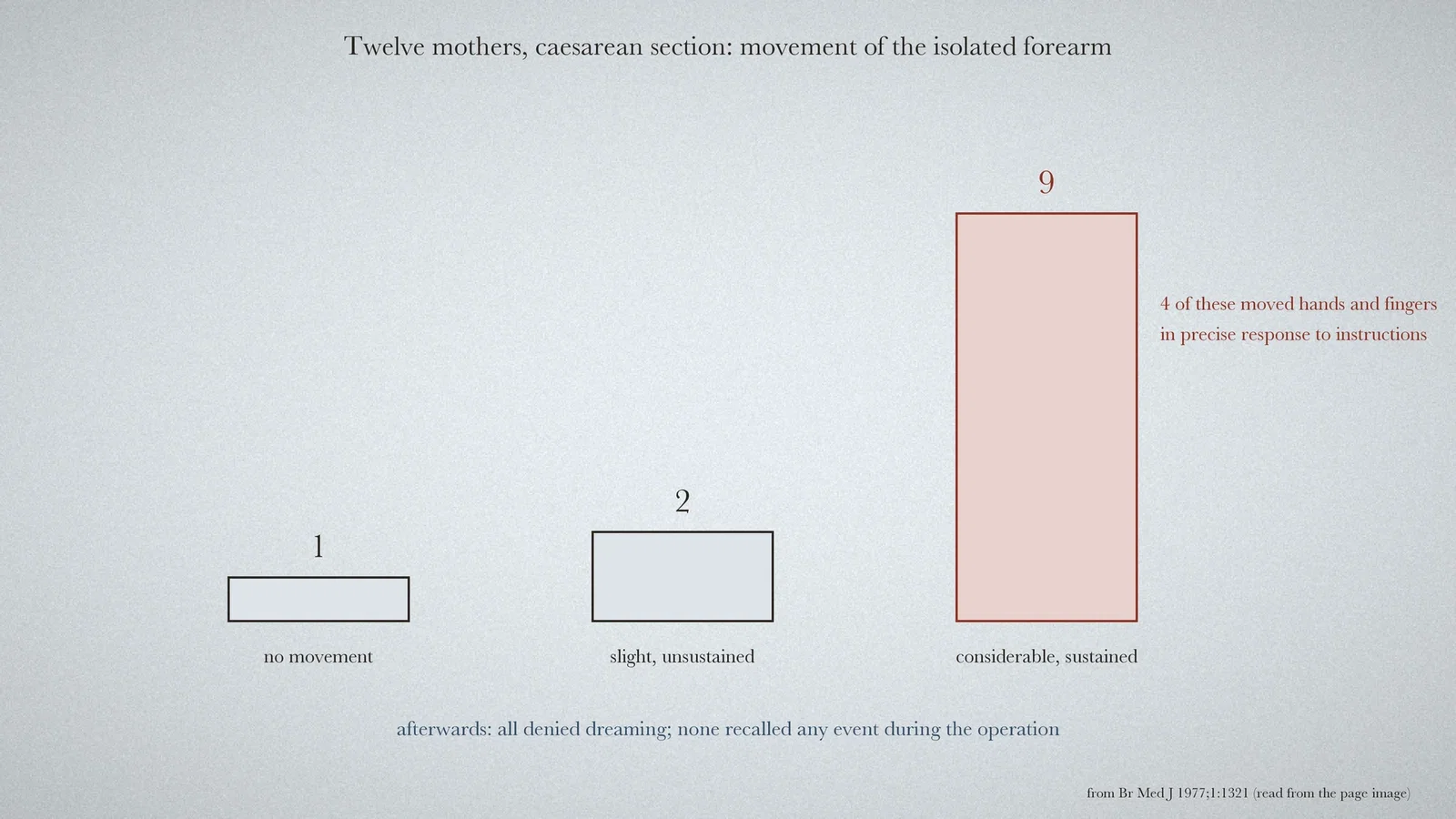
One woman showed no movement, two showed slight and unsustained movement, and nine showed considerable and generally sustained movement. Four of the nine moved their hands and fingers in precise and direct response to the instructions coming through their earphones. After the operation all the women denied dreaming, and none could recall any event during the operation. [1, p. 1321]
Tunstall drew the distinction carefully. "Awareness" did not cover a patient who had been awake but could not recall it. That was wakefulness without recall, which could happen at amnesic levels of drug depression or shortly before retrograde amnesia set in. The isolated forearm technique let the anaesthetist "take immediate action to abolish wakefulness", and after circulatory occlusion the forearm kept its motor power for about 20 minutes. [1, p. 1321] The report came from Aberdeen Maternity Hospital and was signed "M E Tunstall, MB, FFARCS, consultant anaesthetist". [1, p. 1321]
How it is seen now
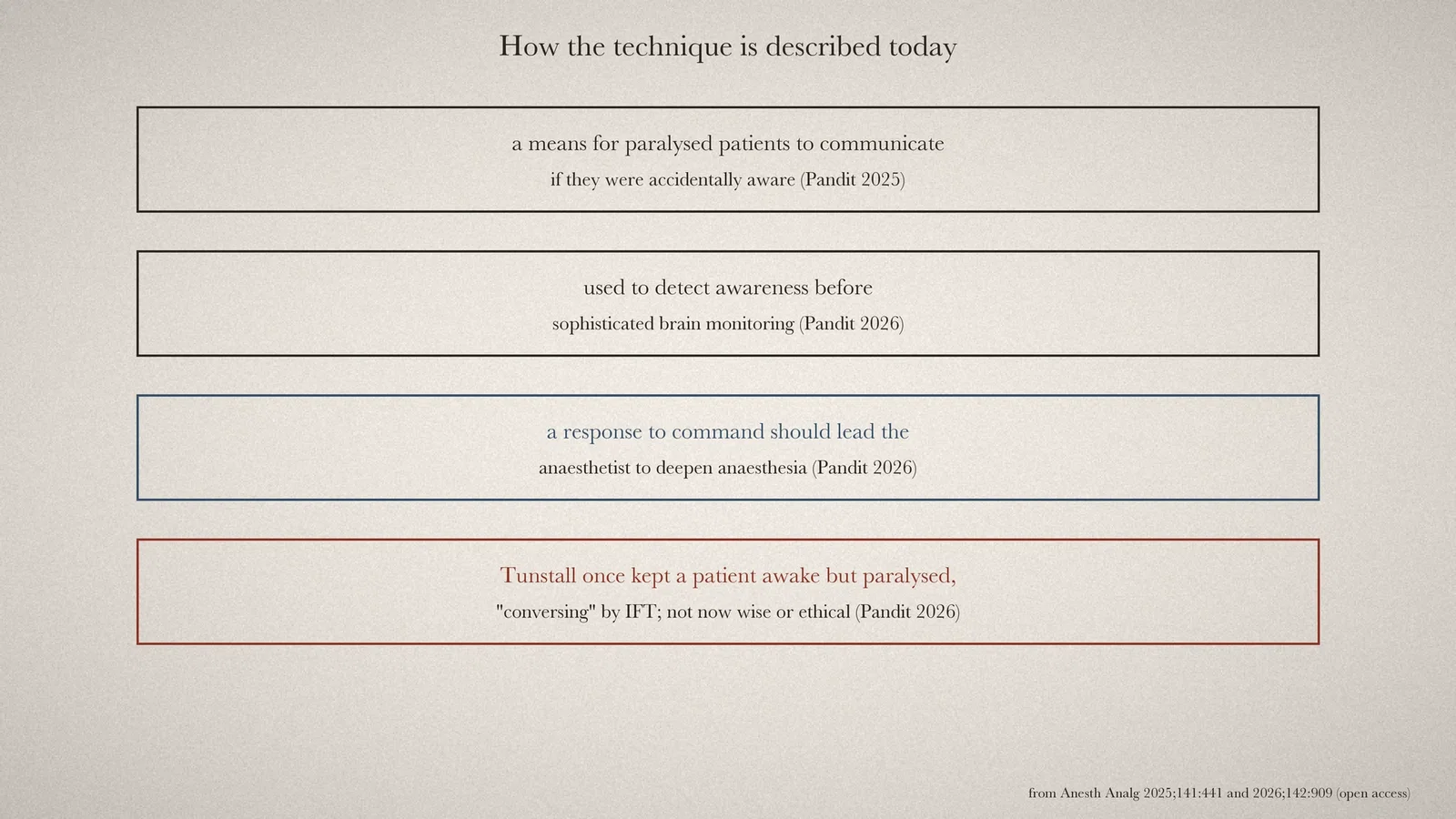
The Australian Society of Anaesthetists' timeline lists it under 1977 as "The first attempt to detect awareness during anaesthesia": Tunstall "developed the 'isolated arm technique' of assessing whether or not" a paralysed patient was aware. [4, p. 75] Pandit, writing in 2025, describes it the same way: "The isolated forearm technique (IFT) was introduced by Tunstall" as a means to give paralysed patients "the ability to communicate, if perchance they were accidentally aware". In it "a cuff temporarily isolates a forearm from the circulation after anesthetic induction" and before neuromuscular blockade. [2]
In 2026 Pandit added that the technique was introduced "to detect AAGA in the days before sophisticated brain monitoring", and that the correct reaction to a hand that responds "to verbal command in IFT is correctly to deepen anesthesia". [3] Pandit also recalls a later episode. In a 1979 letter, "Reduction of amnesic wakefulness during Caesarean section", Tunstall described keeping a patient largely awake but paralysed and "conversing" with her through the forearm throughout surgery. Pandit judges that this "would not be now considered a wise or even ethical approach". [3]
What the record shows
Tunstall's method needed only a blood-pressure cuff and a question. In 1977 it showed that mothers under light anaesthesia could hear and obey while remembering nothing afterwards. It drew a line between being awake and remembering being awake that later research on awareness has kept.
Sources and reading limits
Read: Tunstall's BMJ short report of 21 May 1977, in full from the PubMed Central page image, and its PubMed record; Pandit's open-access papers of 2025 (introduction) and 2026; the ASA history timeline (2024).
Not covered: Tunstall's 1979 letter in Anaesthesia was not read, and the episode it describes is known only from Pandit's summary. Later work on the technique, such as Russell's, was not read. "The first attempt to detect awareness" is the ASA timeline's claim and is not checked here. The numbers in this article are transcribed from the page image of the 1977 report.
One illustration is a crop of the 1977 report; three are drawn from the sources, and no patient or limb is depicted.
- Tunstall ME. Detecting wakefulness during general anaesthesia for caesarean section. Br Med J. 1977;1(6072):1321. PMC
- Pandit JJ. Absence of movement to command with a pseudo-"isolated forearm technique" in nonparalyzed, spontaneously breathing patients monitored with bispectral index. Anesth Analg. 2025;141(2):441–444. DOI
- Pandit JJ. Movements during intended general anesthesia and psychologically traumatic accidental awareness: explanatory role of the "efference copy network". Anesth Analg. 2026;142(5):909–916. DOI
- Australian Society of Anaesthetists. Anaesthesia History Timeline 2024. PDF
Continue exploring
Related reading connects shared questions and contexts; it does not by itself establish historical influence.
Anesthesia Epochs · The Source Room · About & Editorial Method
Published November 2, 2026. Sources and reading limits are stated above. Illustrations are labelled as original source images or AI-made. Historical accounts are educational; they are not current treatment instructions.