In 1972 Pontoppidan, Geffin and Lowenstein opened a three-part NEJM review of adult respiratory failure by discussing the organisation of care alongside lung physiology and circulatory measurement; only the first part was read for this article.
Reading Library · Anesthesia Epochs · 中文版
Watch the companion film
1972: Adult Respiratory Failure — Beyond the Ventilator · Watch on YouTube
Historical anchor: 1972. Date details and source qualifications are explained below.

A review of respiratory failure can begin with a lung, a blood-gas result or a ventilator. Pontoppidan, Geffin and Lowenstein began their 1972 review by also asking where patients should be cared for and who would care for them. The first of their three articles appeared in the New England Journal of Medicine on October 5. Its authors worked in the Massachusetts General Hospital respiratory unit and associated Harvard laboratories.[1, p.690] Organisation and physiology belonged in the same account.
This article is based on all nine scanned pages of Part I, printed pages 690–698. Parts II and III are not covered. A later explicit citation supplies the series bibliography, but does not supply access to those missing articles.[2, p.79, reference 4] The content described here therefore concerns the opening review, rather than a reconstruction of the complete three-part treatment system.

Prolonged ventilation required observation, nursing and medical attention around the clock. The opening discussion placed the growth of respiratory support beside questions of staffing and the organisation of services. The authors also reported their unit's experience. Those local retrospective figures cannot isolate the contribution of one device, specialty or intervention to changing outcomes.[1, pp.690–691] They are not used here to calculate lives saved by the review or by mechanical ventilation.
The physiological sections asked why movement of gas into the lung did not ensure adequate ventilation throughout it. Airway closure, lung volume, gas distribution and extravascular lung water provided a framework for examining conditions described under several clinical labels.[1, pp.691–695] This was a synthesis of existing work, not evidence that every mechanism discussed had first been discovered by these authors in 1972.
The synthesis retained unresolved questions. The authors distinguished airway from alveolar closure, cautioned against carrying large-tidal-volume animal experiments directly into human practice, and did not establish surfactant deficiency as a universal explanation for adult respiratory failure. They also described limitations in measuring lung water and uncertainty about the practical clinical value of those measurements.[1, pp.692–695] A historical account should preserve those qualifications rather than turn a developing interpretation into settled knowledge.
A specific link to circulatory measurement can be checked in the article itself. On page 696 the authors discuss the Swan–Ganz catheter; reference 84 on page 698 identifies 1970: Swan and Ganz Bring Pulmonary Artery Pressure to the Bedside. The first page of that report describes a flow-directed balloon-tipped catheter and the acquisition of right-heart and pulmonary capillary wedge pressures.[1, pp.696,698;3, p.447] The relationship between these articles records an explicit citation and a measurement problem. It does not assert a proven improvement in patient outcomes.
Bendixen cited the 1972 series in a 1981 lecture on managing respiratory failure, while separately listing a 1977 review of respiratory intensive care.[2, pp.73,79–80] This documents later teaching use. It neither independently validates the original review nor allows the 1981 discussion to be attributed wholesale to unread portions of the 1972 series.

The opening article brings the organisation of a respiratory unit, the interpretation of pulmonary physiology and circulatory measurement into one discussion. Its account includes both usable knowledge and limits to measurement and explanation.[1, pp.690–696] Those are the features retained in this history. Its historical treatment discussions are not presented as current ventilation, fluid-management or monitoring instructions.
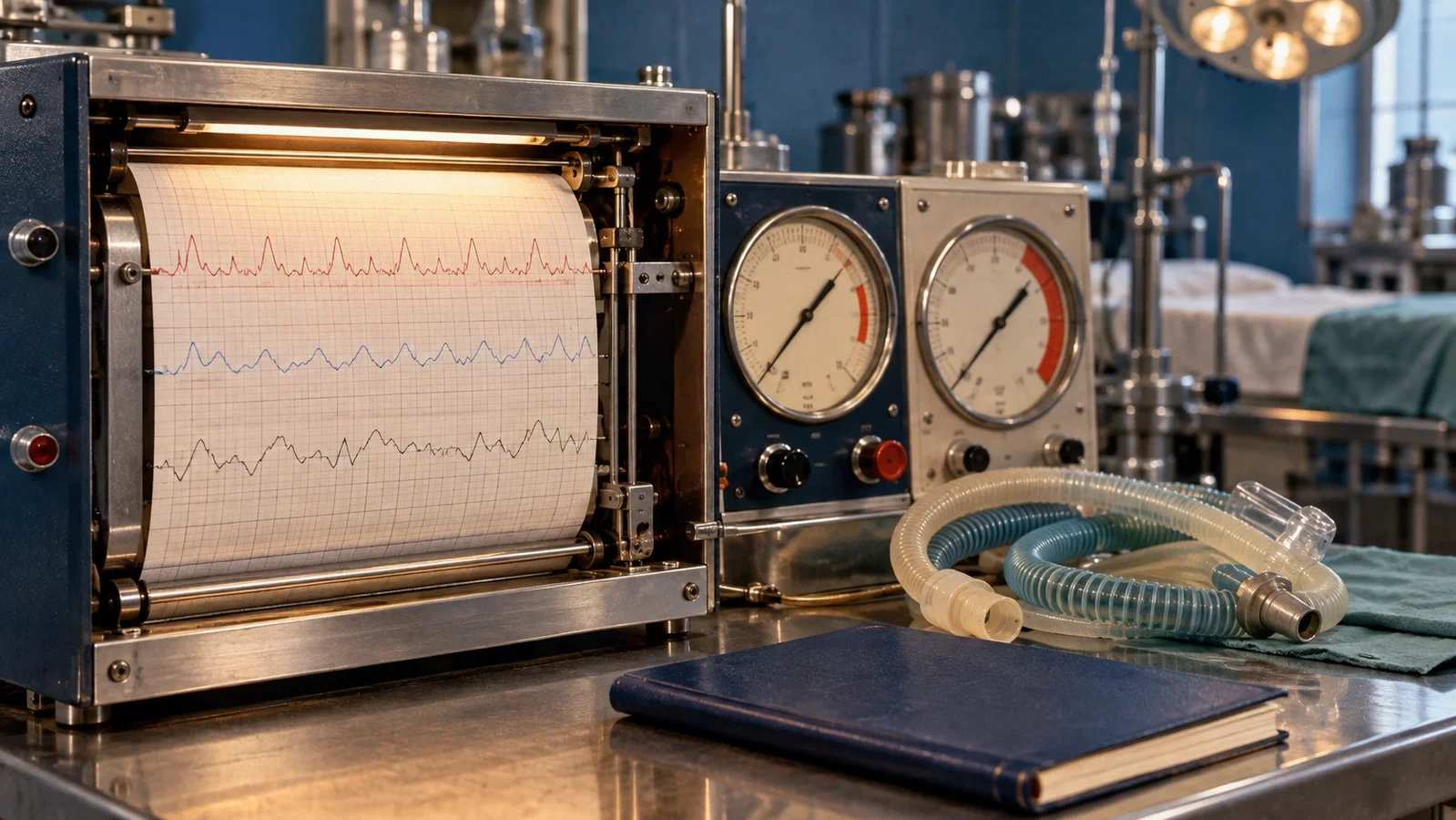
All four images are modern editorial reconstructions or concepts, not authentic ward photographs, author portraits or procedural demonstrations.
Sources and reading limits
- Pontoppidan H, Geffin B, Lowenstein E. Acute respiratory failure in the adult: first of three parts. NEJM. 1972;287:690–698. All nine pages of the publisher scan were read. An unrelated article beginning below the references on page 698 is excluded.
- Bendixen HH. Patients in Respiratory Failure — Aspects of Management. J Jpn Soc Clin Anesth. 1981;1(1):71–82. Only the relevant lecture passages, bibliography and Slide 5 on pages 73, 79 and 80 are used here; evidence of later citation.
- Swan HJC et al. Catheterization of the heart in man with use of a flow-directed balloon-tipped catheter. NEJM. 1970;283:447–451. Only original page 447 was read and matched to reference 84.
Parts II and III, pages 743–752 and 799–806, are not covered. Their bibliographic identity is not evidence of unseen content. These sources have citation dependencies; they are not three independent experiments.
Continue exploring
Related reading connects shared questions and contexts; it does not by itself establish historical influence.
The Source Room · About & Editorial Method
Sources and reading limits are stated above. Illustrations are labelled as original source images or AI-made. Historical accounts are educational; they are not current treatment instructions.