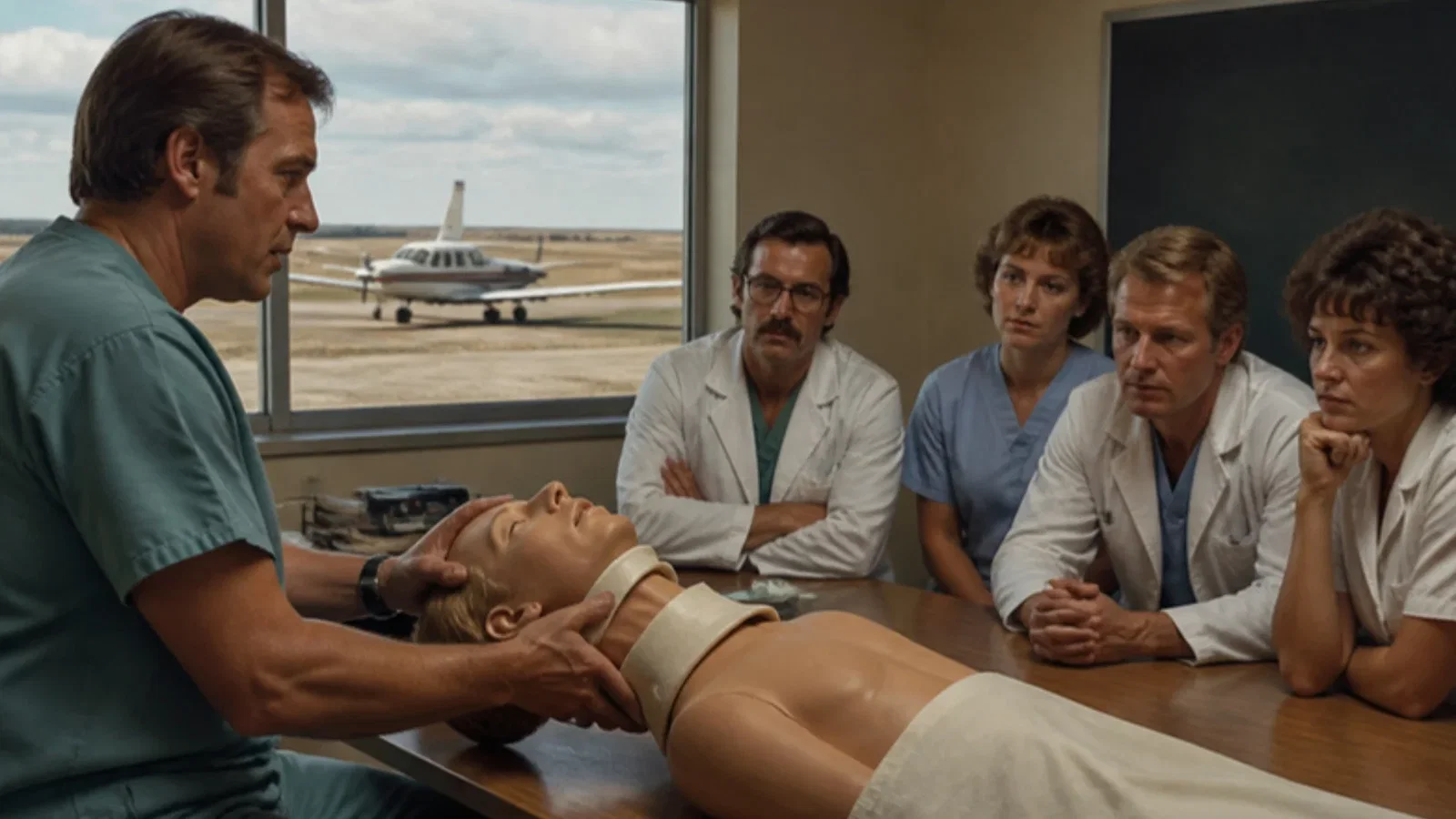
After James Styner and the Styner family received inadequate care in a rural emergency department in 1976, Paul Collicott built and piloted a standard course for the first hour of trauma care; the American College of Surgeons adopted it a year later and it spread worldwide.
Reading Library · Anesthesia Epochs · 中文版
Watch the education video (for clinicians)
1978: Advanced Trauma Life Support — Rural Nebraska · Anesthesia Epochs Education Series
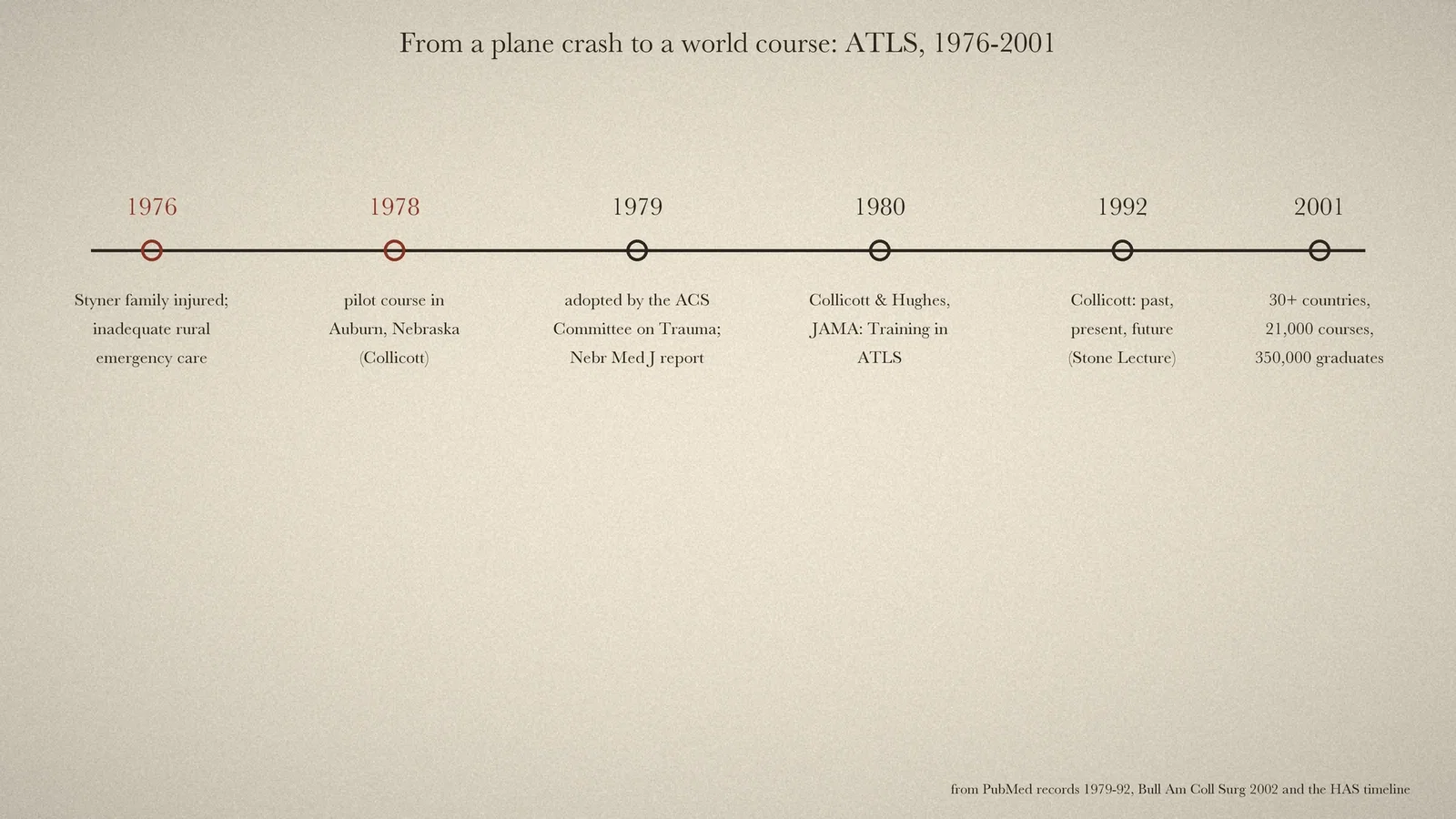
The History of Anaesthesia Society's timeline lists, under 1978, "Advanced Trauma Life Support (ATLS)", a trauma system built around the "Golden hour" and "first devised by physicians in Nebraska". [5] This article follows how that course began. The founders' own papers could not be read in full. The story comes from their PubMed records and from a 2002 account in the Bulletin of the American College of Surgeons.
The crash
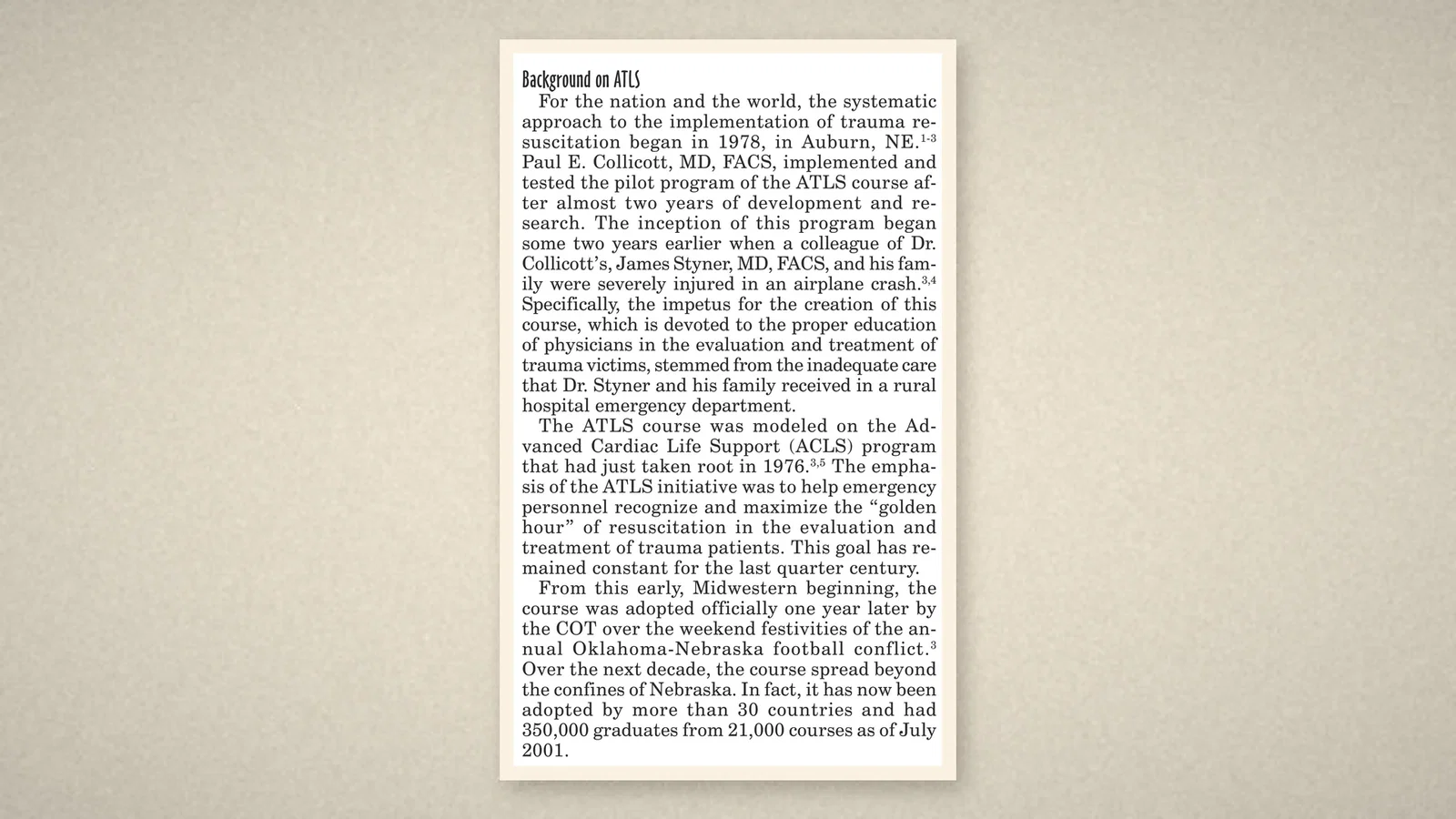
The 2002 account, by Christopher Weldon and colleagues at Tulane, opens its history plainly. The systematic approach to trauma resuscitation "began in 1978, in Auburn, NE". There Paul E. Collicott "implemented and tested the pilot program of the ATLS course" after almost two years of development and research. [4, p. 16] The program had begun two years earlier, when Collicott's colleague James Styner and the Styner family "were severely injured in an airplane crash". The impetus for a course to teach physicians how to evaluate and treat trauma victims "stemmed from the inadequate care that Dr. Styner and his family received in a rural hospital emergency department". [4, p. 16]
The course
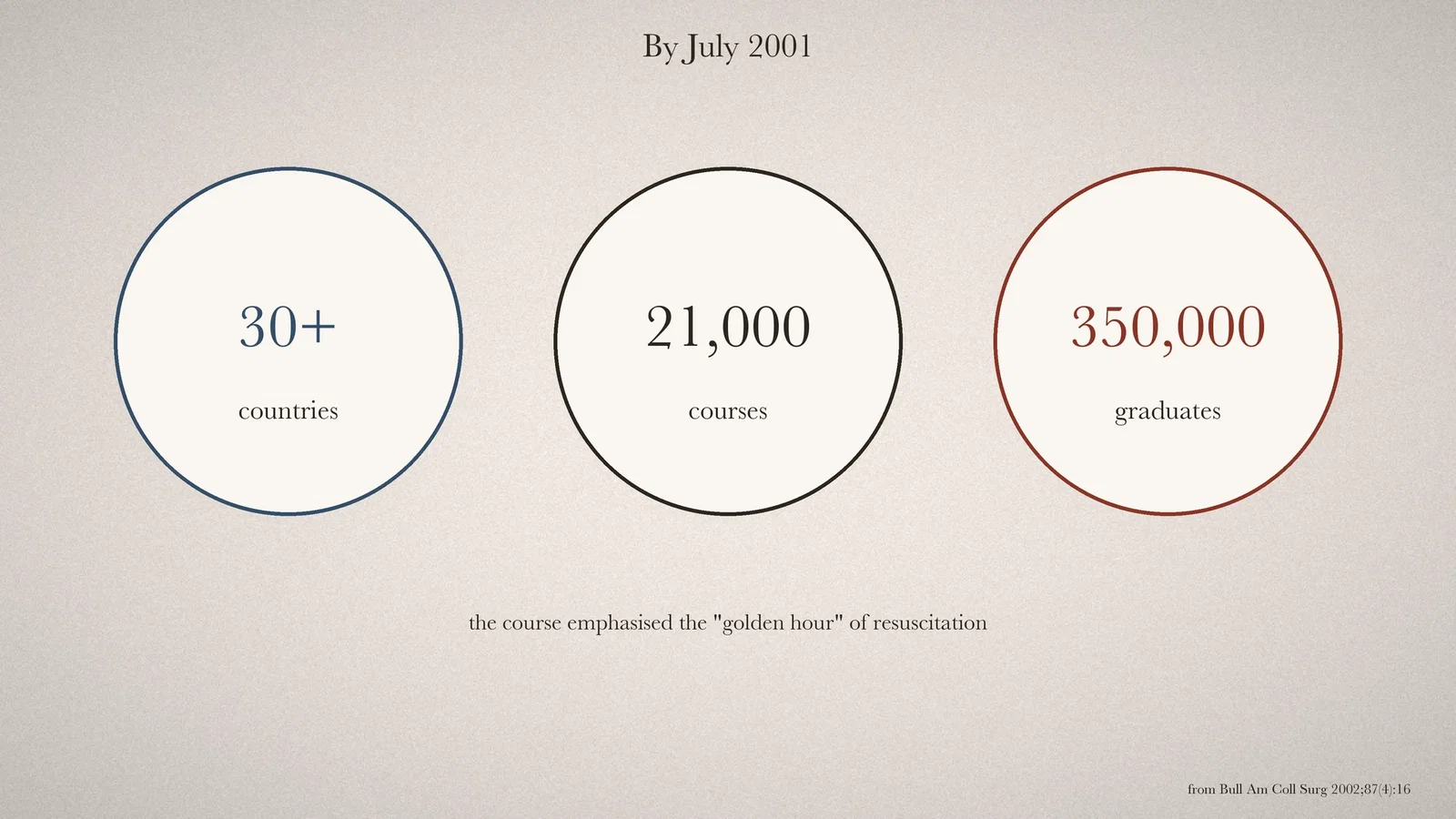
"The ATLS course was modeled on the" Advanced Cardiac Life Support programme, which had taken root in 1976. Its emphasis was to help emergency staff recognise and use the "golden hour" of resuscitation. [4, p. 16] From that Midwestern beginning, "the course was adopted officially one year later by the COT", the College's Committee on Trauma. [4, p. 16]
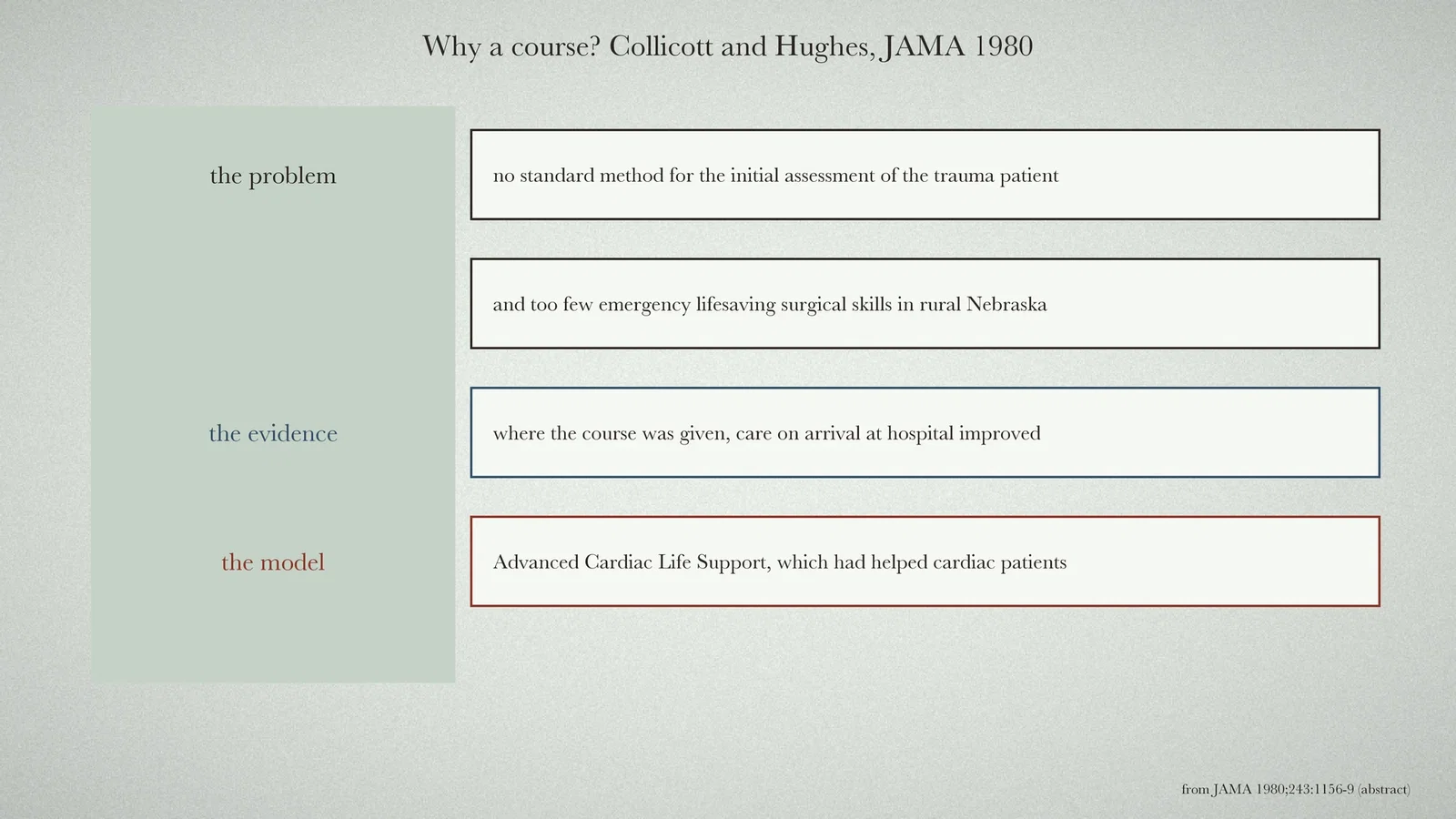
Collicott reported the course in the Nebraska Medical Journal in 1979 under the title "Advanced trauma life support course, an improvement in rural trauma care". [1] In 1980, with I. Hughes, Collicott explained the reasoning in JAMA. The lack of a standardised method for the initial assessment of the trauma patient, and of the skills to perform emergency "lifesaving surgical techniques in rural Nebraska has led to the development" of the course. "There has been a direct correlation between the" presentation of the course in several rural areas and better trauma care on arrival at a definitive-care hospital. The authors expected a national course to improve survival, "as has been experienced with the Advanced" Cardiac Life Support course and cardiac patients. [2]
Spread
Collicott, writing from the "Department of Trauma, Lincoln General Hospital" in Nebraska, gave the American Trauma Society's 16th Stone Lecture in 1992 under the title "Advanced Trauma Life Support (ATLS): past, present, future". [3] By July 2001, the Bulletin reports, the course had been adopted by more than 30 countries and had "350,000 graduates from 21,000 courses". [4, p. 16]
What the record shows
ATLS came from the inadequate care one injured family received in a rural emergency department, and from the decision of the injured surgeon's colleague to turn that experience into a teaching course. Its premise, that the first hour can be taught as a standard sequence to any physician, took the course from one Nebraska town to the world in about twenty years.
Sources and reading limits
Read: the PubMed records of Collicott 1979 (title), Collicott and Hughes 1980 (abstract) and Collicott 1992 (title and affiliation); the "Background on ATLS" section of Weldon and colleagues' 2002 Bulletin article; the History of Anaesthesia Society timeline.
Not covered: Collicott's 1979 and 1992 papers and Styner's own later account were not read. The crash, the rural emergency department, the year 1976 and the adoption a year after the pilot come from the 2002 article. The exact date and the faculty and students of the first course are not given in the sources read. A course manual found online appeared to be a third party's upload of a copyrighted publication and was not used. No crash or patient is depicted.
One illustration is a crop of the 2002 Bulletin page; three are drawn from the sources.
- Collicott PE. Advanced trauma life support course, an improvement in rural trauma care. Nebr Med J. 1979;64(9):279-80. PubMed
- Collicott PE, Hughes I. Training in advanced trauma life support. JAMA. 1980;243(11):1156-9. PubMed
- Collicott PE. Advanced Trauma Life Support (ATLS): past, present, future--16th Stone Lecture, American Trauma Society. J Trauma. 1992;33(5):749-53. PubMed
- Weldon CB, Silberfein E, Chehardy PL, McSwain NE Jr. ATLS training: a novel approach. Bull Am Coll Surg. 2002;87(4):15-. Internet Archive
- History of Anaesthesia Society. Timeline. Website
Continue exploring
Related reading connects shared questions and contexts; it does not by itself establish historical influence.
Anesthesia Epochs · The Source Room · About & Editorial Method
Published November 2, 2026. Sources and reading limits are stated above. Illustrations are labelled as original source images or AI-made. Historical accounts are educational; they are not current treatment instructions.