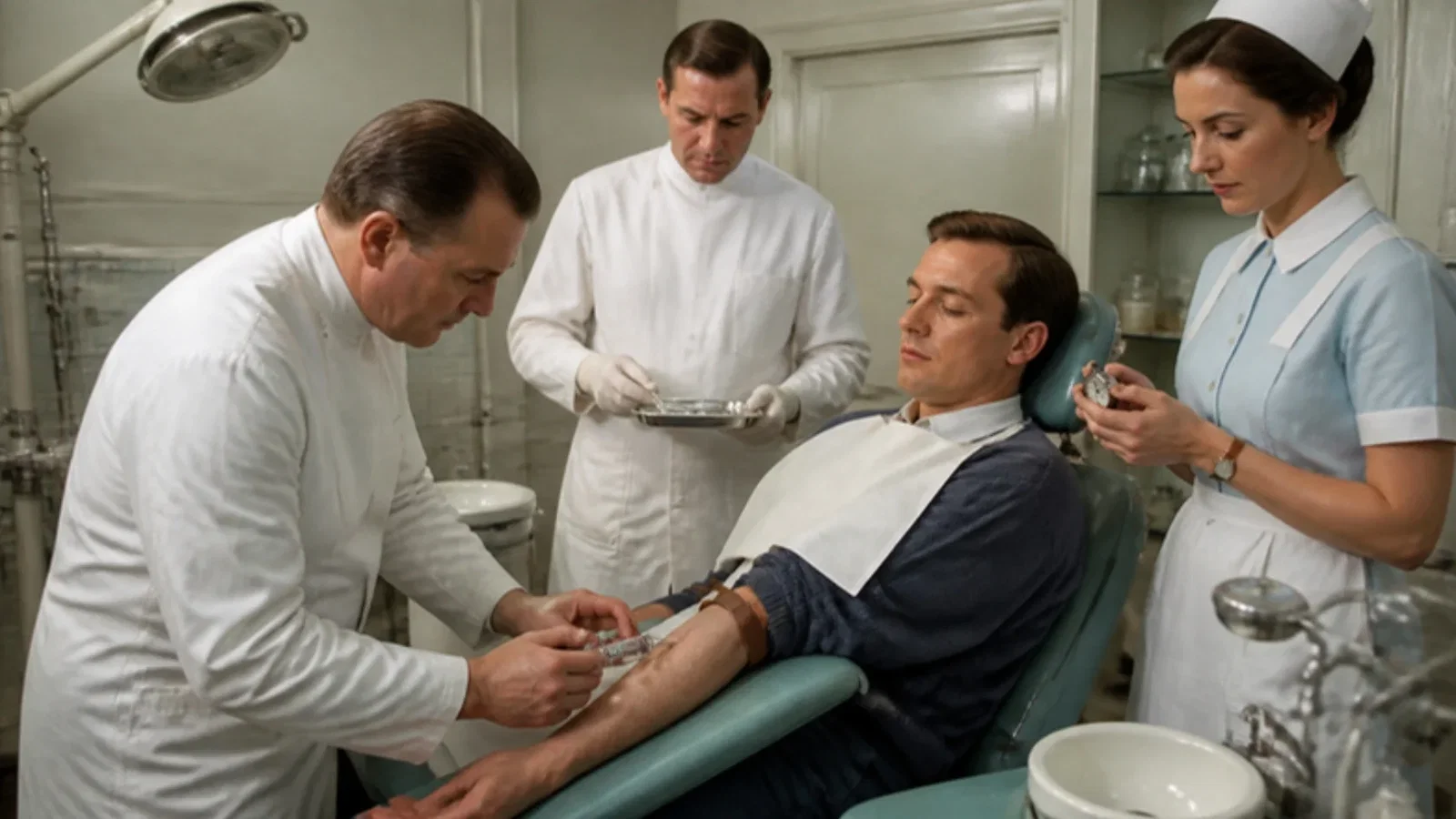
The first British trials of Bayer's FBA 1420: 230 cases in the dental chair, a run of papers in the British Journal of Anaesthesia in 1964-65, the drug's advantages and troubles, and its withdrawal in 1984 over anaphylaxis linked to its solvent, Cremophor EL.
Reading Library · Anesthesia Epochs · 中文版
Watch the education video (for clinicians)
1964: Propanidid — Not a Barbiturate, at the Dental Chair · Anesthesia Epochs Education Series
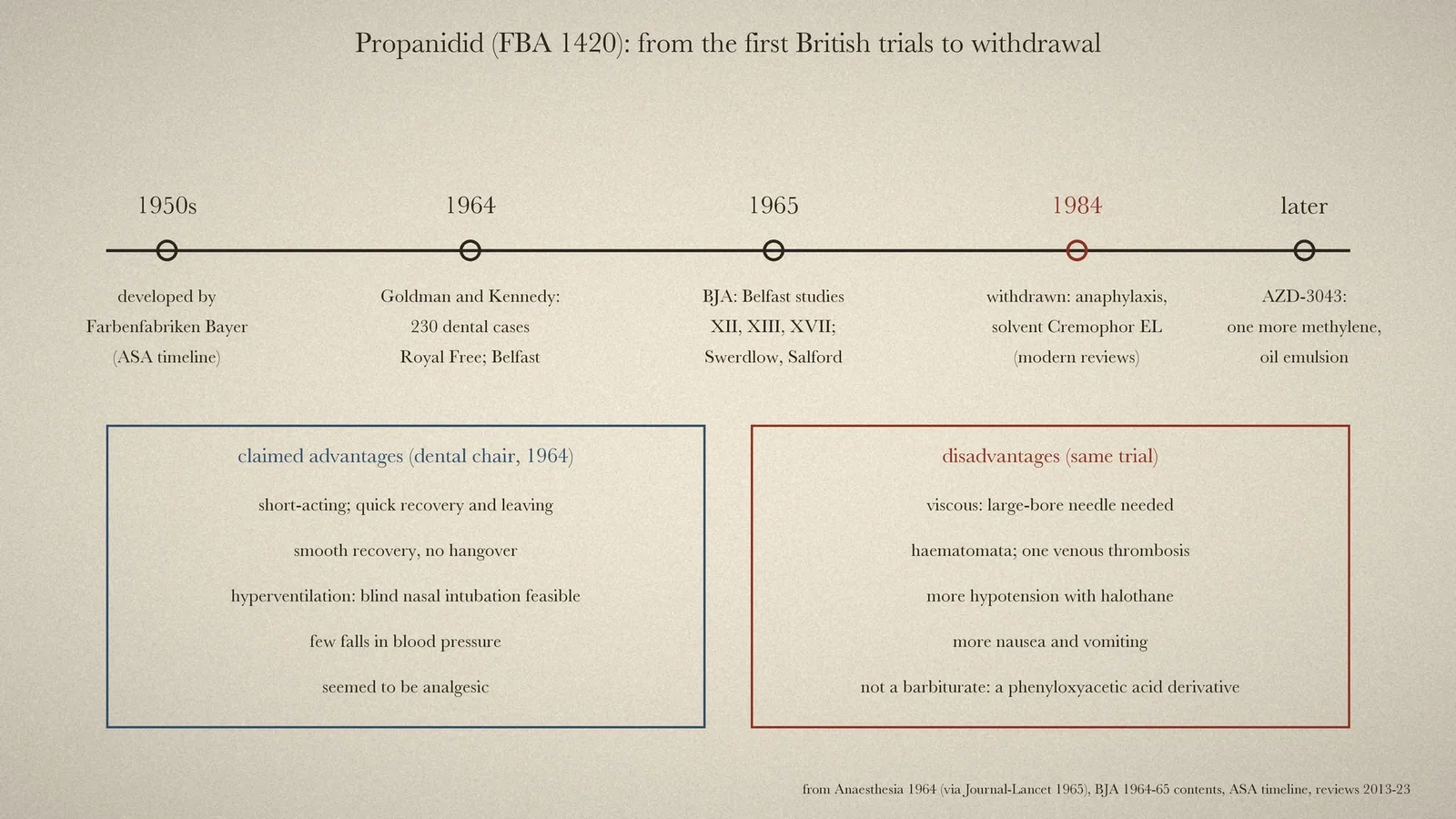
Most short-acting intravenous anaesthetics introduced until then were barbiturates. In 1964 British anaesthetists began trying something different. A drug from Farbenfabriken Bayer, known in the laboratory as FBA 1420 and soon named propanidid, put patients to sleep and let them wake within minutes, and it was not a barbiturate at all. This article follows its first British trials, what the trial reports praised and what worried them, and its withdrawal twenty years later. None of the 1964-65 papers themselves could be read. What follows rests on a verbatim abstract of the first trial, on the journal's tables of contents, and on later reviews.
A drug from Bayer
The Australian Society of Anaesthetists' history timeline records propanidid as developed by Farbenfabriken Bayer AG "but not introduced until 1964". [4, p. 58] For 1964 it lists "Propanidid first used", naming a group at the Royal Free Hospital in Hampstead and J. W. Dundee and R. S. J. Clarke of the Queen's University of Belfast. [4, p. 69]
Two hundred and thirty cases in the dental chair
The clearest early voice is a pilot trial by Victor Goldman and Pat Kennedy, "A non-barbiturate intravenous anaesthetic", published in Anaesthesia in July 1964. The paper itself is not covered, but John Lundy's Anesthesia Abstracts quoted it at length, and the quotation was reprinted in The Journal-Lancet of Minneapolis in October 1965. [1, p. 460-461]
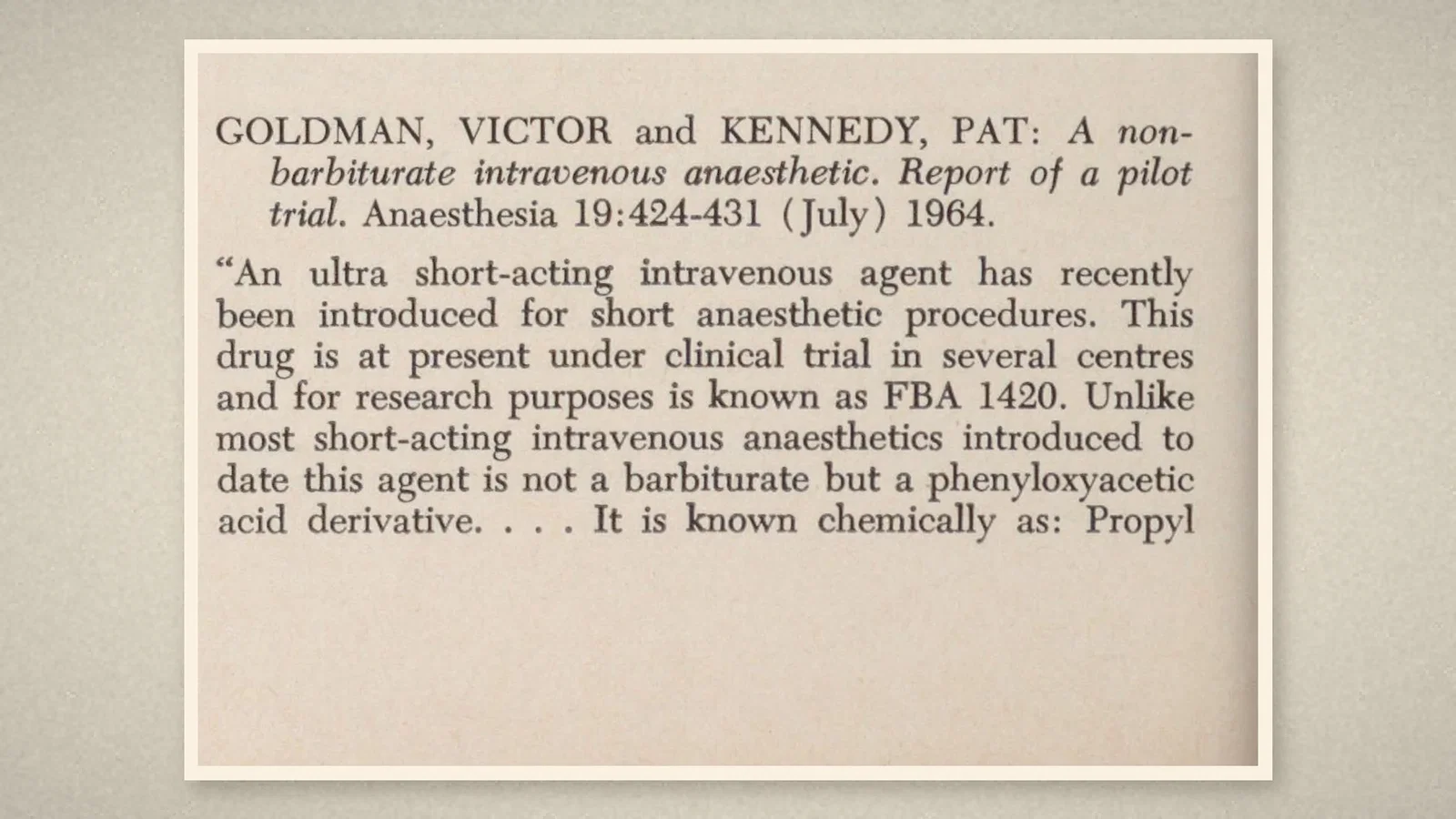
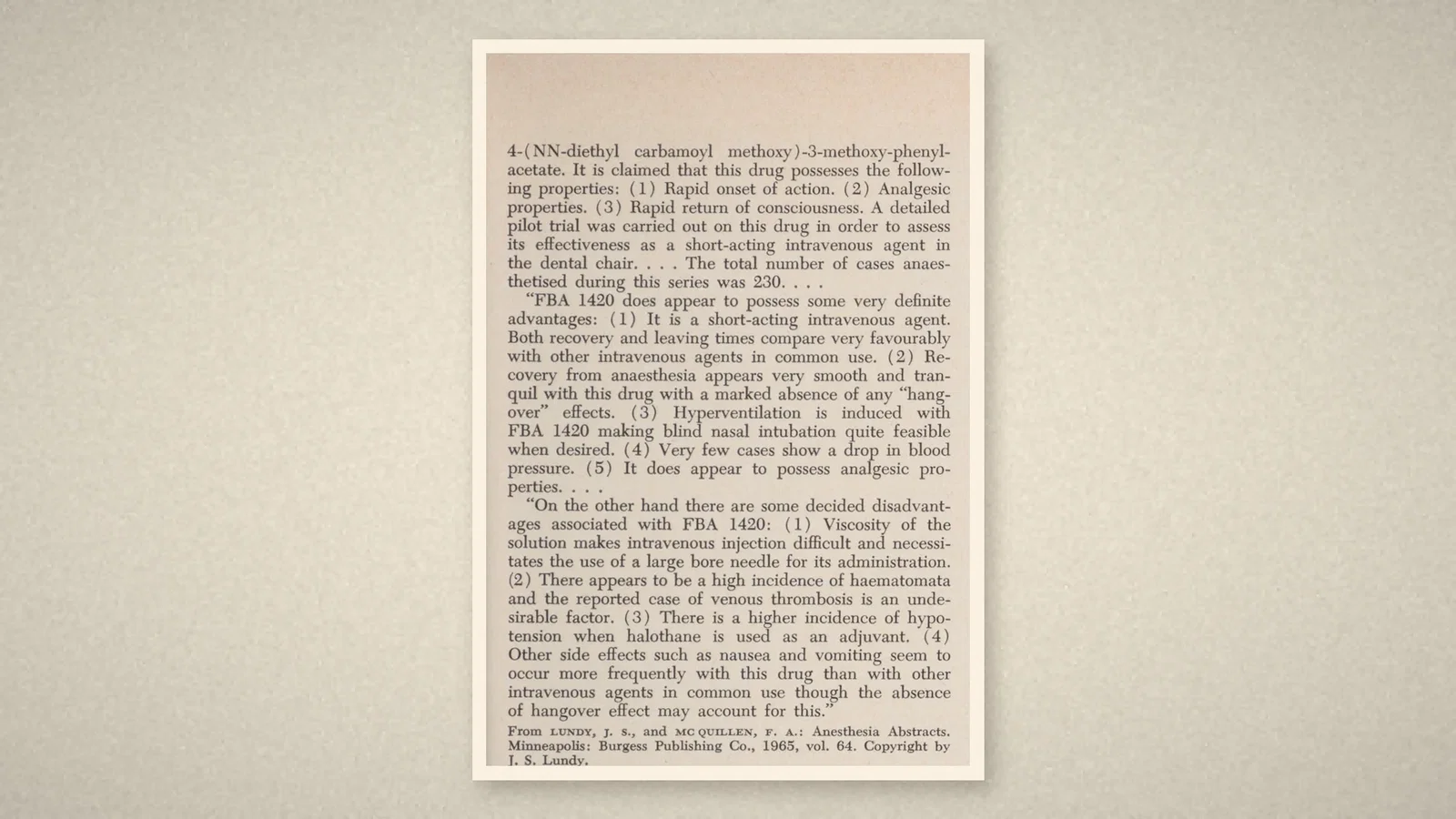
The authors explained that an ultra short-acting intravenous agent had recently been introduced for short procedures, was "at present under clinical trial in several centres", and "for research purposes is known as FBA 1420". Unlike most such agents, "this agent is not a barbiturate but a phenyloxyacetic acid derivative". [1, p. 460] The makers claimed rapid onset, analgesic properties and rapid return of consciousness. Goldman and Kennedy tested it as a short-acting agent "in the dental chair", and the series reached 230 cases. [1, p. 461]
Their verdict was mixed. On the credit side, recovery and leaving times compared "very favourably" with other intravenous agents. Recovery was smooth and tranquil, with no "hangover". The drug caused hyperventilation, which made blind nasal intubation "quite feasible". Very few patients' blood pressure fell, and the drug seemed to be analgesic. [1, p. 461] Against it, the solution was so viscous that injection was difficult and needed a large-bore needle. Haematomata were common, and one case of venous thrombosis had been reported. Hypotension was commoner when halothane was added, and nausea and vomiting seemed more frequent, perhaps, the authors thought, because patients woke without a hangover. [1, p. 461]
A run of papers in the British Journal of Anaesthesia
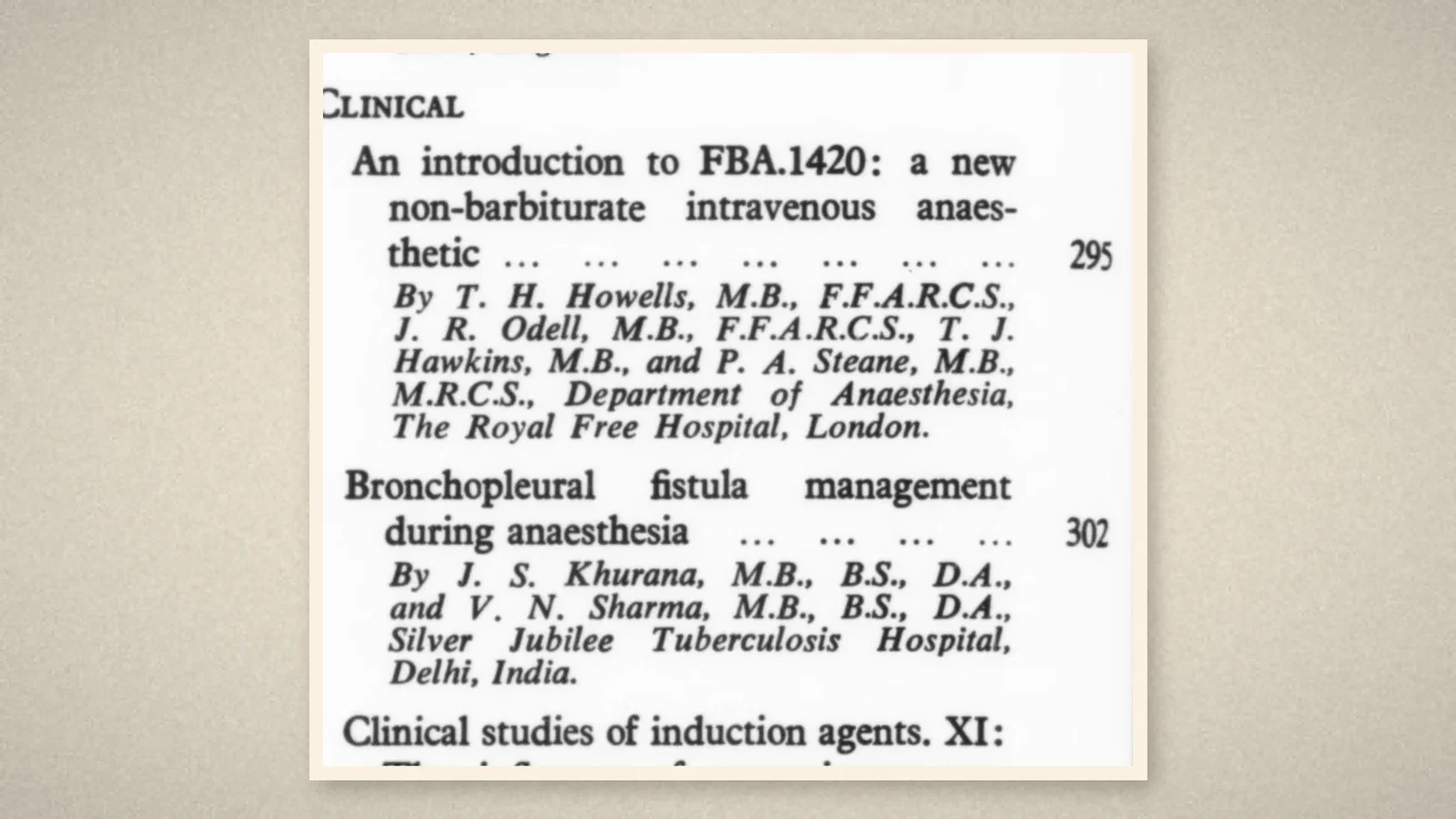
The British Journal of Anaesthesia followed the drug closely. Its 1964 volume lists Dundee and Clarke's ninth "clinical study of induction agents", a comparison of "a new eugenol derivative, FBA.1420" with another experimental agent, G.29.505, and standard barbiturates (p. 100). [2] It also lists "An introduction to FBA.1420: a new non-barbiturate intravenous anaesthetic" by T. H. Howells, J. R. Odell, T. J. Hawkins and P. A. Steane of the Department of Anaesthesia, Royal Free Hospital, London (p. 295). [2]
By 1965 the code name was giving way to the generic one. The Belfast group published on the effect of premedicants on "the course and sequelae of propanidid anaesthesia", on liver function after propanidid and thiopentone, and on propanidid's effect on the response to pain. [3] M. Swerdlow of Salford Royal Hospital reported "A trial of propanidid (FBA.1420): a new ultrashort-acting anaesthetic" (p. 785). [3] Only the titles, authors and pages of these papers were seen, not their findings.
Withdrawal
Propanidid was given dissolved in a solvent, Cremophor EL, and modern reviews connect its end to that vehicle. Feng and colleagues, writing in 2017, say that propanidid, introduced into clinical practice in the decade of these first trials, "was withdrawn in 1984 because of a high incidence of anaphylactic reactions", believed to be caused by Cremophor EL. [5] Baldo's 2023 review of allergic reactions in anaesthesia puts propanidid beside alfathesin among the Cremophor-based induction agents that caused life-threatening anaphylaxis, at "incidences as high as 1 in 875 cases". In an early Australian survey of 443 patients, propanidid accounted for 7.7% of the anaphylactic reactions to hypnotics. [6] The ASA timeline gives the same year, 1984, for the banning of Althesin (introduced in 1972), which also used Cremophor EL. [4, p. 72]
An idea that outlived the drug
The quick wake-up Goldman and Kennedy liked has kept drawing drug designers. Chitilian, Eckenhoff and Raines in 2013 described AZD-3043 as a close structural analogue of propanidid, differing by one methylene group and given in an emulsion, "whereas the latter was dissolved in cremophor". [7] Feng and colleagues describe the same compound. [5]
What the record shows
In 1964 British anaesthetists trialled a fast intravenous anaesthetic that was not a barbiturate. The first dental trial liked how quickly and cleanly patients woke, and disliked the thick solution and the bruised veins. The drug lasted twenty years, until the solvent that carried it became the reason to stop.
Sources and reading limits
Read: the verbatim abstract of Goldman and Kennedy's trial in The Journal-Lancet, October 1965, pp. 460-461; the tables of contents of the British Journal of Anaesthesia for 1964 and 1965; the ASA history timeline (2024); and three open-access reviews (Feng et al. 2017; Baldo 2023; Chitilian, Eckenhoff and Raines 2013).
Not covered: none of the 1964-65 papers was read. Goldman and Kennedy's paper is known through the abstract's quotations. The BJA papers are known only by title, authors and page, because the journal's open archive serves them as PDFs that could not be obtained. Bayer's pharmacology and the 1964 Frankfurt symposium volume on propanidid are held on the Internet Archive only as restricted loans and were not read. The 1984 withdrawal and its link to Cremophor EL come from modern reviews, not from a withdrawal notice. The ASA timeline names "Howard et al" at the Royal Free; the BJA contents list Howells, Odell, Hawkins and Steane. Both are given here.
One illustration is a timeline drawn from these sources; three are crops of the 1965 abstract and the 1964 contents.
- Goldman V, Kennedy P. A non-barbiturate intravenous anaesthetic: report of a pilot trial. Anaesthesia. 1964;19:424-31. Abstract in: Current literature on pain. Journal-Lancet. 1965;85:460-1. Internet Archive
- British Journal of Anaesthesia. Vol. 36 (1964), contents. Internet Archive
- British Journal of Anaesthesia. Vol. 37 (1965), contents. Internet Archive
- Australian Society of Anaesthetists. Anaesthesia History Timeline 2024. PDF
- Feng AY, Kaye AD, Kaye RJ, Belani K, Urman RD. Novel propofol derivatives and implications for anesthesia practice. J Anaesthesiol Clin Pharmacol. 2017;33(1):9–15. DOI
- Baldo BA. Allergic and other adverse reactions to drugs used in anesthesia and surgery. Anesthesiol Perioper Sci. 2023;1:16. DOI
- Chitilian HV, Eckenhoff RG, Raines DE. Anesthetic drug development: novel drugs and new approaches. Surg Neurol Int. 2013;4(Suppl 1):S2-S10. DOI
Continue exploring
Related reading connects shared questions and contexts; it does not by itself establish historical influence.
Anesthesia Epochs · The Source Room · About & Editorial Method
Published November 2, 2026. Sources and reading limits are stated above. Illustrations are labelled as original source images or AI-made. Historical accounts are educational; they are not current treatment instructions.