
The Canadian Anaesthetists' Society approved guidelines for standards of practice in 1975, which it calls the first by any anaesthesia society; provinces wrote their own in the same years, and Saskatchewan's inquiry shows how such guidelines were meant to be used.
Reading Library · Anesthesia Epochs · 中文版
Watch the education video (for clinicians)
1975: Canada's Written Standards — Who Issued Them? · Anesthesia Epochs Education Series
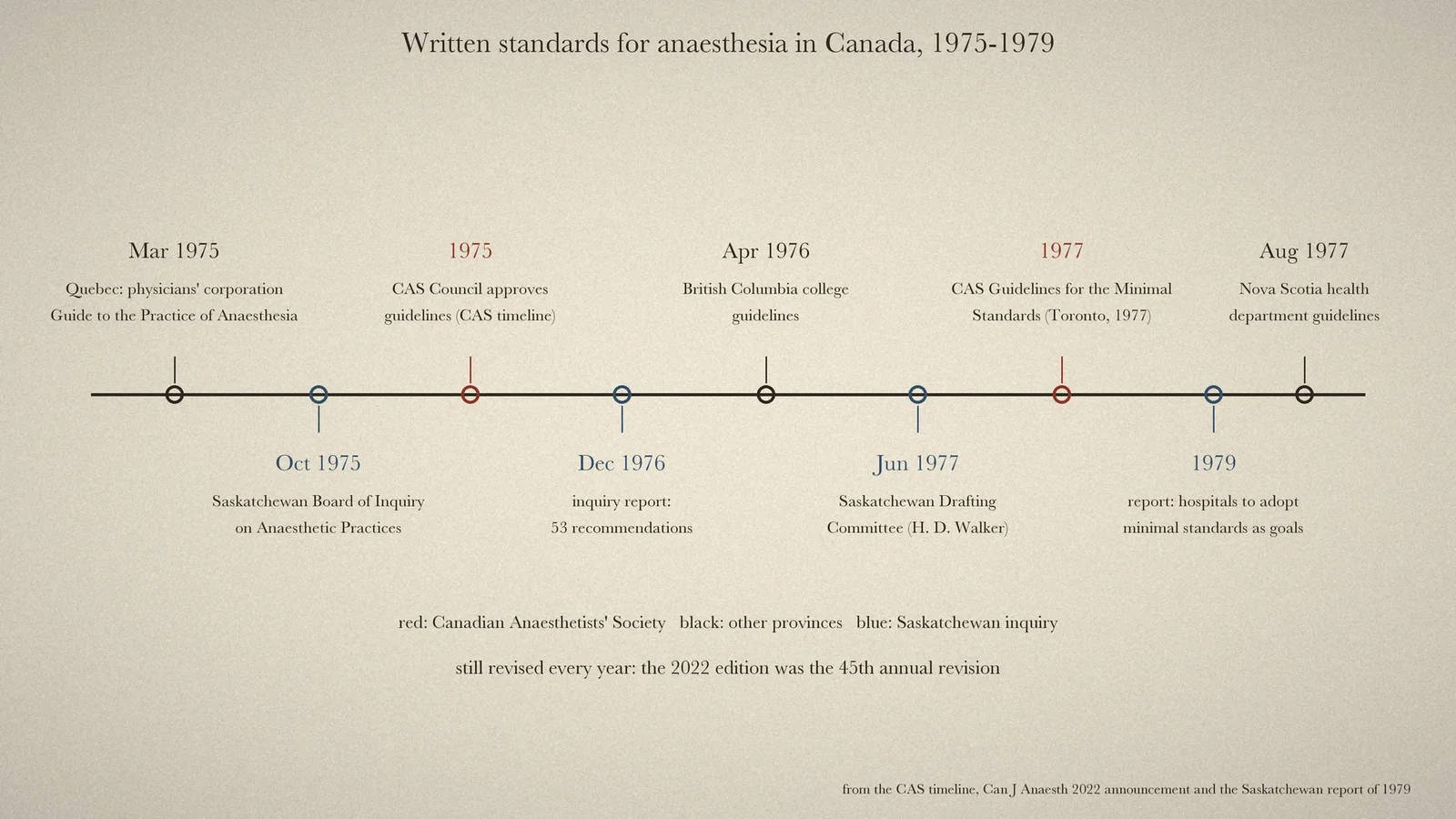
Today almost every national anaesthesia society publishes standards for safe practice. The Canadian society claims to have been the first. This article looks at that claim and at what can be learned about the first Canadian guidelines from the sources that can be read now. Those sources are the society's own timeline, its 2022 announcement of the latest annual revision, and a Saskatchewan government report of 1979 that shows how such guidelines were being written and used across Canada at the time. The first guidelines themselves were not found.
The society's claim
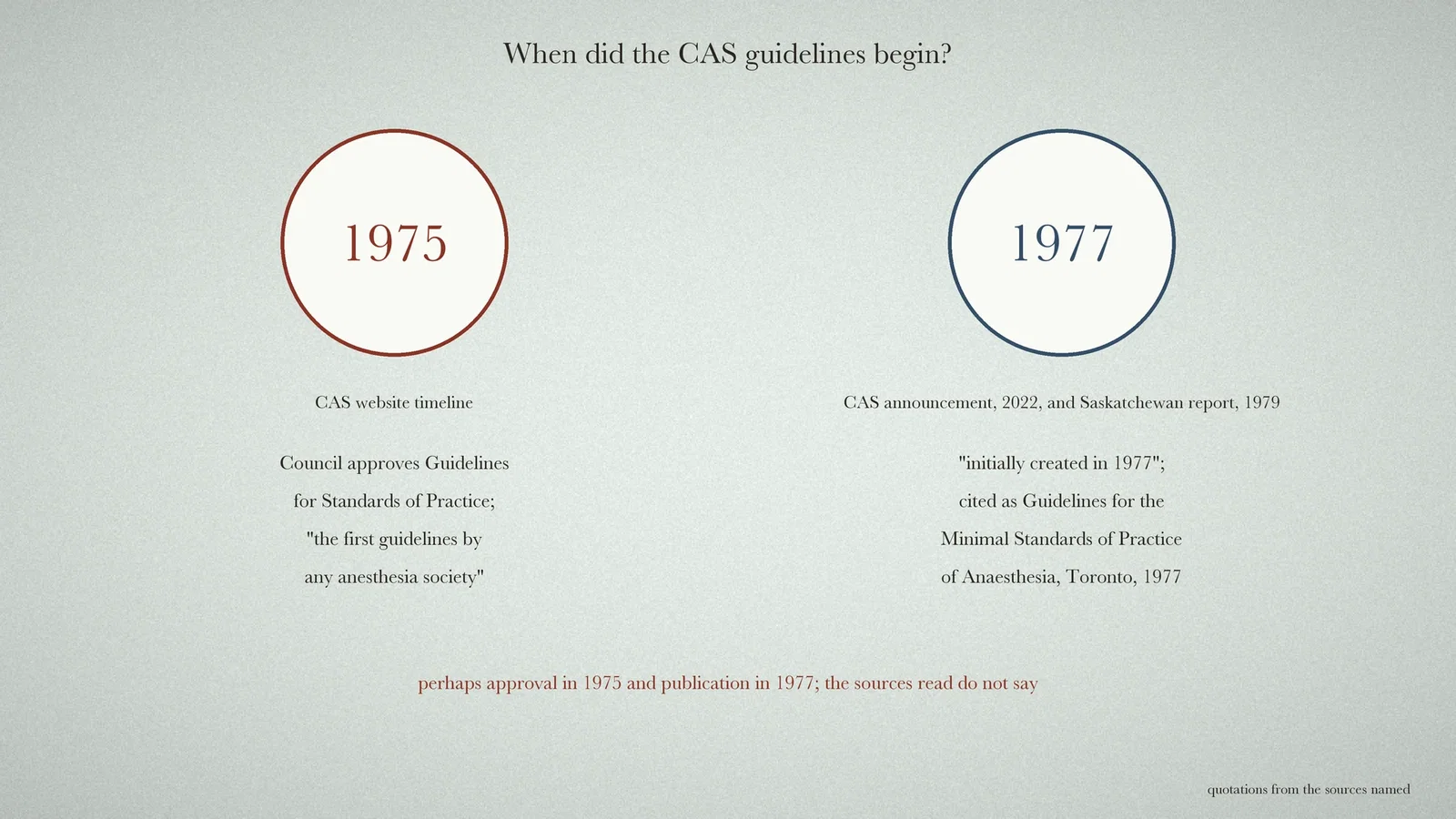
The Canadian Anesthesiologists' Society (CAS) timeline lists, under 1975: "Council approves Guidelines for Standards of Practice - the first guidelines by any anesthesia society". [1] The timeline is "excerpted in part" from David Shephard's 1993 history of the society, Watching Closely Those Who Sleep, which could not be read here. [1] It places the step after the Royal College's single-standard examinations of 1972, which made certification "the sole standard for specialty certification", and before the founding of the Association of Canadian University Departments of Anesthesia in 1976. [1]
A second date
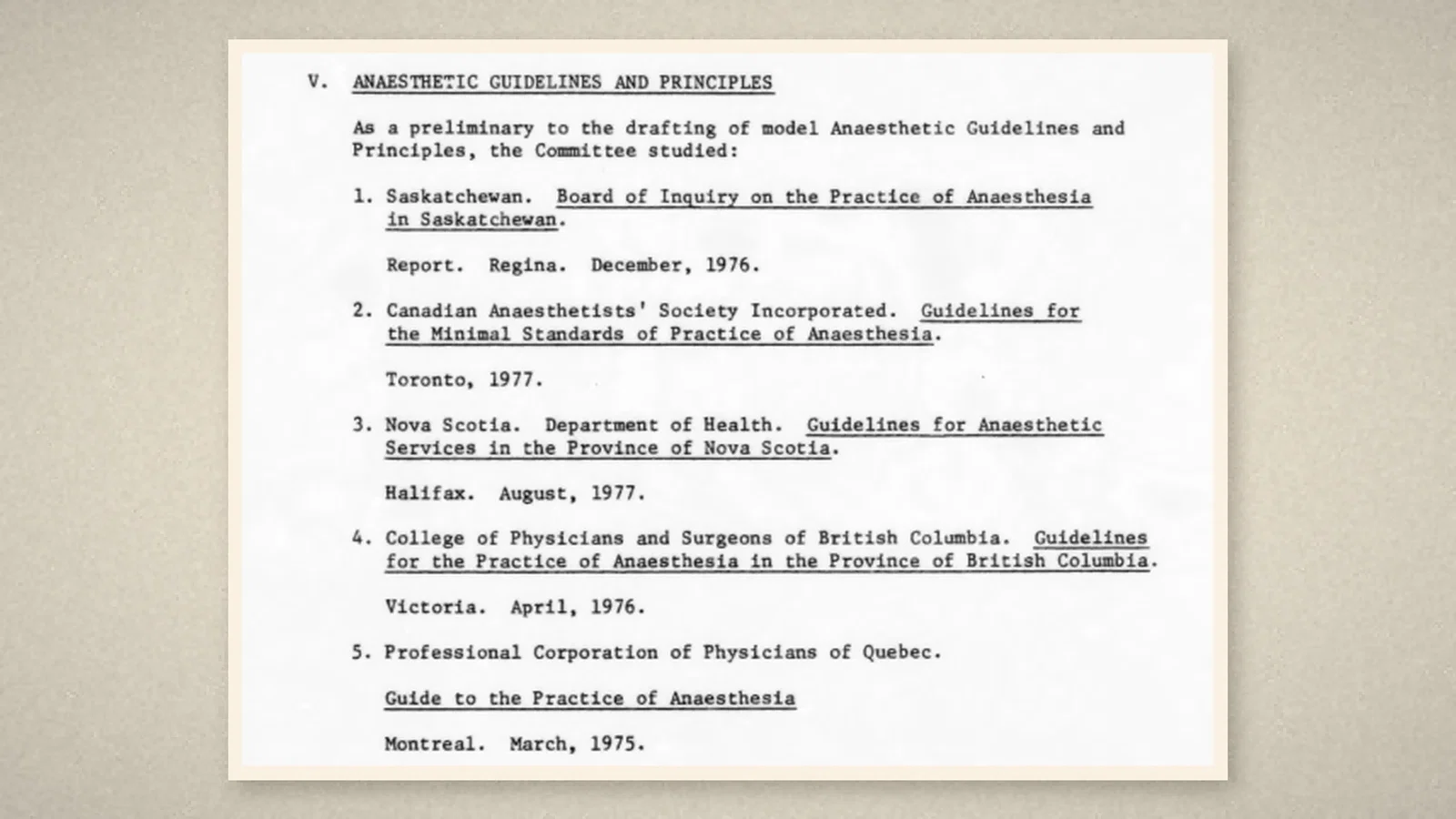
The society's own announcement of the 2022 revision, in the Canadian Journal of Anesthesia, tells it slightly differently. The guidelines, it says, are developed and "updated annually, by the Canadian Anesthesiologists' Society (CAS) Committee on Standards" and "are approved by the CAS Board of Directors". It adds: "They were initially created in 1977 and represented a bold and visionary initiative", at a time before clinical practice guidelines were common. "This will be the 45 th annual revision." [2] A contemporary document supports 1977. Saskatchewan's 1979 report lists among the documents its committee studied the "Canadian Anaesthetists' Society Incorporated. Guidelines for the Minimal Standards of Practice of Anaesthesia. Toronto, 1977". [3, p. 6] The sources read do not say whether 1975 was the year of approval and 1977 the year of the printed edition.
A Canadian wave
The same Saskatchewan list shows that the national society was not writing alone. The committee also studied a Quebec "Guide to the Practice of Anaesthesia" issued by the province's professional corporation of physicians in "Montreal. March, 1975". It studied guidelines from the College of Physicians and Surgeons of British Columbia ("Victoria. April, 1976") and from Nova Scotia's Department of Health ("Halifax. August, 1977"). [3, p. 6] The Quebec guide predates both dates for the CAS guidelines, but it came from a provincial licensing body, not an anaesthesia society.
What the guidelines were for: Saskatchewan
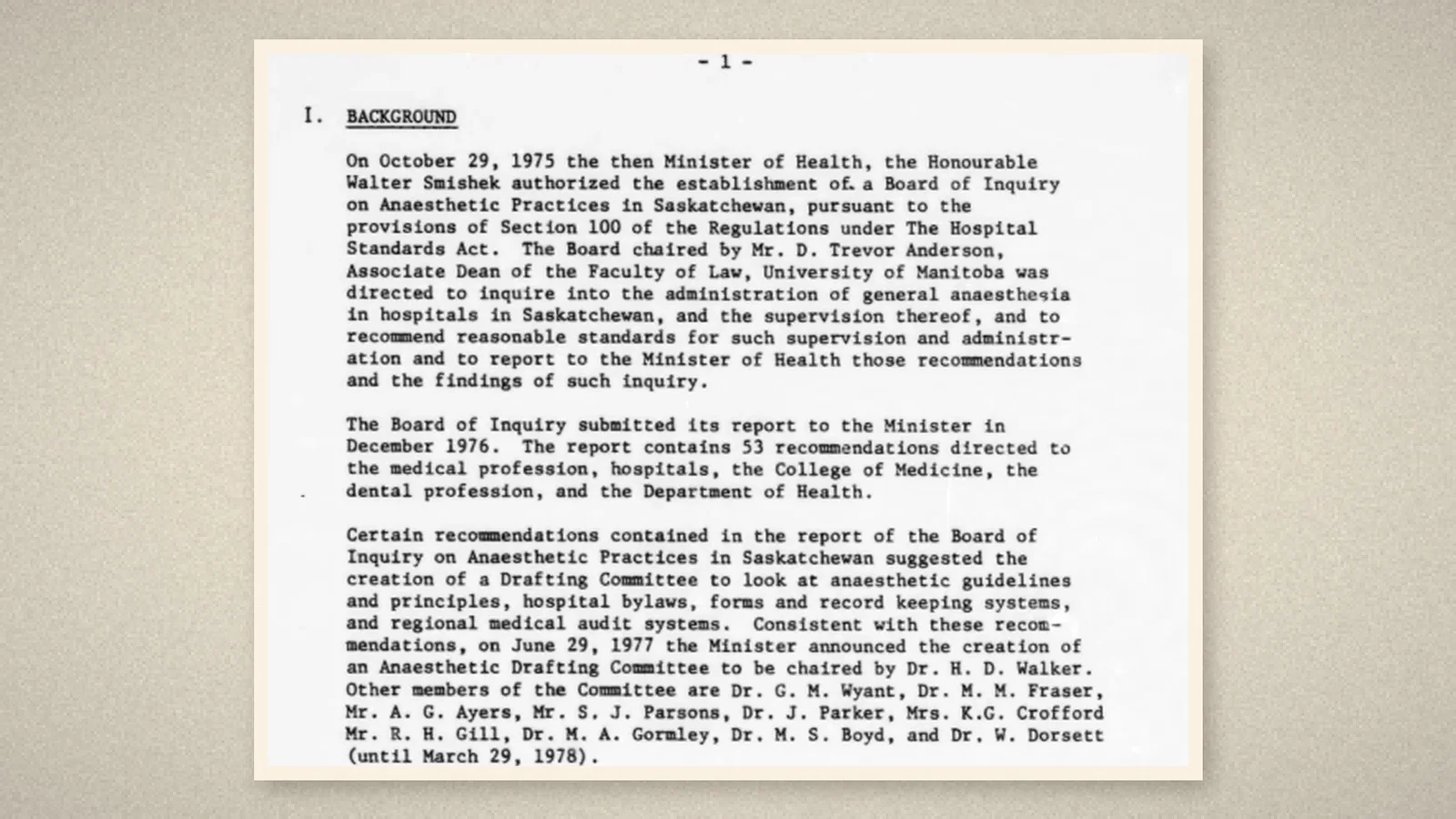
Saskatchewan shows why provinces wanted such documents. On 29 October 1975 the provincial Minister of Health set up a "Board of Inquiry on Anaesthetic Practices in Saskatchewan", chaired by D. Trevor Anderson, "Associate Dean of the Faculty of Law, University of Manitoba". Its task was "to inquire into the administration of general anaesthesia" in the province's hospitals and its supervision, and to recommend standards. [3, p. 1] It reported in December 1976, and "The report contains 53 recommendations" addressed to the profession, the hospitals, the College of Medicine, dentists and the department. [3, p. 1] In June 1977 the minister created an "Anaesthetic Drafting Committee to be chaired by Dr. H. D. Walker". "Other members of the Committee are Dr. G. M. Wyant" and others. [3, p. 1]
The committee's guidelines covered the organisation of hospital services, responsibilities and duties, qualifications, other personnel, equipment, and the pre-anaesthetic, anaesthetic and post-anaesthetic periods. [3, p. 7] Its hope was that every hospital providing anaesthesia would adopt the minimal standards "as goals which they will strive to achieve". [3, p. 6] The report is dated from "Regina, Saskatchewan". [3]
What the record shows
Between 1975 and 1979 Canadian anaesthetists, and the provinces that licensed them, began to put the minimum conditions for safe anaesthesia into writing. The national society's guidelines date from 1975 or 1977, depending on which of the society's own accounts one follows. They were one of several such documents in those years, and they are still revised every year.
Sources and reading limits
Read: the CAS website timeline; the CAS Committee on Standards' announcement of the 2022 revision (Can J Anesth 2022); the Saskatchewan Report of the Anaesthesia Drafting Committee (1979).
Not covered: the first CAS guidelines themselves were not found, so their contents are not described. The headings listed above belong to Saskatchewan's own guidelines. Shephard's 1993 history of the society was not available. The 1975 date comes from the society's timeline, and the 1977 date from its 2022 announcement and the Saskatchewan report. The claim to be the first guidelines by any anaesthesia society is the society's own and was not checked against other societies' records. The Saskatchewan Board of Inquiry's 1976 report was not read, only the drafting committee's summary of it.
Two illustrations are drawn from these sources (a timeline and a comparison of dates); two are crops of the Saskatchewan report.
- Canadian Anesthesiologists' Society. History - Timeline. Website
- Dobson GR. Special announcement - Guidelines to the Practice of Anesthesia - Revised Edition 2022. Can J Anaesth. 2022;69(1):1–12. DOI
- Saskatchewan. The Report of the Anaesthesia Drafting Committee. Regina; 1979. Internet Archive
Continue exploring
Related reading connects shared questions and contexts; it does not by itself establish historical influence.
Anesthesia Epochs · The Source Room · About & Editorial Method
Published November 2, 2026. Sources and reading limits are stated above. Illustrations are labelled as original source images or AI-made. Historical accounts are educational; they are not current treatment instructions.