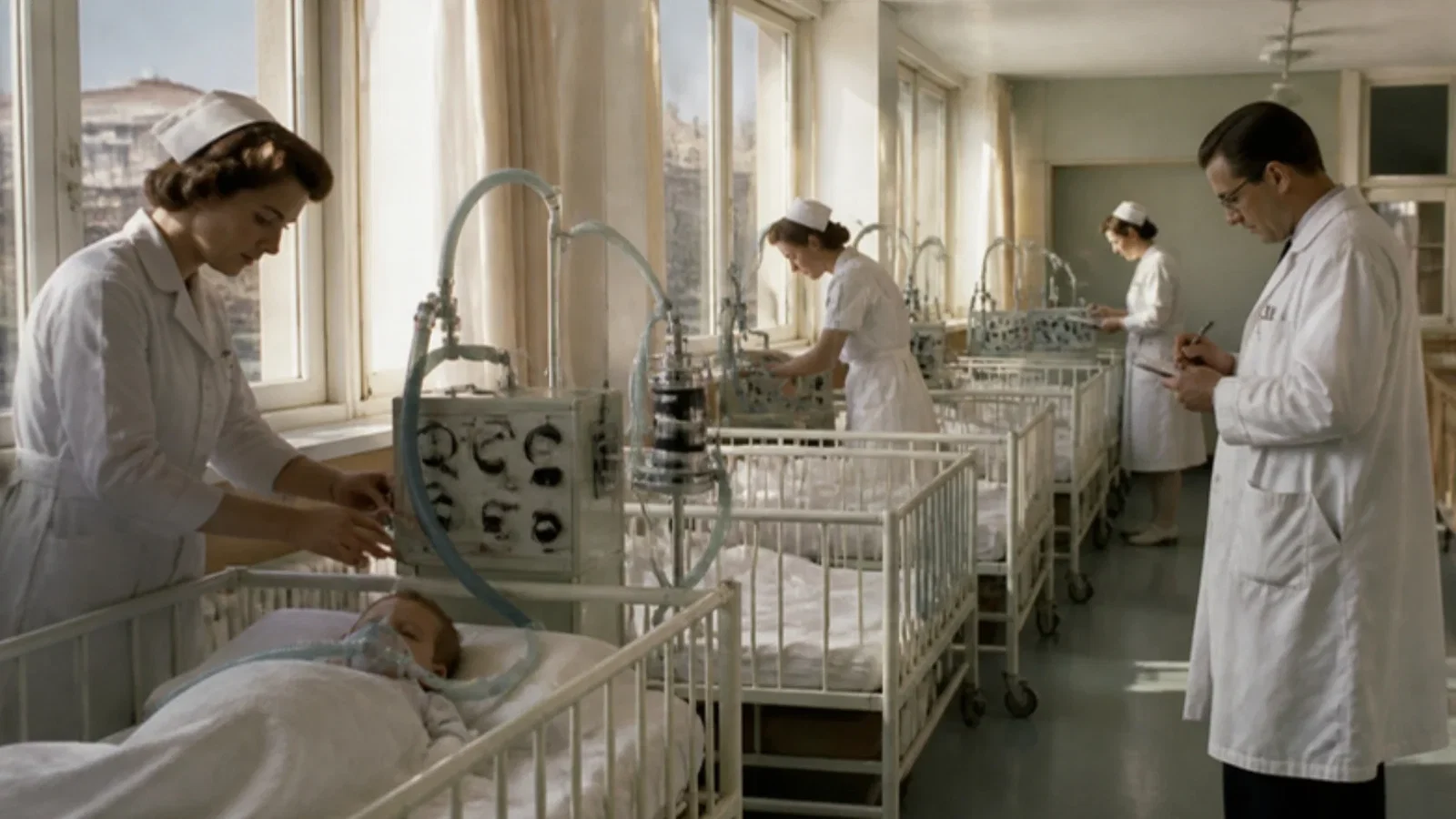
Two open-access reviews date the first paediatric intensive care unit to the Children's Hospital of Göteborg in 1955, where skills learned on polio wards were turned to ventilating newborns and treating severe pneumonia and sepsis in children.
Reading Library · Anesthesia Epochs · 中文版
Watch the education video (for clinicians)
1955: Gothenburg's Paediatric ICU — After Polio · Anesthesia Epochs Education Series
Paediatric intensive care is younger than most of the specialties that feed it. In 2014 K. J. S. Anand wrote that the field traces "its origins to the polio epidemics", was "birthed by ongoing efforts in pediatric anesthesiology and neonatology", and grew alongside paediatric pulmonology, cardiology, adult critical care and surgery. [1] Anand added that not many paediatric intensive care units existed before 1980. [1] Two open-access reviews put the starting point in western Sweden. This article follows them, and marks clearly where they stop.
From polio ward to intensive care
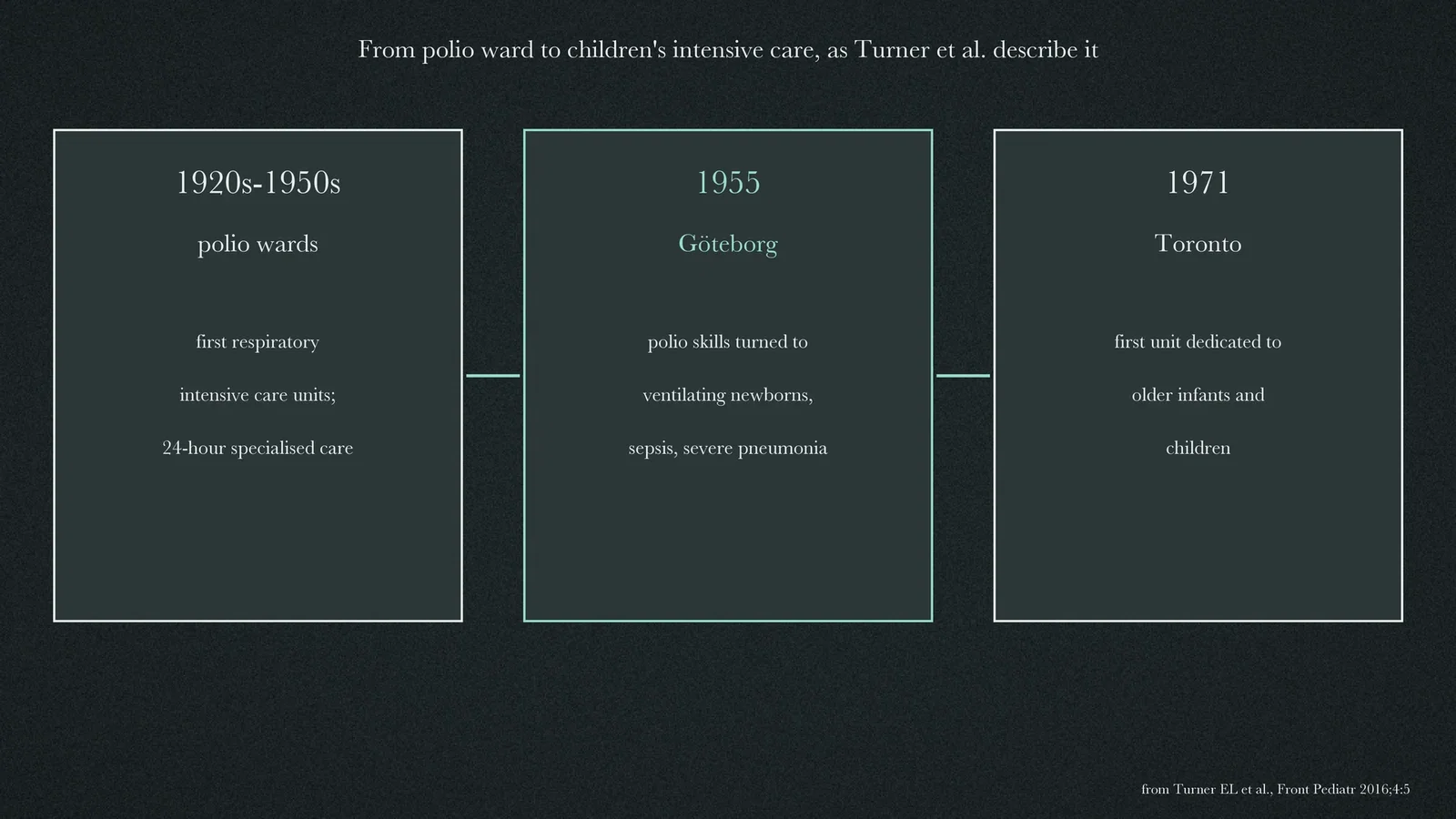
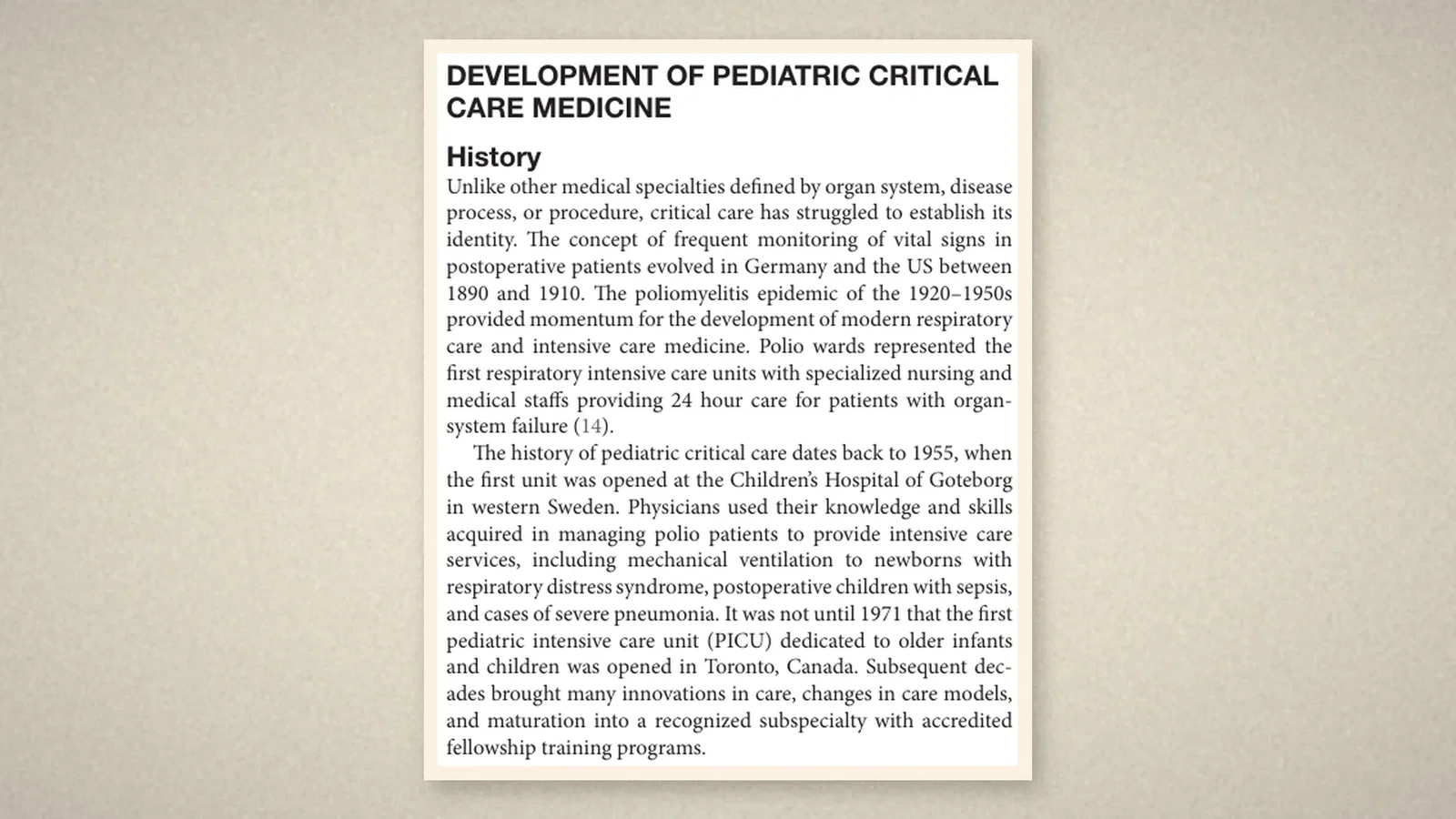
Erin L. Turner and colleagues begin with general critical care. Frequent monitoring of vital signs in postoperative patients developed in Germany and the United States between 1890 and 1910, and the poliomyelitis epidemics of the 1920s to 1950s gave momentum to modern respiratory and intensive care. [2] "Polio wards represented the first respiratory intensive care units with specialized nursing and medical staffs providing 24 hour care for patients with organ-system failure." [2]
Göteborg, 1955
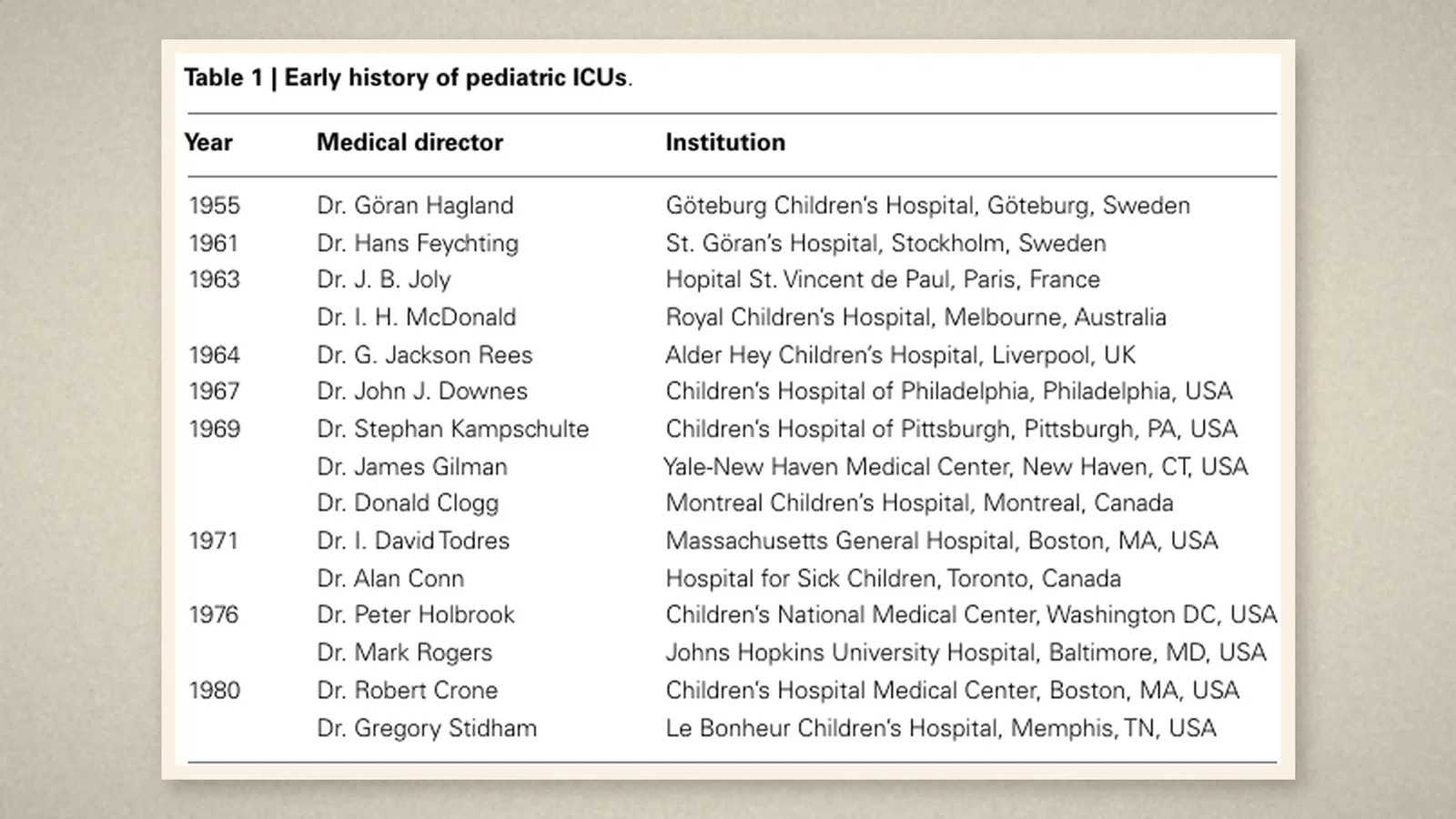
"The history of pediatric critical care dates back to 1955," Turner and colleagues write, "when the first unit was opened at the Children's Hospital of Goteborg in western Sweden." [2] The physicians there "used their knowledge and skills acquired in managing polio patients" to provide intensive care, including mechanical ventilation for newborns with respiratory distress syndrome, care of postoperative children with sepsis, and treatment of severe pneumonia. [2] Anand's table of early units lists the same hospital in 1955, with the medical director given as "Dr. Göran Hagland". [1]
The spread of units
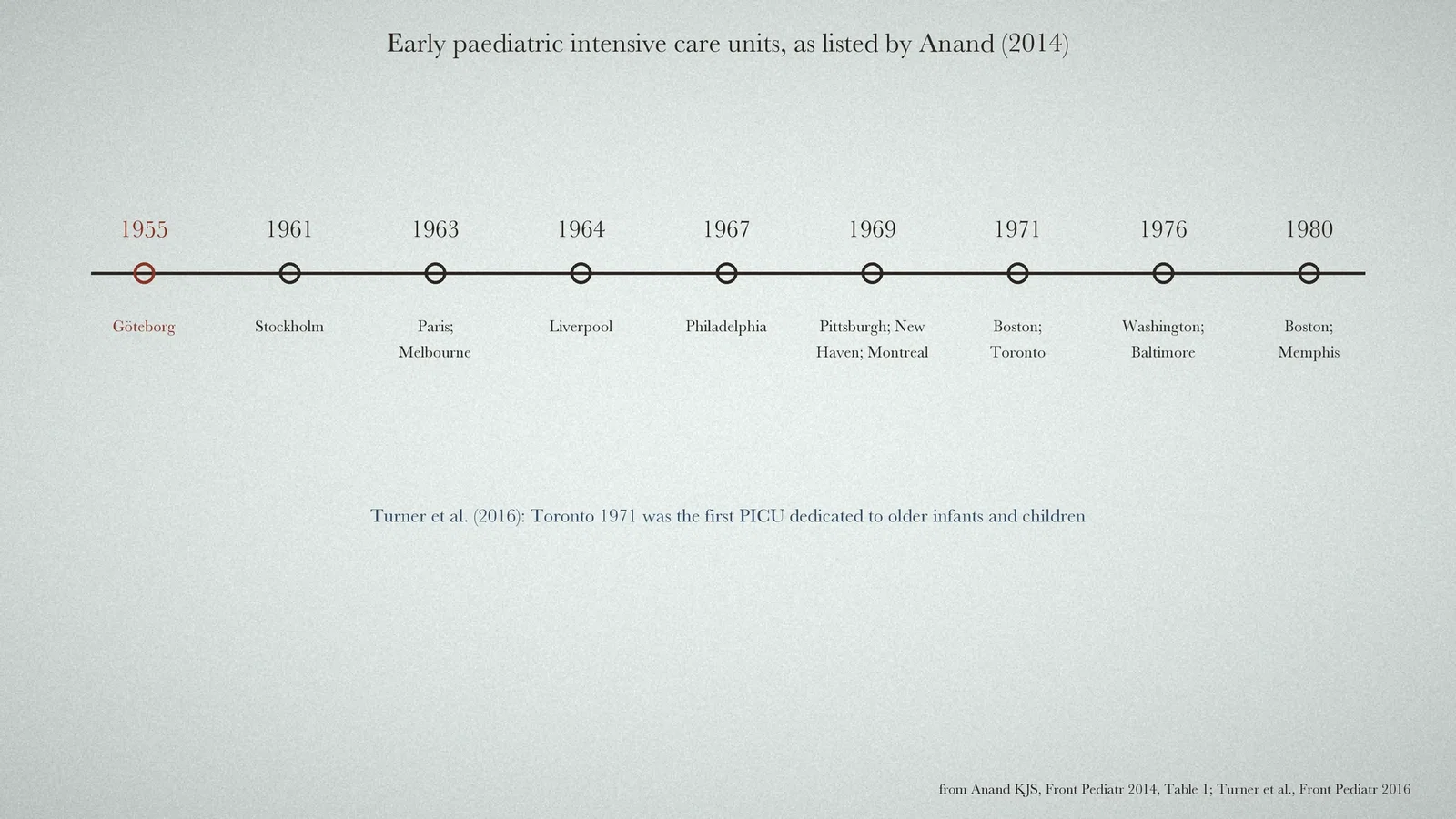
Anand's table then traces a slow spread. It lists St. Göran's Hospital in Stockholm (1961); the Hôpital St. Vincent de Paul in Paris and the Royal Children's Hospital in Melbourne (1963); Alder Hey Children's Hospital in Liverpool under G. Jackson Rees (1964); the Children's Hospital of Philadelphia under John J. Downes (1967); Pittsburgh, New Haven and Montreal (1969); Massachusetts General Hospital and the Hospital for Sick Children in Toronto under Alan Conn (1971); Washington and Baltimore (1976); and Boston and Memphis (1980). [1] Turner and colleagues describe Toronto's 1971 unit as the first paediatric ICU "dedicated to older infants and children". [2] The two statements are not identical. Anand's table records several earlier units, and the phrase about older children may reflect a distinction from units that began with newborns. The sources read do not settle it.
What the record shows
The first children's intensive care unit grew out of polio, not out of paediatrics alone: skills in ventilation and round-the-clock nursing, learned on respiratory wards, were moved to the care of newborns and sick children. Anand's phrase about anaesthesiology and neonatology names the two disciplines that brought those skills to the bedside. The table of early units also shows how few such units there were before 1971.
Sources and reading limits
Read: Anand's 2014 perspective in Frontiers in Pediatrics, including Table 1; the history section of Turner et al.'s 2016 review in Frontiers in Pediatrics. Both are open-access PDFs.
Not covered: any primary record of the Göteborg unit or of its director; the 2013 history of paediatric critical care medicine by Levin, Downes and Todres, which is not open access; the references behind Anand's table. Everything about Göteborg in this article comes from two secondary reviews. The director's name is given as printed in Anand's table. The specialties of the listed directors are not stated in the sources and are not inferred. "First" is used only as each review uses it.
Two illustrations are crops of the two reviews; two are drawn from them.
- Anand KJS. Pediatric critical care: grand challenges for a glowing future. Front Pediatr. 2014;2:35. DOI
- Turner EL, Nielsen KR, Jamal SM, von Saint André-von Arnim A, Musa NL. A review of pediatric critical care in resource-limited settings: a look at past, present, and future directions. Front Pediatr. 2016;4:5. DOI
Continue exploring
Related reading connects shared questions and contexts; it does not by itself establish historical influence.
- 1986: The Society for Pediatric Anesthesia Admits Members by Interest
- 1987: A Critical Care Society for Anaesthesiologists, from ASCCA to SOCCA
Anesthesia Epochs · The Source Room · About & Editorial Method
Published November 2, 2026. Sources and reading limits are stated above. Illustrations are labelled as original source images or AI-made. Historical accounts are educational; they are not current treatment instructions.