
An anaesthetic introduced in 1934 disappeared from US hospitals not because a better drug replaced it, but because the manufacturer could not guarantee that it would stay out of execution chambers.
Reading Library · Anesthesia Epochs · 中文版
Watch the education video (for clinicians)
2011: Thiopental Leaves the US Market — Reasons Outside Medicine · Anesthesia Epochs Education Series
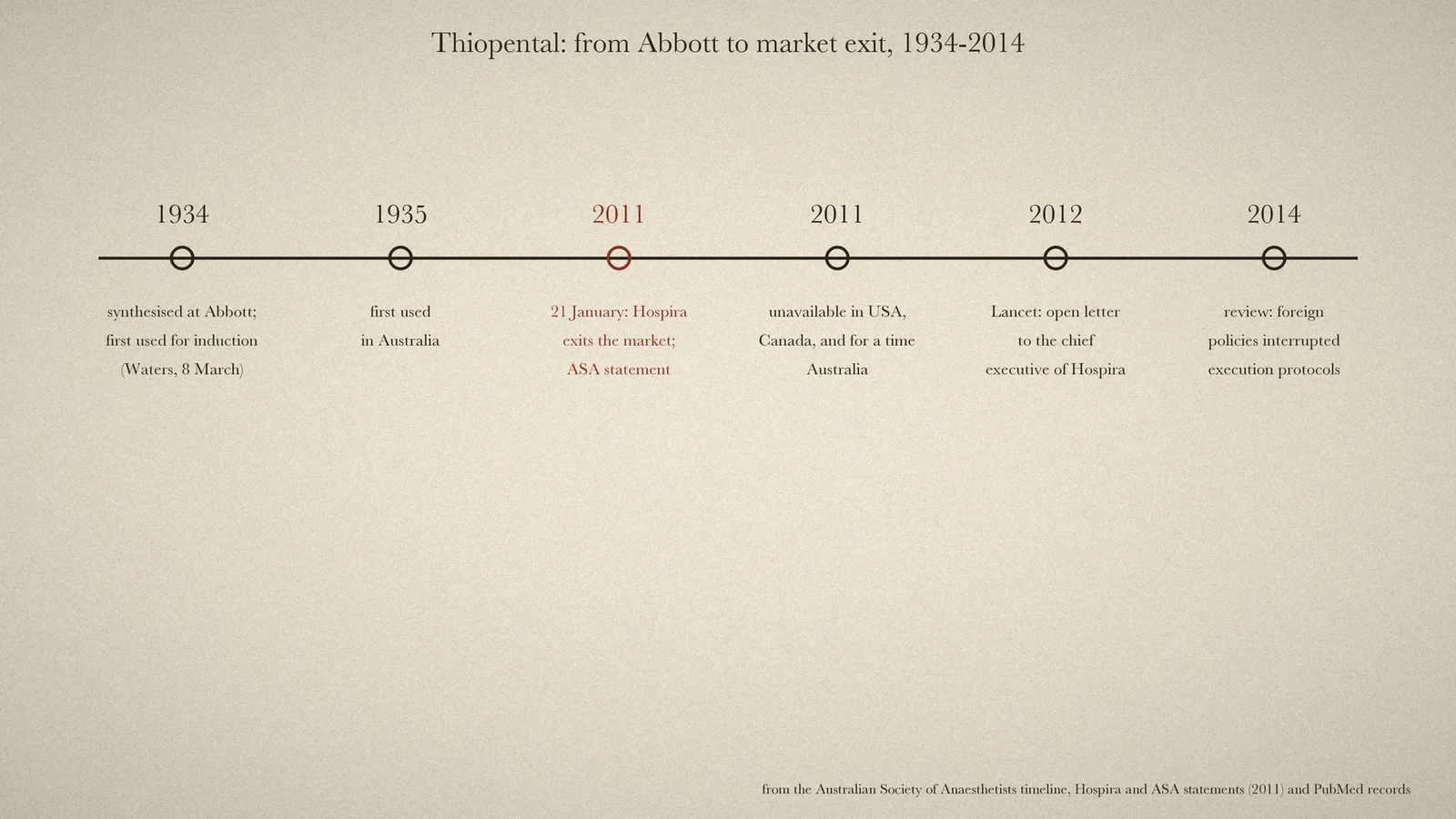
On 21 January 2011 a short press release went out from Lake Forest, Illinois: "Hospira announced today it will exit the sodium thiopental market and no longer attempt to resume production of its product, Pentothal." [1] The same day the American Society of Anesthesiologists (ASA) said its members were "extremely troubled". [2] This article is about how one of anaesthesia's oldest intravenous induction agents left the American market, and why the reason had nothing to do with anaesthesia.
An old drug
Thiopental belongs to the first generation of intravenous anaesthesia. The Australian Society of Anaesthetists' history timeline records its synthesis in 1934 by Ernest H. Volwiler and Donalee L. Tabern of Abbott Laboratories, under the name Pentothal, and its first use for induction of general anaesthesia on 8 March 1934 by Ralph Milton Waters at the University of Wisconsin. Gilbert Troup first used it in Australia in 1935. [3]
Hospira's reasons
By 2011 Hospira was, in the ASA's words, "the sole manufacturer" for the US market. [2] Its release explains that it had planned to make the drug at its Italian plant, and that for a month it had been in discussion with the Italian authorities about the use of Pentothal in capital punishment in the United States, a use the company said it had never condoned. Italy wanted the company to control the product "all the way to the ultimate end user". After talking to the wholesalers who distributed the drug, the company concluded that it could not stop the drug being diverted to departments of corrections, and that it would not risk being held liable in Italy. [1]
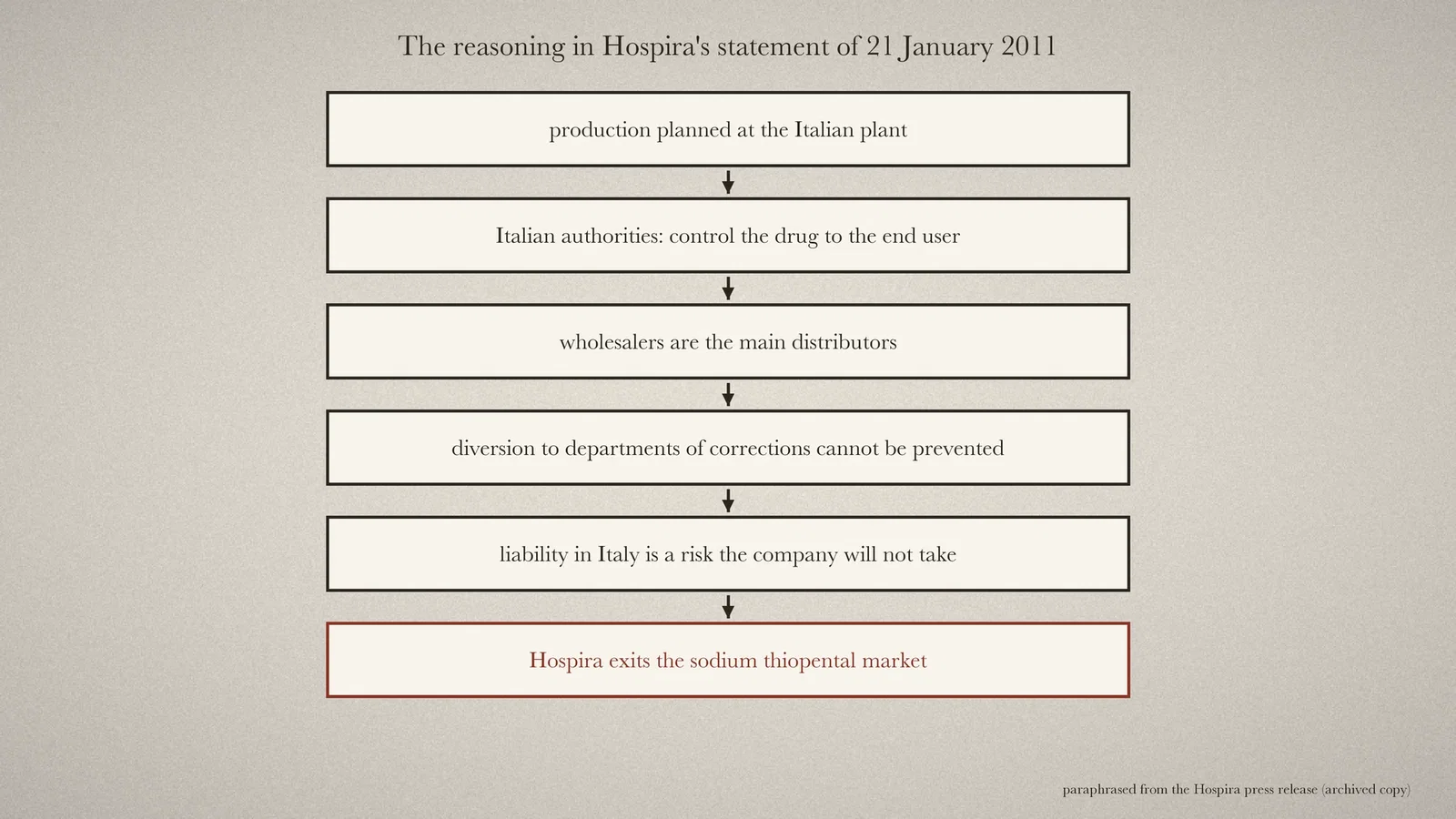
The release ends with regret that hospital customers who used the drug "for its well-established medical benefits" would no longer be able to obtain it from Hospira. [1] A BMJ news item dated six days later was headed "Last US manufacturer of drug used in executions stops production". [4]
The anaesthesiologists' response
The ASA statement admitted that thiopental use had fallen since newer drugs such as propofol arrived. Yet it described the drug as still a first-line choice for many geriatric, neurological, cardiovascular and obstetric patients, in whom other agents might cause serious complications. The society did not condone the use of thiopental for executions, but it also opposed using that issue as grounds for placing "undue burdens" on distribution of the drug. "It is an unfortunate irony," the statement said, that more lives might be lost or endangered because the drug was unavailable for medical use. [2]
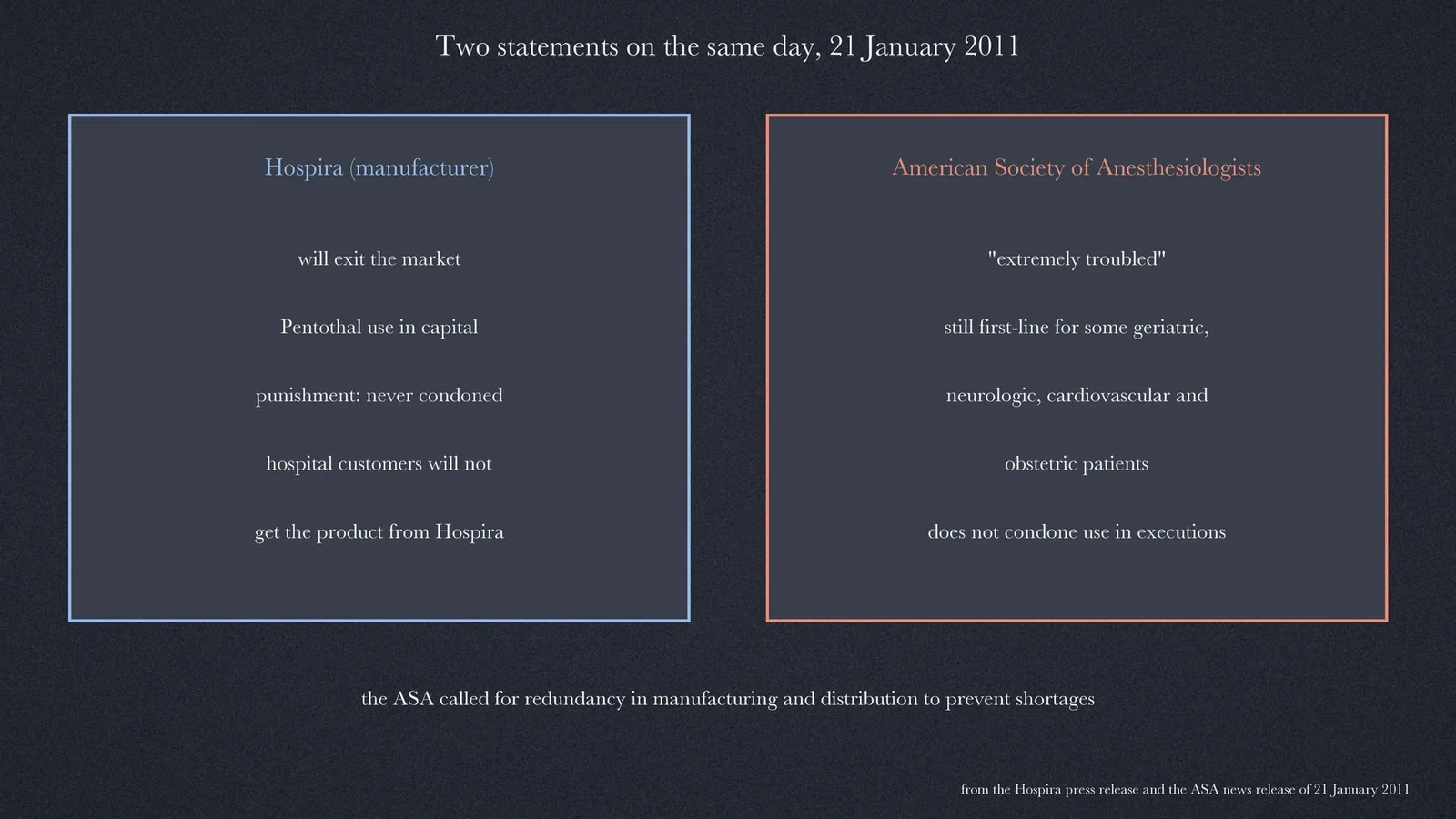
The ASA placed the loss within a wider problem. The statement says the society had co-sponsored a Drug Shortage Summit with partner organisations in November, and it called for redundancy in manufacturing and distribution so that patients would have drugs when needed. [2]
Beyond the United States
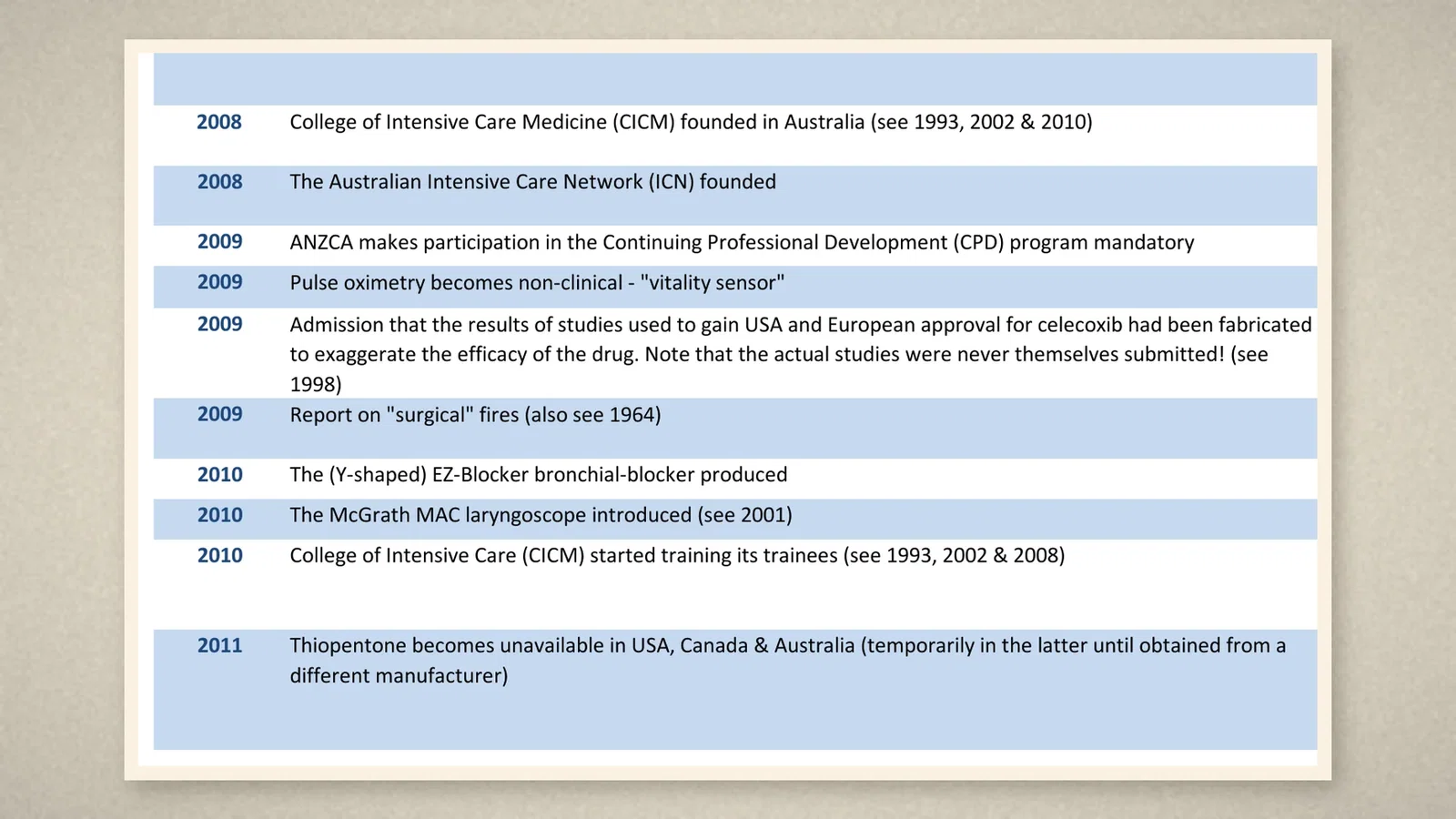
The Australian Society of Anaesthetists' timeline records that in 2011 thiopentone became unavailable in the USA, Canada and Australia, in Australia only until it could be obtained from a different manufacturer. Canada and Australia were affected secondarily, the timeline says, and were left for a time with no alternative to propofol for intravenous induction. [3] In France the anaesthesia journal Annales Françaises d'Anesthésie et de Réanimation published an editorial on Hospira France's withdrawal of Pentothal, which the title calls "bad news" that would probably announce others. [5]
The other story
The capital punishment side lies outside this article, but the titles show its outline. A 2010 letter in the BMJ protested British export of a "death row drug"; in February 2011 the BMJ reported that prisoners on death row were suing the US Food and Drug Administration over imports of the drug; in 2012 The Lancet published an open letter to Hospira's chief executive. [6-8] A 2014 review summarised the result for American execution protocols: foreign policies had interrupted them by banning key ingredients. [9]
What the record shows
Thiopental did not leave American anaesthesia because a trial showed it to be worse. It left because a drug made for anaesthesia was also used to kill, and the maker could not separate the two uses. The anaesthesiologists' society found itself defending patients' access to a drug while condemning one of its uses.
Sources and reading limits
Read: Hospira's press release of 21 January 2011 (Internet Archive copy) and the ASA statement of the same day, both in full; the Australian Society of Anaesthetists' Anaesthesia History Timeline 2024 (entries for 1934, 1935 and 2011, with p. 89 as a page image); PubMed records of the BMJ, Lancet and French items (titles only) and the abstract of the 2014 review.
Not covered: the texts of the BMJ, Lancet and French items; Italian government or parliamentary documents; the ASA letter to the FDA linked from its statement; European export-control documents (the EUR-Lex server presented a bot check, which was not bypassed); any count of patients affected or of what was used instead. The release's words "resume production" imply an earlier interruption that the sources read do not describe. The Canadian and Australian effects rest on the Australian timeline alone.
One illustration is a crop of the Australian timeline; three are drawn from the sources.
- Hospira. Hospira statement regarding Pentothal (sodium thiopental) market exit. Lake Forest, IL; 21 January 2011. Archived copy
- American Society of Anesthesiologists. ASA statement on sodium thiopental's removal from the market. 21 January 2011. Website
- Australian Society of Anaesthetists. Anaesthesia History Timeline. 2024. PDF
- Dyer C. Last US manufacturer of drug used in executions stops production. BMJ. 2011;342:d590. PubMed
- Plaud B. [Withdrawal of thiopental (Pentothal) marketing by Hospira France]. Ann Fr Anesth Reanim. 2011;30(9):617-8. PubMed
- Knibb AA. UK export of death row drug. Like rope to England, or steel to France. BMJ. 2010;341:c6836. PubMed
- Dyer C. Death row prisoners sue FDA for allowing unapproved execution drug to be imported. BMJ. 2011;342:d818. PubMed
- Nicholl DJ. An open letter to Michael Ball, Chief Executive of Hospira Pharmaceuticals. Lancet. 2012;379(9810):25. PubMed
- Ruble JH. The "death" of lethal injection as we know it? The role of chemical execution in the American criminal justice system. J Pain Palliat Care Pharmacother. 2014;28(3):276-81. PubMed
Continue exploring
Related reading connects shared questions and contexts; it does not by itself establish historical influence.
Anesthesia Epochs · The Source Room · About & Editorial Method
Published November 2, 2026. Sources and reading limits are stated above. Illustrations are labelled as original source images or AI-made. Historical accounts are educational; they are not current treatment instructions.