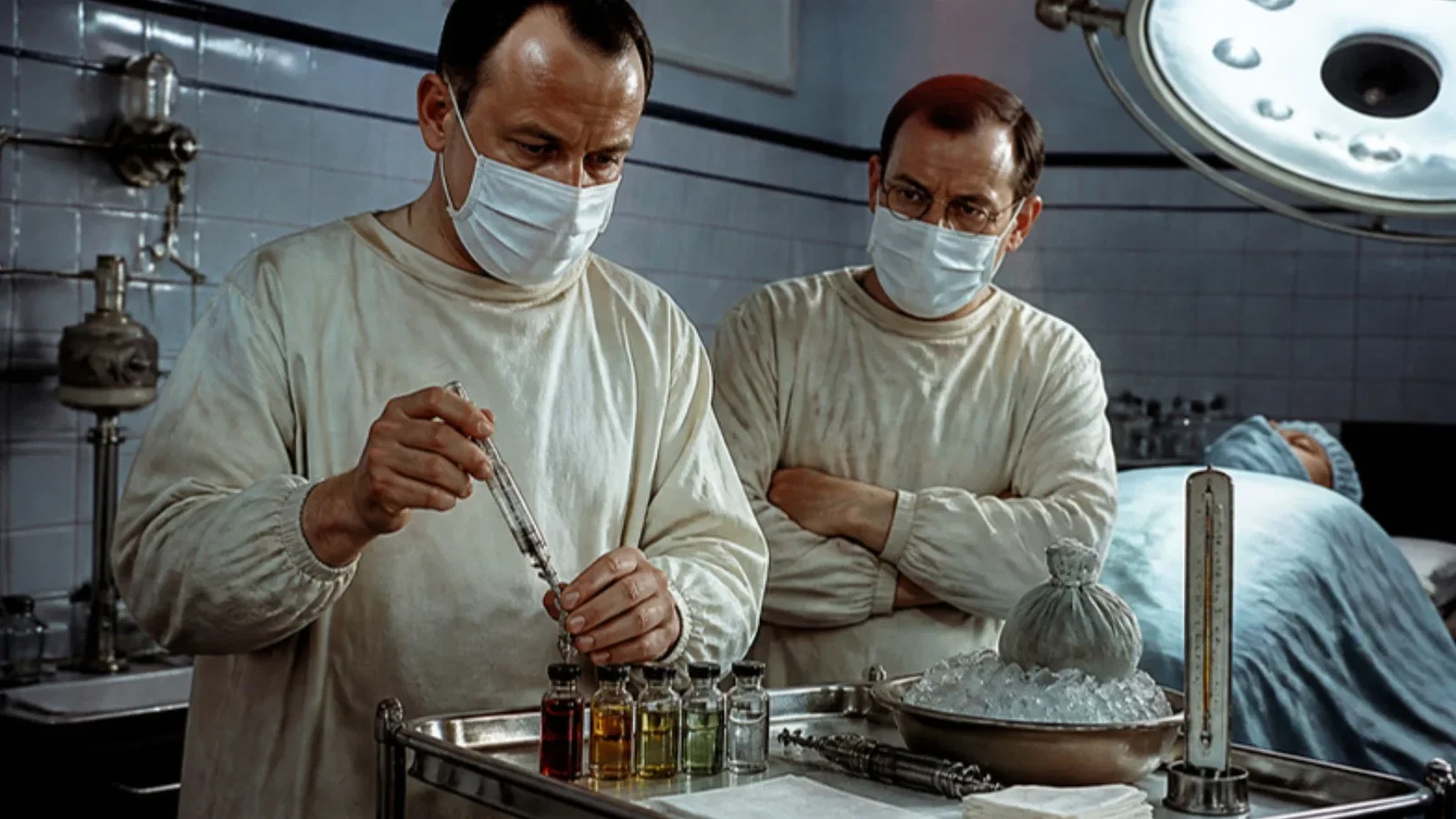
Two papers from Liverpool in the BMJ of 5 December 1953: Laborit and Huguenard's 'potentiated anaesthesia' and 'lytic cocktail' from Paris, how the British borrowed it, renamed it and reported its deaths, and the French split over potentiated anaesthesia in 1960.
Reading Library · Anesthesia Epochs · 中文版
Watch the education video (for clinicians)
1953: Induced Hypothermia at Liverpool — Artificial Hibernation · Anesthesia Epochs Education Series
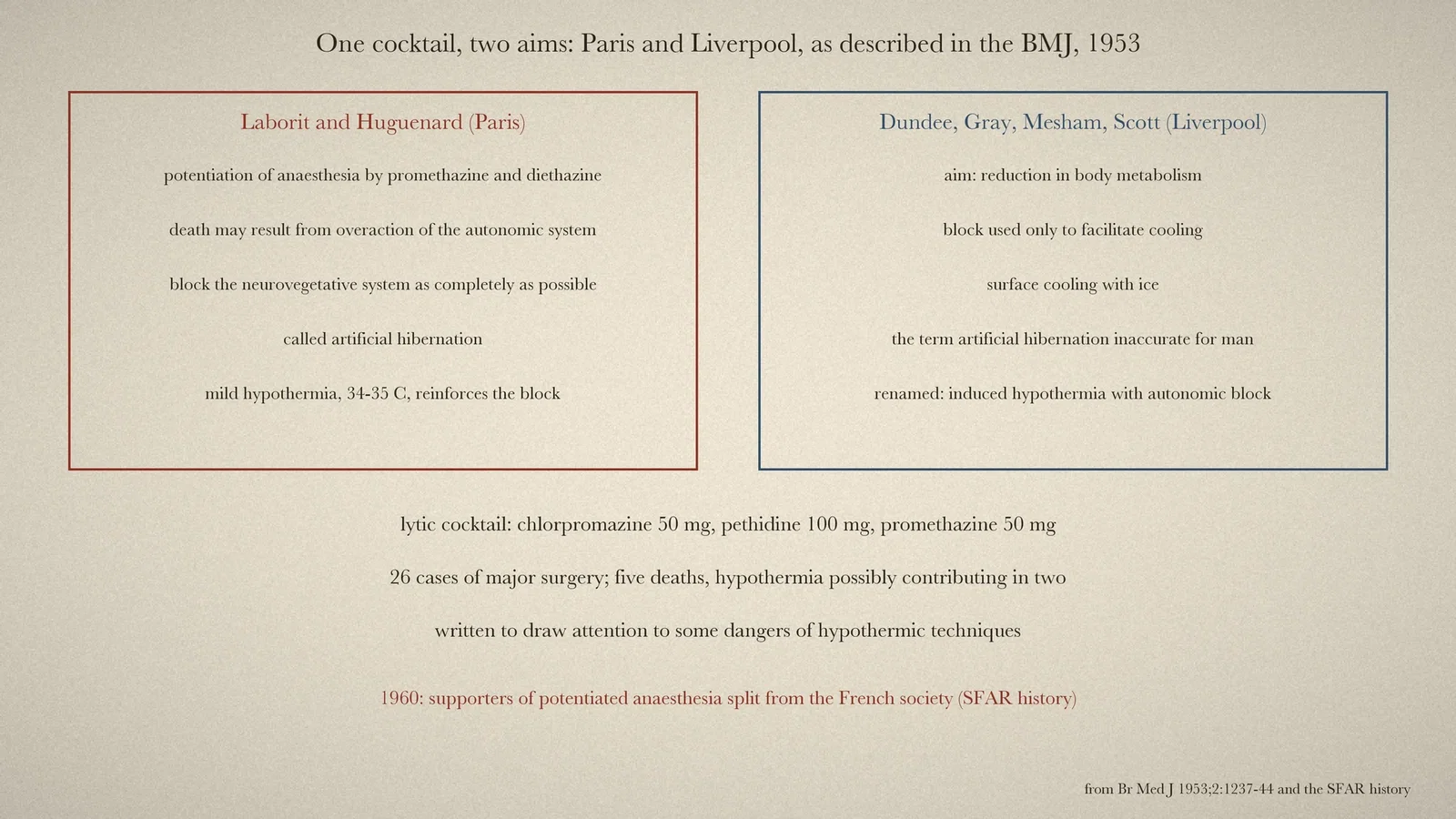
A few years before 1953, two Paris doctors, Henri Laborit and Pierre Huguenard, proposed a new way of anaesthetising seriously ill patients. They called it "potentiated anaesthesia" and, in its strongest form, "artificial hibernation", and its tool was a "lytic cocktail" of drugs that included the new chlorpromazine. An existing article in this series follows artificial hibernation in China. This one looks at how the idea reached British anaesthesia, through two papers from Liverpool in the British Medical Journal of 5 December 1953. It ends with the quarrel the idea caused in France. Laborit's and Huguenard's own writings are not covered, so their ideas appear here as the Liverpool authors summarised them.
The French idea, as Liverpool explained it
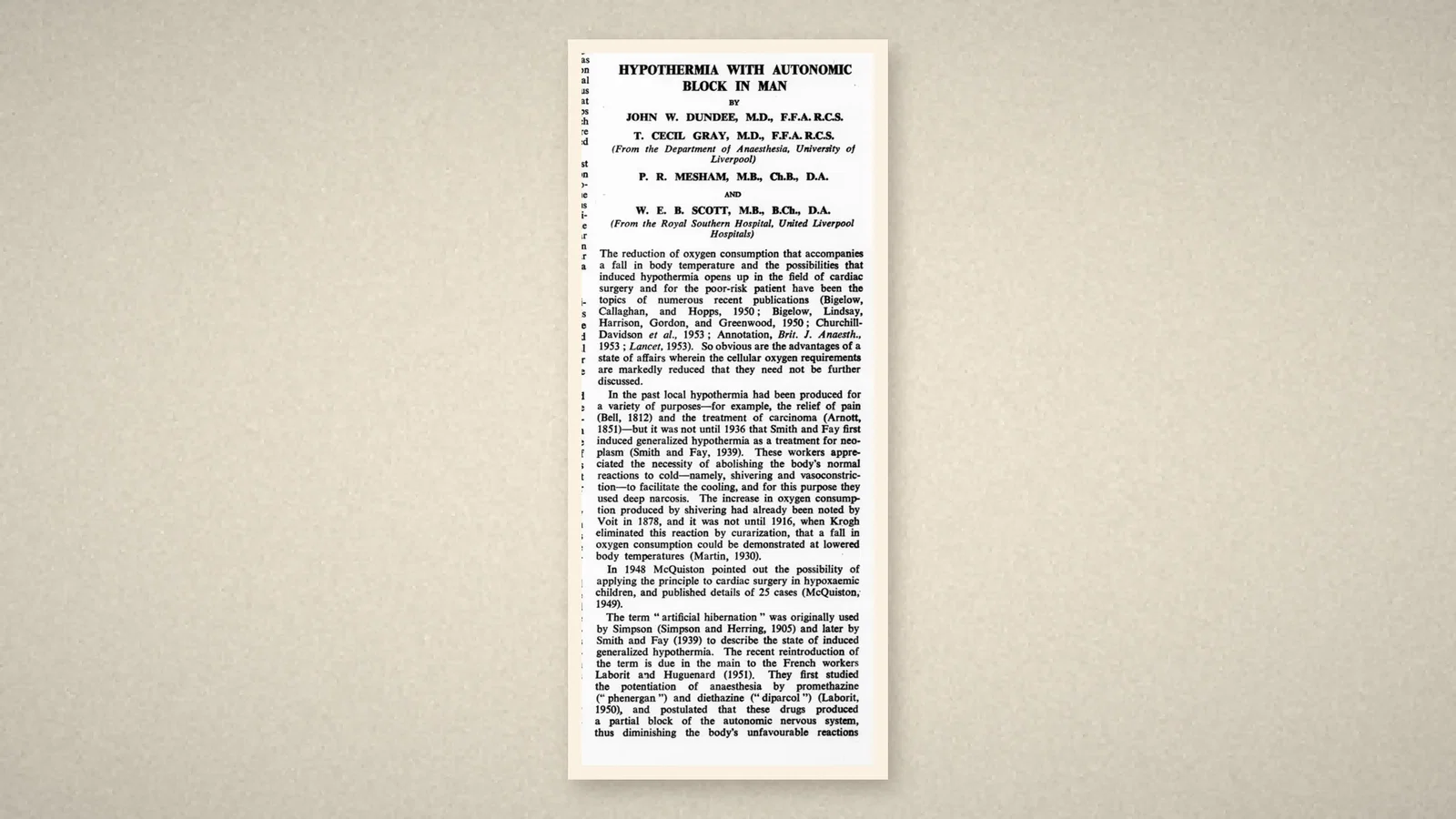
John W. Dundee and T. Cecil Gray of the Department of Anaesthesia at the University of Liverpool, with P. R. Mesham and W. E. B. Scott of the Royal Southern Hospital, began with a history of cooling the body. The term "artificial hibernation" had been used by Simpson in 1905 and by Smith and Fay in 1939. Its recent revival "is due in the main to the French workers Laborit and Huguenard (1951)". [1, p. 1237] The French had "first studied the potentiation of anaesthesia by promethazine ('phenergan') and diethazine ('diparcol')", and suggested that these drugs produced "a partial block of the autonomic nervous system", reducing the body's harmful reactions to surgical trauma. [1, p. 1237-1238]
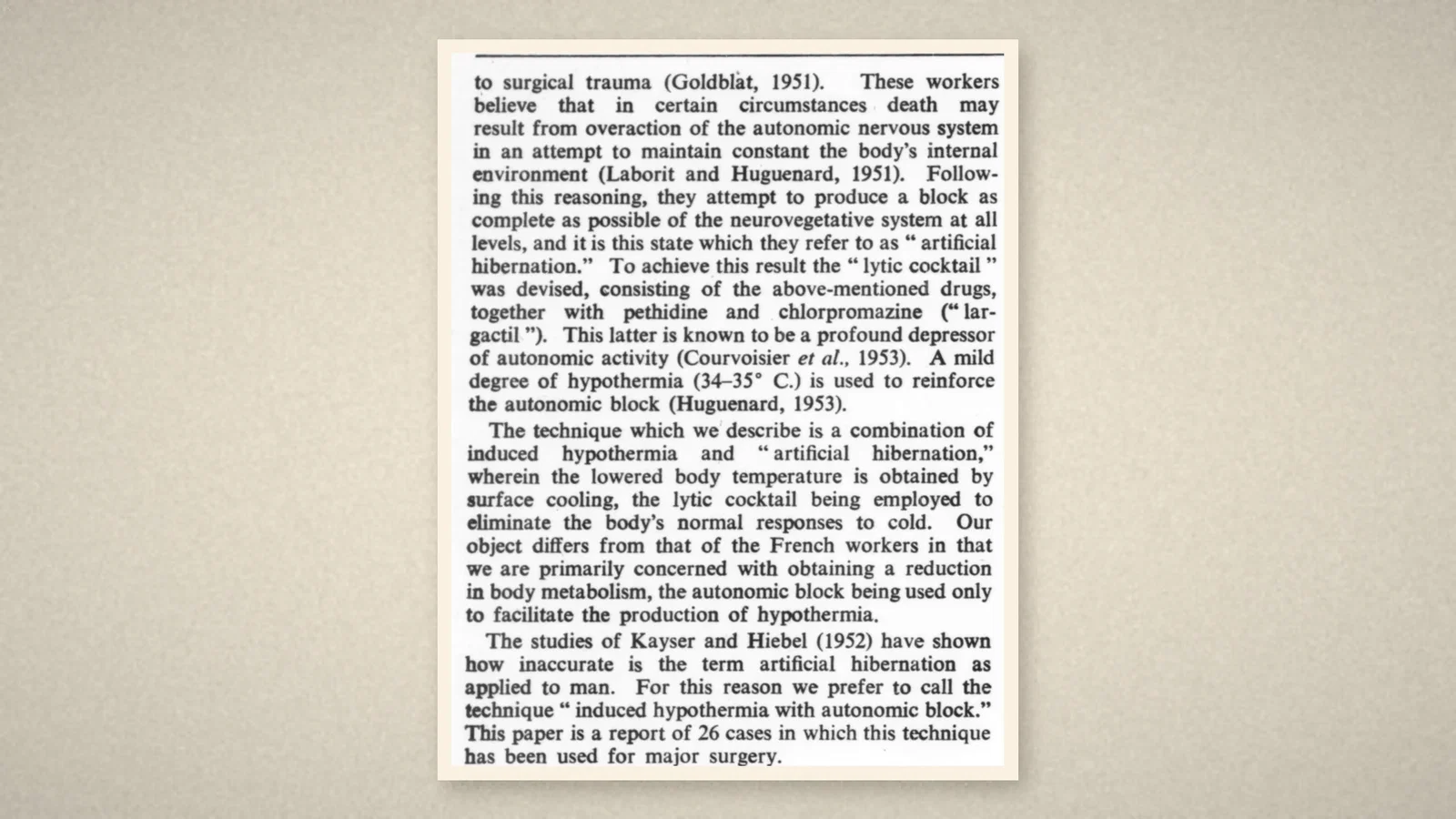
According to the paper, Laborit and Huguenard "believe that in certain circumstances death may result from overaction of the autonomic nervous system". They therefore tried to block the "neurovegetative system" as completely as possible at every level. That state they called artificial hibernation. To reach it they devised the "lytic cocktail" of these drugs with pethidine and chlorpromazine ("largactil"), a profound depressor of autonomic activity, and used mild hypothermia of 34-35 °C to reinforce the block. [1, p. 1238]
The Liverpool version
The Liverpool group adopted the cocktail but changed the purpose. "Our object differs from that of the French workers," they wrote: they wanted a lower body metabolism, and used the autonomic block "only to facilitate the production of hypothermia". [1, p. 1238] Animal studies by Kayser and Hiebel had shown "how inaccurate is the term artificial hibernation as applied to man". So they renamed the method "induced hypothermia with autonomic block", and reported 26 cases of major surgery. [1, p. 1238]
The cocktail they gave intravenously was "chlorpromazine 50 mg. (2 ml.), pethidine 100 mg. (2 ml.), and promethazine 50 mg. (2 ml.)", in small repeated doses. Ice bags were placed on the groin and then over the whole body, and any shivering was treated with more cocktail. Less ice was used in the early cases, "partly due to attempts to follow the French methods". [1, p. 1238] The anaesthetic itself was conventional: a relaxant, nitrous oxide and oxygen, and tracheal intubation in every case. [1, p. 1238]
The cost
The results were sobering. "Five deaths occurred in this series of cases", and in two of them the authors thought hypothermia might have contributed. [1, p. 1242] They said plainly why they had written: "This paper has been written with the purpose of drawing attention to some dangers of hypothermic techniques". The high mortality fell in patients "who were seriously ill and who were grave operative risks by any standards", and for that group the authors still judged the method their best chance. [1, p. 1243] It also avoided "an undesirable depth of anaesthesia" or long curarisation. [1, p. 1243] The drugs had been supplied by May & Baker. [1, p. 1243]
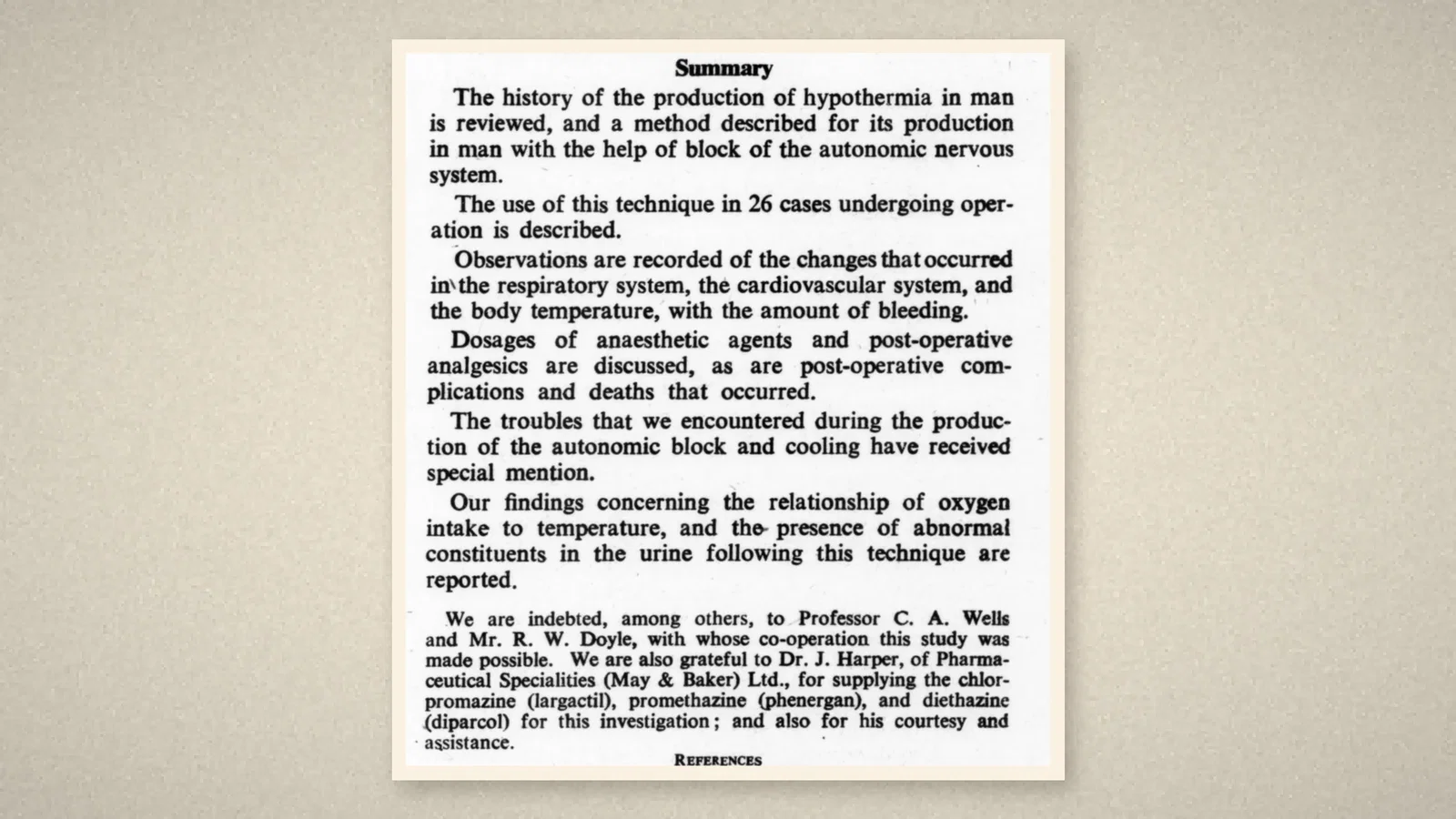
A second paper in the same issue, by Dundee, Scott and Mesham, compared in dogs three ways of preventing the response to cold: deep anaesthesia, muscle relaxants, and "the 'lytic cocktail' or 'liberation cocktail' introduced by the French workers Laborit and Huguenard". [1, p. 1244]
A quarrel in France
In France, potentiated anaesthesia divided the profession. According to the history of the Société Française d'Anesthésie et de Réanimation (SFAR), the society, which had counted 17 anaesthetists in 1947 and added "réanimation" to its name in 1956, split in 1960. That year "une scission se crée et réunit les partisans de l'anesthésie potentialisée prônée par Henri Laborit et Pierre Huguenard". The supporters founded the Association des Anesthésistes Français, with its own journal, Convergences Médicales. [2]
What the record shows
British anaesthetists in 1953 took the French drugs, kept the cooling, dropped the French theory and the French name, and published their deaths. In France the same ideas proved divisive enough to split the national society seven years later.
Sources and reading limits
Read: Dundee, Gray, Mesham and Scott, BMJ 1953;2:1237-1243, in full, and the opening of Dundee, Scott and Mesham, BMJ 1953;2:1244; the SFAR's history page.
Not covered: Laborit's and Huguenard's own papers and their book on hibernotherapy are not covered. Their theory is reported only in the Liverpool authors' summary and citations, which may simplify it. Kayser and Hiebel were not read. The French split of 1960 is known only from the SFAR's short account, and neither side's arguments, nor the AAF journal, were read. The existing article on artificial hibernation in China is not revisited.
One illustration is a comparison drawn from the BMJ papers and the SFAR history; three are crops of the 1953 paper.
- Dundee JW, Gray TC, Mesham PR, Scott WEB. Hypothermia with autonomic block in man. Br Med J. 1953;2(4848):1237-43; and Dundee JW, Scott WEB, Mesham PR. The production of hypothermia. Br Med J. 1953;2(4848):1244-. Internet Archive
- Société Française d'Anesthésie et de Réanimation. Histoire de la SFAR. Website
Continue exploring
Related reading connects shared questions and contexts; it does not by itself establish historical influence.
Anesthesia Epochs · The Source Room · About & Editorial Method
Published November 2, 2026. Sources and reading limits are stated above. Illustrations are labelled as original source images or AI-made. Historical accounts are educational; they are not current treatment instructions.