
Britain's intensive care units multiplied in the 1960s without a forum of their own; in 1970 the anaesthetist Alan Gilston circulated colleagues and drafted the structure of an Intensive Care Society, small, multidisciplinary and limited to consultants, as its founders recalled forty years later.
Reading Library · Anesthesia Epochs · 中文版
Watch the education video (for clinicians)
1970: Gilston's Draft — The Intensive Care Society · Anesthesia Epochs Education Series
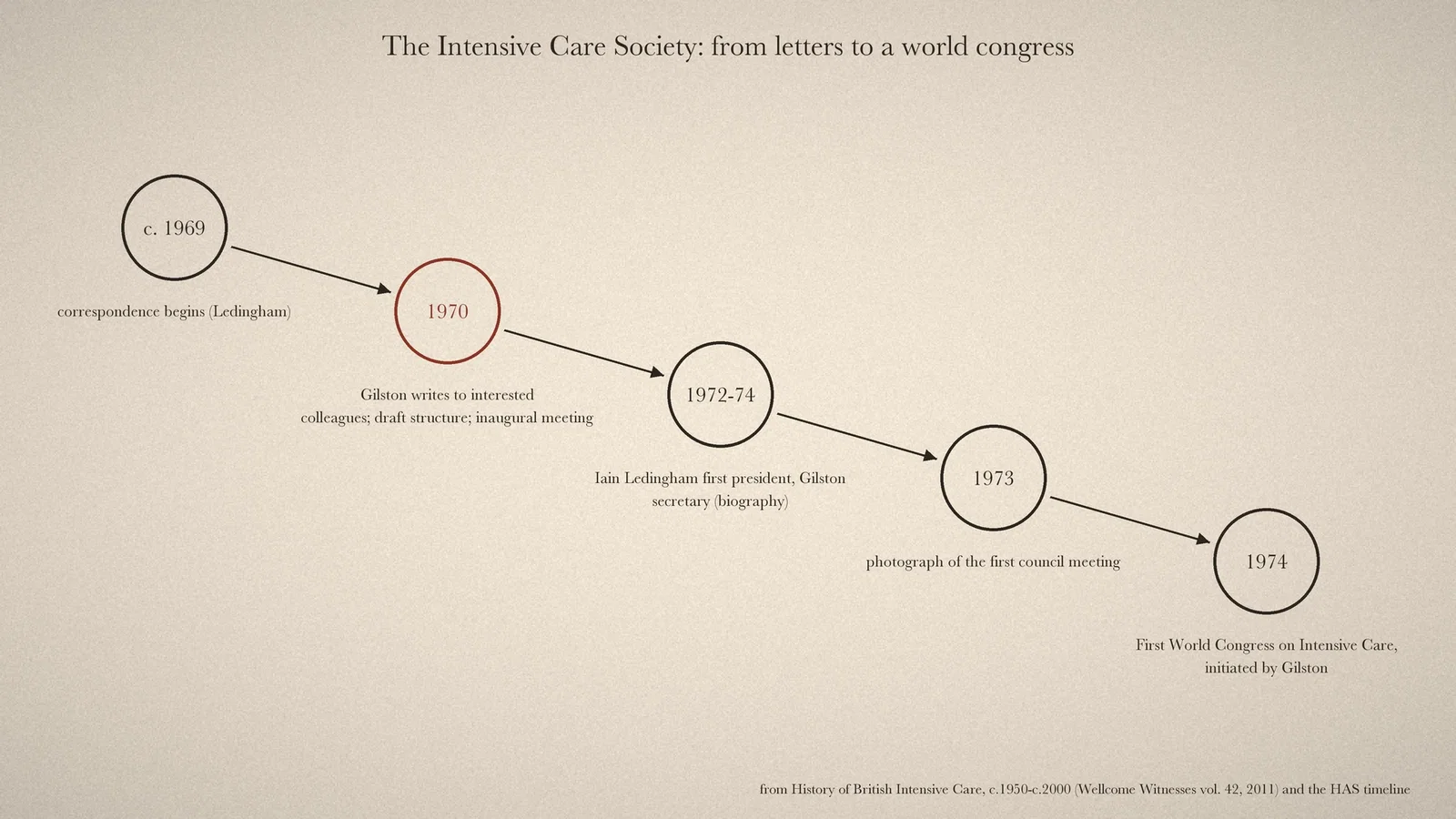
By 1969 British hospitals had intensive care units, run mostly by anaesthetists, but no society of their own. The History of Anaesthesia Society's timeline records the step in one line: in 1970 the "Intensive Care Society is founded in the UK". [2] This article looks behind that line through the best open source on it: a Witness Seminar held by the Wellcome Trust Centre for the History of Medicine on 16 June 2010, at which the founders and their successors talked about British intensive care. The published transcript (2011) reprints, as an appendix, the anaesthetist Alan Gilston's 1970 draft of what the society should be. [1]
A letter from the National Heart Hospital
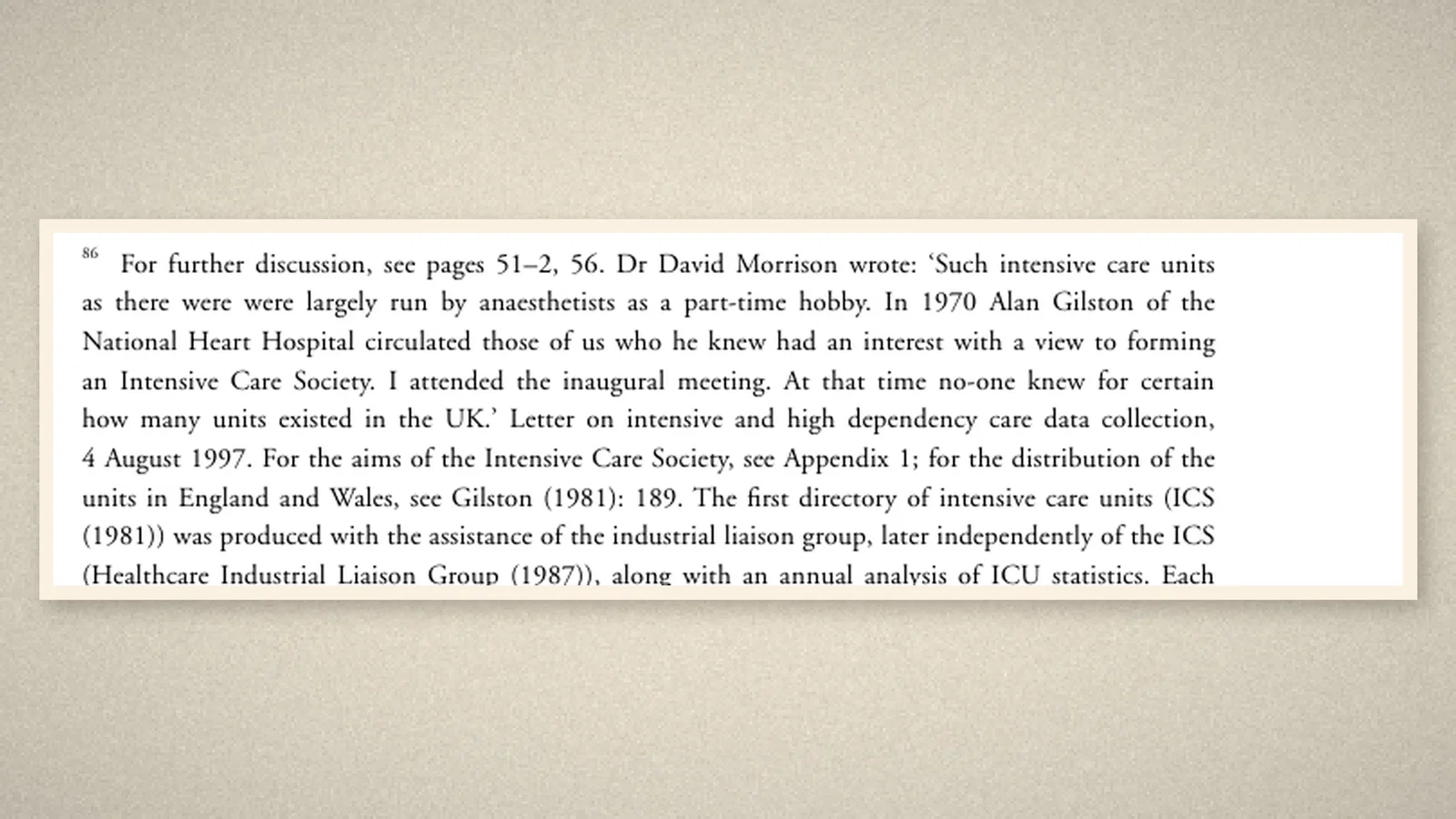
In the seminar, Iain Ledingham, a Glasgow clinical physiologist at the time, recalled that "correspondence began to be generated around 1969". The late Alan Gilston "was a major force in terms of setting up the Society in 1970". [1, p. 51] A footnote quotes David Morrison: "In 1970 Alan Gilston of the National Heart Hospital" wrote to colleagues known to be interested, with a view to forming an Intensive Care Society. Morrison continued: "I attended the inaugural meeting." At that time "no-one knew for certain how many units existed in the UK". [1, p. 26] The volume's biographical note describes Gilston as one who "was senior consultant anaesthetist" "at the National Heart Hospital" from 1967 to 1990, and as the society's chairman and founder. [1, p. 139]
What Gilston proposed
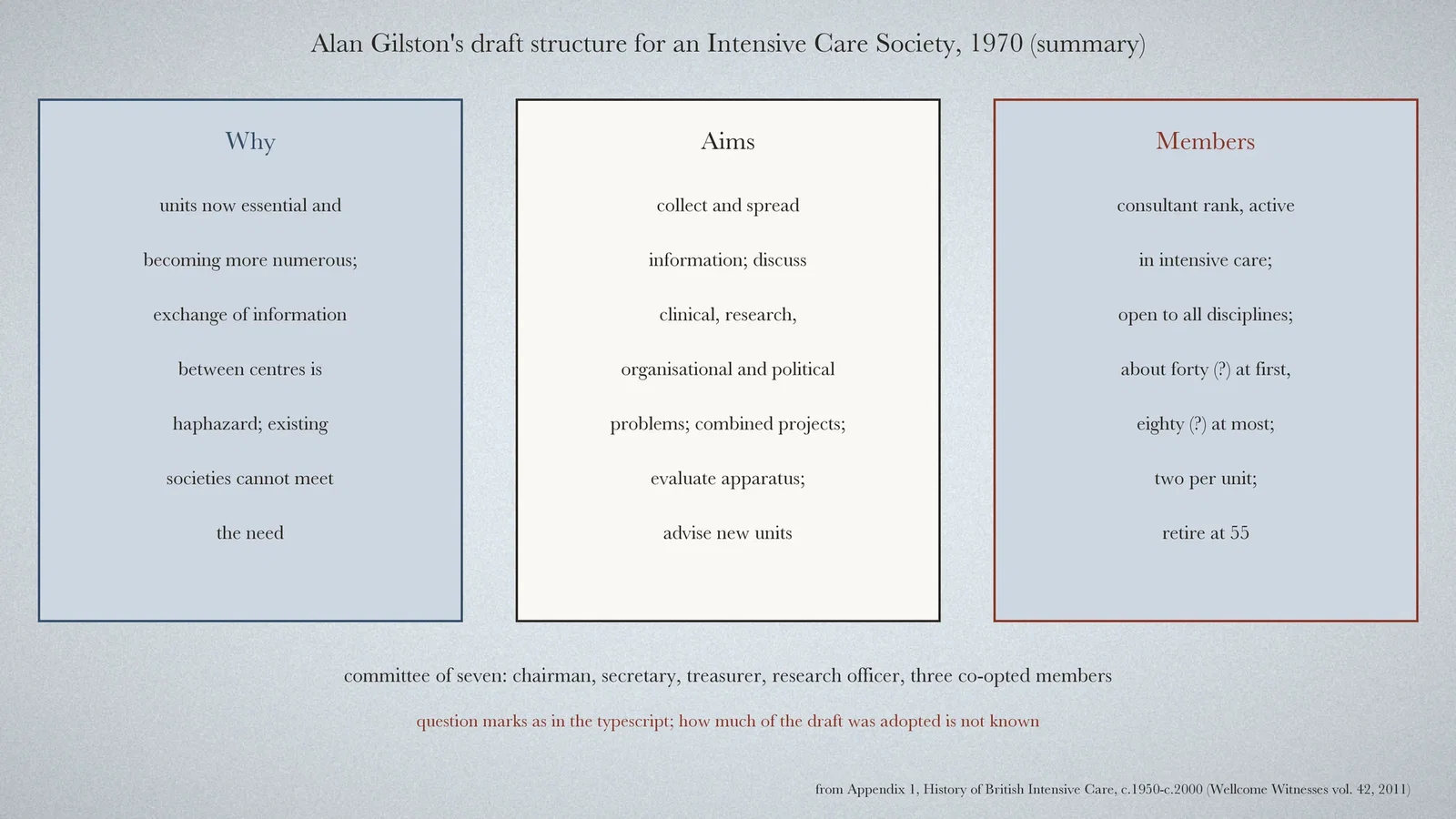
Gilston's draft, a typed document reproduced as Appendix 1, suggests the title "The Intensive Care Society". It argues that intensive care units "now play an essential role in the care of the gravely ill" and are becoming more numerous. The exchange of information between centres and disciplines, however, was "at best haphazard", depending on an occasional article, symposium, lecture or personal contact. Existing societies, Gilston wrote, could not meet this need. [1, p. 87]
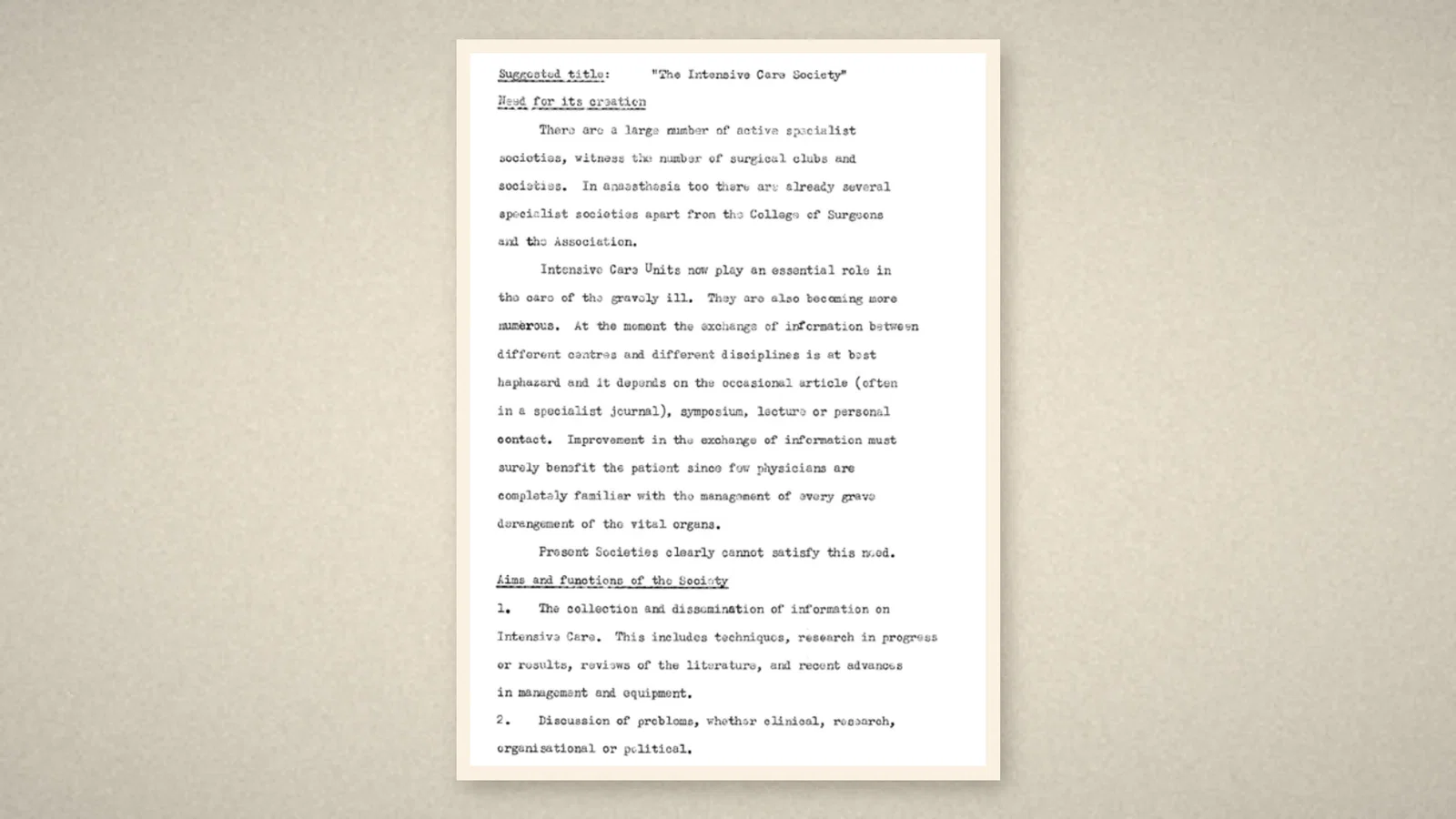
The aims followed: to collect and spread information on intensive care, to discuss problems "whether clinical, research, organisational or political", to set up combined projects, to evaluate apparatus, to advise new units, and to form specialist subcommittees. [1, p. 87-88] The membership rules were strict. Members were to be of consultant rank and actively engaged in intensive care work, and membership "must be open to all disciplines". There would be perhaps forty members at first and no more than eighty, with no more than five newly elected each year, because unlimited numbers would destroy the personal contact the society needed. [1, p. 88]
There were to be at most two members per unit, and members would retire at 55 to make room for younger colleagues. A committee of seven would run it: chairman, secretary, treasurer, research officer and three co-opted members. [1, p. 89] The question marks in the typescript, after "forty" and "eighty", show that this was still a proposal. The sources read do not say how much of it the society adopted.
The society at work
Ledingham remembered that "a few of us got together and set up the Intensive Care Society". Its first challenge was the "First World Congress on Intensive Care", which Gilston initiated and which met in 1974. [1, p. 26; 1, p. 139] The first council included Gillian Hanson, a physician; Joe Stoddart, an anaesthetist from Newcastle; Keith Roberts, a cardiac surgeon; Gilston and Ledingham. Ledingham "had the honour of serving as the first president", with Gilston as secretary. [1, p. 52] Ledingham's biography dates that presidency to 1972-74, and the volume's photograph of the "first council meeting of the Intensive Care Society" is from 1973. [1, p. 51; 1, p. 141] So the steps between the 1970 founding and a working council are not clear from these sources.
Ledingham stressed that the society's first input "was very much multidisciplinary". The US Society of Critical Care Medicine, Ledingham noted, "was formed two years later". [1, p. 52] Stoddart added a small story about the name. When the society first opened its doors, a very senior nurse wrote that "we should call ourselves" the intensive therapy society instead, because "nurses always care intensively". [1, p. 22]
What the record shows
The Intensive Care Society began as a letter and a typed page. An anaesthetist at a London heart hospital proposed a small, selective, multidisciplinary club of consultants, to end the haphazard exchange of experience between units whose number nobody knew. Within four years the society was organising a world congress.
Sources and reading limits
Read: the Wellcome Witness Seminar volume History of British Intensive Care, c.1950-c.2000 (2011), pp. 22-26 and 51-52, Appendix 1 (pp. 87-90, Gilston's typescript, read from page images), and the biographical notes (pp. 139-141); the History of Anaesthesia Society timeline.
Not covered: the society's minutes, the 1969-70 circulars and the record of the inaugural meeting were not found. Stoddart's 2005 tribute to Gilston and the society's own history pages (which return 404) were not read. The seminar is a set of recollections forty years after the event, edited with footnotes. Founding is dated 1970 by the recollections and the timeline, while the first presidency is dated 1972-74 and the first council photograph 1973. The draft is a proposal, and its adoption is not established. The volume's photographs, reproduced there by permission, are not reproduced here.
Two illustrations are drawn from the seminar volume (a sequence of dates and a summary of the draft); two are crops of the volume: the first page of the 1970 typescript and Morrison's footnote.
- Reynolds LA, Tansey EM, eds. History of British intensive care, c.1950-c.2000. Wellcome Witnesses to Twentieth Century Medicine, vol. 42. London: Queen Mary, University of London; 2011. Internet Archive
- History of Anaesthesia Society. Timeline. Website
Continue exploring
Related reading connects shared questions and contexts; it does not by itself establish historical influence.
Anesthesia Epochs · The Source Room · About & Editorial Method
Published November 2, 2026. Sources and reading limits are stated above. Illustrations are labelled as original source images or AI-made. Historical accounts are educational; they are not current treatment instructions.