How a society founded by surgeons, with four anaesthetists among its members, passed to anaesthetists over half a century.
Reading Library · Anesthesia Epochs · 中文版
Watch the education video (for clinicians)
1934: From SEAA to SFAR — French Anaesthesia Organizes · Anesthesia Epochs Education Series
The Société Française d'Anesthésie et de Réanimation (SFAR) is today the society of French anaesthetists and intensivists. Its own history begins with a society that was deliberately not meant for anaesthetists at all. This article follows that history as the SFAR tells it on its website, and checks its starting point against what the British Journal of Anaesthesia printed in 1935.
A society for everyone but anaesthetists
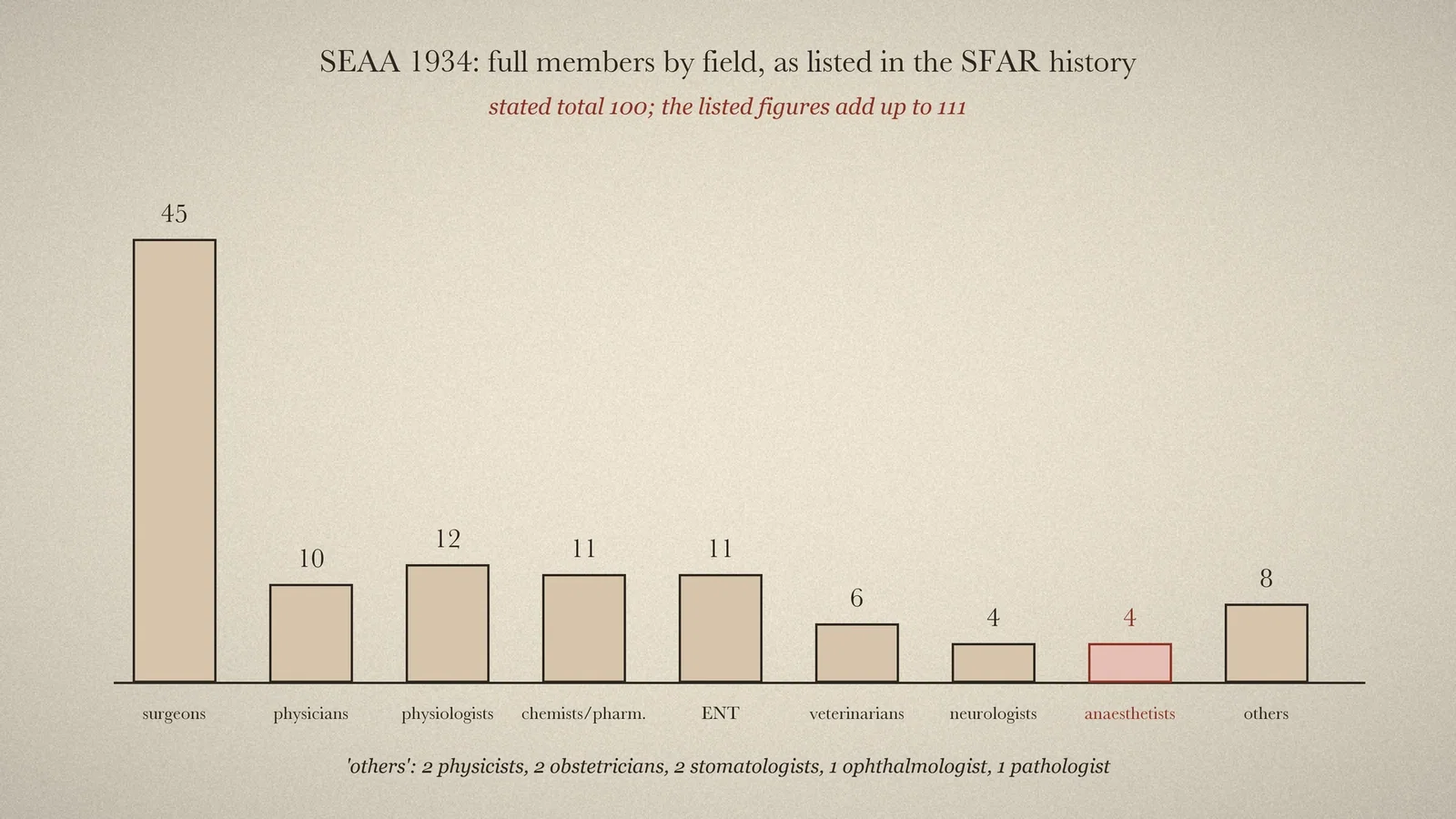
In 1933, the SFAR relates, the thoracic surgeon Robert Monod began making contacts to create a society for anaesthesia and analgesia. Founded in 1934, the Société d'Etudes sur l'Anesthésie et l'Analgésie (SEAA) had, among its full members, 45 surgeons, 10 physicians, 12 physiologists, 11 chemists or pharmacologists, 11 ear, nose and throat specialists, 6 veterinarians, 4 neurologists and a handful of others, and 4 anaesthetists. Its president was the visceral surgeon Antonin Gosset. [1] At the inaugural session Monod said: "The objective of the Society is not to become a society of anaesthetists"; it would stay outside the limits of any one specialty, "to approach the problem of anaesthesia and analgesia as a whole". [1]
Seen from London in 1935
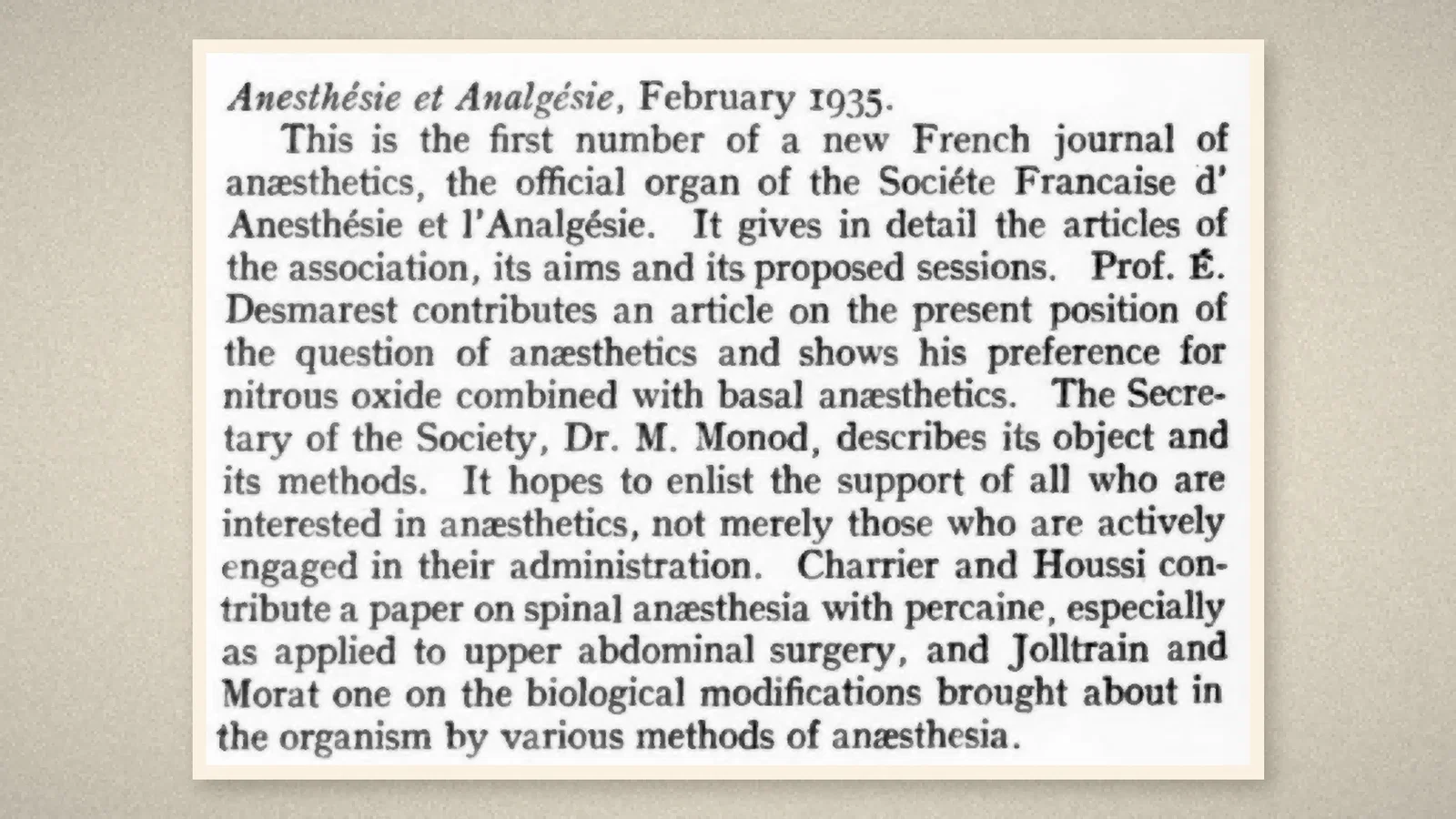
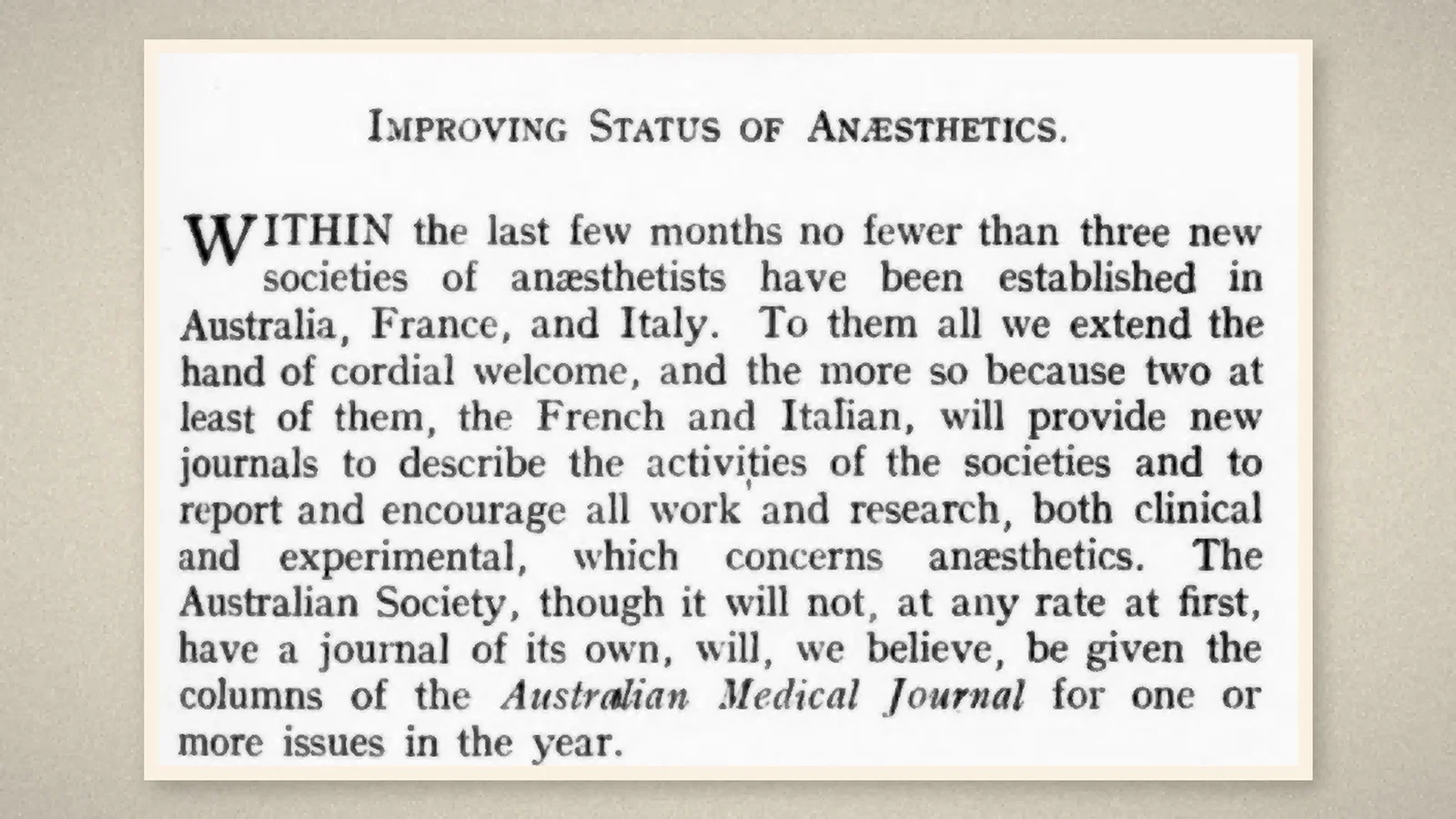
The British journal noticed the new body at once. Its July 1935 editorial welcomed "no fewer than three new societies of anaesthetists" in Australia, France and Italy, two of them with journals. [2, p. 149] It abstracted the first number of the French journal, Anesthésie et Analgésie, dated February 1935, "the official organ" of the French society. It printed the society's articles, aims and proposed sessions; Professor Desmarest wrote on the state of anaesthetics; and the secretary, "Dr. M. Monod", described "its object and its methods", hoping "to enlist the support of all who are interested in anaesthetics, not merely those who are actively engaged in their administration". [2, p. 192] The SFAR history says the same journal was created in 1935, with Monod as editor until 1951. [1]
Slowly into anaesthetists' hands
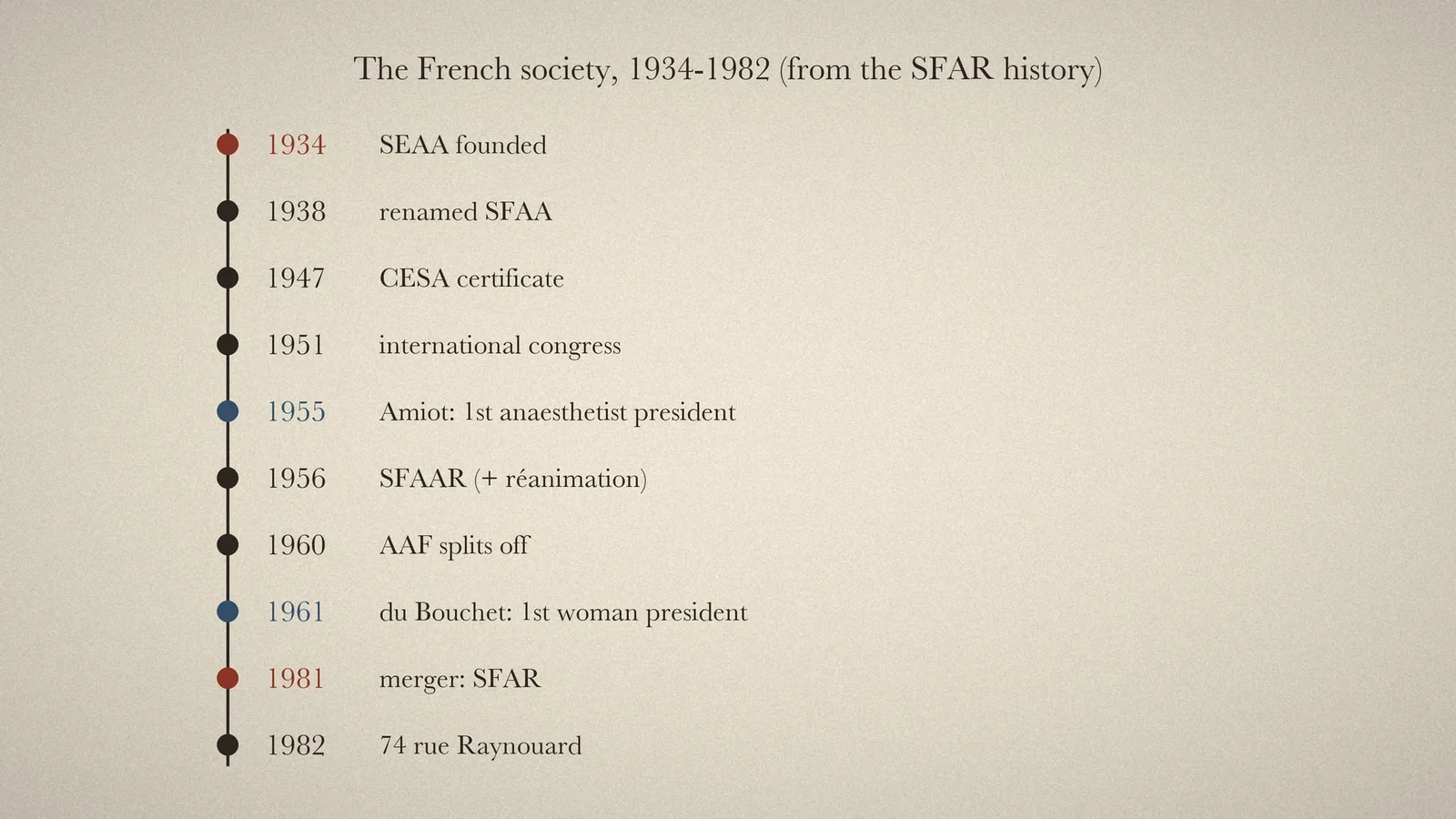
The SFAR history then traces the shift. In 1936 the SEAA had 120 full members. In 1937 it organized a standing service of professional anaesthetists for Paris, "but the surgeons' calls remain exceptional". In 1938 it took the name Société Française d'Anesthésie et d'Analgésie (SFAA); in 1939 the first teaching was created, and the war suspended its activities. [1] It resumed on 17 January 1946. In 1947 the SFAA counted 17 anaesthetists, an anaesthetist, Georges Jacquot, became its general secretary, and the certificate of specialised teaching in anaesthesia (CESA) was created. [1]
In 1951 the society organized the first international congress of anaesthesiology, with 32 countries, which the SFAR history calls the origin of the World Federation of Societies of Anaesthesiologists. After it, the society "decided to hand the direction of the society to anaesthetists" and encouraged surgeons to withdraw, a transition that took ten years. In 1955 Louis Amiot became the first anaesthetist president; from 1956 the society became the SFAAR, adding réanimation, as its journal became Anesthésie Analgésie Réanimation. [1]
Split and merger
In 1960 a split produced the Association des Anesthésistes Français (AAF), formed by supporters of the "potentiated anaesthesia" of Henri Laborit and Pierre Huguenard. In 1961 Nadia du Bouchet became the SFAAR's first woman president. By 1967 it had 477 members, and a directory of 1969 listed nearly 2,000 French anaesthetists. [1] In 1981 President Charles Rouet, through a union of the societies and unions, achieved "the merger of the two societies"; the Société Française d'Anesthésie et de Réanimation was created, and in 1982 it installed its seat at 74 rue Raynouard in Paris. [1]
What the record shows
The French society began as a meeting place for surgeons, physiologists and chemists interested in anaesthesia, with four anaesthetists among its founders and a founder who said it was not meant to be theirs. Over five decades it trained anaesthetists, handed itself over to them, added resuscitation to its name, split, and reunited as the SFAR.
Sources and reading limits
Read: the SFAR's web page "Histoire de la SFAR"; BJA July 1935, editorial (p. 149) and abstract of Anesthésie et Analgésie (p. 192).
Not covered: Cousin's history of French anaesthesia (2005) is not covered. The sequence from 1936 to 1982 rests on the SFAR's own account, a secondary source; only its 1935 starting point is checked against a contemporary journal. The SFAR page gives 100 full members in 1934, but its listed figures add up to 111; both are reported. Nothing beyond the SFAR page and BJA 1935 is used.
Two illustrations are drawn from the SFAR history; two are crops of BJA July 1935.
- Société Française d'Anesthésie et de Réanimation. Histoire de la SFAR [Internet]. Paris: SFAR; [cited 2026 Nov 1]. sfar.org
- Editorial: Improving status of anaesthetics; Abstracts: Anesthésie et Analgésie, February 1935. Br J Anaesth. 1935;12(4):149, 192. Internet Archive
Continue exploring
Related reading connects shared questions and contexts; it does not by itself establish historical influence.
Anesthesia Epochs · The Source Room · About & Editorial Method
Published November 2, 2026. Sources and reading limits are stated above. Illustrations are labelled as original source images or AI-made. Historical accounts are educational; they are not current treatment instructions.