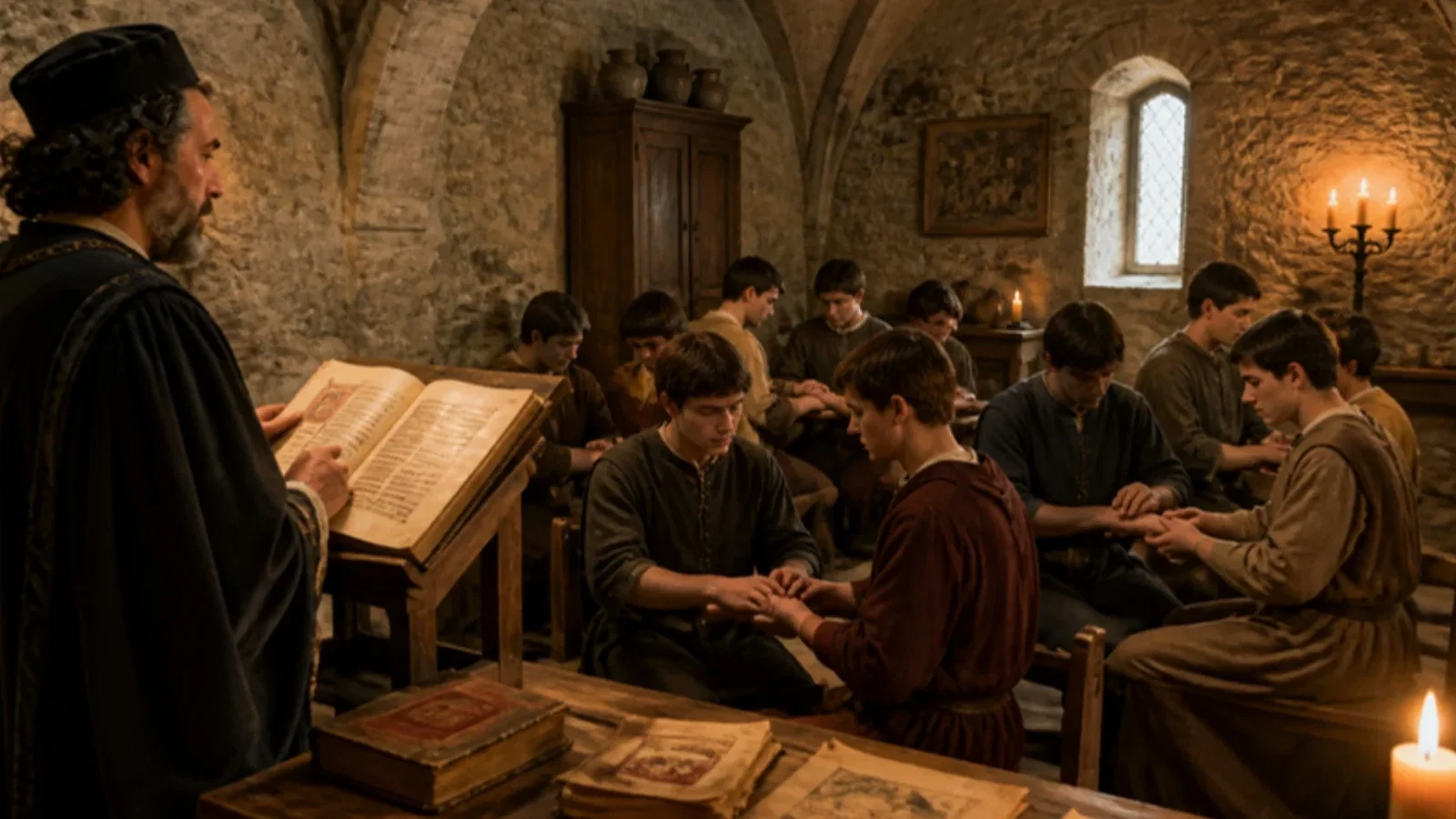
A Salerno-trained physician to King Philip Augustus put the reading of the pulse into 380 Latin hexameters, a poem that students copied, memorised and annotated for centuries.
Reading Library · Anesthesia Epochs · 中文版
Watch the education video (for clinicians)
c. 1200: Gilles de Corbeil — Teaching the Pulse in Verse · Anesthesia Epochs Education Series
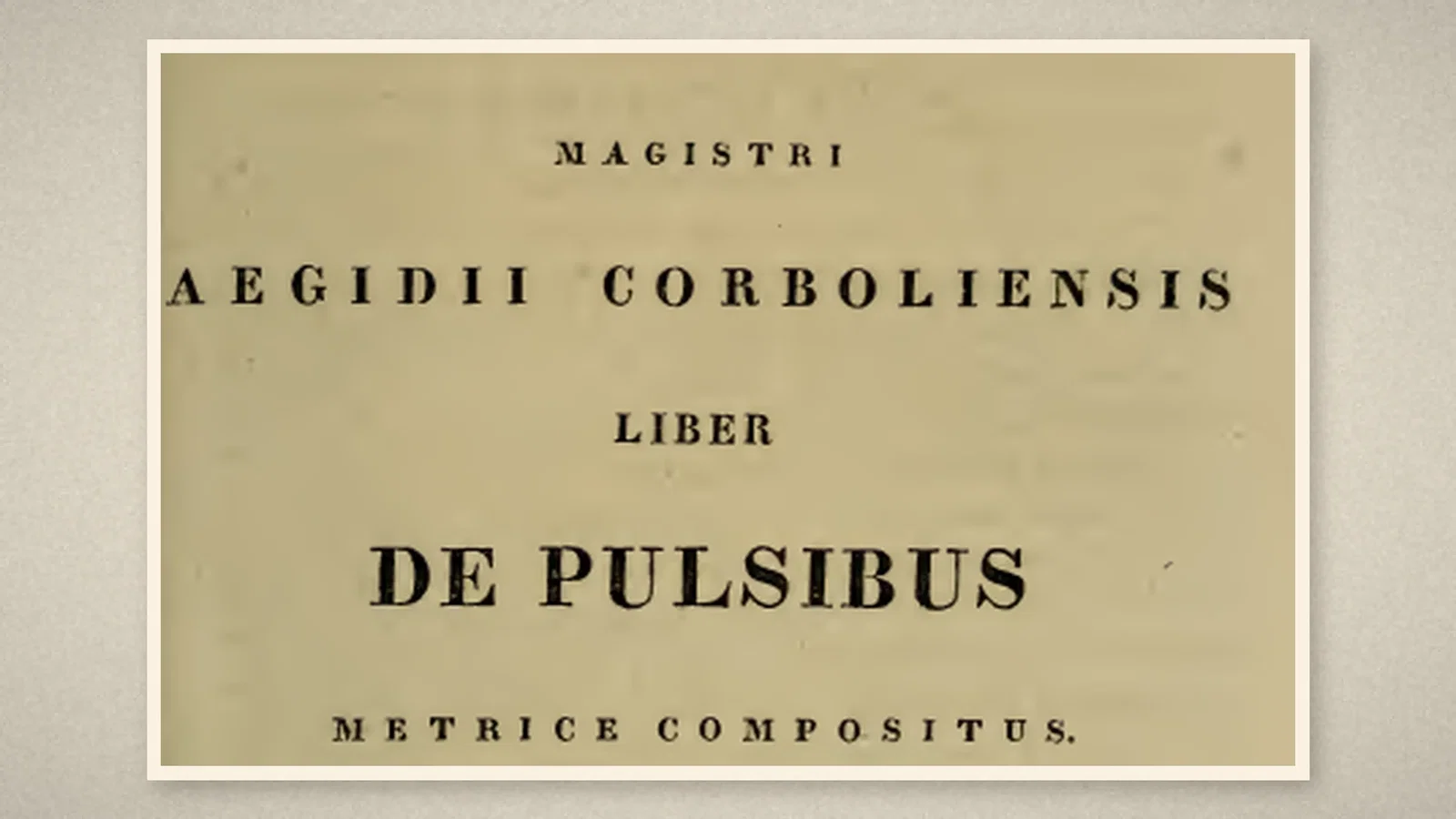
Long before monitors displayed a heart rate, physicians learned to read the pulse with their fingers, and they learned it from books. One of the most widely copied of those books in medieval Paris was a Latin poem: the Liber de pulsibus metrice compositus, "the book on pulses composed in verse", by Gilles de Corbeil (Aegidius Corboliensis). [1,2] This article reads the poem in its 1826 edition and the life of its author as reconstructed by a historian in 1925.
From Salerno to the king's bedside
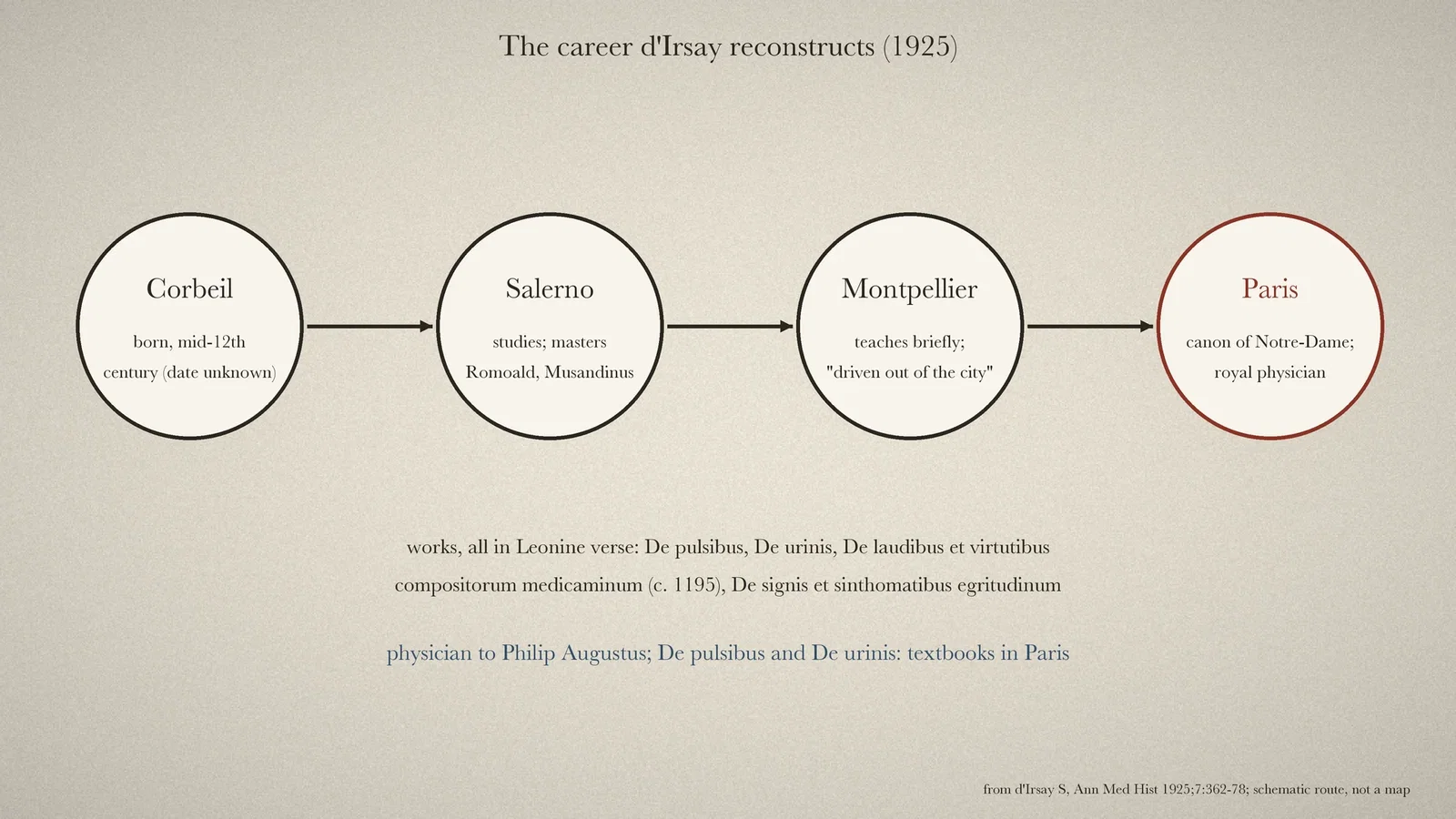
Stephen d'Irsay's study in the Annals of Medical History calls Gilles "the dominating medical personality in Paris" at the end of the twelfth century and the beginning of the thirteenth, and physician-in-ordinary to King Philip Augustus (1180-1223). [2] Gilles was born at Corbeil, about twenty-five miles south-east of Paris; the date of birth is unknown, but d'Irsay placed it in the middle of the twelfth century. The decisive episode was medical study at Salerno, where Gilles's masters included Romoald and Musandinus. D'Irsay set the end of those studies no later than Romoald's death in 1181, and noted that Gilles never stopped lamenting the sack of Salerno by the Emperor Henry VI in 1193. After teaching briefly at Montpellier, where, d'Irsay writes, Gilles "was bodily driven out of the city", Gilles went to Paris, became a canon of the cathedral and served as royal physician. [2]
Medicine in verse
All of Gilles's medical works were written in Leonine verse, hexameters mixed with couplets, a form common in Salernitan teaching. D'Irsay lists four: De pulsibus, De urinis, De laudibus et virtutibus compositorum medicaminum (dated to around 1195) and De signis et sinthomatibus egritudinum. The two books on pulse and urine "were used as textbooks", reappearing as the "Versus Egidii" in manuscripts for generations, and students at the University of Paris used them. Later commentators included Gilbertus Anglicus and Gentile da Foligno. [2]
What the poem teaches
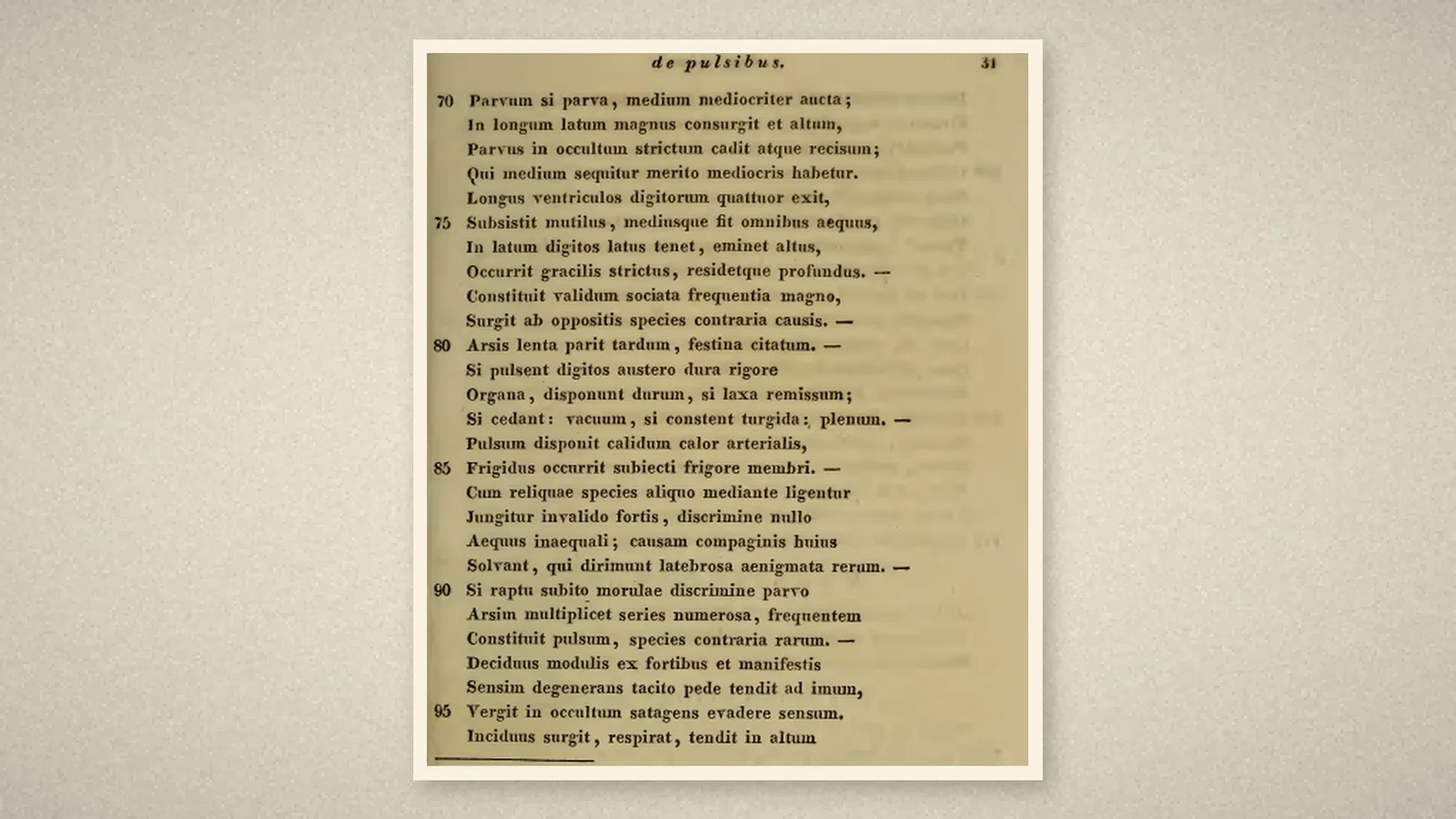
In 1826 the Leipzig scholar Ludwig Choulant published a critical edition of Gilles's medical poems. Choulant's introduction explains that De pulsibus was written later than De urinis and consists of a prose prologue and 380 hexameters, a polished work that found many copyists and commentators and great authority among teachers and students. [1] Gilles tried to steer between Galen's long volumes on the pulse and a short Greek treatise attributed to Philaretus, which Gilles criticised sharply for a brevity that made it obscure; the poem's last line turns away from "Philaretus" for good. [1]
The poem opens with the heart and its motion. It then explains what the pulse can reveal: in health, differences of constitution; in disease, the increase of illness, crisis, remission, convalescence and death. Choulant summarises Gilles's view that the pulse corrects and confirms the uncertain judgment drawn from the urine, and narrows a diagnosis from the general to the particular. [1]
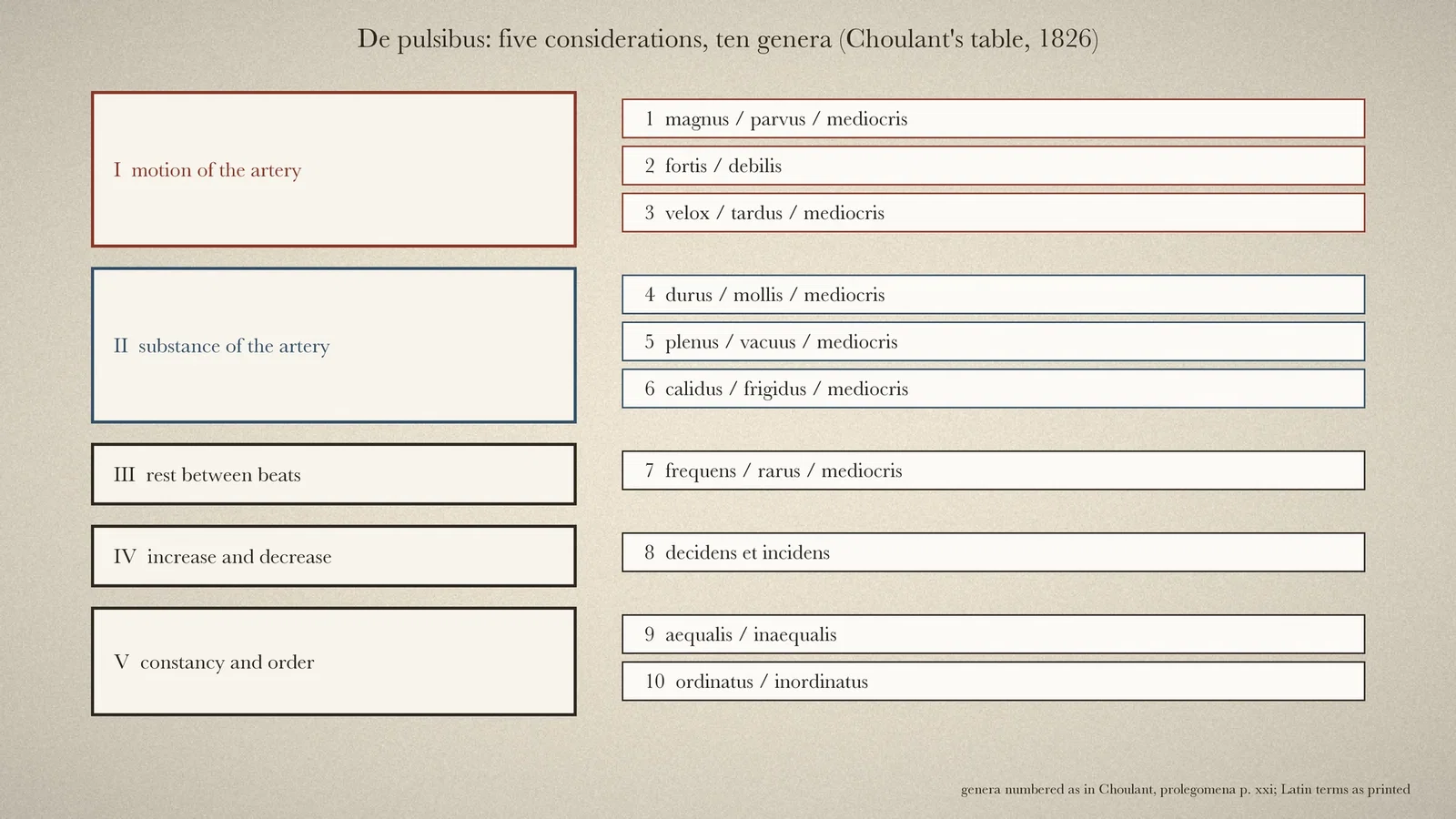
Choulant set out Gilles's system as a table: five considerations, yielding ten genera of pulse. The motion of the artery gives large, small or medium; strong or weak; quick, slow or medium. Its substance gives hard or soft, full or empty, hot or cold. The rest between beats gives frequent or rare. Increase and decrease give the "falling" and "rising" pulse, and constancy and order give equal or unequal, ordered or disordered. [1] Each genus is then divided further; a large pulse, for instance, might be long, broad or high according to which dimension of the artery is enlarged under the examining fingers. [1]
What the record shows
De pulsibus belongs to medicine before measurement, when the pulse was judged by touch and named in Latin categories inherited from Galen. Gilles's achievement was to make that system teachable: short enough to memorise, ordered enough to apply at the bedside, and copied for centuries by students in Paris. The anaesthetist's later habit of watching the pulse continuously has a long pedagogical ancestry in texts like this one.
Sources and reading limits
Read: Choulant's 1826 edition (prolegomena on De pulsibus and the text of the poem); d'Irsay's 1925 article on Gilles's life and works.
Not covered: any manuscript of the poem; Vieillard's monograph on Gilles; modern editions or translations. The date of the poem is not known from the sources read; "c. 1200" is an approximation based on Gilles's career and on d'Irsay's dating of another poem to about 1195. Latin passages are summarised from Choulant's text and introduction, not translated in full. The link to anaesthesia is indirect and is stated as such.
Two illustrations are crops of Choulant's edition; two are drawn from the sources.
- Choulant L, ed. Aegidii Corboliensis carmina medica. Lipsiae: Voss; 1826. Internet Archive
- d'Irsay S. The life and works of Gilles de Corbeil. Ann Med Hist. 1925;7(4):362-78. Internet Archive
Continue exploring
Related reading connects shared questions and contexts; it does not by itself establish historical influence.
Anesthesia Epochs · The Source Room · About & Editorial Method
Published November 2, 2026. Sources and reading limits are stated above. Illustrations are labelled as original source images or AI-made. Historical accounts are educational; they are not current treatment instructions.