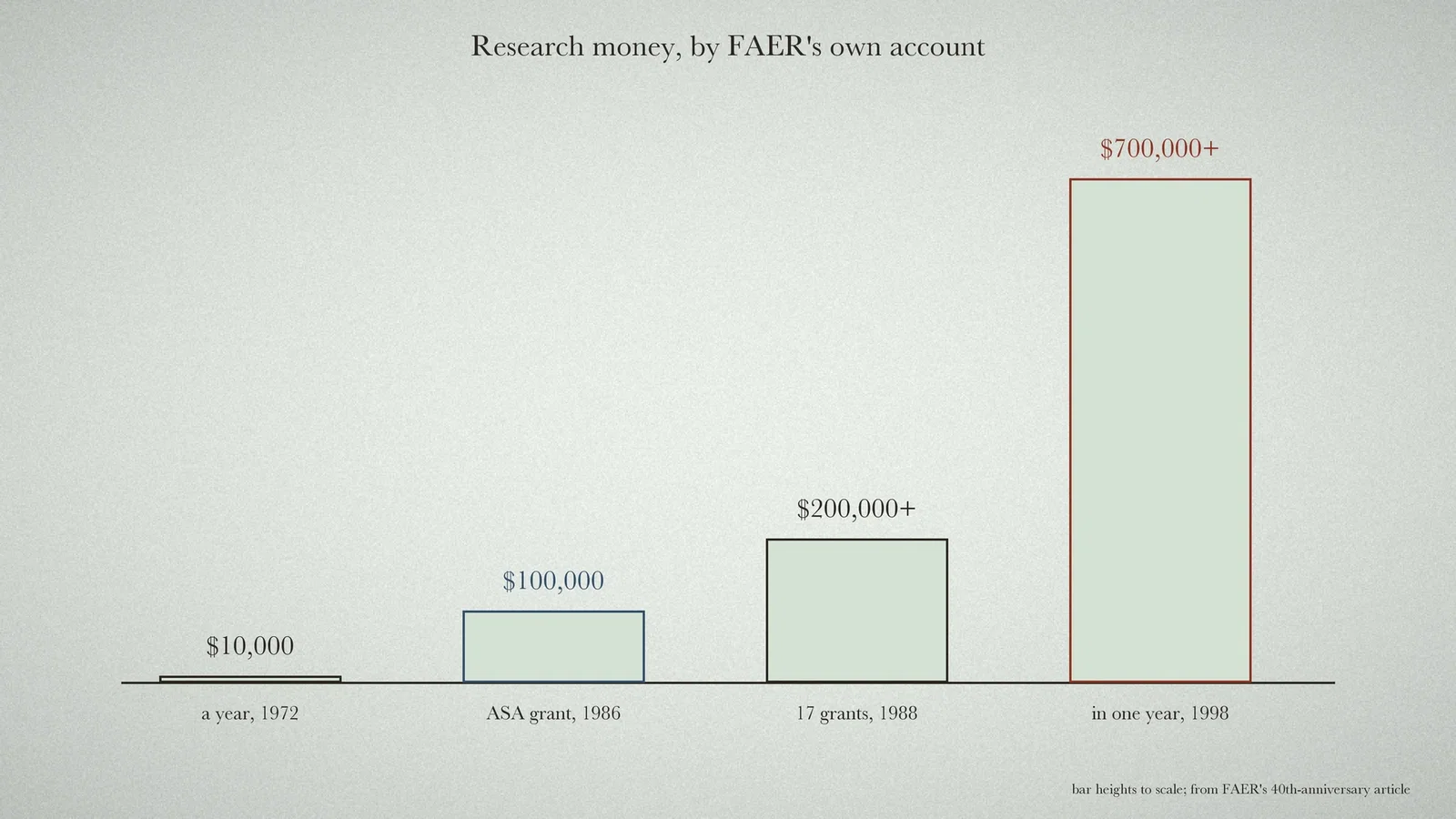
An ASA committee had handed out about $10,000 a year in research grants since 1972; on 21 October 1986 the Foundation for Anesthesia Education and Research was founded at arm's length from the Society, and by 1988 it was funding 17 research starter grants worth over $200,000.
Reading Library · Anesthesia Epochs · 中文版
Watch the education video (for clinicians)
1986: The Foundation for Anesthesia Education and Research · Anesthesia Epochs Education Series
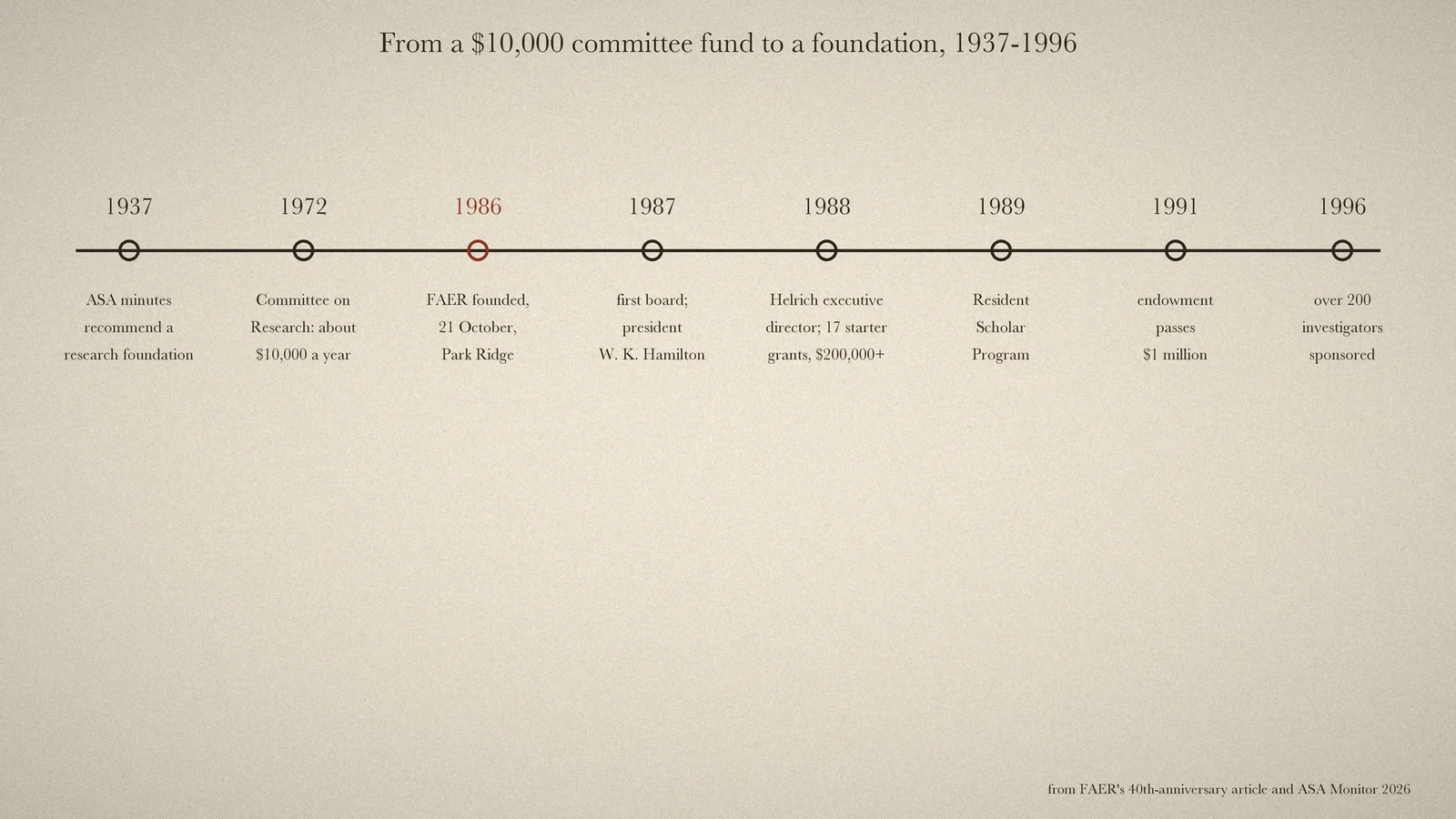
The Foundation for Anesthesia Education and Research (FAER) was, in its own words, "officially founded on October 21, 1986, in Park Ridge, Illinois". [1] Its purpose was to fund research and education in anaesthesiology at a distance from the American Society of Anesthesiologists (ASA) that created it. This article follows how FAER came about and what it did in its first decade. Nearly all of the story comes from FAER's own accounts, written for its 40th anniversary in 2026. FAER says its web history was "compiled from a broad range of historical FAER documents". [1]
Before the Foundation
According to FAER, the idea was old. ASA committee minutes "as far back as" 1937 recommended a research foundation. [1] In 1972 the ASA's Committee on Research was formed with "a budget of $10,000 to distribute as grants to four to five skilled physician-investigators each year". [1] The ASA Monitor article for the anniversary gives the same origin: FAER was "formally incorporated in 1986", but "its origin was in 1972". [2] FAER's published list of grantees still includes those committee grants. Its last page ends with four Research Starter Grants approved in 1973, well before the Foundation existed. [5, p. 20]
In the mid-eighties, while working with the ASA's Committee on Industry Relationships, Clifford Parrish of the Burroughs Wellcome Foundation "reasserted the recommendation that the ASA develop an 'arm's-length foundation'". [1] Charles Emala, writing in the ASA Monitor in 2026, explains the concern: without "independent, sustained research support, the specialty's progress could stagnate". [2]
Founding, 1986-1988
FAER was founded on 21 October 1986. The ASA became its principal sponsor "via a grant of $100,000", and the Burroughs Wellcome Foundation and the Parker B. Francis Foundation provided further early support. [1] The first board met in 1987 at the Hilton San Francisco Airport Hotel, and the Foundation set up its first offices in Park Ridge. Its inaugural president was William K. Hamilton. The founding board members were S. Craighead Alexander, George W. N. Eggers Jr., Gerald A. Gronert, Patricia A. Kapur, Richard I. Mazze, Edward D. Miller Jr., Michael F. Roizen, Alan D. Sessler and Donald R. Stanski. [1] One early fundraising effort was a mailing to ASA members selling neckties and scarves. FAER notes that no examples of this first merchandise survive. [1]
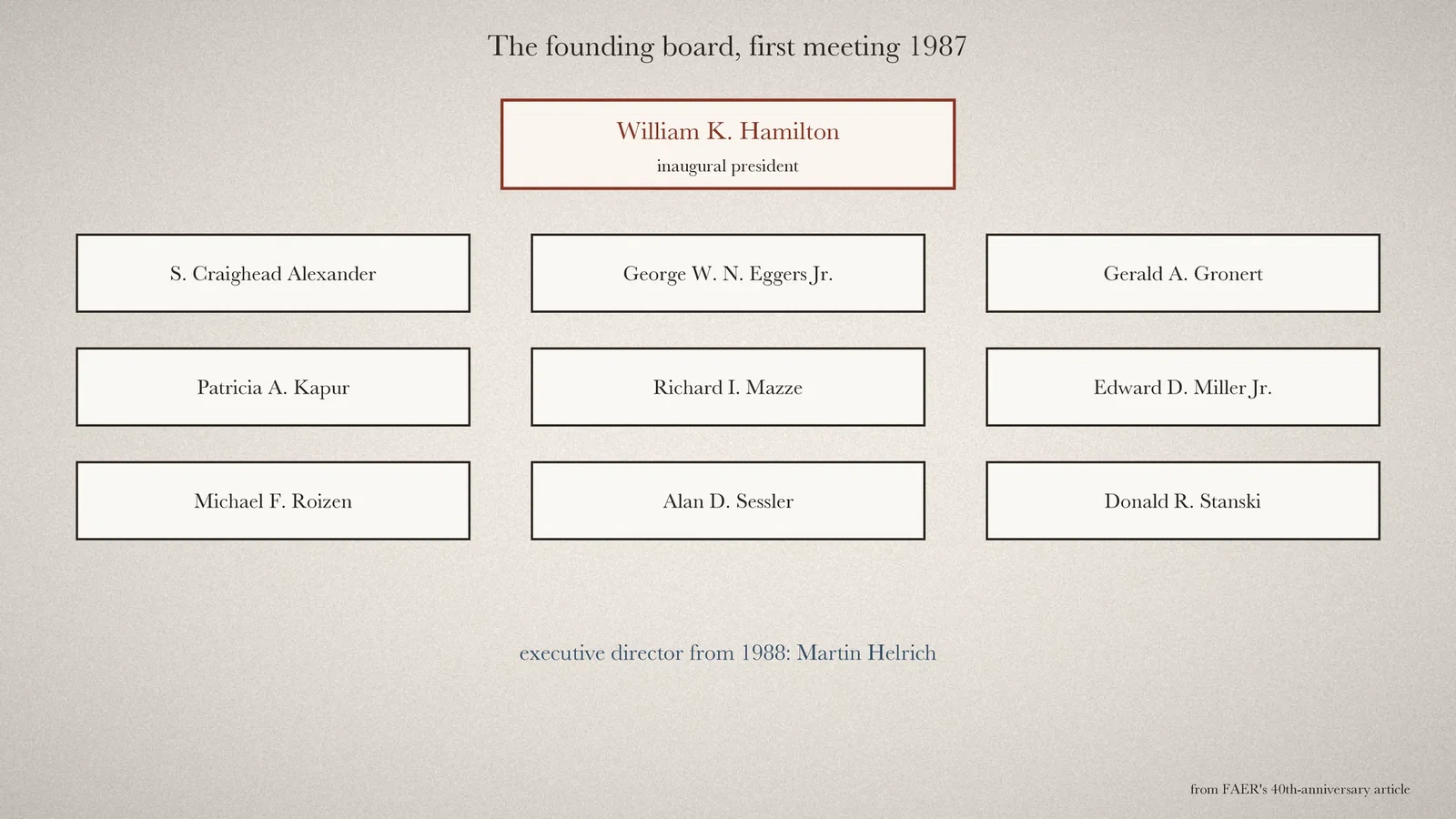
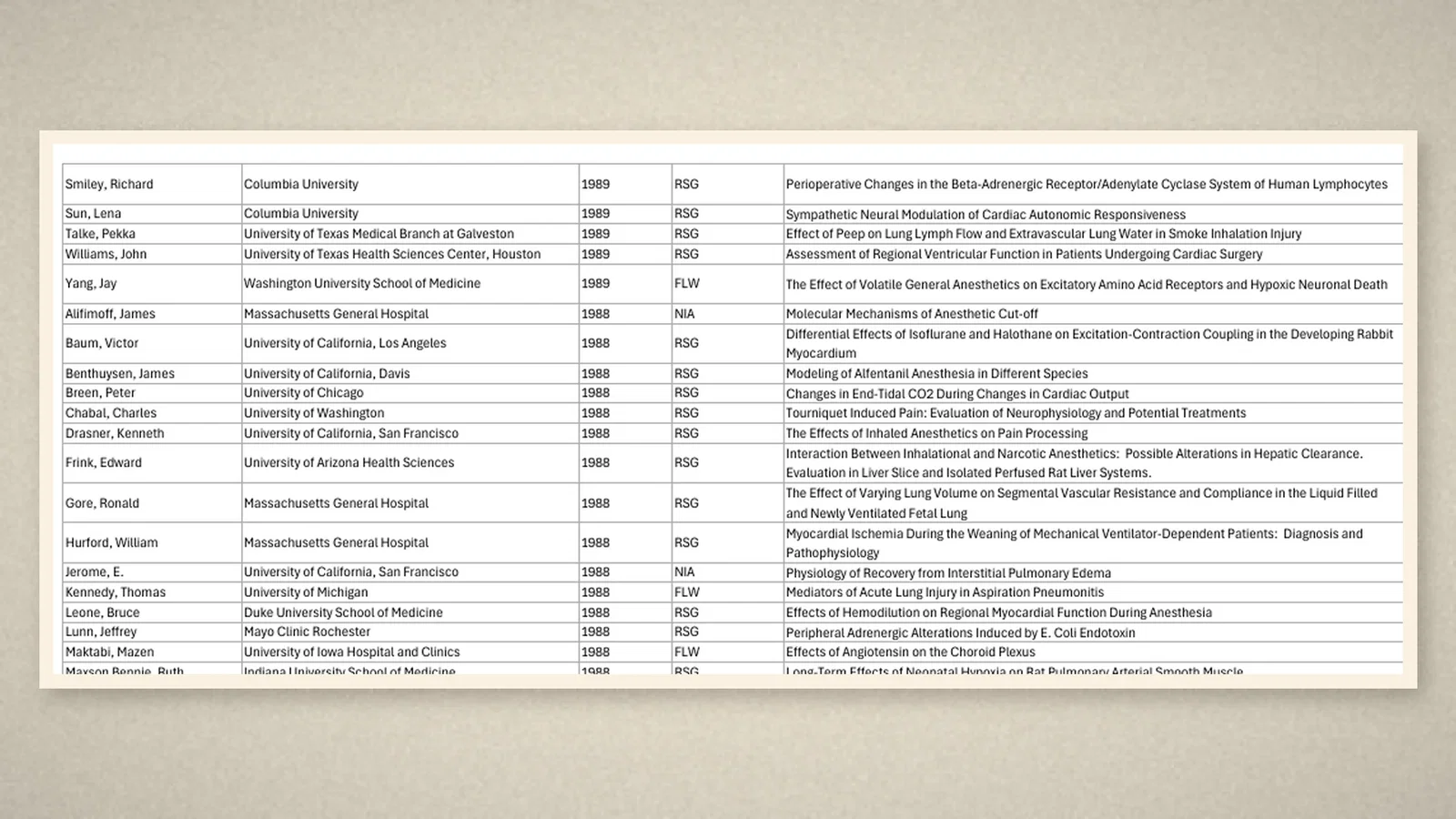
Patricia Kapur, who served on the board from 1986 to 1994, recalled that the inaugural directors "developed the award program structure and amounts, application and scientific review processes" and raised money beyond the ASA's annual commitment. [1] In 1988 Martin Helrich became FAER's first executive director and the office moved to Baltimore, Maryland. That year FAER awarded Research Starter Grants "to 17 talented researchers to the tune of over $200,000", and it set up an endowment fund. [1] FAER's grantee list counts the same 17 starter grants for 1988. [5, p. 17] According to FAER, Helrich had first taken the post on a one-year trial basis and stayed seven years. [1]
The first decade
FAER introduced its Resident Scholar Program in 1989, awarded its first Educational Research Grant in 1990, and saw its endowment pass $1 million in 1991. [1] Every grant was reviewed by the ASA's Committee on Research "using NIH-style peer review standards". [1] By its tenth anniversary in 1996, FAER had "sponsored over 200 investigators". In 1998 it awarded more than $700,000 in a single year, and its total awards since 1986 passed $6 million. [1]
Did it work?
Two studies asked what became of FAER's grantees. In 1998 C. P. King and C. C. Hug Jr., writing from FAER and Emory University, published in Anesthesiology a survey of former recipients of research funding from the ASA and FAER. [3] Only the PubMed record was read here. The 2026 ASA Monitor article summarises it as showing that most recipients stayed in academic medicine and went on to win further research funding. [2] In 2015 Vega and colleagues surveyed 882 former Resident Scholars. Of the 26% who replied, 45% were working at an academic institution, compared with a national average of 18%. [4] Both studies are observational and measure where careers went, not what the grants caused.
What the record shows
FAER turned a small research fund run by an ASA committee into a foundation with its own board, endowment and grant programmes. Its grantee list also shows that it did not start from nothing: the ASA had been making research grants every year since 1973, and FAER took that work over and enlarged it.
Sources and reading limits
Read: FAER's 40th-anniversary web article; Emala's 2026 ASA Monitor article (free full text); the PubMed records of King and Hug 1998 (title and affiliation) and Vega and colleagues 2015 (abstract); FAER's 2026 grantee list, pp. 17-20, with pp. 17 and 20 checked by page image.
Not covered: FAER's founding documents, articles of incorporation and early board minutes; contemporary announcements in ASA publications; the full text of King and Hug; the Wood Library-Museum's timeline entry, which refused the request. The anniversary article asks readers to report any inaccuracies, and it and the Monitor article are FAER's own accounts. The grantee list was used only to check FAER's 1988 figure and the year of its earliest entries.
One illustration is a crop of the grantee list; three are drawn from the sources. No portraits are used.
- Foundation for Anesthesia Education and Research. Celebrating FAER's 40th Anniversary. 2026. Website
- Emala CW. The 40-Year Journey of the Foundation for Anesthesia Education and Research, 1986-2026. ASA Monitor. 2026;90(2):38. Full text
- King CP, Hug CC Jr. Survey of former recipients of research funding from the American Society of Anesthesiologists and the Foundation for Anesthesia Education and Research. Anesthesiology. 1998;88(2):519-24. PubMed
- Vega EA, Dillman D, Toledo P, Kirsch JR. Assessing the Academic Productivity of Foundation for Anesthesia Education and Research (FAER) Resident Scholars. J Educ Perioper Med. 2015;17(4):E302. PubMed
- Foundation for Anesthesia Education and Research. Grantee list. 2026. PDF
Continue exploring
Related reading connects shared questions and contexts; it does not by itself establish historical influence.
Anesthesia Epochs · The Source Room · About & Editorial Method
Published November 2, 2026. Sources and reading limits are stated above. Illustrations are labelled as original source images or AI-made. Historical accounts are educational; they are not current treatment instructions.