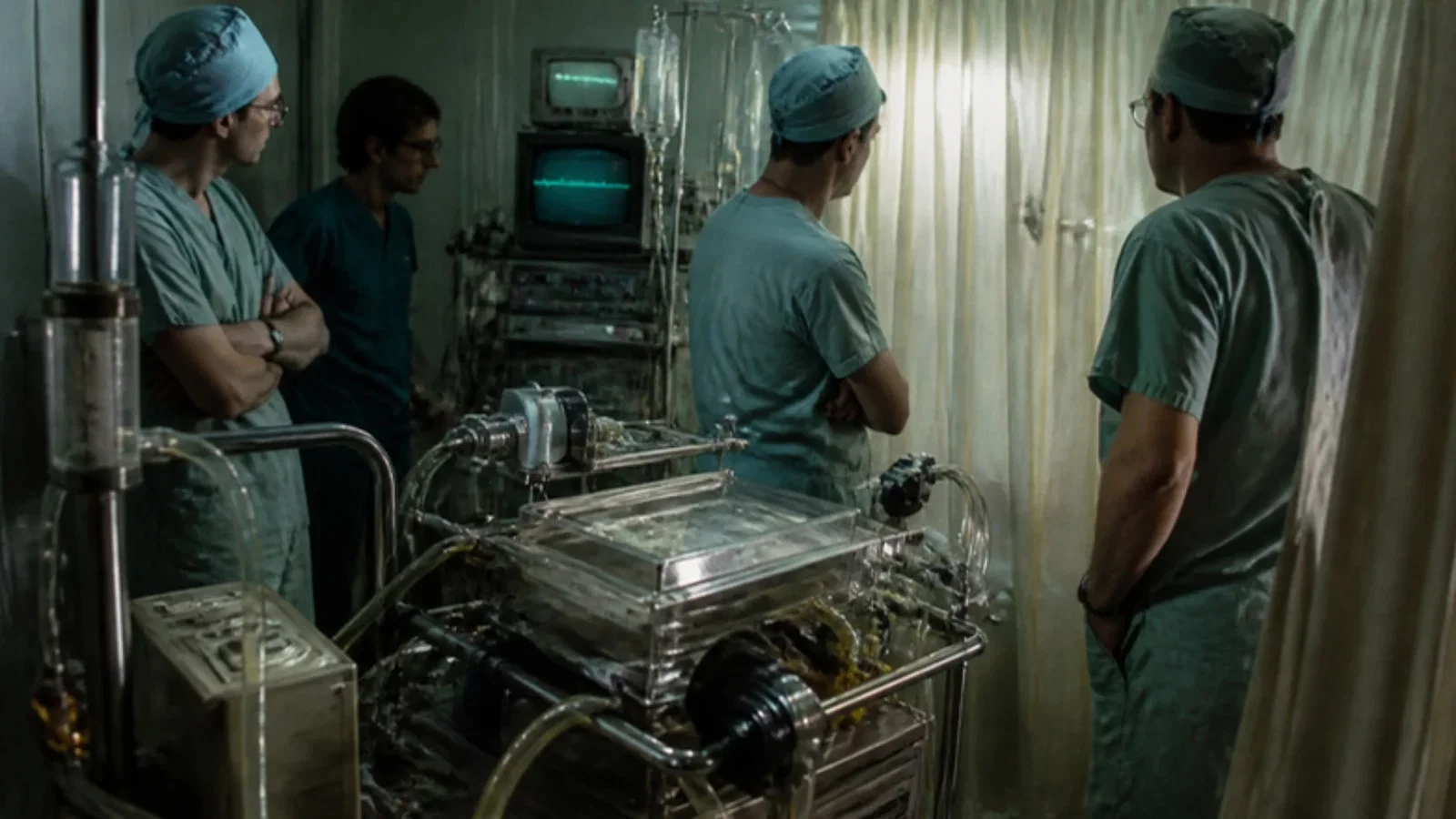
Membrane lungs made days-long extracorporeal oxygenation possible: an adult trauma patient survived in Santa Barbara, Bartlett's team rescued newborns from 1975, and a nine-centre adult trial published in 1979 found no survival benefit.
Reading Library · Anesthesia Epochs · 中文版
Watch the education video (for clinicians)
1972: Early ECMO — Prolonged Support After Trauma · Anesthesia Epochs Education Series
The heart-lung machine could take over the lungs for the length of an operation. Taking them over for days, to carry a patient through respiratory failure, needed a gentler artificial lung. This article follows the first years of prolonged extracorporeal membrane oxygenation (ECMO): an adult survivor in California, newborns rescued from 1975, and a national trial in 1979 that seemed to show it did not work in adults. None of the original papers could be read in full here. The account rests on their PubMed records, two open-access reviews and the Australian Society of Anaesthetists' history timeline, and the sources do not always agree.
A gentler lung
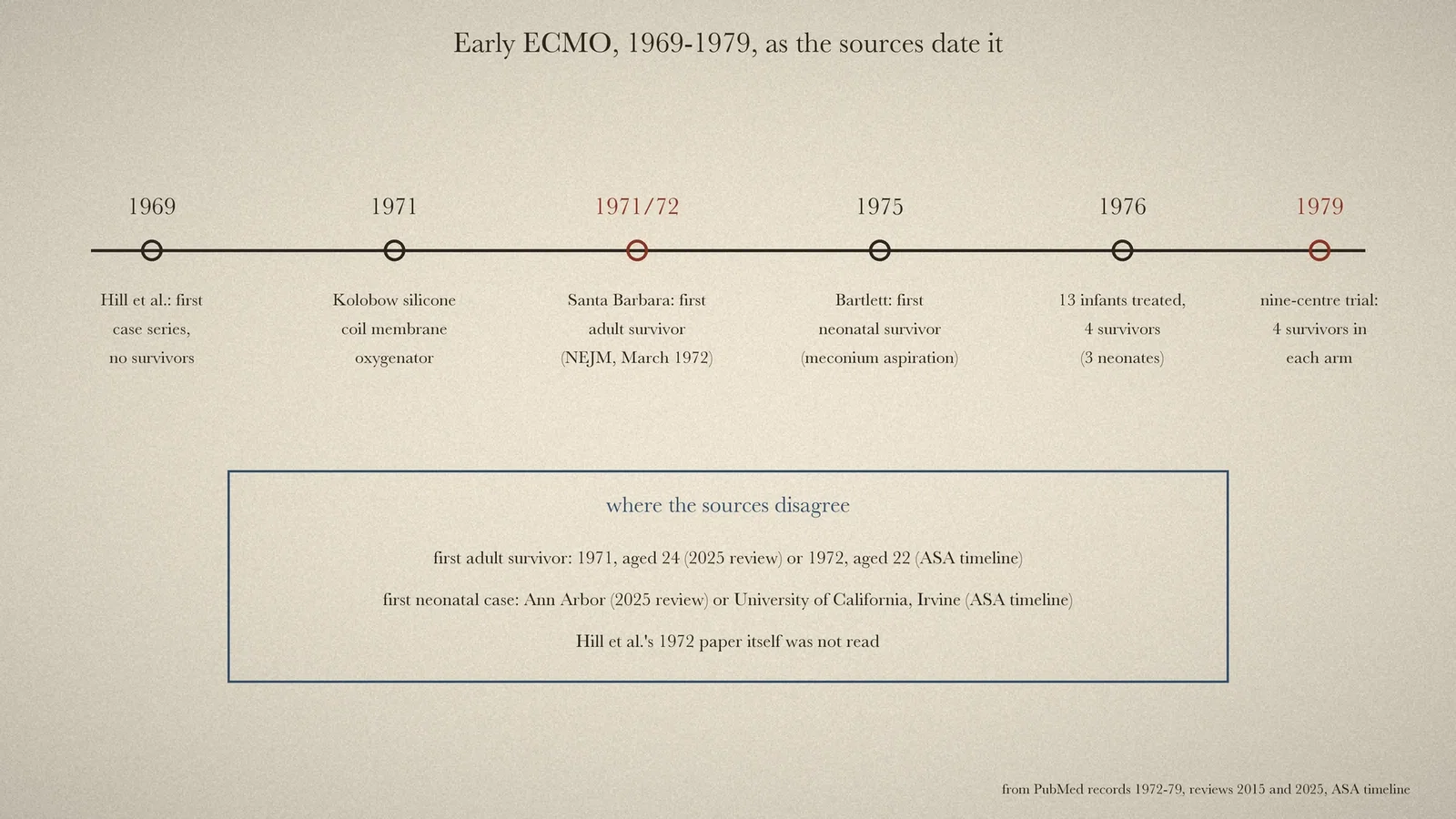
The 2025 review by Szentgyorgyi, Butt and Krishnamoorthy places the change in the oxygenator. In 1971 "Kolobow developed his disposable coil membrane oxygenator" from silicone rubber, and Hill's team used a membrane oxygenator for the first successful respiratory support. [4] The review dates ECMO's first success to 1971: "Since its first successful use in 1971", it writes, the technique has changed care for cardiac and respiratory failure. [4]
Santa Barbara
"In 1969, Hill et al. from San Francisco, California" presented a series of patients given venoarterial and venovenous extracorporeal support, but "survival was not achieved in these early cases". [4] Then "the same team in Santa Barbara" treated a "24-year-old trauma patient with respiratory failure", using peripheral venoarterial support and a Bramson membrane lung, and the patient survived. [4] The team's report appeared in the New England Journal of Medicine on 23 March 1972 under the title "Prolonged extracorporeal oxygenation for acute post-traumatic respiratory failure (shock-lung syndrome)", with the subtitle "Use of the Bramson membrane lung". [1] PubMed holds no abstract for it, and the paper itself was not read.
The ASA timeline tells the same story with different details. It lists, under 1972, the "First successful use of extracorporeal membrane oxygenation" for acute respiratory distress, by J. Donald Hill and Maury Bramson in Santa Barbara, in a 22-year-old post-trauma patient "who survived after 72 hours of treatment". [6, p. 73] So the year (1971 or 1972) and the patient's age (24 or 22) differ between the two accounts. Both are given here. The ASA timeline also credits Robert Bartlett with a 1969 "Demonstration that prolonged ECMO could be used to treat respiratory failure", noting: "This was in an experimental setting". [6, p. 71]
Newborns
The first newborn to survive ECMO, according to the 2025 review, was a girl with severe meconium aspiration, treated in 1975 ("The inaugural success in neonatal ECMO treatment"). "Bartlett et al. utilised venoarterial ECMO", and support was withdrawn after six days. [4] The review places this in Ann Arbor, Michigan. The ASA timeline says Bartlett was then at the "University of California Irvine School of Medicine". [6, p. 74]
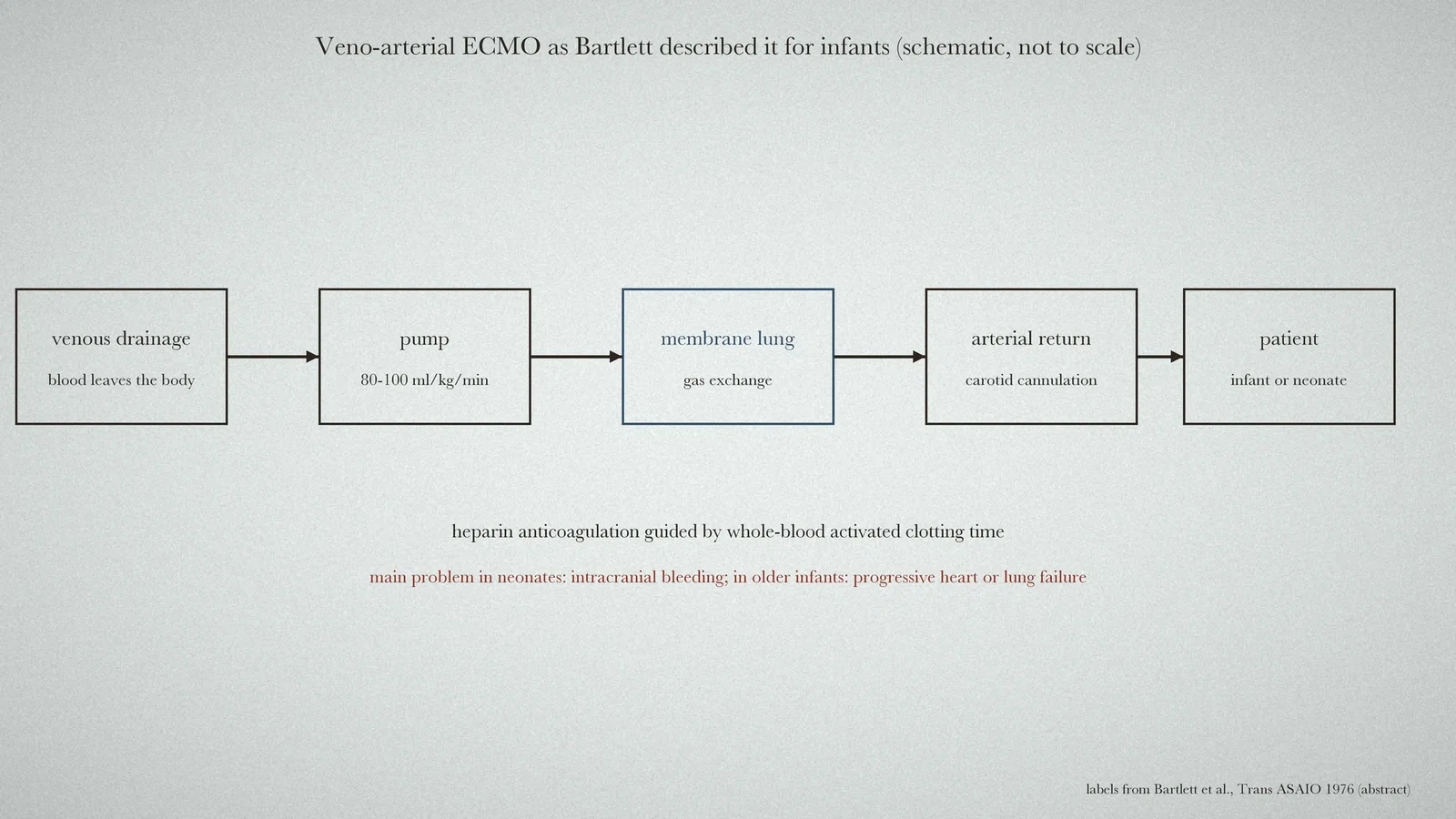
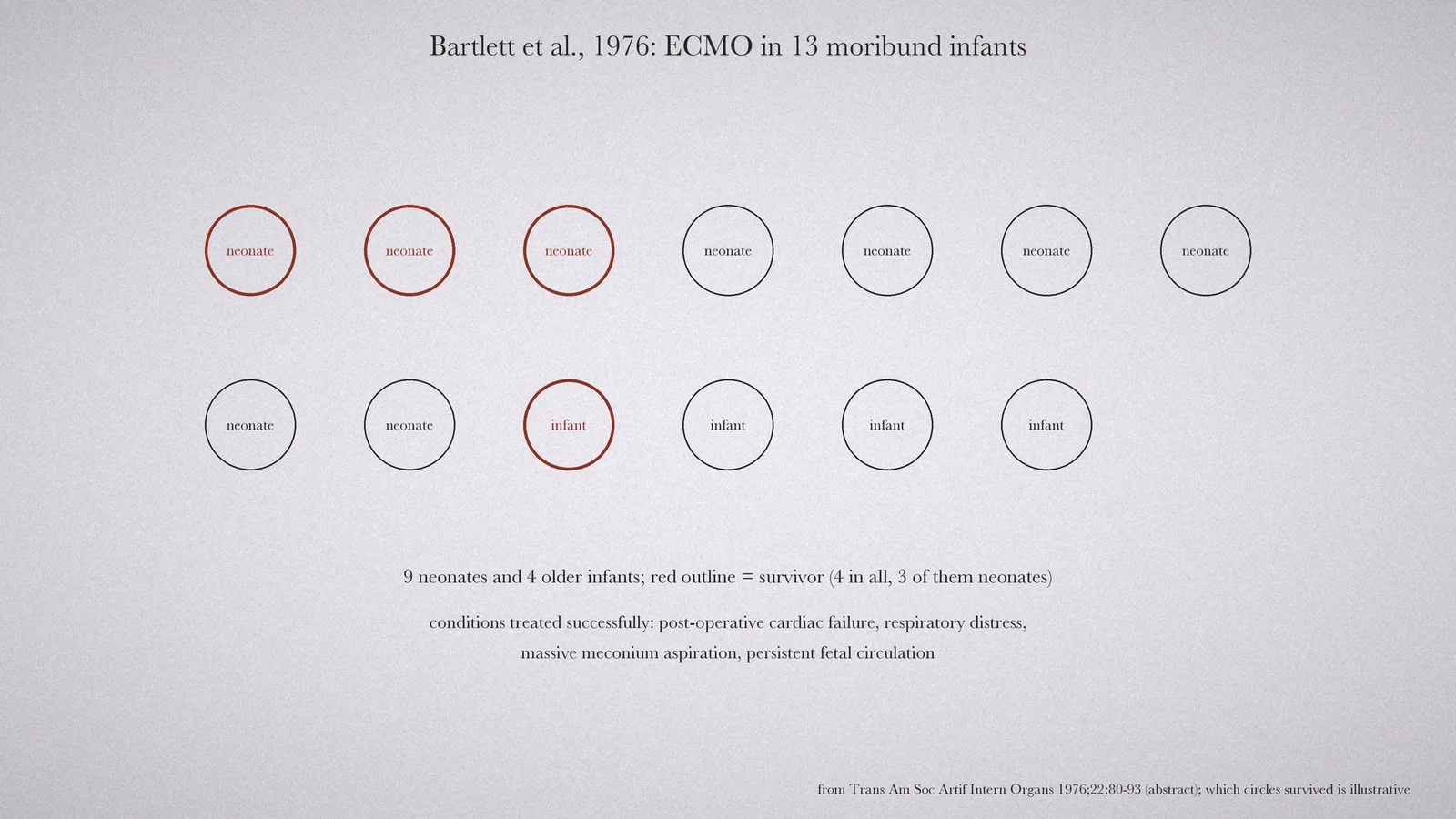
The team's own report, presented in 1976, gives the numbers. They had used prolonged ECMO "in the treatment of 13 moribund infants", including nine neonates, "with 4 survivors (3 neonates)". The conditions treated successfully were post-operative cardiac failure, respiratory distress, massive meconium aspiration and persistent fetal circulation. "All cases have been managed with veno-arterial" bypass at 80-100 ml/kg/min. "Carotid cannulation for arterial" access and heparin controlled by the whole-blood activated clotting time had helped. The authors also named the danger: "intracranial bleeding is the major problem in neonates". [2]
A trial that stalled it
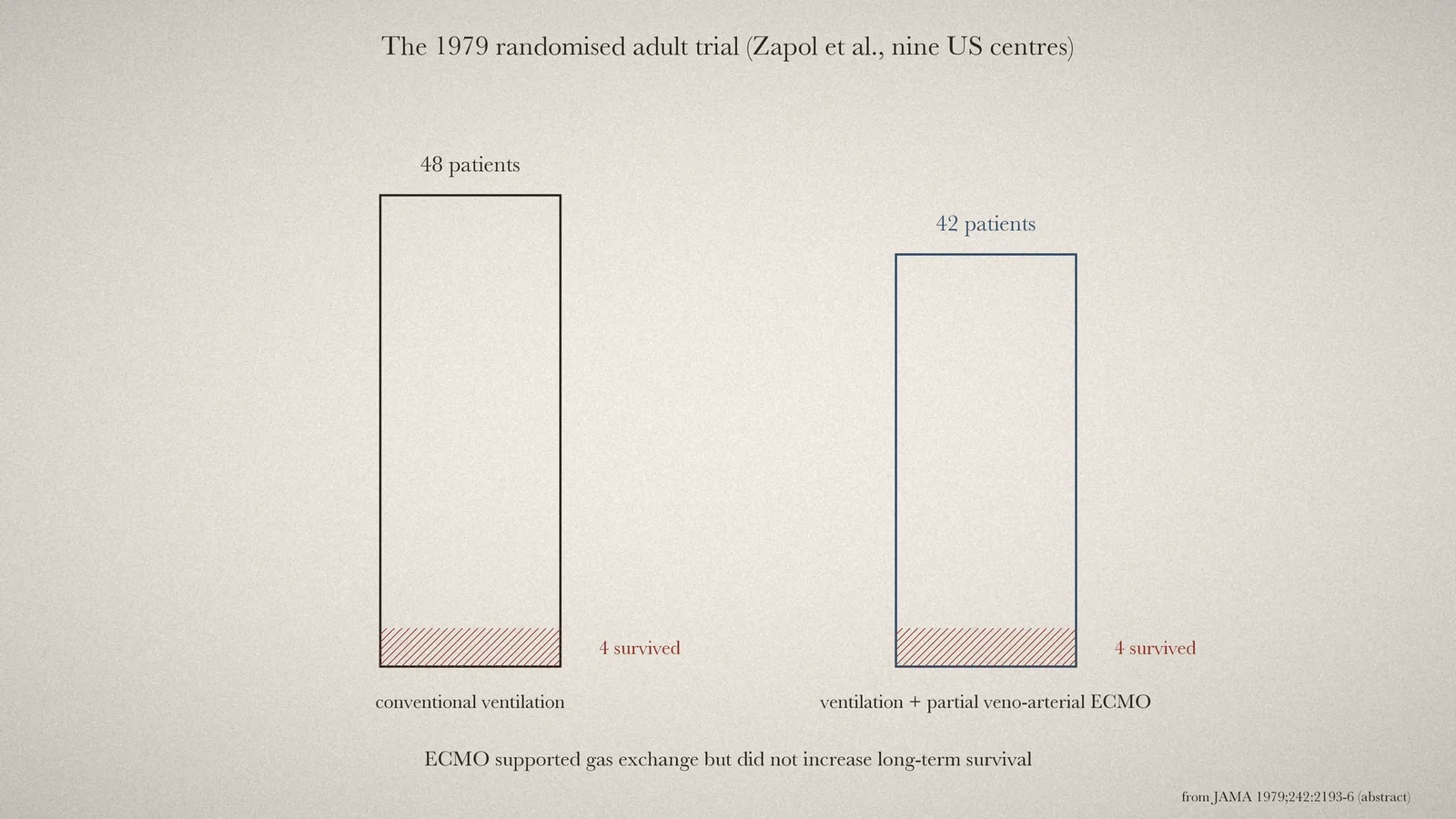
For adults, the decisive test came from a randomised trial. "Nine medical centers collaborated", and "Ninety adult patients were selected" with severe acute respiratory failure: 48 received conventional mechanical ventilation and 42 ventilation with partial venoarterial bypass. "Four patients in each group survived." The authors concluded that ECMO could support gas exchange "but did not increase the probability of long-term survival". [3] The 2015 review by Mosier and colleagues sums up the effect: the trial "reported a 90 % mortality rate for patients in both groups", and "Thus, enthusiasm stalled". [5] The 2025 review adds that the trial began in 1975 and "hindered the widespread adoption of ECMO technology" in adults for almost two decades. [4]
What the record shows
Within a few years ECMO had produced its first adult and newborn survivors, and then a careful trial showed that in adults with severe respiratory failure it changed nothing. The two halves went different ways. Newborn ECMO grew from Bartlett's small series, while adult ECMO waited for different patients, different machines and different trials.
Sources and reading limits
Read: two open-access reviews in full (Szentgyorgyi, Butt and Krishnamoorthy 2025; the history section of Mosier et al. 2015); the PubMed records of Hill et al. 1972 (title only), Bartlett et al. 1976 (abstract) and Zapol et al. 1979 (abstract); the ASA history timeline (2024).
Not covered: none of the original papers was read in full. Hill et al.'s report has no abstract in PubMed, so the patient's age, the year and the 72-hour duration come from secondary sources that disagree, as set out above. Bartlett's own account of the first neonatal patient (2017) and a 2025 anniversary article were not accessible. Bartlett's 1969 experimental work is known only from the ASA timeline. All four illustrations are drawn from the sources; no figure from the reviews is reproduced. The diagram of thirteen infants shows the counts only, and which circles are marked as survivors is illustrative.
- Hill JD, O'Brien TG, Murray JJ, Dontigny L, Bramson ML, Osborn JJ, Gerbode F. Prolonged extracorporeal oxygenation for acute post-traumatic respiratory failure (shock-lung syndrome). Use of the Bramson membrane lung. N Engl J Med. 1972;286(12):629-34. PubMed
- Bartlett RH, Gazzaniga AB, Jefferies MR, Huxtable RF, Haiduc NJ, Fong SW. Extracorporeal membrane oxygenation (ECMO) cardiopulmonary support in infancy. Trans Am Soc Artif Intern Organs. 1976;22:80-93. PubMed
- Zapol WM, Snider MT, Hill JD, et al. Extracorporeal membrane oxygenation in severe acute respiratory failure. A randomized prospective study. JAMA. 1979;242(20):2193-6. PubMed
- Szentgyorgyi L, Butt SP, Krishnamoorthy B. Evolution of extracorporeal membrane oxygenation: historical milestones and advanced developments. J ExtraCorpor Technol. 2025;57(4):243-62. DOI
- Mosier JM, Kelsey M, Raz Y, et al. Extracorporeal membrane oxygenation (ECMO) for critically ill adults in the emergency department: history, current applications, and future directions. Crit Care. 2015;19:431. DOI
- Australian Society of Anaesthetists. Anaesthesia History Timeline 2024. PDF
Continue exploring
Related reading connects shared questions and contexts; it does not by itself establish historical influence.
Anesthesia Epochs · The Source Room · About & Editorial Method
Published November 2, 2026. Sources and reading limits are stated above. Illustrations are labelled as original source images or AI-made. Historical accounts are educational; they are not current treatment instructions.