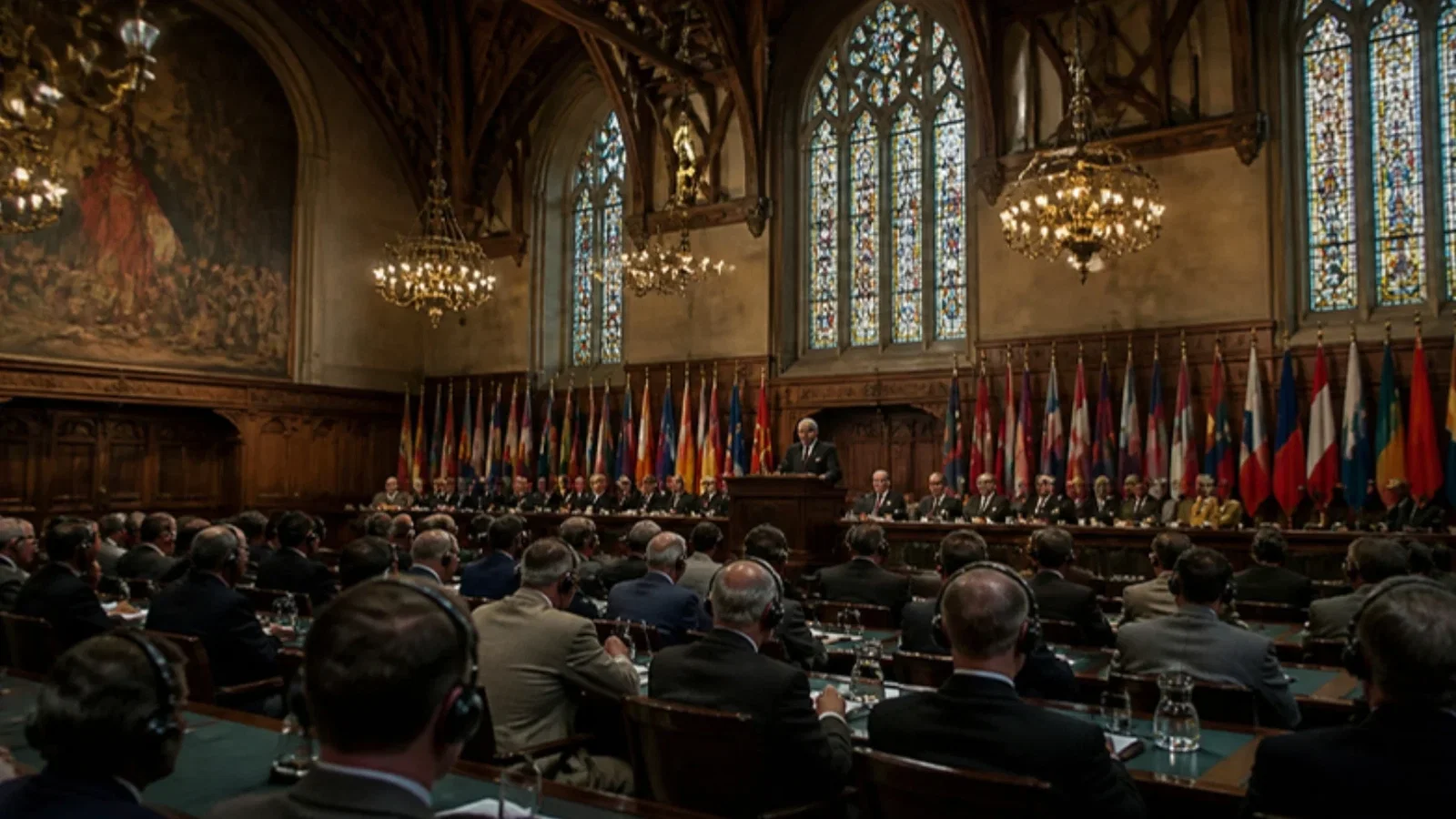
The British Journal of Anaesthesia's report of October 1955, its notice of 1954 and the Federation's own timeline: an opening in the Ridderzaal, translation into three languages, delegates from 26 countries and observers from six, and a constitution adopted in the Kurhaus.
Reading Library · Anesthesia Epochs · 中文版
Watch the education video (for clinicians)
1955: The World Federation Is Founded — Scheveningen · Anesthesia Epochs Education Series
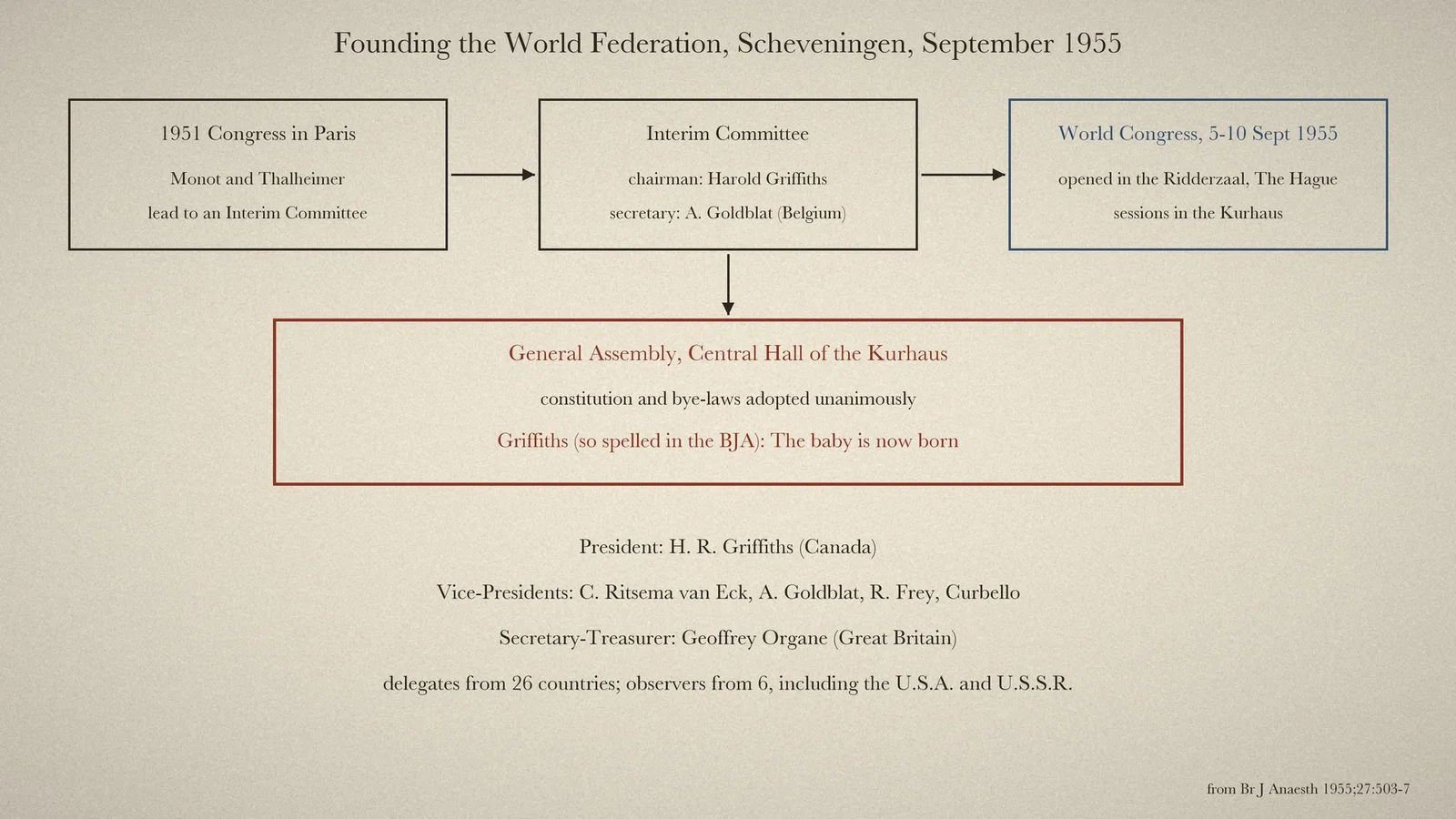
Existing articles in this series follow the World Federation of Societies of Anaesthesiologists in its later work. This one goes back to the week it was born: a congress at a Dutch seaside resort in September 1955, reported at length in the British Journal of Anaesthesia a month later. The report gives the speeches, the arguments, the list of countries present and the sentence with which the Federation's first President greeted its constitution.
Announced in advance
In November 1954 the BJA printed a notice. The World Congress of Anaesthesiologists would be held at Scheveningen near The Hague "from September 5 to September 10, 1955". Its subjects were relaxants and ganglion blockers, hypotension and phenothiazines, hypothermia and "hibernation", respiration and circulation, the teaching of anaesthesia, and free papers. [2, p. 410] "It is the intention that the Official Foundation of the World Federation of Societies of Anaesthesiologists should take place in the course of this Congress." The fee was 35 Dutch guilders, or 25 for those who applied before 31 March 1955. [2, p. 410]
The Congress
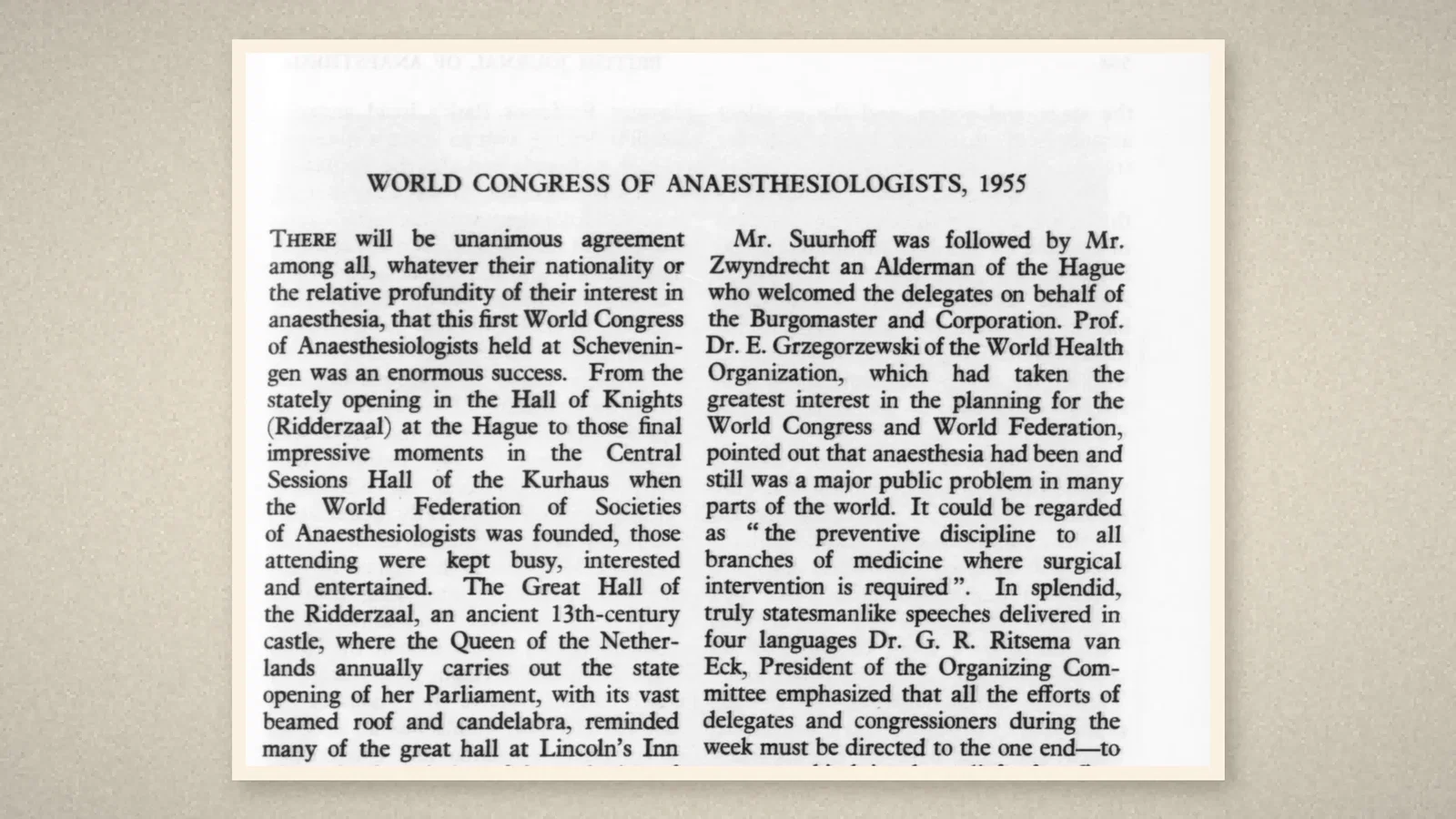
The October 1955 report began by calling the first World Congress "an enormous success". It ran from the opening in the Hall of Knights (Ridderzaal) at The Hague to the final moments in the Central Sessions Hall of the Kurhaus at Scheveningen, "when the World Federation of Societies of Anaesthesiologists was founded". [1, p. 503] The Dutch Minister of Social Affairs and Public Health, J. G. Suurhoff, opened the Congress. The minister noted that anaesthetists' skills were being applied to the treatment of poliomyelitis as well as to heart and lung surgery. [1, p. 503] Professor E. Grzegorzewski of the World Health Organization, which had taken "the greatest interest" in planning the Congress and Federation, said that anaesthesia was still "a major public problem in many parts of the world". He called it "the preventive discipline to all branches of medicine where surgical intervention is required". [1, p. 503] The president of the organizing committee, G. R. Ritsema van Eck, spoke in four languages. [1, p. 503]
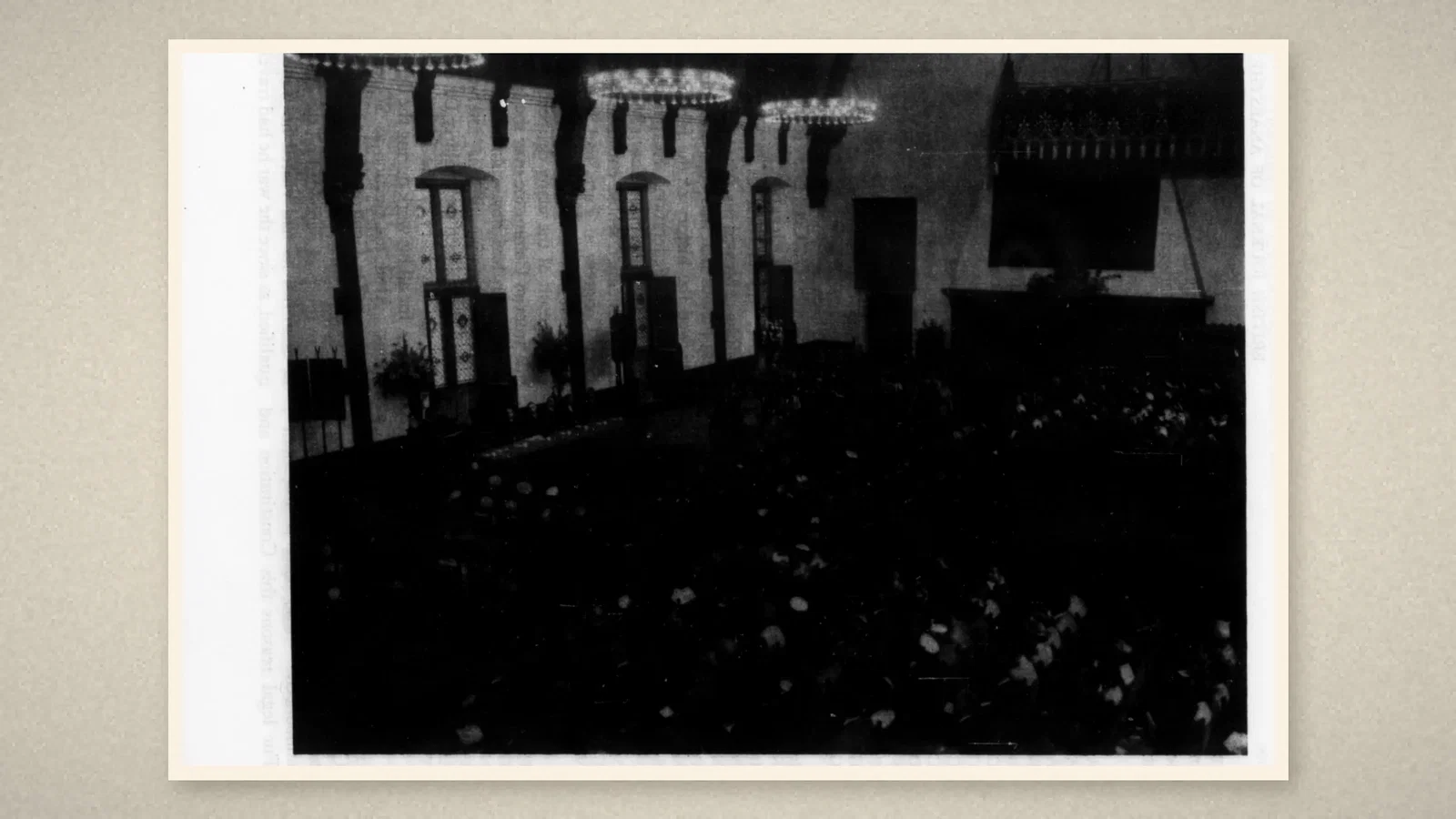
Every chair had headphones on which the speaker could be heard "in English, French and German". The report notes that the translators had some trouble with the more technical papers. [1, p. 504] As expected, the main themes were hypothermia, hypotension and the relaxant drugs. At one panel discussion Professor Beecher declared that hypotension and hypothermia were the only two advances of the previous twenty years that had let surgeons do what had been impossible; "it was clear that all present did not agree". [1, p. 504]
The General Assembly
"The climax of this outstanding Congress was the General Assembly" in the Central Hall of the Kurhaus. National delegates sat on the stage on either side of the chairman of the Interim Committee that had planned the Federation. [1, p. 504] The report spells the chairman's name "Dr. Harold Griffiths". The Canadian Society's timeline and the Federation's own spell it Griffith. [1, p. 504] [4] [3] The committee's secretary, A. Goldblat of Belgium, reported the credentials accepted. Twenty-six countries sent delegates, among them Canada (H. R. Griffith and R. A. Gordon), Sweden (T. Gordh), India, Brazil, Israel and South Africa. Six sent observers: Czechoslovakia, Greece, New Zealand, the USA, the USSR and Yugoslavia. [1, p. 506]
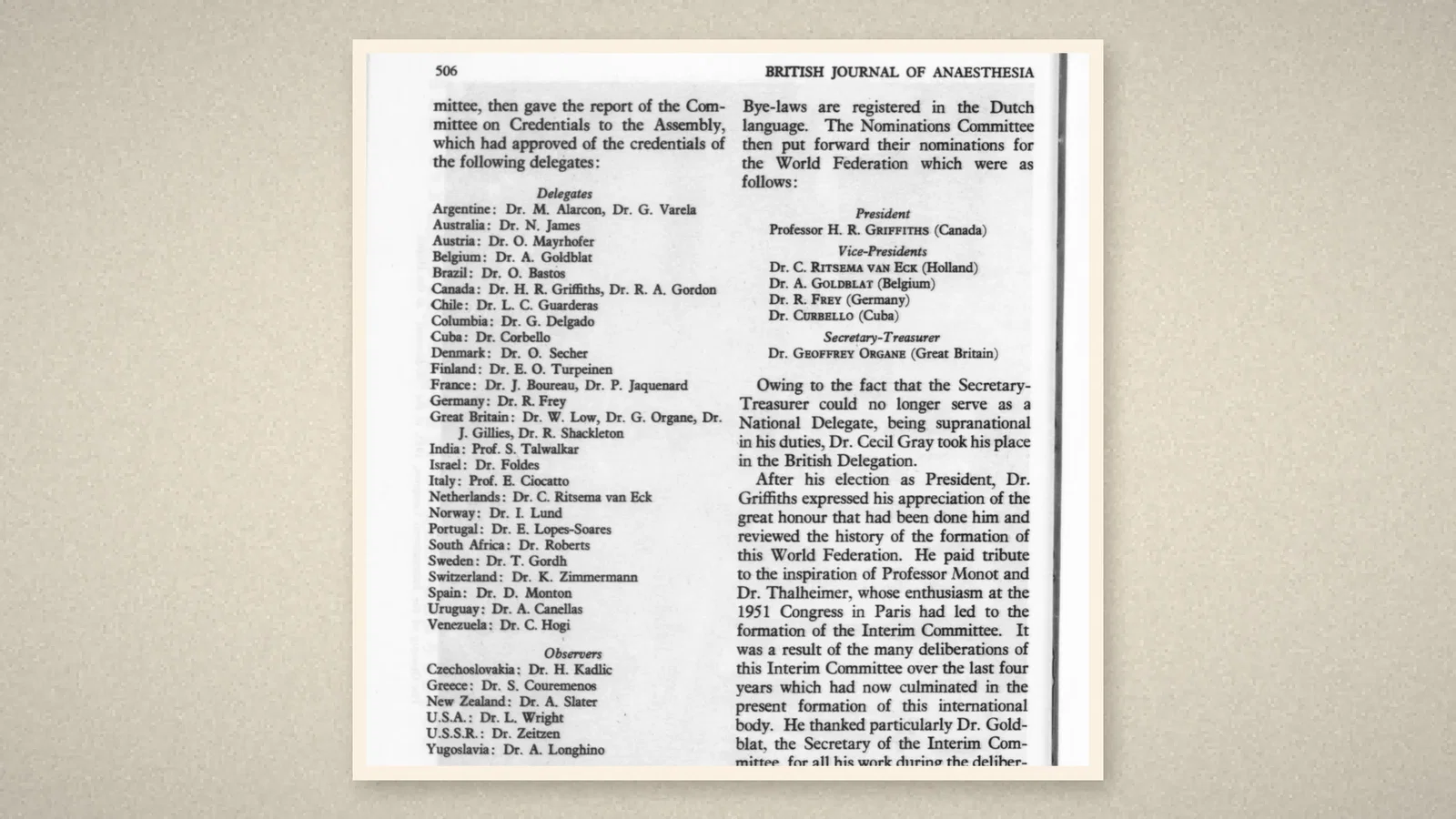
The constitution and bye-laws drawn up by the Interim Committee "were then unanimously adopted". Griffith announced: "The baby is now born." For legal reasons the constitution was registered in Dutch. [1, p. 506] Griffith of Canada was elected President. The Vice-Presidents were Ritsema van Eck, Goldblat, R. Frey of Germany and Curbello of Cuba, and the Secretary-Treasurer was Geoffrey Organe of Great Britain. Because that post was "supranational", Cecil Gray took Organe's place in the British delegation. [1, p. 506] Griffith traced the Federation back to the 1951 congress in Paris, where the enthusiasm of Professor Monot and Dr Thalheimer had led to the Interim Committee. [1, p. 506] Organe said that war was "the greatest futility", the result of misunderstanding that people could avoid by getting to know each other better. [1, p. 507] The time and place of the next congress were left to the Executive Committee. [1, p. 507]
In the Federation's memory
The WFSA's own timeline records the Congress "on 5-10 September under the patronage of H.M. Queen Juliana". It dates the founding to 9 September, "with Harold Griffith as the first President and 26 Member Societies". [3] The 26 matches the delegate list printed in the BJA. [1, p. 506] The same timeline adds that the American Society of Anesthesiologists, an observer in 1955, joined in 1960, when the second congress met in Toronto under R. A. Gordon. [3] The Canadian Society lists the Federation's founding, with Griffith as Founder-President, among its own events of 1955. [4]
What the record shows
The Federation was founded on the last day of a congress that had worked in three languages. An interim committee had prepared it over four years, a health minister opened the congress, and the World Health Organization had taken an interest in the planning. Twenty-six countries voted. The United States and the Soviet Union watched from the observers' seats.
Sources and reading limits
Read: the BJA report "World Congress of Anaesthesiologists, 1955" (October 1955, pp. 503-507), including the photograph on p. 505; the BJA notice of November 1954, p. 410; the WFSA history timeline; the CAS timeline.
Not covered: the constitution and bye-laws, the minutes of the General Assembly, the Interim Committee's papers and the congress proceedings are not covered, and the 1951 Paris congress was not researched. The BJA report gives no date for the General Assembly; 9 September comes from the WFSA timeline. The report spells the President's name Griffiths; other sources spell it Griffith, and the article follows them except where quoting the report. The report also once calls the body the "World Federation of National Societies of Anaesthesiologists". The photograph on p. 505 is printed sideways in the journal and is shown turned upright.
One illustration is a diagram drawn from the BJA report; three are crops of its pages.
- World Congress of Anaesthesiologists, 1955. Br J Anaesth. 1955;27(10):503-7. Internet Archive
- World Congress of Anaesthesiologists. Br J Anaesth. 1954;26(6):410. Internet Archive
- World Federation of Societies of Anaesthesiologists. WFSA history timeline. Website
- Canadian Anesthesiologists' Society. Timeline of CAS Events. Website
Continue exploring
Related reading connects shared questions and contexts; it does not by itself establish historical influence.
Anesthesia Epochs · The Source Room · About & Editorial Method
Published November 2, 2026. Sources and reading limits are stated above. Illustrations are labelled as original source images or AI-made. Historical accounts are educational; they are not current treatment instructions.