A 1974 patent anchor, with design, commercialization and later use kept distinct.
Reading Library · Anesthesia Epochs · 中文版
Watch the companion film
1974: The Mayfield Skull Clamp — Holding Steady · Watch on YouTube
Historical anchor: 1974. Date details and source qualifications are explained below.
A United States patent granted on September 17, 1974 described a surgical head clamp intended to close quickly, hold the head firmly and accommodate differences in head shape and positioning. The named inventors were George Kees Jr. and Horst R. Hickmann; the assignee was Kees Surgical Specialty Company.[1, cover and column 1] For the history of the Mayfield clamp, this provides a dated design document. It does not, by itself, identify the first commercial sale.
The design used two sliding L-shaped main sections. One side carried a single pin; the opposite side carried two pins on an arcuate sliding bar. A rack-and-pawl arrangement allowed the sections to close while restraining separation. The curved bar accommodated position, while a threaded carrier, spring and graduations on the single-pin side addressed adjustment and applied force.[1, columns 1–4] These passages describe mechanical features and their intended functions. The patent did not report a patient trial establishing their clinical safety.
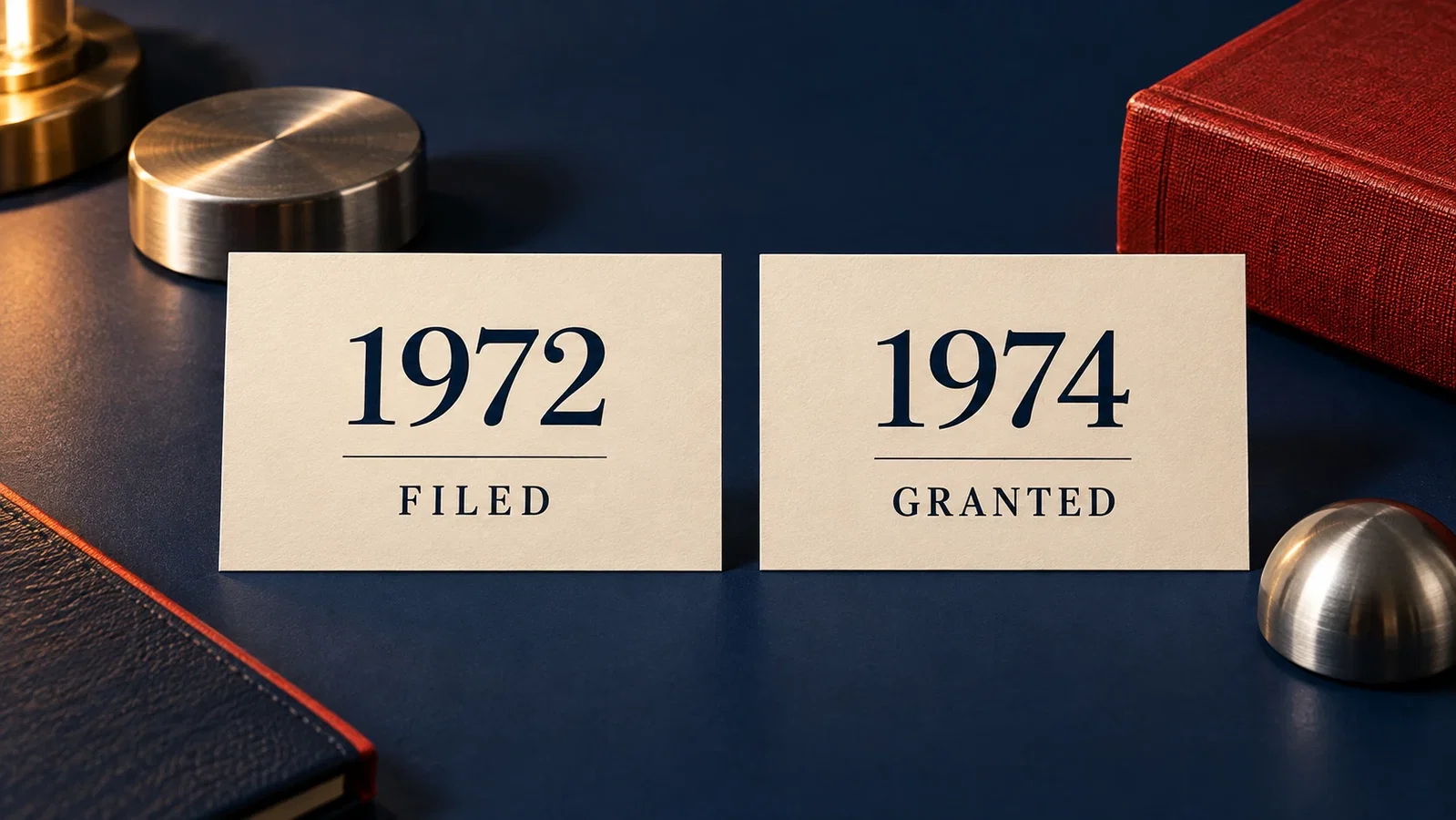
The application had been filed on December 8, 1972. Keeping filing and grant separate prevents either date from being mistaken for the first operation performed with the device.[1, cover] Later histories introduce another distinction. The Mayfield institutional timeline places the three-pin clamp under 1974; the biography of Frank Mayfield and Integra’s timeline use 1973. The institutional entry for 1968 describes the formation of a company.[4–6] These accounts do not establish a 1968 launch of the skull clamp.
The names also need to remain attached to their respective records. Mayfield’s biography concerns his contributions to surgical instruments. The patent records Kees and Hickmann as inventors. The brand name does not authorize adding Mayfield to that patent’s inventor list, and his absence from the list does not disprove the development role described in institutional histories.[1, cover; 4–5] The date used for this article is therefore the documented 1974 grant, with the retrospective chronology left unresolved.
A second patent makes a subsequent design change explicit. Granted in 1979 to Hickmann and assigned to Ohio Medical Instrument Company, US4169478 described an improvement to the type of clamp shown in US3835861. Its stated objective was to permit rotation of the head while the pins remained engaged, followed by locking in a selected position.[2, cover and column 1] This addressed adjustment after fixation. The later rotating mechanism should not be projected back into the 1974 design.
A 2003 patent connected the brand name to this documentary sequence. Day and Lincoln stated that the assignee had commercialized a series of three-pin clamps under the MAYFIELD trademark, specifically identifying the device in US4169478. Their new design addressed load distribution between the two pins on the rocker arm, using indicators to make differences in loading visible.[3, columns 1–2] This supports a connection between the brand and the earlier design. It supplies neither a first-sale date nor independent verification of the patent’s account of market success.
Clinical records raise a different question. In a single-center retrospective pediatric series published in the 2023 volume of Child’s Nervous System, Hermann and colleagues described three-point Mayfield fixation during team positioning. They also recorded median-nerve somatosensory evoked-potential baselines in the supine and semi-sitting positions.[7, pp. 159–161] This was a later use of the device in a selected population. The authors also discussed clamp-related skull fractures, so successful fixation cannot be equated with absence of risk.[7, p. 166]
This offers a specific comparison with 1977: Nash's Spinal Cord Monitoring Interprets the Recorded Signal. Fixing position and interpreting a neural signal were separate tasks brought together in the later positioning workflow. Nuwer’s historical chapter describes noise, variability and anesthetic influence as problems in early SEP work by Nash and colleagues.[7, p. 161; 8, p. 1] The link is an editorial comparison of functions. It does not establish a causal invention chain or claim that Hermann cited Nash directly.
Read together, these documents distinguish a structure for fixation, a mechanism for adjustment and observation during use. Patents record what designers intended a device to do. Clinical accounts place it within a team’s work. Each contributes something the other cannot establish alone.[1–3; 7]
All four illustrations are modern editorial concepts, not historical photographs, product replicas, original patent drawings, patient records or procedural demonstrations.
Sources and reading limits
- Kees G Jr, Hickmann HR. US3835861: Surgical head clamp. Filed December 8, 1972; granted September 17, 1974. All six original pages were read, including the cover and specification columns 1–4.
- Hickmann HR. US4169478: Surgical head clamp. Filed March 15, 1978; granted October 2, 1979. All ten pages were read, including the cover and columns 1–2.
- Day JL, Lincoln DA. US6629982B2. Granted October 7, 2003. Four of nine pages were read: 1, 4, 8 and 9. These include the cover, columns 1–2, final claims and the February 10, 2004 correction certificate, which corrects one reference from the “148” patent to the “478” patent. The whole specification and all thirteen claims were not read.
- Mayfield Brain & Spine. Our History. Selected entries for 1967, 1968, 1973 and 1974 read. A later institutional history, not a contemporary sales record.
- Mayfield Brain & Spine. Frank H. Mayfield. Inventions section read. The same institutional source as the timeline, not independent confirmation.
- Integra. MAYFIELD historical timeline. 1968 and 1973 entries read. Manufacturer retrospective; promotional metrics and current instructions are not used.
- Hermann EJ et al. Resection of posterior fossa tumors in the semi-sitting position in children younger than 4 years of age. Childs Nerv Syst. 2023;39:159–167; online November 9, 2022. Only pp. 159, 160, 161 and 166 were read in text and original page images. The December 30, 2022 name correction was checked. Unreviewed complete results and generalized safety conclusions are not adopted.
- Nuwer MR. Introduction, history, and staffing for intraoperative monitoring. Cambridge, 2010, pp. 1–9. Only printed page 1 of the preview was read in text and original image. A later historical account, not an original Nash report.
The patents form a dependent citation sequence, and the institutional histories share provenance. These sources and the later clinical report serve different evidentiary roles. They are not three independent confirmations of commercial priority or clinical benefit. The first-sale date and the 1973/1974 retrospective discrepancy remain unresolved.
First commercialization remains unresolved.
Continue exploring
Related reading connects shared questions and contexts; it does not by itself establish historical influence.
The Source Room · About & Editorial Method
Sources and reading limits are stated above. Illustrations are labelled as original source images or AI-made. Historical accounts are educational; they are not current treatment instructions.