In a paper printed in 1756, Joseph Black showed by weighing that magnesia lost a kind of air when heated and nearly regained it when remade, the substance he called fixed air, now known as carbon dioxide.
Reading Library · Anesthesia Epochs · 中文版
Watch the education video (for clinicians)
1756: Joseph Black and Fixed Air — Weighing the Missing Part · Anesthesia Epochs Education Series

The powder weighed less after heating. Where had the missing weight gone?
Joseph Black did not leave the answer at “burnt away.” He compared weights, tested how the material behaved with acids and tried to recover its earlier properties. Something invisible could be investigated through changes that could be weighed and compared.[1, pp. 172–179]
His subject was what he called fixed air, now identified as carbon dioxide.[3] This belongs to the history of distinguishing gases, a useful background to their later medical uses. It is not an account of discovering oxygen or beginning clinical anesthesia.
Two dates with different jobs
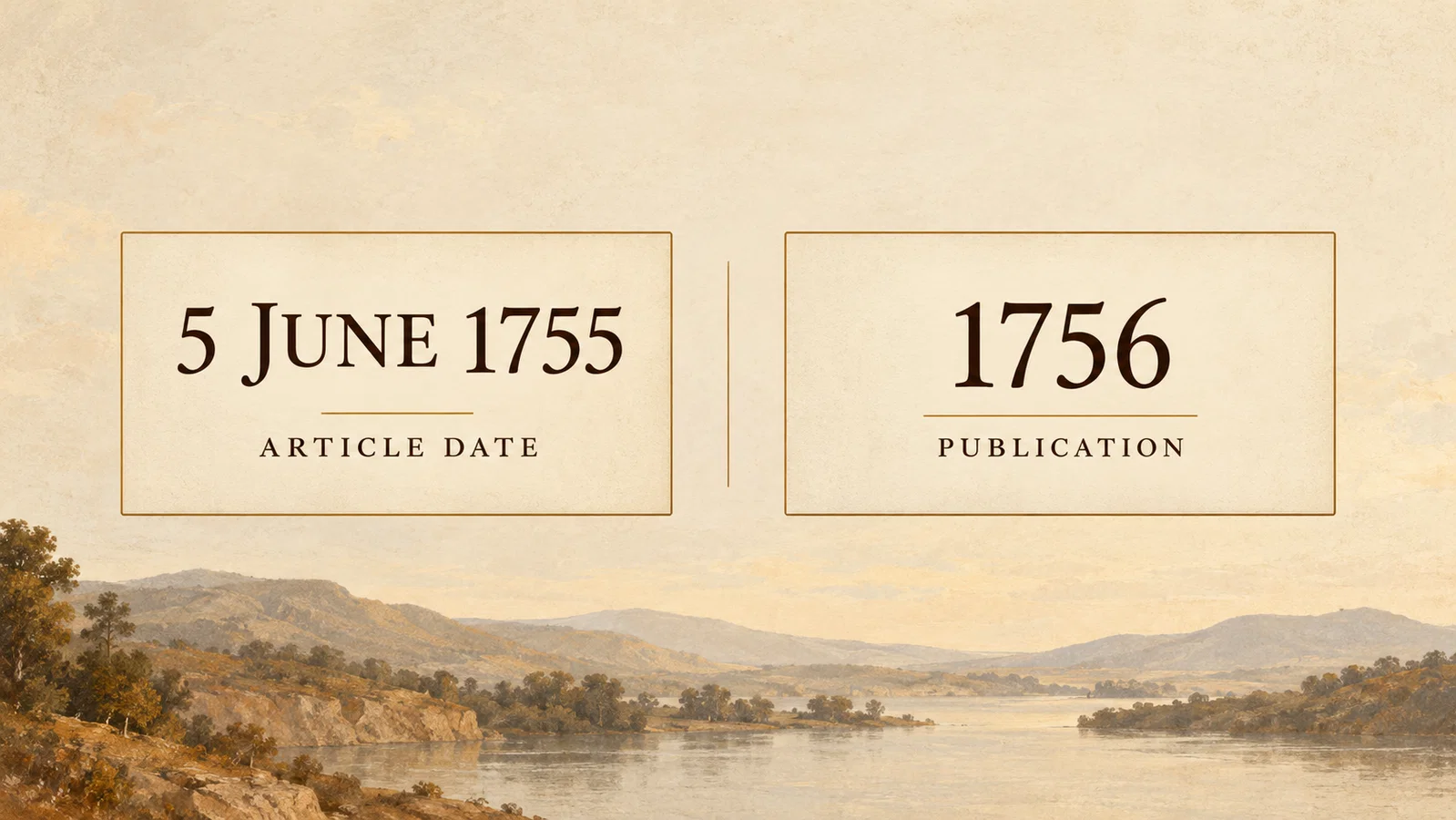
Black’s Experiments upon Magnesia alba, Quicklime, and some other Alcaline Substances appeared in the second volume of the Edinburgh Essays and Observations, Physical and Literary. The original volume’s title page bears 1756; a footnote on the article’s first page separately prints “June 5. 1755.”[1, title page and p. 157] The preface to the 1898 Alembic Club reprint identifies June 1755 as the reading and distinguishes publication in 1756.[2, preface]
This article dates the paper by its publication in 1756, without assigning every experiment to that year. Black is often said to have shown, around 1757, that exhaled breath contains fixed air; that claim is not in this paper and is not examined here.
A medical hope that did not succeed
Black explained that his interest in these absorbent earths arose partly from a hope of finding a new lime and limewater that might dissolve stones more effectively. He immediately acknowledged that his expectation had been disappointed.[1, p. 160]
That opening preserves both the medical motivation and its unsuccessful outcome. The chemical investigation does not need an invented therapeutic success to make it significant.
More than water was missing
In one experiment, Black recorded that an ounce of magnesia lost seven twelfths of its weight on heating. The heated material still dissolved in acids, but without the earlier effervescence.[1, p. 172]
He also tried collecting what escaped during heating. The liquid recovered accounted for only part of the weight loss, and he acknowledged that this particular heating experiment was incomplete. From these observations he concluded that most of the volatile material lost was air, helping explain why the calcined material no longer bubbled when treated with acid.[1, pp. 173–175]
Seven twelfths is his reported loss in weight. It cannot be rewritten as the proportion of pure carbon dioxide in the sample. Water and other possible losses also entered his discussion.
Bringing the properties back
Black then dissolved calcined material and precipitated it again with an alkali. The resulting powder recovered properties including effervescence with acids, while its gain in weight nearly matched what had previously been lost.[1, pp. 175–177]
“Nearly” matters. This was not a report of an error-free closed account. Black later considered why the original weight had not been recovered completely, suggesting that some solid material might have escaped along with the volatile portion. That remained his proposed explanation of the discrepancy.[1, p. 179]
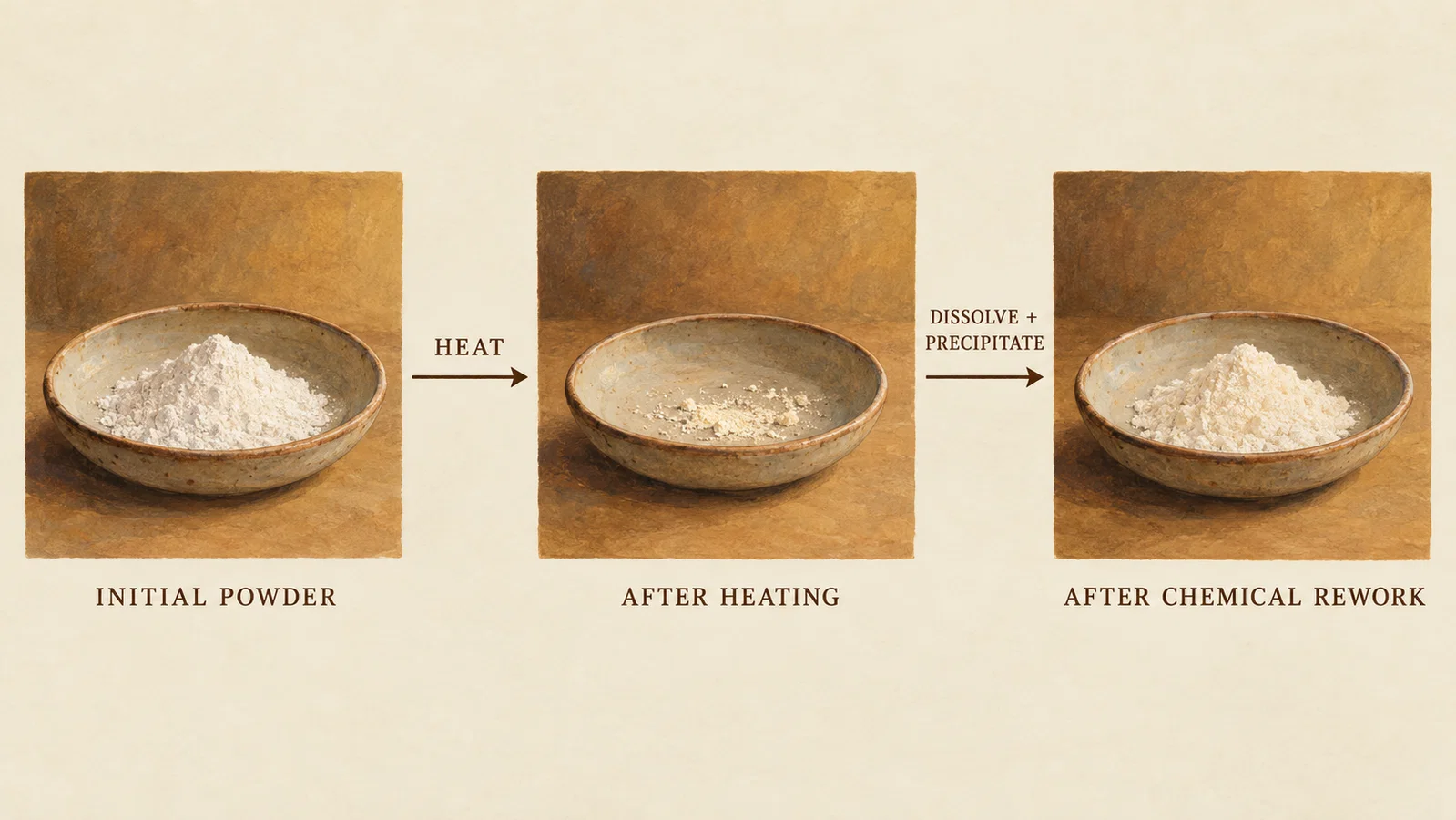
Discussing another chemist’s estimate, he observed that a material could gain weight and lose weight during the same treatment. Counting only the final increase could miss what had departed.[1, pp. 177–178] That reasoning shows more of his work than the compressed statement that he discovered a gas.
Distinguishing one kind of air
Later in the paper, Black compared the behavior of limewater under different conditions of exposure. He argued that lime combined with a particular substance dispersed through the atmosphere, rather than with ordinary air indiscriminately.[1, pp. 198–199]
He still considered alternatives for its physical state: an extremely fine powder, or more probably an elastic fluid. He used the familiar expression fixed air, acknowledged that it might be imperfect and left further properties for future inquiry.[1, p. 199] This was neither a complete modern theory of gases nor a claim to have invented the expression from nothing.
The missing weight had become something to explain. By bringing weight changes, altered reactions and the recovery of properties into one argument, Black made an invisible component accessible to investigation. That is this article’s place in the history surrounding anesthesia and respiratory gases. Oxygen, nitrous oxide and their clinical applications retain their own evidence and dates.
Material and image limits: Selected original pages and the 1756 volume title were read, not the entire 69-page paper or volume. The 1898 transcription supported reading and date comparison. This is historical interpretation, not a laboratory or treatment procedure. All four images are AI editorial illustrations: an anonymous weighing scene, modern date cards, a nonquantitative conceptual sequence and a still life. They are not portraits, original experimental drawings or authenticated apparatus.
Sources and reading limits
[1] Black J. Experiments upon Magnesia alba, Quicklime, and some other Alcaline Substances. Essays and Observations, Physical and Literary. Vol. II. Edinburgh: G. Hamilton and J. Balfour; 1756:157–225. Original volume scan. Read: the title page and pp. 157, 159–160, 172–180 and 198–199 (p. 180 is misprinted 280).
[2] Black J. Experiments upon Magnesia Alba, Quicklime, and some other Alcaline Substances. Alembic Club Reprints No. 1, 1898. Gutenberg transcription. Preface and text to p. 32 read; the two editions were not collated in full.
[3] Science Museum Group. Joseph Black collection biography. Used only to give fixed air its modern name, carbon dioxide.
Continue exploring
Related reading connects shared questions and contexts; it does not by itself establish historical influence.
Anesthesia Epochs · The Source Room · About & Editorial Method
Updated October 30, 2026. Sources and reading limits are stated above. Illustrations are labelled as original source images or AI-made. Historical accounts are educational; they are not current treatment instructions.