Anesthesia Epochs
About this film
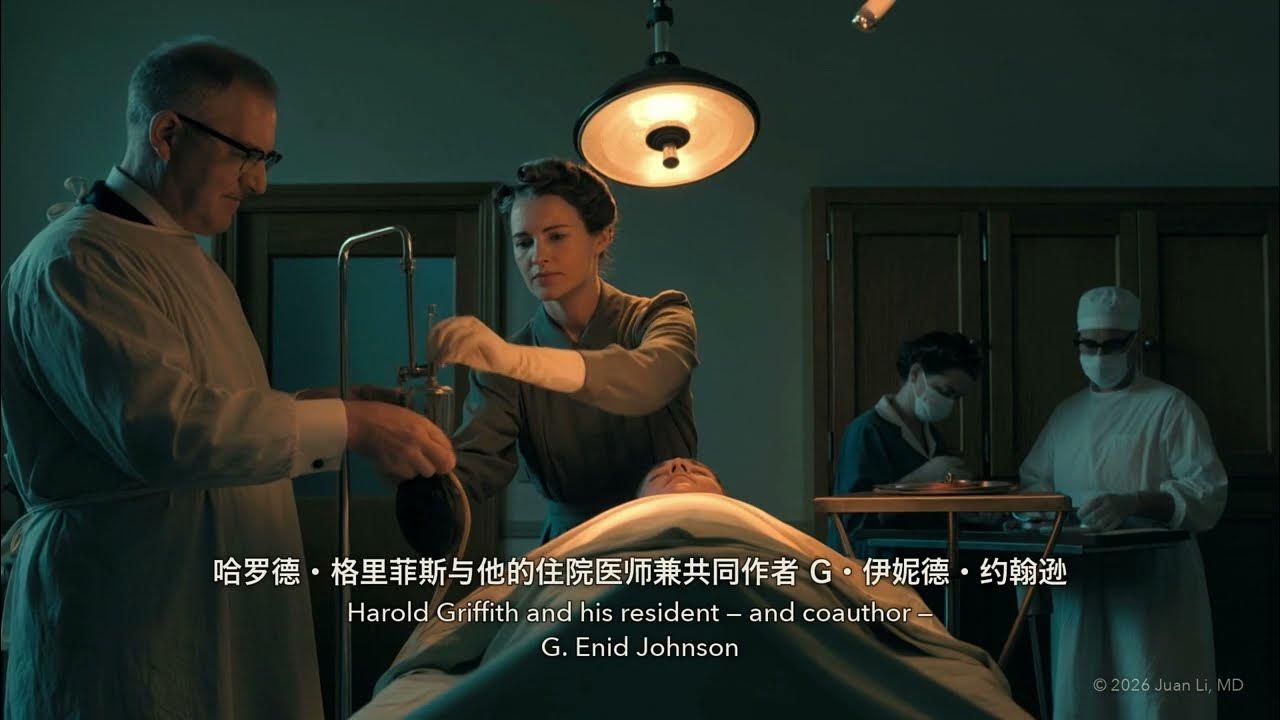
Montreal, 1942. Harold Griffith and G. Enid Johnson reported using Intocostrin, a curare extract, alongside general anesthesia in twenty-five patients. Their report helped distinguish muscle relaxation from the other effects needed during an operation. Relaxation did not itself provide unconsciousness or pain relief, and a motionless patient was not evidence of adequate anesthesia. This film follows that distinction and the continuing responsibility for airway and breathing support that accompanied it.
Read the companion essay · 1942: Griffith and Johnson Use Curare in Twenty-Five Patients
Scientific takeaway
Muscle relaxation does not establish unconsciousness or analgesia; airway and breathing support remain essential concerns.
Sources
- Griffith HR, Johnson GE. The use of curare in general anesthesia. Anesthesiology. 1942;3(4):418-420. doi:10.1097/00000542-194207000-00006. Read the article
- Griffith HR. Editorial. Survey of Anesthesiology. 1957;1:73-74. Read the editorial (authorized reprint, PDF p. 66)
- Dillane D, Chartrand D, Maltby R. Harold Griffith's legacy: a tribute on the 75th anniversary of the introduction of curare into anesthetic practice. Can J Anaesth. 2017;64(6):559-568. doi:10.1007/s12630-017-0864-6. Read the article
Notes on reconstruction
The clinical series is historical; reconstructed scenes are illustrative and should not be read as a verbatim record of a single injection or encounter.
Read beyond the film
1942: Griffith and Johnson Use Curare in Twenty-Five Patients
Explore the longer account, original references, reading limitations and connected stories.