A separately supplied relaxation effect was not anesthesia by itself.
Reading Library · Anesthesia Epochs · 中文版
Watch the companion film
1942: Curare · Watch on YouTube
Historical anchor: 1942. Date details and source qualifications are explained below.
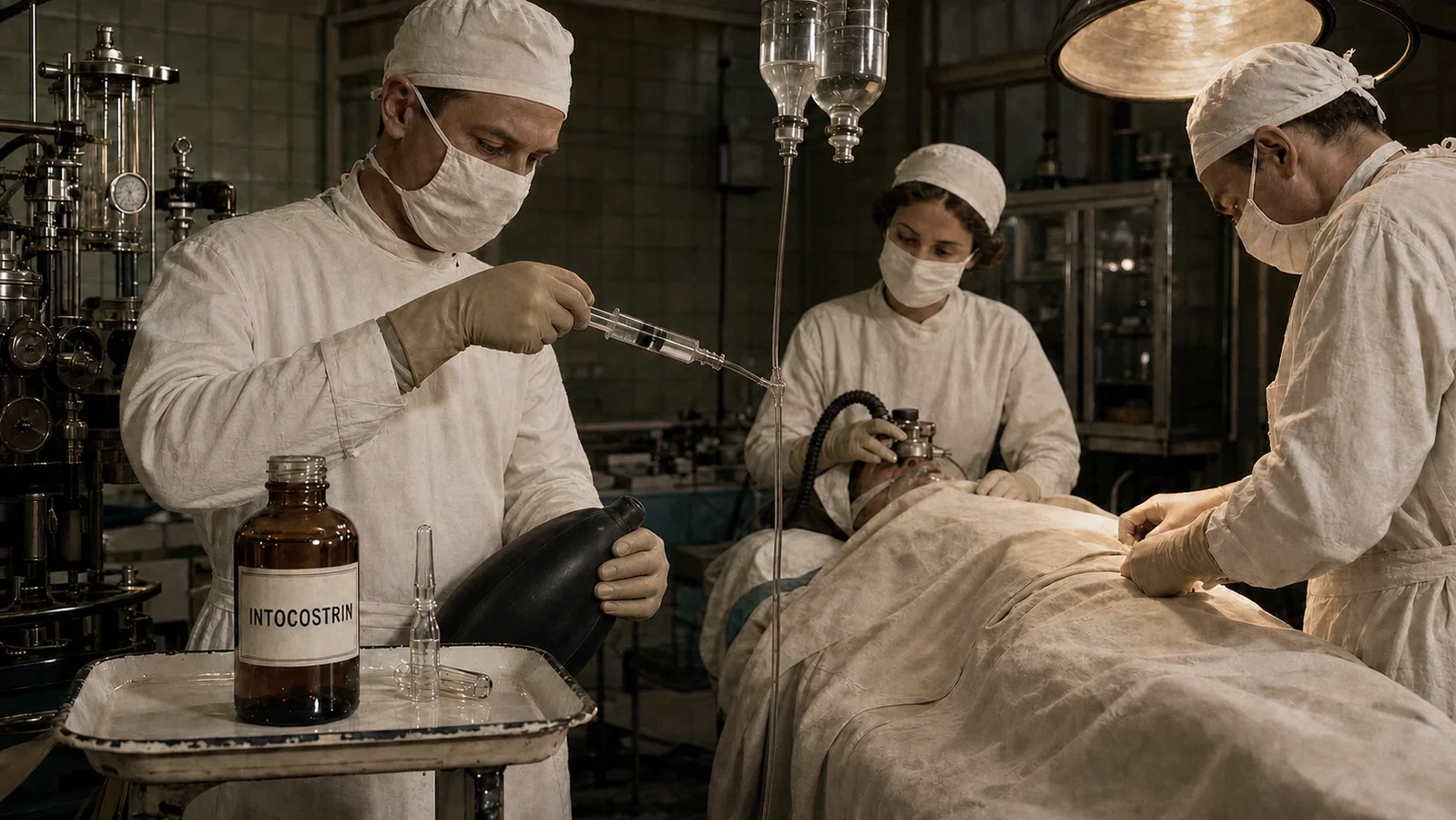
Immobility is not the same thing as anesthesia. That distinction runs through the 1942 paper jointly signed by Harold Griffith and G. Enid Johnson. Their patients received curare alongside cyclopropane anesthesia, not as a replacement for it.[1]
The clinical series matters because of what the added relaxation could provide, and what it could not. It needs no invented emergency at the operating table to make that distinction consequential.
1. One starting date, a series of observations
In a retrospective editorial published in 1957, Griffith identified 23 January 1942 as the starting date. David Bevan's 1992 historical account also reproduced the text of an appendectomy anesthetic record for that day.[2;3, p.50] The original hospital chart itself was not examined.
In the sources read, a single injection, an abdomen described as dough, and an operation that could not be closed do not form a verified continuous scene. Bevan's transcription records two administrations; the dough comparison in the published 1942 paper refers to several appendectomies, not specifically to the first case.[1;3, p.50]
A first case and a series' summary should not be edited into one dramatic minute. The doses are unnecessary to the historical point and are not reproduced here.
2. An extract, not a fully identified molecule
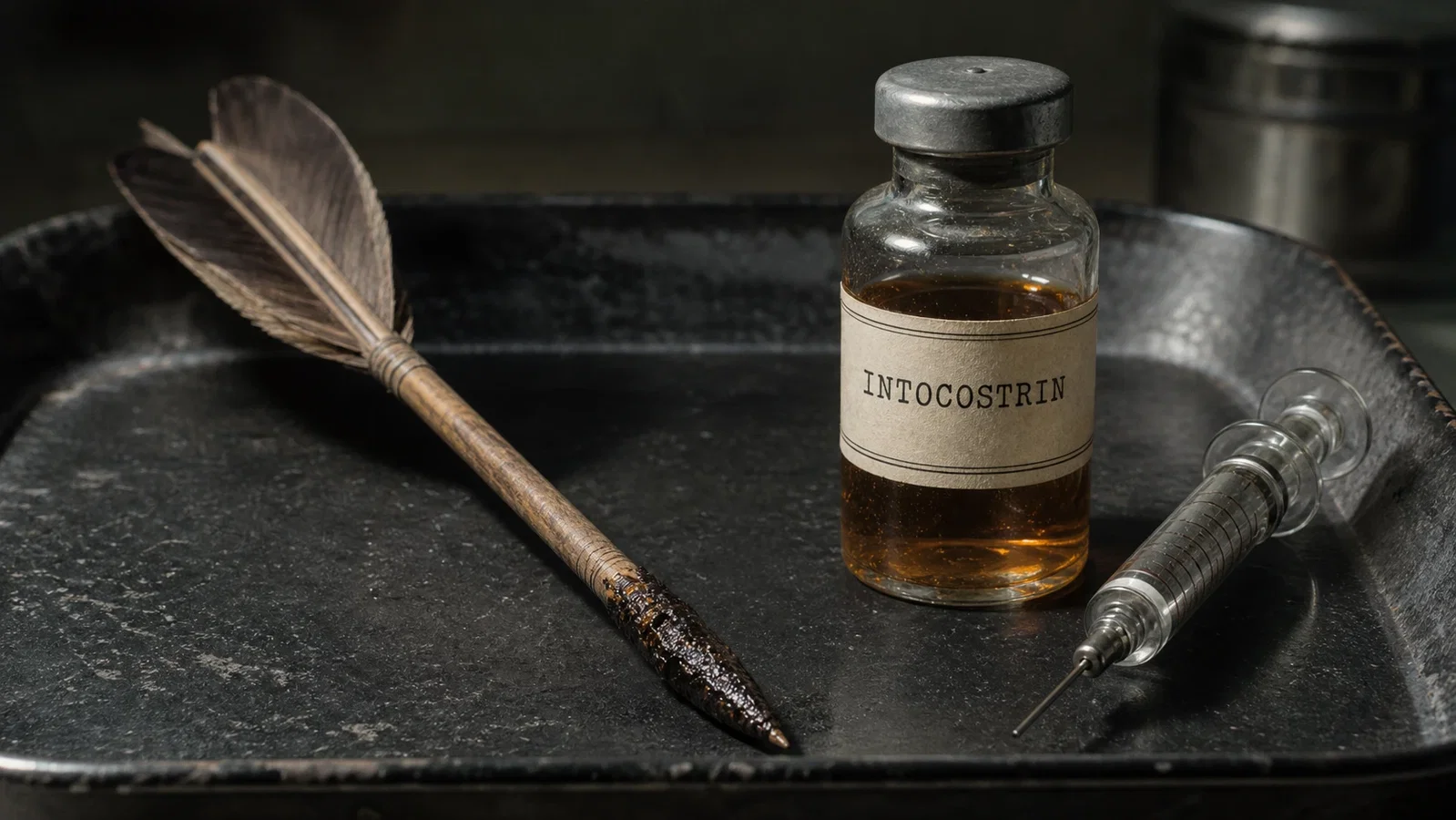
Curare's history includes preparations used by Indigenous South American peoples in hunting. That background does not, by itself, identify the contents of a particular clinical bottle.
The 1942 article described Intocostrin as a Squibb curare extract and explicitly retained uncertainty about the source in the preparation's name.[1] It should not be equated with pure d-tubocurarine or confidently assigned to one plant species.
Nor does the route into medicine need to be told as mysterious Indigenous knowledge awaiting rescue by a lone modern physician. In the clinical report itself, the named work was shared. Johnson was a physician and coauthor; the commemorative volume's preface identifies her as a resident at the time.[1;3, preface]
3. A separately supplied effect, not the invention of every component
The clinical objective was relaxation. Curare did not supply unconsciousness or relief from pain, which is why the series combined it with an anesthetic. The authors explicitly distinguished it from an anesthetic agent.[1]
That made a clinically important separation visible. It does not mean that, before 1942, every doctor had only one option: deepen an inhaled anesthetic. Bevan's historical discussion describes earlier attempts with curare, other anesthetic techniques and uneven subsequent adoption.[3, pp.49–51]
This article therefore does not claim the first human administration of curare, or an absolute first use during general anesthesia. Its subject is Griffith and Johnson's twenty-five-case report and the clinical development it helped advance. A narrower claim leaves room for the people and practices that preceded it.
4. Relaxation did not remove the obligation to protect breathing
The optimism of an early paper must not be mistaken for an established safety conclusion. In his 1957 editorial, Griffith emphasized the respiratory danger of muscle relaxants and the importance of preparation and training.[2]
Reading that later warning alongside the 1942 report preserves a history of learning, rather than pretending that purification had already eliminated respiratory risk. A drug could facilitate operating conditions while introducing responsibilities that its early advocates still had to clarify.
For this article, the lasting question is not whether a single injection changed everything. It is how clinicians distinguished a patient who could not move from a patient adequately anesthetized. The two were not interchangeable.
The story still has tension: an extract with a long history, two coauthors, a clinical series and a useful effect that did not perform the whole job. It becomes more compelling when its limits remain visible.
Sources and reading limits
[1] Griffith HR, Johnson GE. The Use of Curare in General Anesthesia. Anesthesiology. 1942;3:418–420. The complete article was read visually in the Canadian Anaesthetists' Society's 1992 commemorative volume, printed pp.56–57, PDF pp.60–61. This is a complete reprint, reflowed from three original pages to two, not an abstract.
[2] Griffith HR. Editorial. Survey of Anesthesiology. 1957;1:73–74. Its complete reprint on printed p.62/PDF p.66 of the same volume was read. It is a participant's retrospective account, not a contemporaneous 1942 chart.
[3] Bevan DR. Curare. In: Maltby JR, Shephard DAE, eds. Harold Griffith: His Life and Legacy. Can J Anaesth. 1992;39(1 suppl):49–55. Reading covered pp.49–52 and the volume's preface, not the entire chapter or volume. The first-case chart is known here through this transcription.
Revised 7 September 2026. Sources and reading limits are stated above. Illustrations are labelled as original source images or AI-made. Historical accounts are educational; they are not current treatment instructions.
Visual interpretations
These illustrations explore the setting and ideas. Depicted people, actions, instruments and documents are reconstructions, not evidence of their exact historical appearance.

Continue exploring
Related reading connects shared questions and contexts; it does not by itself establish historical influence.
- 1884: Koller Brings Cocaine to the Surface of the Eye
- c. 1964: Block-Aid Makes Muscle-Relaxant Action Repeatedly Observable
- 2002: The Sugammadex Concept Builds a Molecular Pocket for Rocuronium
- 2008: Bridion Enters the European Union
- 2020: Japan Approves Remimazolam for General Anesthesia
Anesthesia Epochs · The Source Room · About & Editorial Method
Continue this reading route
Stop 4 of 7 · Back to route · From Ether to Balanced Anesthesia
Previous · 1934: Lundy Uses and Observes Thiopental at the Mayo Clinic
Next · c. 1964: Block-Aid Makes Muscle-Relaxant Action Repeatedly Observable
The curare cases describe muscular relaxation. Block-Aid made it possible to elicit a response repeatedly and compare it over time.