The 1934 introduction and the cases, airway concerns and limits in a 1935 report.
Reading Library · Anesthesia Epochs · 中文版
Watch the companion film
1934: Thiopental at Mayo—The Airway Still Matters · Watch on YouTube
Historical anchor: 1934. Date details and source qualifications are explained below.
In 1934, John S. Lundy’s anesthesia section at the Mayo Clinic began using a new thiobarbiturate. His report the following year called it “barbiturate A” and thionembutal. The drug became known as thiopental, marketed as Pentothal.[1,p.537;2]
The report concerned more than rapid onset. Lundy repeatedly returned to airway patency, depressed respiration and the difficulty of attending to an injection while observing the patient. A new drug brought practical questions to the bedside.[1,pp.539–540]

Historical concept illustration. The person, notes, containers and room are imagined, not a Lundy portrait or a reconstruction of the first Mayo administration.
What belongs to 1934
The contemporary report dates the section’s introduction of the compound to 1934. In a statement written to Waltman Walters in 1967, Lundy also recalled introducing intravenous Pentothal at Mayo in that year. The Wood Library-Museum’s historical account agrees. These sources support the year, although the memoir and museum account are not additional eyewitness records made in 1934.[1,p.537;3,p.2;4]
First clinical use and subsequent investigation are separate questions. Ball and Westhorpe attribute the earliest clinical use, according to the historical reports they discuss, to Ralph Waters. They credit Lundy with much of the early clinical research and reporting. This article therefore dates Mayo’s introduction to 1934 without supplying an unverified day or making Lundy the sole discoverer.[2]
Intravenous anesthesia already had a history. Lundy opened his paper with earlier experience using amytal and pentobarbital. Calling thiopental the beginning of all intravenous anesthesia would erase those predecessors.[1,p.536;2]
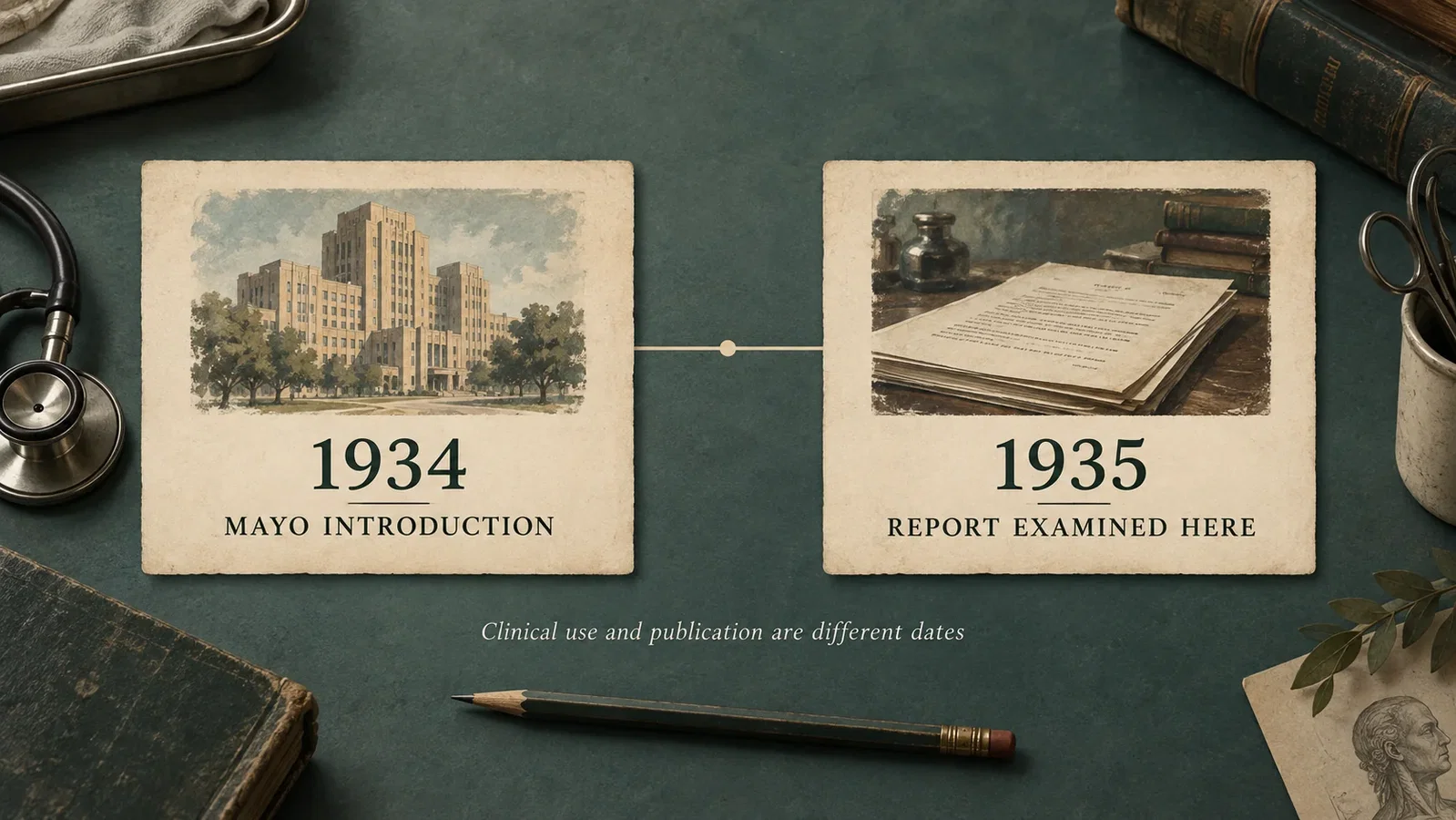
1934: use begins at Mayo. 1935: the report examined here. The latter date does not claim that no related experience had previously been published.[1,pp.536–537]
Reading the drug names carefully
The paper was a preliminary report on two new thiobarbiturates, designated A and B. Lundy preferred A. He also discussed other barbiturates, so a familiar later title is not enough to identify the drug behind every passage or figure. Figure 2 concerns amytal; Figure 8 concerns Evipal. Neither is a thiopental response curve.[1,pp.536–539,542]
Table 1 lists 700 cases involving A across different operations and procedures. That total documents accumulated experience, not universal safety. It also carries an unresolved date discrepancy: the issue header reads August 21, 1935, while the table footnote dates completion of the figures to August 23. The surviving reprint does not explain the difference. “The 700 cases in the 1935 report” preserves what can be stated without selecting a cutoff by guesswork.[1,pp.541–543]
Breathing required attention
Lundy warned that chest movement alone did not establish a patent airway. His discussion included using a small wisp of cotton near the nose and mouth to observe airflow. He also described the practical difficulty of one person supporting the airway while attending to the injection.[1,pp.539–540]
The paper stressed experience and appropriate facilities. In a longer brain operation, Lundy described a Magill tube providing an airway and a route for assistance with breathing or inhaled anesthetics if required. Those stated contingencies do not establish that either rescue action actually occurred.[1,p.540]
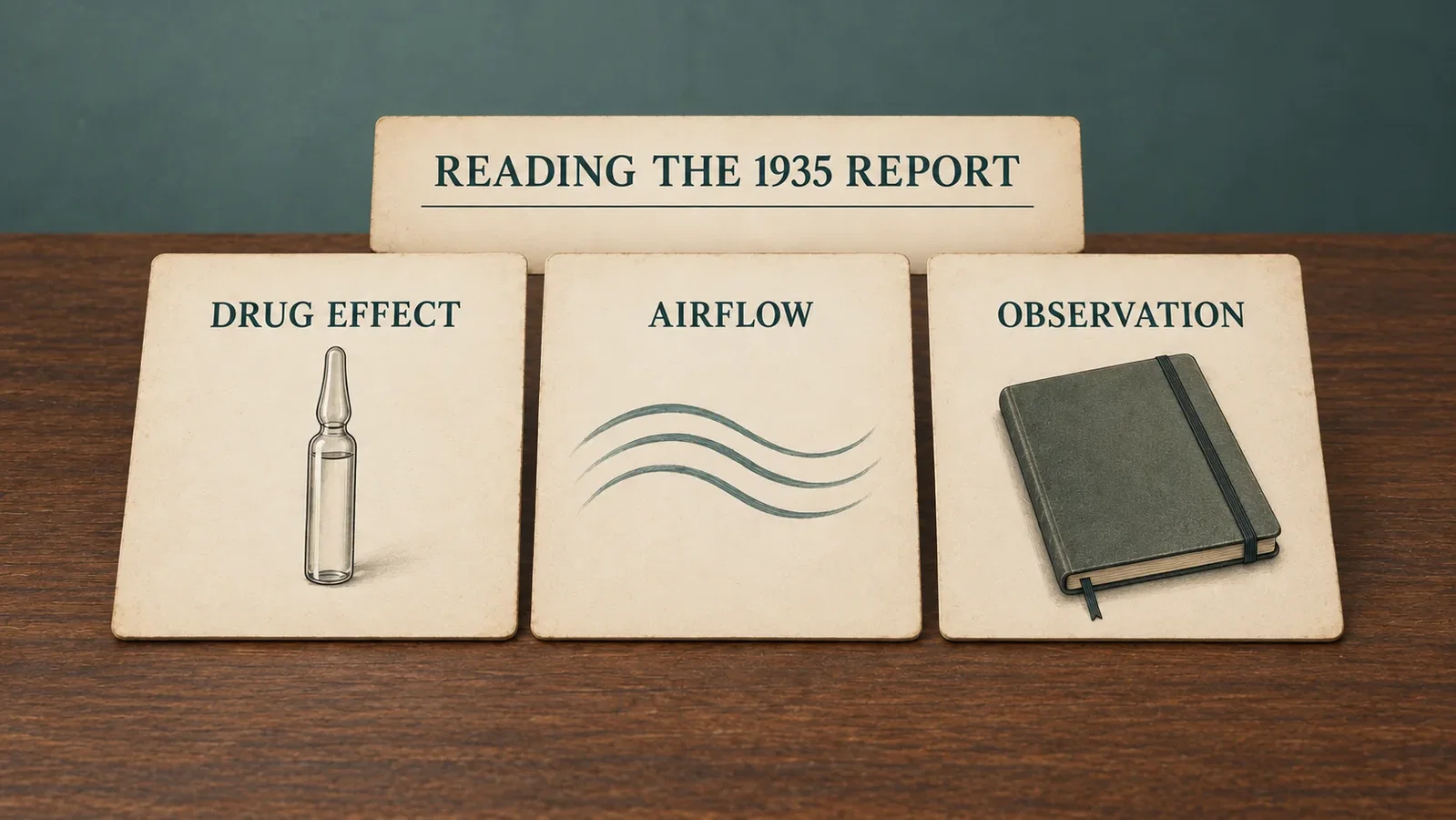
A modern diagram of themes in the historical report, not an administration sequence, dosing plan or current monitoring standard.
This passage supplies a specific connection to the 1920: Magill and Rowbotham Open a Nasal Route for Oral Surgery. Lundy explicitly included a Magill tube in his account of intravenous anesthesia. The link does not depend on neighboring dates, nor does it identify the tube as the same physical instrument described in 1920.[1,pp.539–540]
Reporting experience and its limits
Ellis, Narr and Bacon’s later study of Mayo archives places drug investigation and communication among Lundy’s contributions. Clinical introduction involved recording experience and making it available to colleagues.[5,p.228]
Lundy’s own 1935 conclusion remained cautious: an ideal agent for routine intravenous anesthesia had yet to be found, although available agents were satisfactory in selected kinds of cases. His report records both substantial experience and limits still being worked out.[1,p.543]

Historical concept illustration. The papers are not facsimiles of the original table, and the containers are not authenticated 1934 objects.
Sources and reading limits
- Lundy JS. Intravenous anesthesia: preliminary report of the use of two new thiobarbiturates. Proc Staff Meet Mayo Clin. 1935;10:536–543. Authorized WLM reprint · Archived copy. All eight article pages read, plus the issue contents page; the entire 70-page collection was not read. The header/footnote discrepancy remains unresolved.
- Ball C, Westhorpe R. The history of intravenous anaesthesia: the barbiturates. Part 2. Anaesth Intensive Care. 2001;29(3):219. DOI. Complete page and caption read. Its 1936 series of 2,207 patients and 1935 ampule donation are not treated as 1934 documentation; cited early papers were not thereby directly read.
- Lundy JS. Statement to Dr. Waltman Walters. November 15, 1967. Mayo archive. Extracted memoir text read; facsimile verification limited to statement pages 1–2. The 1934 recollection appears on statement page 2.
- Wood Library-Museum. Thiopental · Archived copy. Institutional introduction and three catalogue entries read. Objects postdate 1934; repeated catalogue narratives count as one source.
- Ellis TA II, Narr BJ, Bacon DR. Developing a specialty: J.S. Lundy’s three major contributions to anesthesiology. J Clin Anesth. 2004;16:226–229. Mayo full-text archive. All four pages read and viewed. Underlying unpublished letters and annual reports were not directly acquired; peripheral chronology discrepancies were excluded.
Medical history, not current administration guidance. All illustrations are conceptual. Sources and reading limits are stated above. Illustrations are labelled as original source images or AI-made. Historical accounts are educational; they are not current treatment instructions.
Continue exploring
Related reading connects shared questions and contexts; it does not by itself establish historical influence.
The Source Room · About & Editorial Method
Continue this reading route
Stop 3 of 7 · Back to route · From Ether to Balanced Anesthesia
Previous · 1847: Snow Makes Ether a Question of Observation and Control
Next · 1942: Griffith and Johnson Use Curare in Twenty-Five Patients
Lundy’s report describes induction. The next patients received curare, so a motionless patient poses a different question about depth of anesthesia.