Nasal access, catheter guidance and an exit for gas in 1920–1921.
Reading Library · Anesthesia Epochs · 中文版
Watch the companion film
1920–1921: Magill and Rowbotham’s Nasal Route · Watch on YouTube
Historical anchor: 1920. Date details and source qualifications are explained below.
A bent pair of forceps can make an invention look self-contained. The two short papers published in the British Medical Journal in October 1920 tell a more connected story.
On 16 October, Stanley Rowbotham described a nasal route for intratracheal anesthesia during operations on the mouth and lips. On 30 October, Ivan W. Magill explicitly followed up that report with an instrument for guiding the catheter. The problem was not simply how to place a tube: it was how to provide anesthesia while leaving the surgeon room to work.[1,2]
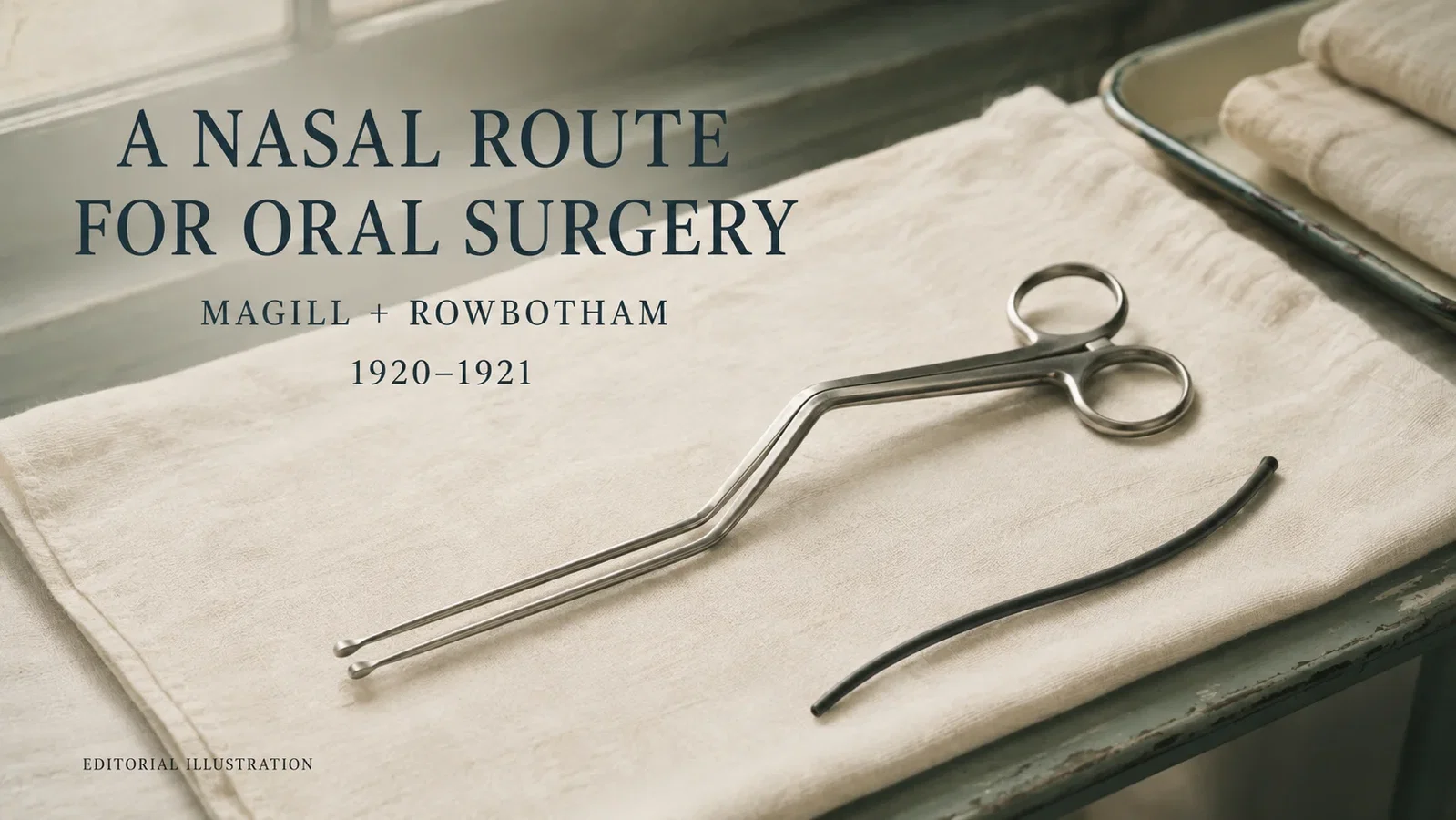
A route, then a different way of guiding it
Rowbotham's account distinguished the catheter's passage through the nose, its capture in the pharynx with a guiding rod, and its entry into the trachea. A laryngoscope introduced through the mouth provided the view. Nasal entry did not mean that the mouth was never used for instrumentation.[1]
Magill's forceps addressed the capture and guidance problem. Their bend kept the operator's hand clear of the sightline, while the tips gripped the catheter. His description retained an electrically illuminated speculum: this was not a claim to a completed blind technique.[2]
Magill presented advantages over the rod, including a more secure grasp and less damage to the catheter end. Those were the designer's reported advantages, not results from a controlled comparison. The distinction matters: a useful design contribution does not need an invented trial behind it.
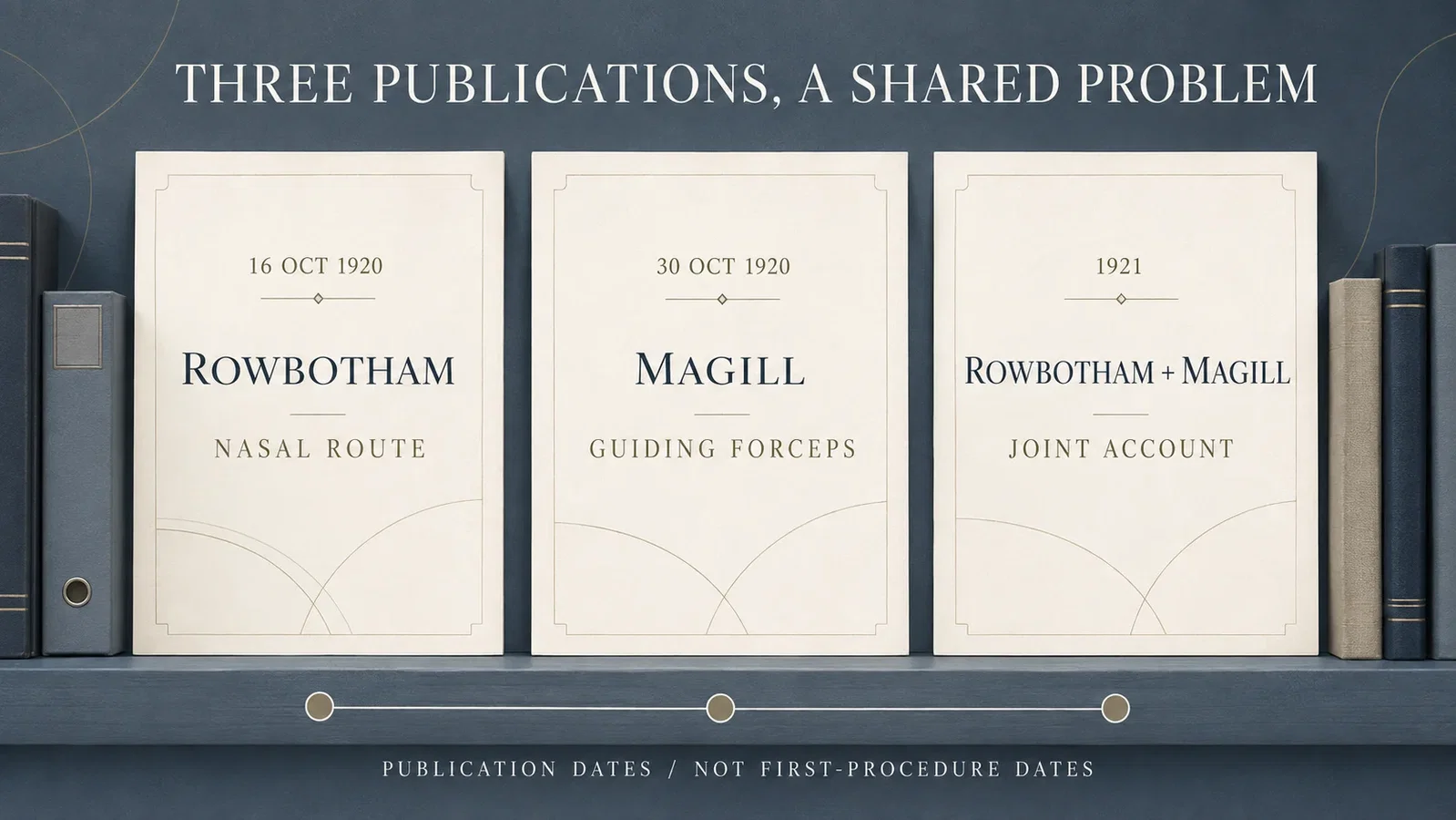
The shared operating field
The joint paper of 1921 makes the setting clearer. Rowbotham and Magill described approximately 3,000 anesthetic administrations for war injuries at Queen's Hospital, Sidcup. These were administrations, not 3,000 separate patients or successful uses of the forceps. Repeated reconstructive operations were central to their experience.[3]
They organized their account around which access route the operation left available: mouth, nose, or either. Oral techniques remained part of the account. The nasal route was a response to particular surgical demands, not a universal replacement.
A second distinction runs through the paper. A pharyngeal airway was not the same as a catheter entering the trachea. In some nasal intratracheal insufflation arrangements, another nasal airway provided an exit for gas and diverted ether-laden expiration away from the surgeon. An adequate return airway could not always be obtained.[1,3]
Getting gas in and allowing it out were related but separate practical problems. That is why a compressed phrase such as “nasopharyngeal tracheal tube” can obscure more than it explains.
An occasional event is not yet a dependable method
Rowbotham's 1920 paper and the joint 1921 account describe occasions when a catheter entered the trachea without guidance. But Rowbotham's 1920 paper also says that attempts to anticipate the necessary curve produced an uncertain method. The joint paper and his reply in the 1921 discussion retain that limitation.[1,3]
The principal account therefore remains one of visual guidance, using a rod or forceps. It should not be rewritten as a mature, reliable blind nasal technique.
Nor should every later development in tracheal tubes be packed into 1921. The joint article briefly mentions one or two cases in which a stout rubber tube was passed through the glottis under direct vision and connected to wider tubing and a gas bag. That is a bounded observation, not evidence that the later single wide-bore approach was already universally established. McLachlan's retrospective history places subsequent blind techniques and equipment changes within a longer career.[3,4]
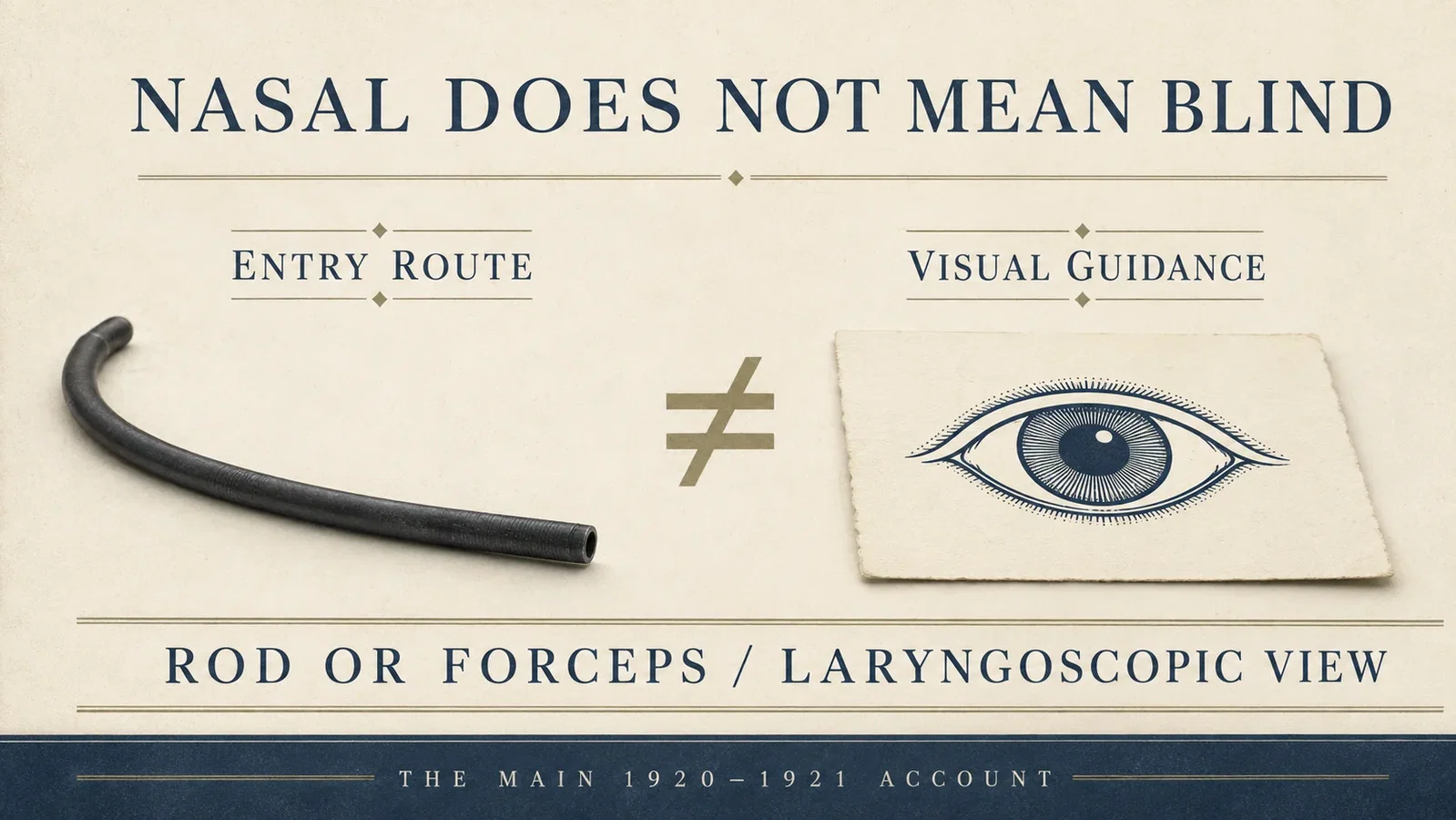
Read the questions after the paper
The 1921 publication includes a discussion, and its tone is not simply congratulatory.
Boyle preferred the forceps to the rod but asked about bleeding from nasal tubes. Shipway raised concerns about mucosal injury, bleeding, and carrying material from the upper passages into the lower airway. He asked whether the reported pneumonia cases had involved nasal catheters; Rowbotham answered.[3]
These exchanges do not establish an adverse mechanism or provide a controlled comparison. They do show that contemporaries questioned the practical limits. Neither the authors' enthusiasm nor their strong claims about keeping blood out should become a universal safety guarantee in a modern historical account.
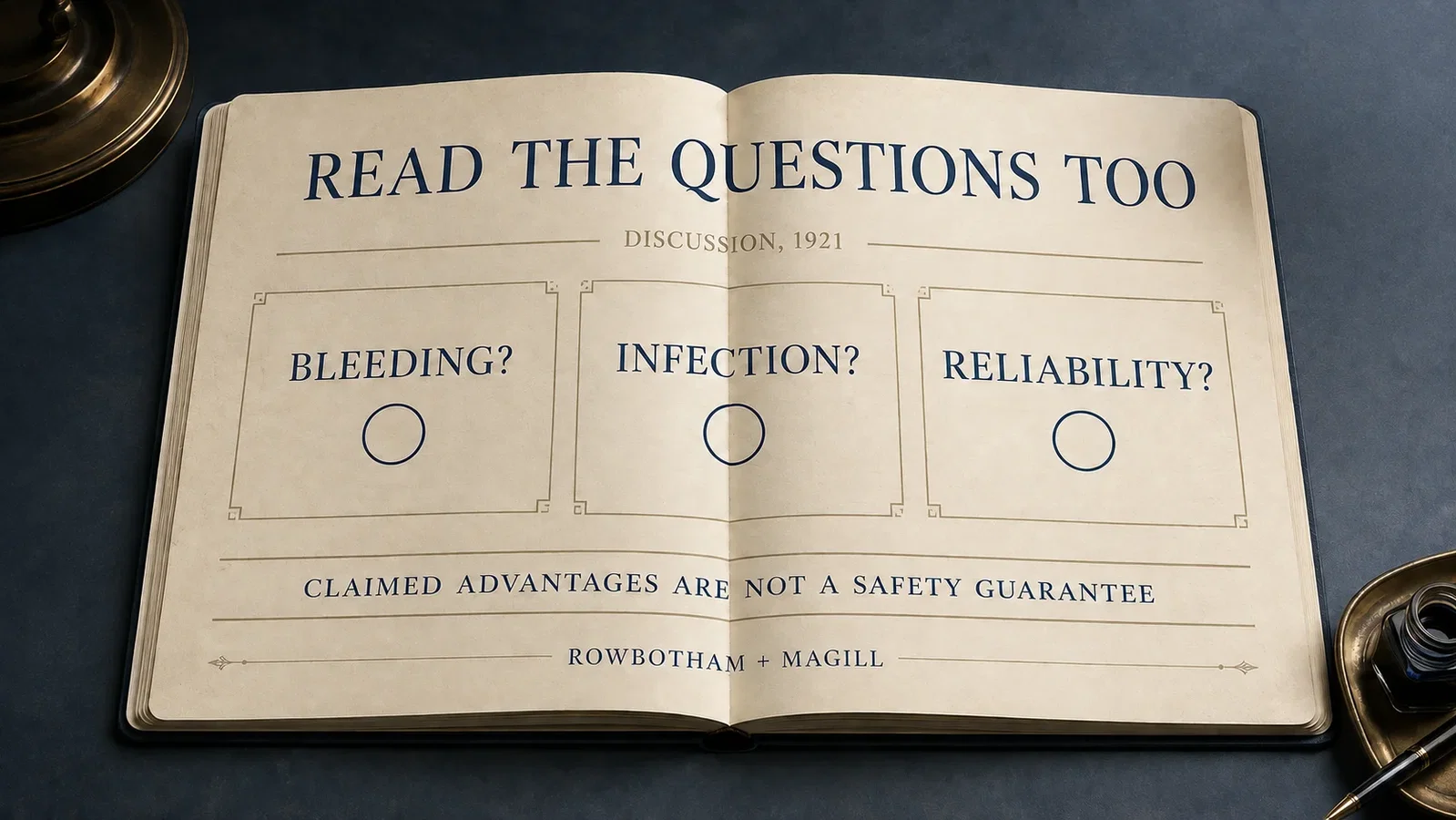
A precise comparison with Elsberg
Elsberg's 1912 account of intratracheal anesthesia specifically discussed head, neck, and oral operations. He valued having the anesthetist away from the operative field and attributed protection from incoming blood to the outward gas stream.[5]
Read beside the 1921 paper, this offers a focused comparison: both address oral surgical space and outgoing gas, while Rowbotham and Magill give detailed attention to the allocation of mouth and nose and to a return airway. This site records that comparison as an undirected relationship, not proof that they directly adopted Elsberg's text or that any absolute protection claim was justified.[3,5]
Museum objects require their own chronological care. The forceps and tubes described in the consulted catalogue records were manufactured substantially later than 1920–1921. They document a continuing instrument tradition, not authenticated first specimens from those publications.[6]
The defensible contribution is concrete: adapting access for oral surgery while improving the means of seeing, grasping, and guiding a catheter. Keeping Rowbotham beside Magill—and the limitations beside the improvements—makes this a history of collaborative problem-solving rather than a single-name origin story.
Image note: All four images are AI-generated modern editorial illustrations or concept graphics. Instrument props interpret historical design features; they are not authenticated original objects. The cards are not journal facsimiles, and no image represents an actual patient or recorded meeting. This is medical history, not an intubation, insufflation-anesthesia, or airway-management guide.
Sources and reading limits
- Rowbotham S. Intratracheal Anaesthesia by the Nasal Route for Operations on the Mouth and Lips. BMJ.1920Oct16;2(3120):590–591. DOI10.1136/bmj.2.3120.590. Original bound-volume PDF. Both article pages and illustrations of the 1,311-page volume were read completely. Neighboring thyroid, cerebellar-tumor, and influenza material is excluded.
- Magill IW. Forceps for Intratracheal Anaesthesia. BMJ.1920Oct30;2(3122):670. DOI10.1136/bmj.2.3122.670. Original bound-volume PDF. The complete left-column instrument item and illustration on p. 670 were read; adjacent university material is not part of it.
- Rowbotham ES, Magill I. Anæsthetics in the Plastic Surgery of the Face and Jaws. Proc R Soc Med.1921;14(Sect Anaesth):17–27. DOI10.1177/003591572101401402. PMC original page scans. All eleven original scans were individually read, including discussion and replies. Meeting: 4 February 1921; publication metadata: April 1921.
- McLachlan G. Sir Ivan Magill … (1888–1986). Ulster Med J.2008;77(3):146–152. PMID18956794. Full journal HTML. Complete text, table, captions, and 32 references were read. Later originals cited there were not separately read or used to establish priority.
- Elsberg CA. Intratracheal Insufflation Anesthesia, Its Value in Thoracic and in General Surgery. New York State Journal of Medicine.1912;12(9):524–528. Original volume PDF. The full title on p524 and oral surgical access/outward-flow passage on p526 were read; the whole volume was not read.
- Wood Library-Museum. Magill Forceps · Archived copy; Magill Nasal Tubes · Archived copy. The complete online forceps catalogue was read. For tubes, reading covered the first object and historical note plus the second object's identity and date, not all five records. Later manufacture dates mean these objects are not 1920 originals.
Continue exploring
Related reading connects shared questions and contexts; it does not by itself establish historical influence.
- 1910: Meltzer, Auer and Elsberg Bring Intratracheal Airflow to Thoracic Surgery
- 1922: Haines Asks What Happened After the Child Left
- 1934: Lundy Uses and Observes Thiopental at the Mayo Clinic
- 1937: Ayre's T-Piece Eases the Apparatus Burden on Infant Breathing
- 1943: The Macintosh Laryngoscope Exposes the Larynx a Different Way
The Source Room · About & Editorial Method
Sources and reading limits are stated above. Illustrations are labelled as original source images or AI-made. Historical accounts are educational; they are not current treatment instructions.