Animal experiments, operative support and contemporary objections remain distinct.
Reading Library · Anesthesia Epochs · 中文版
Watch the companion film
1910: Intratracheal Insufflation · Watch on YouTube
Historical anchor: 1910. Date details and source qualifications are explained below.
An operation could become possible without its intended target being found.
In February 1910, Howard Lilienthal opened the chest of B.F., a 55-year-old butcher thought to have a right lung abscess. Charles A. Elsberg provided intratracheal insufflation anesthesia. No abscess cavity was found. The patient's subsequent improvement was encouraging, but its cause remained uncertain.[2, 3]
This distinction matters to the history of the method. The operation demonstrated a clinical use of an experimental approach to respiratory support. It did not demonstrate that insufflation had cured a lung abscess. Nor should two participants' accounts of the same patient be counted as two independent clinical successes.
The experimental problem came first
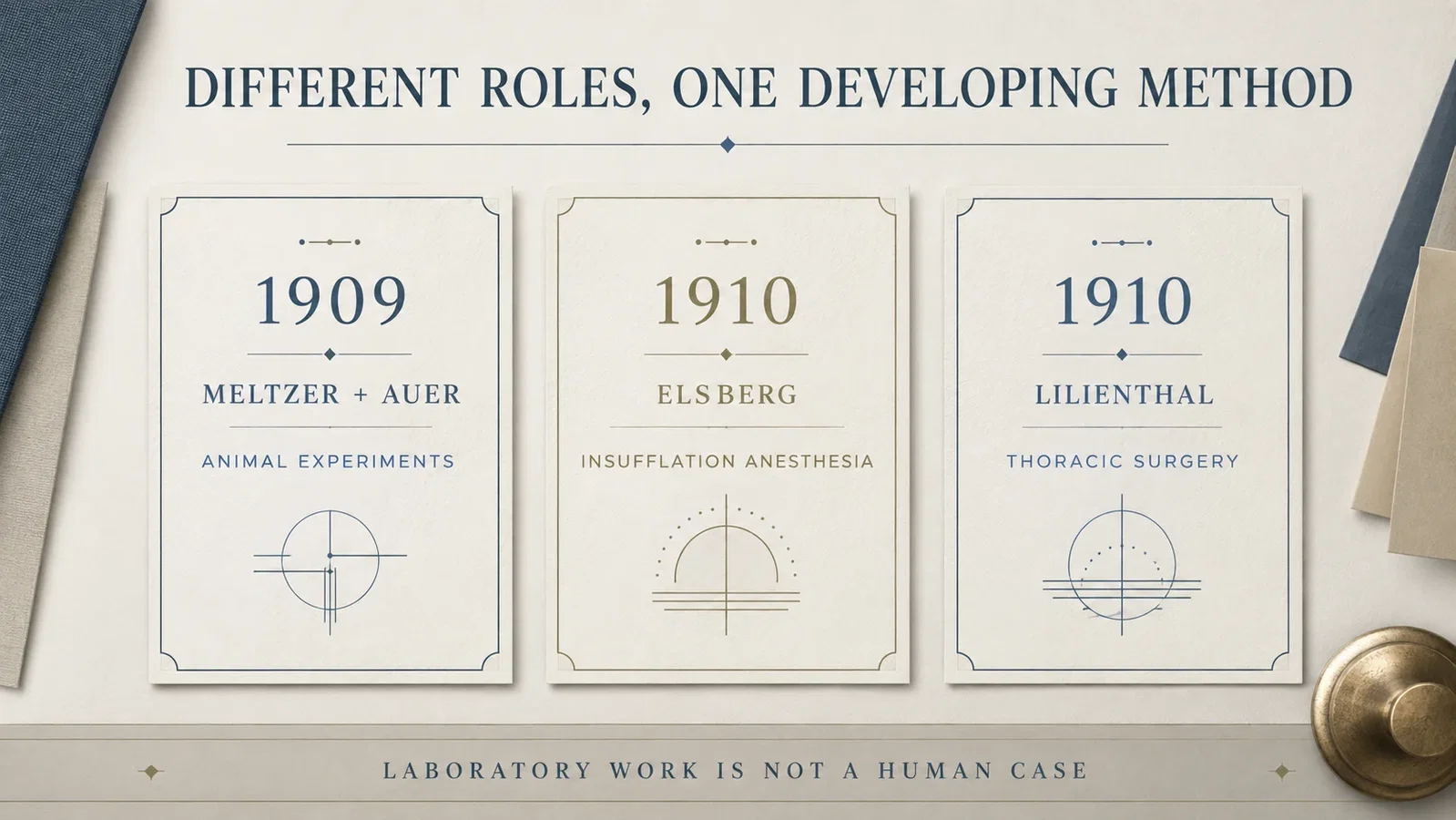
In 1909, S. J. Meltzer and John Auer published a four-page paper from the Rockefeller Institute. Their experiments in anesthetized animals examined respiratory support under conditions that included an open chest and absent respiratory movements. A supply of fresh air was important, but so was a route for gas to escape. The proposal was not simply to seal a tube into the airway and keep adding gas.[1]
Their report was not uniformly successful. Some arrangements produced unfavorable color changes; the heart could slow dangerously, and some configurations failed. The observations relied on cardiac activity, blood pressure and tissue color. The paper did not present modern blood-gas measurements, and its interpretation of apparently physiological gas exchange remained qualified.[1]
Curare belongs to those animal experiments. It must not be added retrospectively to the anesthetic administered to B.F. Elsberg's operative record describes the patient continuing to breathe. The absence of respiratory movements in an experimental title was not a common condition of every later clinical case.[1, 2]
Human application also required people to watch and intervene. Elsberg described two assistants, one attending to pressure and interruptions of airflow, the other to anesthesia and the patient's general condition. This was neither unattended automation nor absolutely uninterrupted flow.[2]
A respiratory crisis was not a recovery
Elsberg's 1910 report begins its patient narratives with a 34-year-old woman suffering from advanced myasthenia. During a respiratory crisis, he found her unconscious, cyanosed and without a palpable pulse. He reported that air-and-oxygen insufflation improved her color and made the pulse palpable.[2]
Support continued for about five hours without visible respiratory movements. It was then stopped because he regarded her condition as hopeless. The paper does not report recovery or discharge.[2]
That account supports a limited historical observation: physiological signs could be maintained temporarily in a profoundly ill patient. It is not a successful rescue-to-discharge story. It also cannot be combined with the paper's two different operative narratives to create an all-successful clinical trial.
The thoracotomy followed a failed attempt
B.F.'s first attempt at tube placement failed on February 14. Lilienthal performed a preliminary rib resection; his account says that the pleura was not opened at that stage.[2, 3]
Successful placement at a later attempt made the open-chest procedure possible. Elsberg records delivery of an air-and-ether mixture for the operation, distinct from the air-and-oxygen support in the respiratory crisis. Lung distension and color became important observations during the operation. Yet the record was not a description of unvarying stability: Elsberg's timed entries include a brief episode of slight cyanosis. “Stable oxygen saturation throughout” would both erase that observation and invent a measurement the report does not contain.[2]
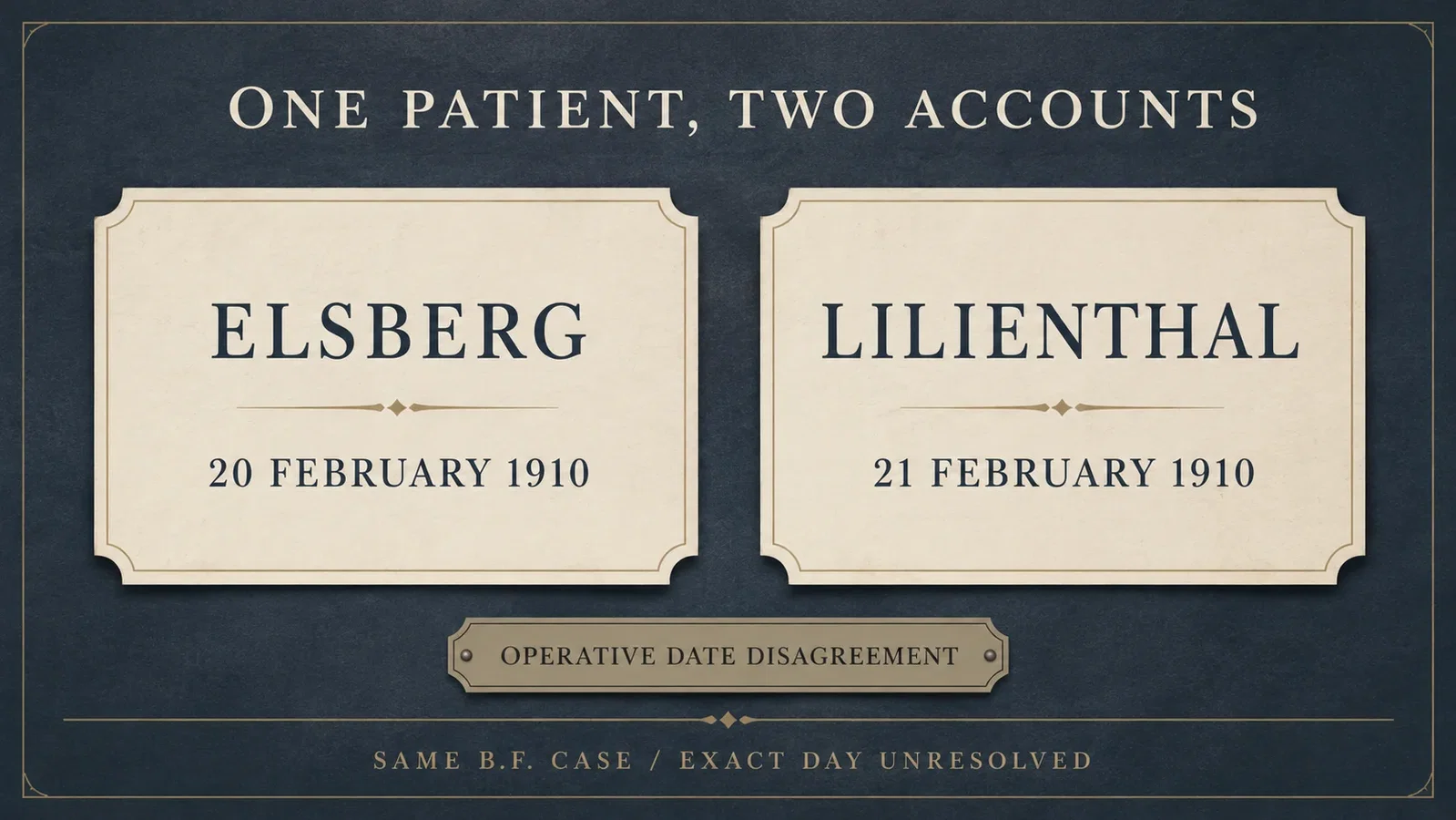
The two authors also disagree on dates. Elsberg gives February 20 for the later procedure; Lilienthal places it on February 21. Their discharge dates are March 25 and March 20, respectively. This article therefore uses 1910 as its date, with February in the narrative, without silently selecting one exact day.[2, 3]
The roles are clearer than those dates. Lilienthal operated; Elsberg managed insufflation anesthesia. Lilienthal's title called it the first human thoracotomy under this particular form of anesthesia. That is a scoped priority claim made by a participant, not the result of a comprehensive search establishing the first intubation, thoracotomy or artificial ventilation anywhere.[3]
Feasibility did not settle the reason for improvement
Neither the expected cavity nor pus was found at operation. Both papers describe a favorable subsequent course, but Elsberg says he could not adequately explain it. He considers earlier expectoration, rib resection, pneumothorax and possibly insufflation. None is established as the cause.[2, 3]
The episode should therefore not become a story about successfully removing or draining a lung abscess with a new anesthetic method. Making an operation feasible is a different achievement from confirming its diagnosis or explaining its therapeutic outcome.
Elsberg also describes a separate patient with empyema who underwent rib resection and drainage under insufflation. That favorable narrative does not authorize importing its drainage procedure into B.F.'s case. At the end of the paper, he still asks for much more experience before definite conclusions.[2]
The discussion belongs beside the report
By 1912, Elsberg was describing wider experience and expressing considerable optimism. The discussion printed with his paper complicates that account. McWilliams described seeing a patient develop swelling of the head, neck and orbital region, become cyanosed and die during an operation. He explicitly did not know the precise mechanism. Excessive tube depth and lung rupture were possibilities, not demonstrated findings.[4]
In reply, Elsberg attributed known adverse cases to technical errors and proposed safeguards. His explanation is part of the historical evidence; it is not an independently established determination of causality. The report's various counts of operations, patients and intrathoracic procedures also cannot be combined with adverse cases mentioned in discussion to manufacture a mortality rate.[4]
Another passage makes a specific comparison with an earlier article useful. For operations around the mouth, Elsberg claimed that outward airflow would keep blood out of the trachea. Macewen's earlier report had described delivering anesthetic through an oral tube while using a pharyngeal sponge to exclude blood.[4, 5]
These accounts address a shared practical problem through different arrangements. Reading them together does not establish that Elsberg derived his method directly from Macewen, or that either arrangement guaranteed protection against aspiration.
The advance was real: experimental airflow support entered human thoracic surgery. So were the unresolved questions about reproducibility, harm and the cause of an apparent benefit. The original reports preserve both, if their discussion and qualifications are allowed to remain in the story.
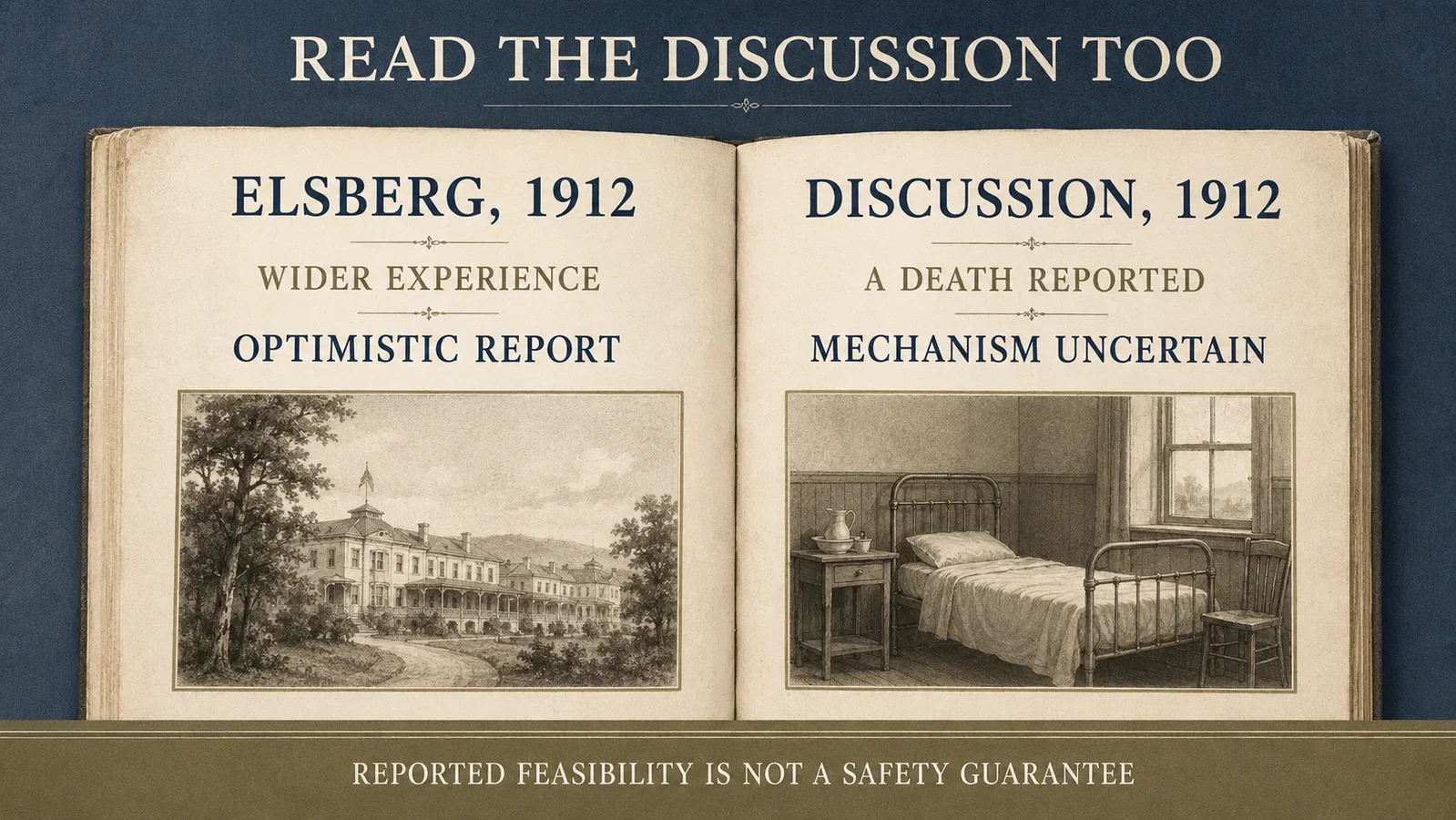
Image note: all four images are AI-generated editorial illustrations, not authenticated apparatus reconstructions, journal facsimiles, portraits or photographs of procedures. Airflow motifs are conceptual, not clinical connection diagrams. The building and ward in the final image are imagined settings, not Mount Sinai or the actual patient's room.
This is medical history, not current guidance on anesthesia, airway placement, airflow or pressure settings.
Sources and reading limits
- Meltzer SJ, Auer J. Continuous Respiration Without Respiratory Movements. J Exp Med. 1909;11(4):622–625. Complete four-page original read: journal scan, DOI.
- Elsberg CA. Clinical Experiences with Intratracheal Insufflation (Meltzer), with Remarks upon the Value of the Method for Thoracic Surgery. Ann Surg. 1910;52(1):23–29. All seven original pages read: scan, DOI. Presented May 11, 1910; July publication is not the procedure date.
- Lilienthal H. The First Case of Thoracotomy in a Human Being under Anaesthesia by Intratracheal Insufflation. Ann Surg. 1910;52(1):30–33. All four original pages read, recounting the same B.F. case: scan, DOI.
- Elsberg CA. Intratracheal Insufflation Anesthesia, Its Value in Thoracic and in General Surgery. New York State Journal of Medicine. 1912;12(9):524–528, including discussion and reply. Complete relevant five pages read: scan. Presented April 17, 1912; published September. The adjoining Pearce paper is excluded.
- Macewen W. Clinical Observations on the Introduction of Tracheal Tubes by the Mouth, Instead of Performing Tracheotomy or Laryngotomy. BMJ. 1880;2(1021):122–124. Original read for the earlier article; printed page 122 read here, focusing on Case I and blood exclusion during oral surgery: DOI, 1878: Macewen's Oral Tracheal Tube.
Continue exploring
Related reading connects shared questions and contexts; it does not by itself establish historical influence.
The Source Room · About & Editorial Method
Sources and reading limits are stated above. Illustrations are labelled as original source images or AI-made. Historical accounts are educational; they are not current treatment instructions.