In 1878 William Macewen passed tubes through the mouth into the trachea for a mouth operation and for two cases of acute laryngeal swelling, and reported these and a fatal fourth case in the BMJ in July 1880.
Reading Library · Anesthesia Epochs · 中文版
Watch the companion film
1878: Macewen’s Oral Tracheal Tube · Watch on YouTube
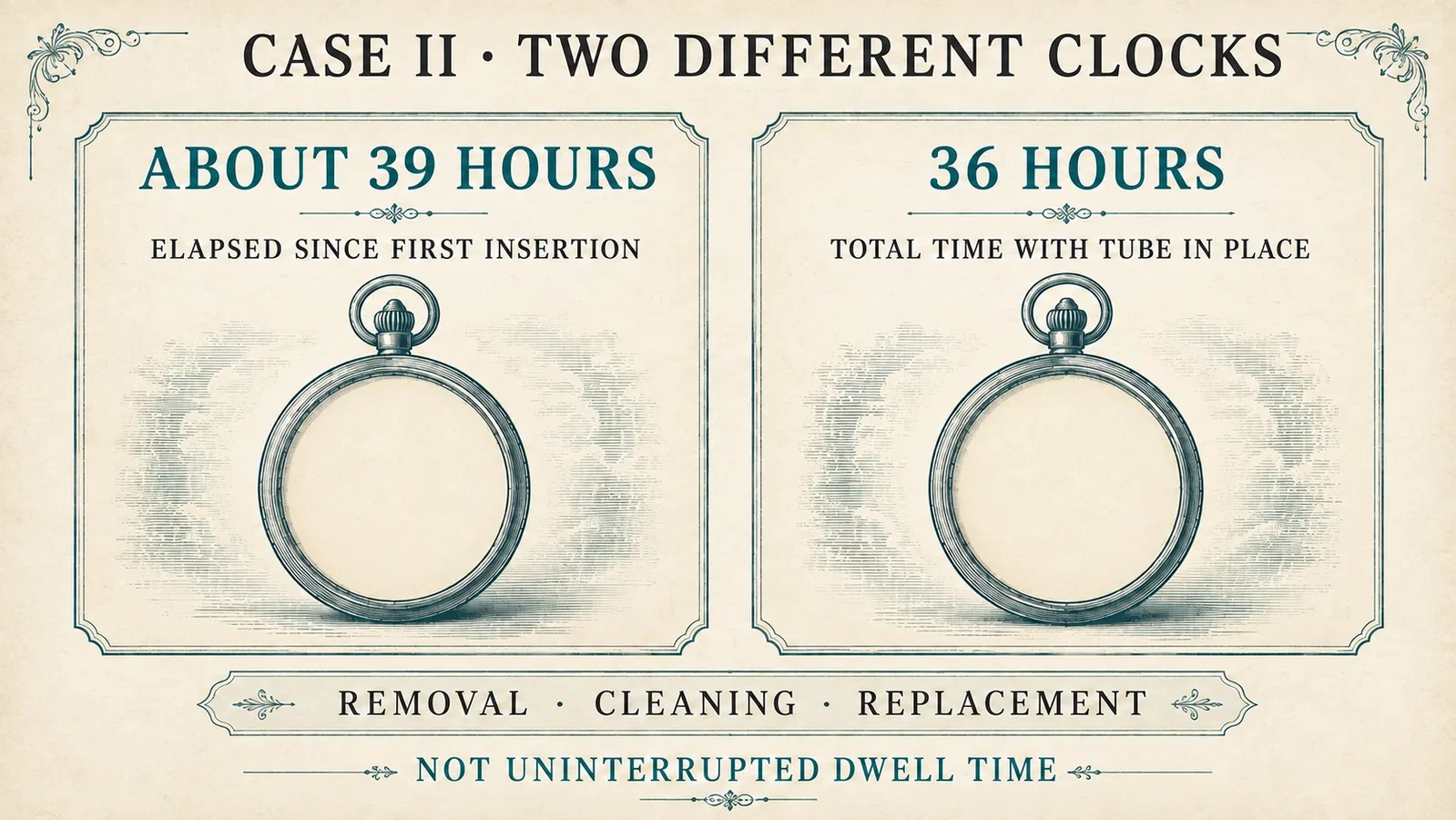
Thirty-six hours with a tube did not mean thirty-six uninterrupted hours. In William Macewen's second case, about thirty-nine hours had elapsed since the first insertion. The smaller figure excluded the intervals when the tube was out.[1,p 123]
That distinction makes the case more interesting, not less. An airway tube was not simply inserted and forgotten. It was removed, cleaned and replaced while the patient was observed and the patient's condition changed. A historical achievement usually compressed into one maneuver was also an exercise in continuing care.
Macewen's report contained four patients, but they did not share one clinical pathway. One underwent oral surgery with the tube in place. Two needed relief from laryngeal swelling. A fourth had preliminary awake tube trials, removed the tube before chloroform, and then suffered a fatal anesthetic collapse without it. Those differences are the report's structure, not details to be tidied away.[1,pp 122–124;2,p 163]
The patient who needed time
The second patient was a 42-year-old commercial traveller, admitted at 1.20 in the morning on 14 September 1878. Roughly twelve hours earlier the patient had swallowed a scalding potato. By arrival at hospital, severe swelling around the larynx made breathing difficult.[1,p 123]
The purpose of the oral tube here was not to deliver anesthesia for an operation. It was to provide a passage through the swollen region while the immediate threat subsided. Macewen described initial coughing followed by easier breathing. The patient was asked to hold the projecting end and told that it could be withdrawn if necessary. The account describes how tolerance and reassurance were handled; it does not document a modern consent process.[1,p 123]
The subsequent intervals matter. Removal allowed cleaning and drinking, after which the tube was reintroduced. The report distinguishes approximately thirty-nine hours since the first placement from thirty-six hours actually spent with the tube in place. It does not justify a precisely measured three-hour total without the tube, since the elapsed interval itself is approximate.[1,p 123]
The third patient brought another problem to the same route: a housewife of 38 with pre-existing laryngeal disease, admitted on 8 December 1878 with additional swelling. Sensation and movement were impaired, so breathing was not the only concern. The report also describes difficulty protecting the larynx during swallowing.[1,pp 123–124]
This tube care extended across two nights, with interruptions for cleaning and feeding. Macewen gives clock endpoints from the evening of 8 December to the morning of 10 December, then explicitly states that the tube was in the larynx for 35 hours in all. That cumulative duration differs from the longer elapsed span and was not uninterrupted. The later professional account also records 35 hours; it is not a conflicting new estimate.[1,p 124;3,p 36]
The patient's later ability to take small amounts of liquid should not erase the earlier swallowing difficulty. In this account, a tube did not make the larynx automatically protective or feeding universally safe. That is a limit within the original case, not a modern instruction extracted from it.[1,p 124]
An operation with a separate airway problem
The first case had occurred earlier, on 5 July 1878. A 55-year-old plasterer had an epithelioma involving the mouth, pharynx and base of the tongue. Previous measures had not stopped its progression. For the proposed removal, Macewen had to consider not only anesthesia but the possibility of blood entering the airway.[1,p 122]
Macewen had practiced an oral route on cadavers, using a finger to guide the instrument. The report discusses the difficulties of different shapes, sizes and routes. This was not direct laryngoscopy with a later illuminated instrument, and it should not be pictured as a modern intubation procedure with present-day components.[1,p 122;3,pp 35–36]
A preliminary opening in the neck, with a tampon arrangement, was one option Macewen considered. Instead Macewen used an oral tracheal tube together with a sponge in the pharynx. The combination matters: the report's protection against blood depended on the packing remaining effective. It was not a description of a modern inflatable cuff or proof that the tube alone sealed every route of aspiration.[1,pp 122–123]
Several preliminary introductions assessed tolerance. The operative account describes coughing that settled after a few whiffs of chloroform, before what Macewen judged to be a constitutional effect. That sequence allows awake preparation to be distinguished from the later anesthetic; it does not support the simpler assertion that no anesthetic agent of any kind was involved throughout placement.[1,p 122]
During the operation, the projecting tube allowed chloroform administration to continue while the surgical field was occupied. Breathing could be heard and airflow felt. These observations were meaningful to the participants, but they are not equivalent to continuous numerical monitoring recorded by later devices.[1,pp 122–123]
The tube was removed after bleeding had ceased and consciousness had returned. Both conditions belong in the account. The reported recovery was favorable, but neither that sequence nor the later follow-up establishes a universal extubation rule or a permanent cure for the tumor.[1,pp 122–123]
A fatal case with the tube absent
The fourth patient, approximately 60 years old, also had an epithelioma, together with chronic bronchitis and substantial secretions. Macewen described preliminary awake tube trials and apparent tolerance. The patient could remove the tube unaided, and did so during these preparations.[2,p 163]
On the operative occasion the tube was initially present while the patient was awake. As chloroform was about to be administered, however, the patient rose up and withdrew it, preferring to receive the anesthetic without it. The plan was to reintroduce it afterwards.[2,p 163]
That planned later step was not reached. After chloroform began, the patient suffered a fatal collapse; attempted resuscitation failed. The oral tube was not in place during this event.[2,p 163]
The temporal sequence prevents two opposite shortcuts. This is not evidence that an indwelling tube caused the death. It is also not proof that leaving the tube in place would have prevented it. Macewen discussed a possible cerebral explanation, with uncertainty, in light of the clinical course and postmortem findings. Macewen's interpretation remains a nineteenth-century interpretation, not a confirmed modern diagnosis supplied by this history.[2,p 163]
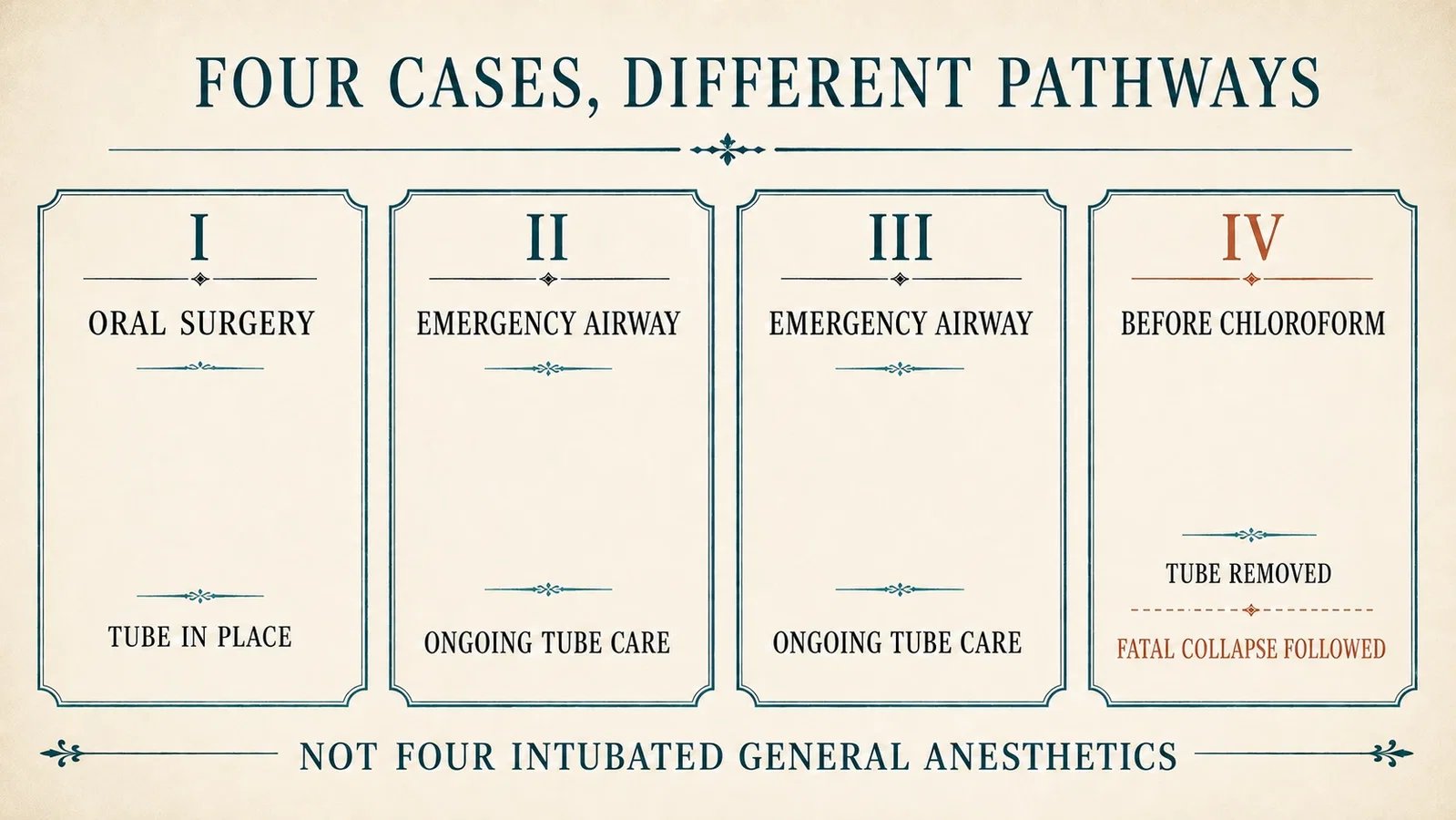
Removing this case would produce a cleaner success story. Pooling it with the others to calculate a tube-specific mortality rate would produce a different error. Indication, illness, anesthetic exposure and the presence of the tube were not uniform across the four patients. The clinical sequence must remain visible before any judgment about outcomes is attempted.
The report arrived two years later
The date 5 July 1878 belongs to the first operation. Publication followed in two installments of the British Medical Journal on 24 and 31 July 1880, at pages 122–124 and 163–165. The later installment explicitly continues the earlier one. They are not independent replications.[1;2]
The first printed heading begins Clinical Observations, while its indexed title begins General Observations. The authorship, issue, page range and scan identity establish the match, but the discrepancy is retained in the reference record.[1;2]
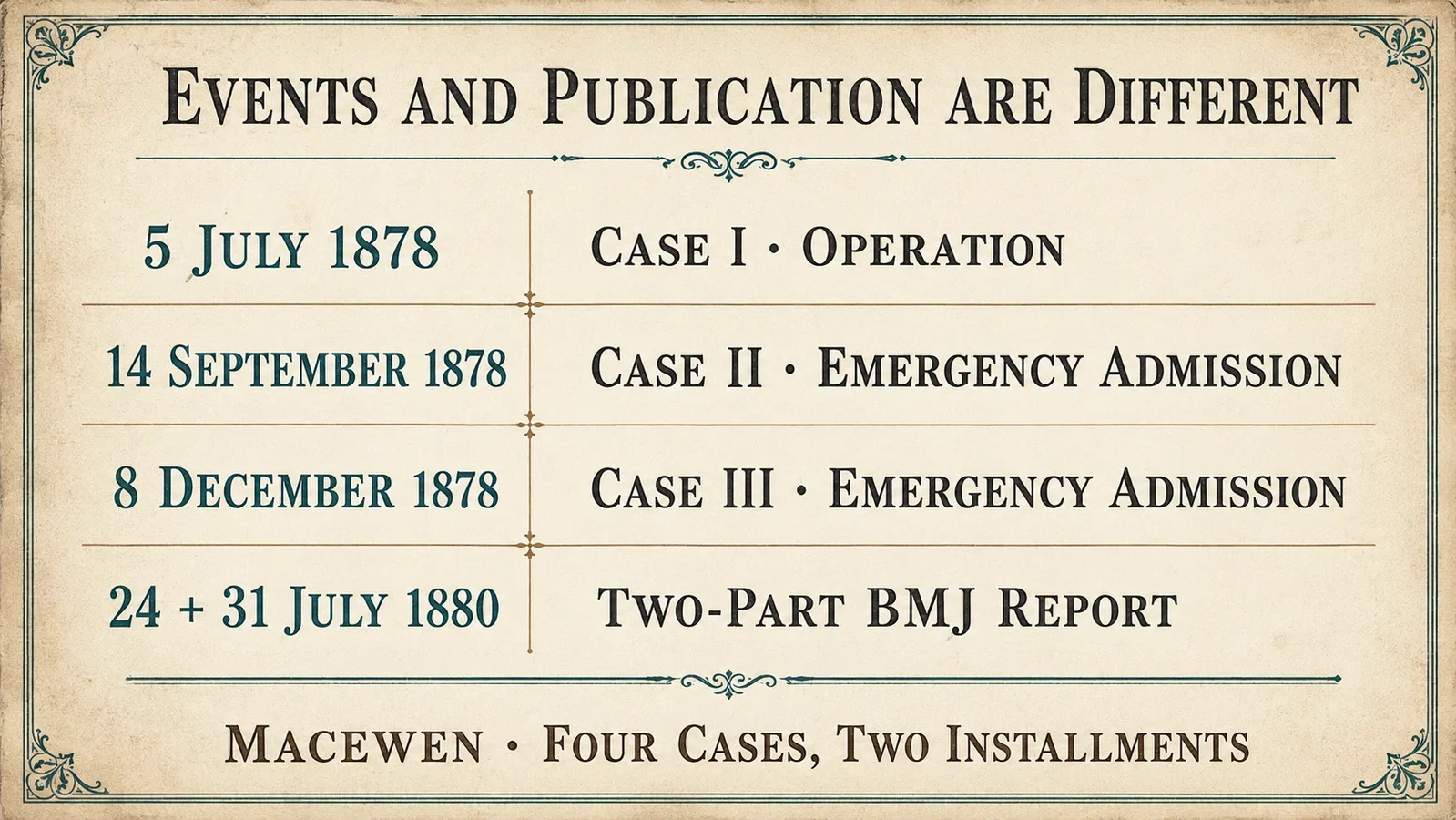
This separation is more than bibliography. A timeline label can otherwise turn a later report into an immediate announcement, or turn one selected operation into the date of every case described. Neither transformation is needed to explain what Macewen did.
A route with predecessors and limits
Macewen discussed earlier work associated with Desault, Bouchut, Trendelenburg, Schrötter and Hack. Macewen distinguished routes and purposes instead of treating every instrument introduced toward the larynx as the same invention. Those earlier original publications are not covered here; their appearance is attributed to Macewen's historical discussion, not presented as a newly adjudicated worldwide priority claim.[2,pp 163–164]
Nor did the report abolish the need for an opening in the neck. It retained selection problems, the importance of practice and situations in which other approaches were still required. Its concluding deductions were explicitly tentative. An oral route could be useful in the described circumstances without having become a universally superior or harmless solution.[2,pp 164–165]
A much later professional commemoration paired Macewen with Kirstein in the history of the European Airway Management Society's medal. That is evidence of later remembrance, not immediate diffusion in 1878. The Kirstein instruments discussed and pictured in that account belong to a later period and cannot be moved backward into Macewen's clinical scene.[3,pp 35–37]
The lasting subject is therefore larger than a first insertion. It is the separation of an airway from an operative field, the possibility of maintaining a route during acute swelling, and the work that follows placement. Cough, secretions, swallowing, patient tolerance, removal and an adverse outcome all remain in the record. Preserving them makes the history less triumphant, but substantially more useful.
Sources and reading limits
Read: Macewen’s report in the British Medical Journal, in two installments of 24 and 31 July 1880 (pp. 122–124 and 163–165), in full; Braun and Henderson’s 2018 account of the Macewen/Kirstein medal of the European Airway Management Society.
Not covered: the earlier works by Desault, Bouchut, Trendelenburg, Schrötter and Hack that Macewen discusses; the Glasgow Royal Infirmary case records. The first installment’s printed heading begins “Clinical Observations”, while database records index it as “General Observations”. Priority is not judged here. The four illustrations are AI-made; the three diagrams are drawn from the BMJ text and show no people.
- Macewen W. Clinical observations on the introduction of tracheal tubes by the mouth instead of performing tracheotomy or laryngotomy. Br Med J. 1880;2(1021):122–4. PMC
- Macewen W. Clinical observations on the introduction of tracheal tubes by the mouth instead of performing tracheotomy or laryngotomy (concluded). Br Med J. 1880;2(1022):163–5. PMC
- Braun U, Henderson JJ. The Macewen/Kirstein medal of the European Airway Management Society. Trends Anaesth Crit Care. 2018;19:34–7. DOI
Continue exploring
Related reading connects shared questions and contexts; it does not by itself establish historical influence.
- 1847: Snow Makes Ether a Question of Observation and Control
- 1910: Meltzer, Auer and Elsberg Bring Intratracheal Airflow to Thoracic Surgery
- 1945–2009: Cuffed Pediatric Tracheal Tubes Rethink Size, Position and Evidence
- 2013: An Old Airway Algorithm Makes Room for Video Laryngoscopy
Anesthesia Epochs · The Source Room · About & Editorial Method
Sources and reading limits are stated above. Illustrations are labelled as original source images or AI-made. Historical accounts are educational; they are not current treatment instructions.