New evidence did not force a wholesale rewrite, but it gave video-assisted laryngoscopy an explicit place inside a still-recognizable difficult-airway architecture.
Reading Library · Anesthesia Epochs · 中文版
Watch the companion film
2013: ASA — Difficult Airway Guideline Update · Watch on YouTube
Historical anchor: 2013. Date details and source qualifications are explained below.
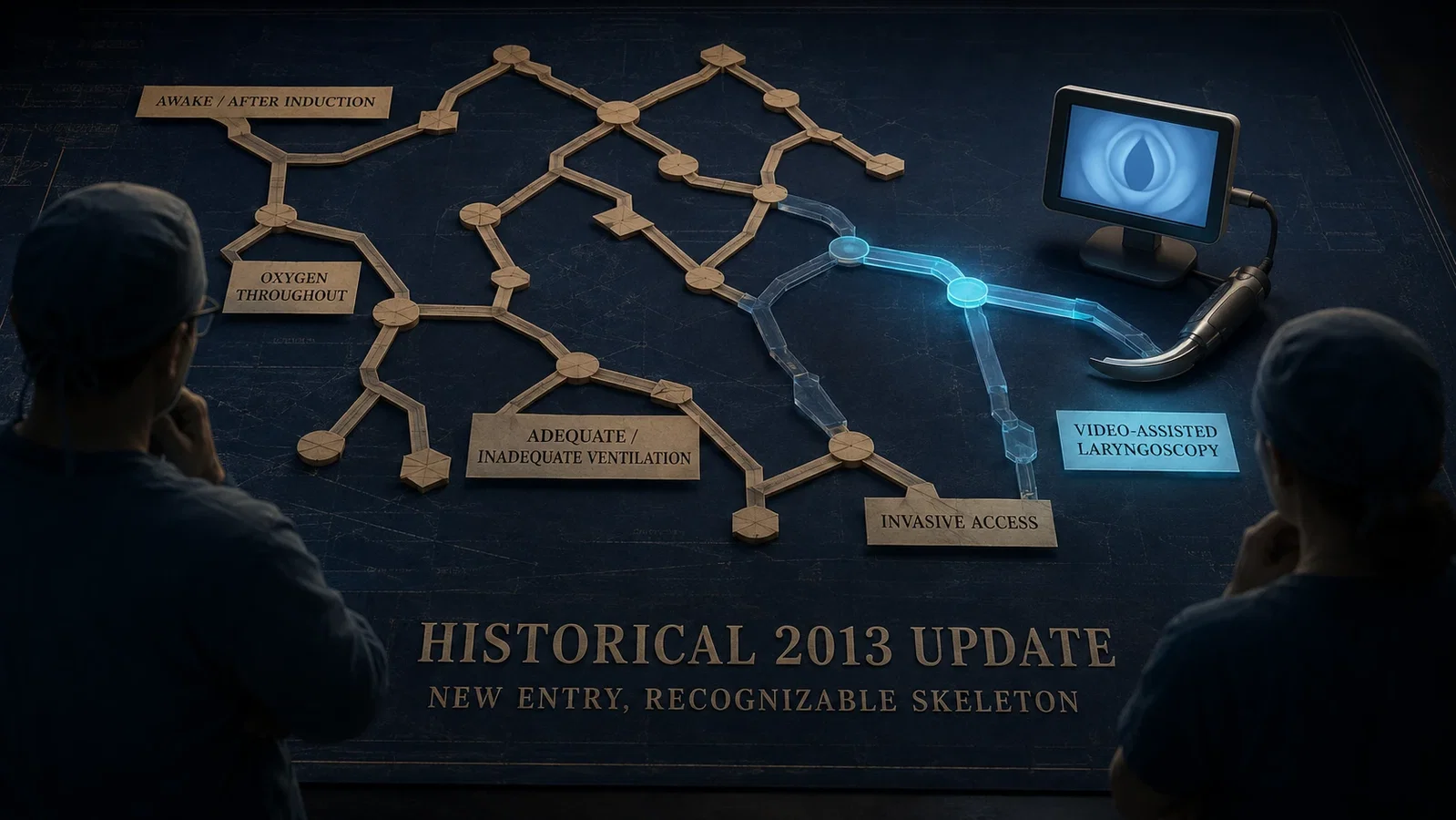
The most revealing sentence in the 2013 American Society of Anesthesiologists difficult-airway update is also the least dramatic: the new findings did not necessitate a change in recommendations.
That line can be misread in two opposite ways. One is to conclude that the update changed nothing. The other is to ignore the authors' restraint and present 2013 as the moment an old algorithm was swept away by the video laryngoscope.
Neither reading fits the document.
The broad safety architecture remained recognizable. Planning still came before crisis. Awake intubation remained distinct from attempts after induction. Oxygenation ran through the process. Adequate and inadequate ventilation opened different routes. Nonemergency rescue, emergency rescue, awakening the patient when feasible, and invasive airway access all remained visible.
Yet the vocabulary inside that architecture had changed. The problem map became more granular, and video-assisted laryngoscopy acquired an explicit place among the basic management choices, equipment, techniques, and alternatives. The update did not replace the map. It revised what the map could name.
A maintenance document can still be a historical event
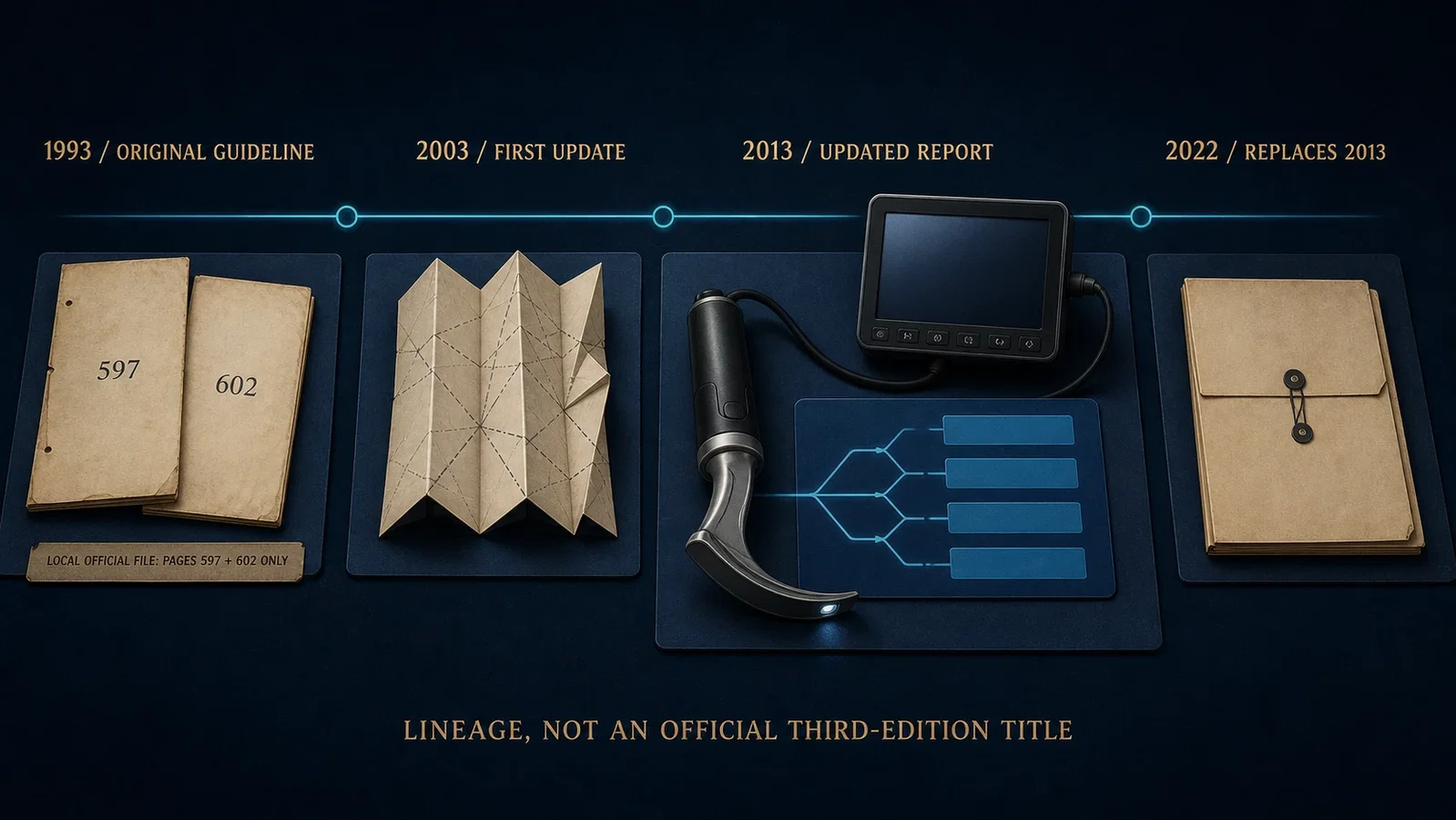
The article's formal title was Practice Guidelines for Management of the Difficult Airway: An Updated Report. It did not call itself the third edition.
There was nevertheless a clear lineage. An original ASA guideline appeared in 1993. A first update was adopted in 2002 and published in 2003. The February 2013 article was the third major publication in that sequence, approved by the ASA House of Delegates on October 17, 2012 and submitted and accepted the following day.
Calling it the third ASA iteration can help orient a reader. Turning that shorthand into an official edition title cannot.
This distinction matters because the document presents itself as maintenance of a living practice parameter. ASA practice guidelines, it explains, are systematically developed recommendations. They may be adopted, modified, or rejected according to clinical needs and constraints. They do not replace local policies, constitute absolute requirements, or guarantee a particular outcome. Revision is expected as knowledge, technology, and practice change.
That description is not a modesty ritual tucked into fine print. It tells us what kind of historical object this is. A guideline is neither a device launch nor a randomized trial. It is an attempt to organize evidence, professional judgment, feasibility, and contingency into a shared decision structure.
The number 693 needs a denominator story
In 2011, the ASA Committee on Standards and Practice Parameters asked for the 2003 guideline to be reevaluated. The update combined a new literature assessment with surveys of expert consultants and randomly selected ASA members.
The search sounds large. The electronic component covered 2002 through 2012, while the manual search covered 1997 through 2012. More than 400 potentially relevant citations were identified. When these were combined with the pre-2002 material used in the earlier guidelines, 693 articles contained airway-management data.
But the update did not treat all 693 as equally direct evidence. Only 253 contained data specifically about difficult-airway management. The other 440 involved nondifficult airways or an inseparable mixture of difficult and nondifficult cases, and the authors did not classify their findings as direct evidence.
That 253/440 split is more informative than the impressive total. It shows a committee confronting a recurring problem in guideline work: the available literature may be abundant while the population that directly answers the question remains much smaller.
The document also combined different kinds of knowledge. Controlled studies, observational reports, case reports, consultant opinion, member surveys, open-forum commentary, and feasibility all had roles, but not interchangeable roles. The update's evidence categories were designed to keep those differences visible.
This is why the sentence about unchanged recommendations should not be read as scientific inertia. The committee had asked whether the existing recommendations still survived a new evidence review. Its answer was largely yes. That answer could coexist with a revised evidence map and a new technology entry.
The screen arrived with technical evidence, not a victory parade
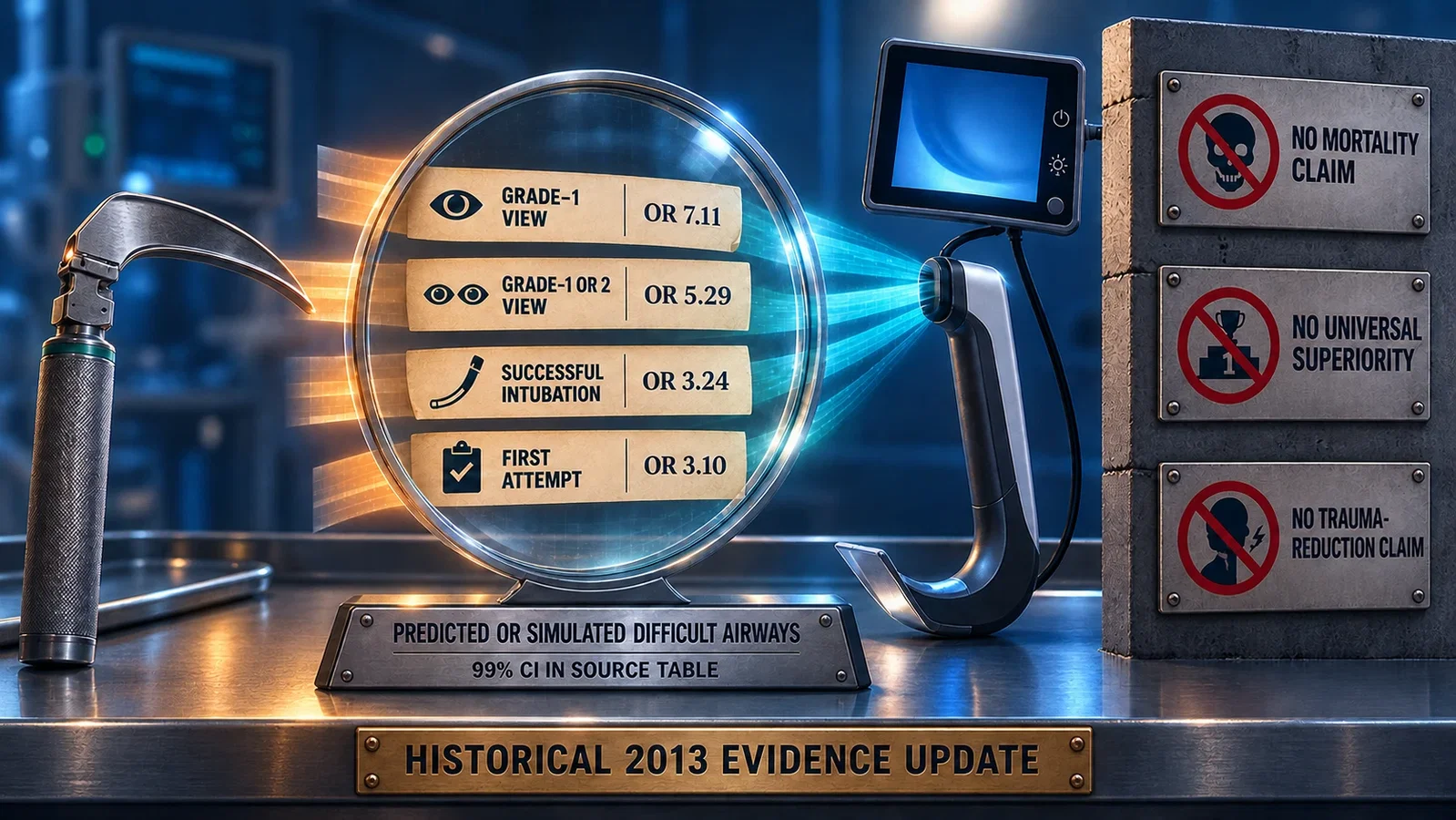
Video-assisted laryngoscopy received its own evidence section. Meta-analyses compared it with direct laryngoscopy in patients with predicted or simulated difficult airways. The reported direction favored video-assisted techniques for laryngeal view, successful intubation, and first-attempt success.
Table 4 made the comparison unusually concrete:
- grade-1 laryngeal view: odds ratio 7.11, 99% CI 2.58-10.72;
- grade-1 or grade-2 view: odds ratio 5.29, 99% CI 3.36-8.33;
- successful intubation: odds ratio 3.24, 99% CI 1.59-6.61;
- successful first-attempt intubation: odds ratio 3.10, 99% CI 1.66-5.81.
Those are clinically relevant technical endpoints. They are not mortality, brain injury, or a guarantee of success for every patient. Nor did every measured outcome favor video. The review reported no differences in time to intubation, airway trauma, lip or gum trauma, dental trauma, or sore throat. One observational study and four case reports showed that airway injury could occur during video-assisted laryngoscopy.
The balanced reading is neither that the device changed nothing nor that it solved the difficult airway. In the studied predicted or simulated settings, it improved the likelihood of obtaining a useful view and placing the tube, including on the first attempt. The evidence did not establish universal superiority or a downstream patient-outcome benefit.
The guideline's placement of the technology reflects that balance. A videolaryngoscope appeared in the suggested contents of the portable difficult-airway storage unit. It appeared among commonly cited difficult-intubation techniques. It was named among noninvasive interventions and alternative approaches. Most significantly, it became one of four basic choices to consider in a preformulated strategy.
A technology becomes part of a safety system when it has a defined place before the emergency, not merely when someone can retrieve it after other plans fail.
Three inherited choices gained a fourth companion
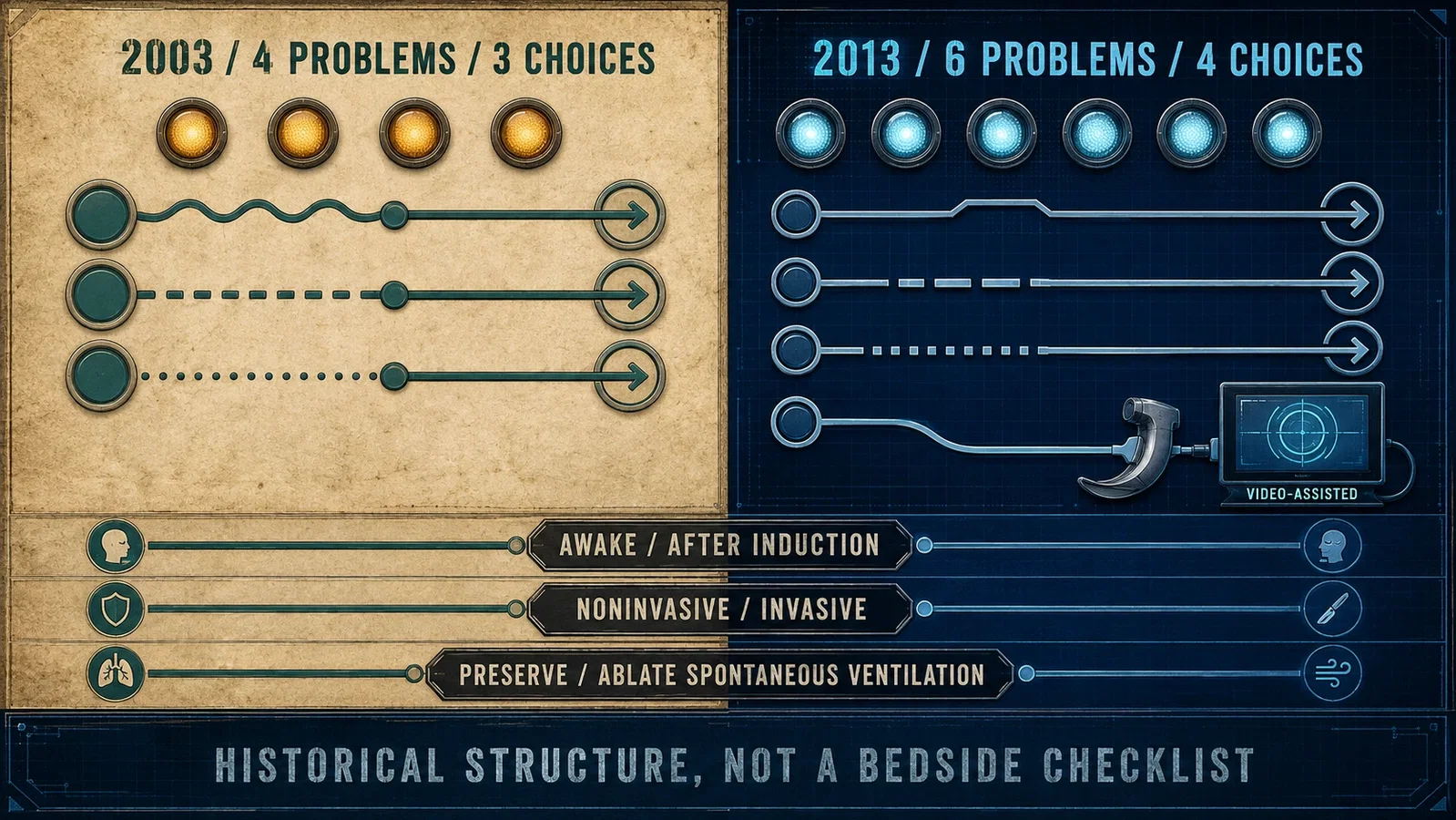
The complete 2003 update provides the clearest comparison. Its preformulated strategy asked clinicians to assess four broad problems: difficult ventilation, difficult intubation, difficulty with patient cooperation or consent, and difficult tracheostomy.
It then set out three paired management choices:
- awake intubation versus intubation after induction of general anesthesia;
- a noninvasive versus an invasive initial approach;
- preservation versus ablation of spontaneous ventilation during intubation attempts.
These were not three steps in a universal sequence. They were decision axes that forced the team to consider what might be lost when one path was chosen over another.
In 2013, those inherited considerations remained. Video-assisted laryngoscopy was inserted as a fourth basic management choice, specifically as an initial approach to intubation. It did not replace the awake/after-induction distinction, erase the invasive-access question, or settle whether spontaneous ventilation should be preserved.
This is the central structural fact of the update. The screen joined the strategy; it did not become the strategy.
A more precise problem map sat above the same rescue logic
The number of basic problems also changed. The 2013 update asked the team to assess six potentially overlapping difficulties:
- patient cooperation or consent;
- mask ventilation;
- supraglottic-airway placement;
- laryngoscopy;
- intubation;
- surgical-airway access.
The move from four to six did not create six new diagnoses. It separated tasks that the phrase difficult airway can blur together. A difficult laryngeal view, failure to pass a tracheal tube, difficulty placing a supraglottic airway, and difficulty ventilating through a mask are not identical events. The feasibility of surgical access is another question again.
The paper's definition section makes the purpose of this granularity explicit. Difficult-airway events arise from an interaction among patient factors, clinical setting, and practitioner skill. The task force urged precise descriptions, preferably ones that could be categorized or expressed numerically, because such descriptions improve communication and cross-study comparison.
That is a quiet but consequential safety move. A record that says only difficult airway leaves the next team with a warning but little operational memory. A record that distinguishes ventilation, visualization, tube passage, supraglottic placement, and access describes where the system actually encountered resistance.
The finer classification sat above a familiar rescue structure. The 2013 algorithm still separated awake intubation from attempts after induction. After unsuccessful attempts under general anesthesia, it still drew attention to calling for help, returning to spontaneous ventilation when possible, and awakening the patient. It still used adequacy of face-mask and supraglottic ventilation to distinguish nonemergency from emergency pathways. It still retained invasive airway access as a possible endpoint.
The device layer evolved; the oxygenation-and-rescue logic remained recognizable.
The algorithm was larger than intubation
A device-centered account of 2013 can easily shrink the guideline to the moment a blade enters the mouth. The document was broader.
Preparation included the availability of specialized equipment, communication with a patient known or suspected to have a difficult airway, an immediately available assistant, preoxygenation, and opportunities to deliver supplemental oxygen throughout difficult-airway management. The evidence strength varied across these items, but the system logic was clear: performance in a crisis depends on work completed before the crisis.
The guideline also treated extubation as a planned phase rather than the blank space after successful tube placement. It called for a preformulated extubation strategy shaped by the surgery, patient condition, skills, and preferences of the anesthesiologist. Follow-up included documentation and communication of the event.
These elements help explain why a better laryngeal view could not logically replace the algorithm. Videolaryngoscopy affects visualization and may improve tube-placement success. It does not supply oxygen, summon skilled help, decide whether awakening remains feasible, create surgical-airway capability, or communicate the encounter to the next team.
The guideline therefore placed the new tool within a network of preparation, decision, rescue, extubation, and memory. That network, not the screen alone, was the safety intervention being maintained.
An archive gap should remain visible
The official 1993 Ovid access route provides only journal pages 597 and 602 of the cited 597-602 article. Both image-only pages were rendered and read at full detail.
The first page establishes the title, purpose, limitations, ASA approval date, intended effective date, and publication history. The final page contains definitions, ten evidence linkages, a stated search of 273 articles from 1973 through 1991, and consultant-agreement material. Pages 598 through 601 are absent from the official downloaded object.
That gap does not prevent a cautious version history. The complete 2003 article explicitly identifies itself as a revision of the original guideline, and the bibliographic identity of the 1993 publication is secure. It does prevent a stronger claim: this article cannot claim to have read the complete 1993 algorithm, quote its missing pages, or reconstruct them from later similarity.
Source transparency matters for the same reason precise failure descriptions are part of airway safety. A vague claim of completeness hides exactly where uncertainty begins.
The 2022 replacement draws the present-day boundary
The historical status of the 2013 document is not ambiguous. The 2022 ASA difficult-airway guideline explicitly says that it replaces the guideline adopted in 2012 and published in 2013.
The later document was developed by an international task force representing multiple anesthesia, airway, and related organizations. Its highlights include greater attention to elapsed time and limiting attempts, more robust extubation recommendations, and new adult and pediatric algorithms and infographics. It also discusses ultrasound-derived airway measurements in its assessment evidence.
That last point prevents an easy conflation. Video laryngoscopy can be paired with ultrasound-assisted airway assessment as if both were systematic 2013 additions. The archived texts support only the first half. Video-assisted laryngoscopy was explicit in 2013. The ultrasound assessment evidence belongs to the later 2022 layer.
The replacement does not retroactively make the 2013 update meaningless. It demonstrates the revision principle that the earlier document itself stated. Practice guidelines have a version life. New evidence, new technologies, new organizations, and new safety concerns eventually require another pass.
It also sets a firm clinical boundary for this history. The 2013 algorithm can be examined as an example of institutional learning. It should not be detached from later guidance, local systems, clinician expertise, and a patient's circumstances and presented as a current bedside script.
What changed was the address of a new tool
The obvious story would cast direct and video laryngoscopy as opponents, place four favorable odds ratios on the screen, and end with a declaration that the new machine won.
The source record supports a subtler and more useful account.
The task force revisited a large but uneven evidence base. It kept direct and indirect evidence distinct. It found technical advantages for video-assisted laryngoscopy while preserving neutral and adverse findings. It expanded the language used to describe where airway management could become difficult. It then gave the device an explicit address within preparation, strategic choice, and rescue alternatives.
At the same time, the framework retained its older commitments: plan before induction, pursue oxygenation, distinguish ventilation states, keep nonemergency and emergency pathways separate, preserve options to awaken or obtain invasive access, and carry information beyond extubation.
That is how a mature safety algorithm absorbs technology. It neither worships the new screen nor pretends the screen never arrived. It changes the map enough that a team can find the tool, while preserving the deeper logic needed when the tool is not enough.
Sources and reading limits
Sources: Apfelbaum JL, Hagberg CA, Caplan RA, et al. Anesthesiology. 2013;118(2):251-270. PMID 23364566. DOI 10.1097/ALN.0b013e31827773b2; ASA Task Force. Anesthesiology. 2003;98(5):1269-1277. PMID 12717151. DOI 10.1097/00000542-200305000-00032; ASA Task Force. Anesthesiology. 1993;78(3):597-602. PMID 8457062. DOI 10.1097/00000542-199303000-00028, with only official journal pp.597 and 602 available and read; Apfelbaum JL et al. Anesthesiology. 2022;136(1):31-81. PMID 34762729. DOI 10.1097/ALN.0000000000004002. All cited sources were read for this article.
Visual interpretations
These illustrations explore the setting and ideas. Depicted people, actions, instruments and documents are reconstructions, not evidence of their exact historical appearance.
Continue exploring
Historical connections
These links follow specific development, adoption or citation connections recorded in the underlying research. They do not imply that history had one inevitable path.
- Later connection: 2016: 1,018 Difficult Intubations Make 'Try Again' a Measurable Risk
Related reading connects shared questions and contexts; it does not by itself establish historical influence.
- 1878: Macewen's Oral Tracheal Tube
- 1981: Archie Brain Begins Developing the Laryngeal Mask
- 1993: The ASA Difficult-Airway Guideline and Its Evidence Methods
- 2001: GlideScope Moves the Glottis onto a Screen
- 1945–2009: Cuffed Pediatric Tracheal Tubes Rethink Size, Position and Evidence
- 2020: Intubation Becomes a Team Protocol, Not Just a Technique
- 2024: ASA Revises PACU Handoff to 'Stay with the Patient'
The Source Room · About & Editorial Method
Sources and reading limits are stated above. Illustrations are labelled as original source images or AI-made. Historical accounts are educational; they are not current treatment instructions.